I Love Boosters
By Brian Eggert |
Boots Riley’s out-there perspective brings the gray areas of our global capitalist culture into vivid color with I Love Boosters. His unabashedly surreal comic touch dreams up all manner of visual delights and playful asides, aligning his anticonsumerist philosophy with his method of vignette-like scenes that, when arranged into a feature, amount to one of the most singular and defiantly political pieces of filmmaking in recent memory. The writer-director’s debut, Sorry to Bother You (2018), and his widely praised limited series, I’m a Virgo (2023), demonstrated how he wraps Marxist ideas in absurdist satire. Whether shocking his audience with the exploitation of half-horse, half-human hybrids called “Equisapiens” or hiring Slavoj Žižek to voice a baby, the rapper-turned-filmmaker’s mind thrives in a realm of political expressionism that few other directors have ever attempted. His latest certainly won’t be for everyone, but it operates in a simultaneously maximalist and fabulist aesthetic so brazenly original that I found it impossible not to admire, even love.
To be sure, I Love Boosters reminded me of some of my favorite films without resorting to homage or overt sampling. The film has the overstuffed energy of Terry Gilliam’s Brazil (1985) and The Zero Theorem (2014) and the sociopolitical edge of Bong Joon-ho’s Okja (2017) and Parasite (2019). Riley’s visual approach and color palette are reminiscent of Pee Wee’s Big Adventure (1985) on psychedelics, complete with a zany Danny Elfman-esque score by Tune-Yards that propels every moment with its oompah-style tempo. But it’s also a layered allegory for how capitalist systems exploit workers, reserving the profits for the super-rich, while the ones actually toiling away at the unfulfilling work of making these products barely receive a living wage. Set in the fashion industry, I Love Boosters is about a revolution in which the underpaid workers finally develop a cohesive class consciousness and overthrow the designer who reaps the benefits. When college students are asked to explain Marxist theories in their courses, this film provides an ideal illustration that lays it all out quite clearly.
More even than its capitalist critique, I Love Boosters is also a wildly entertaining and imaginative ride, anchored by a terrific ensemble. Keke Palmer plays Corvette, an aspiring fashion designer who lives in a former Bay Area chicken joint and runs an underground team of shoplifters, known as “boosters.” Corvette’s crew infiltrates high-end fashion stores, steals expensive apparel, and sells it to people who could not otherwise afford it for one-third of the shop’s price tag. Her main target is Christie Smith (Demi Moore), a popular designer fed up with what she calls “low-class urban bitches” stealing from her Metro Designers locations. Although Christie is a mathematical genius, she used her skills to change perceptions of reality through fashion. But really, one suspects that she just enjoys the power and adulation. Meanwhile, Corvette’s financial pressures and her increasing exasperation with the fashion industry haunt her, manifesting in an imaginary rolling ball of bills that seems to chase her around town and nightmares in which she’s submerged in clothes.
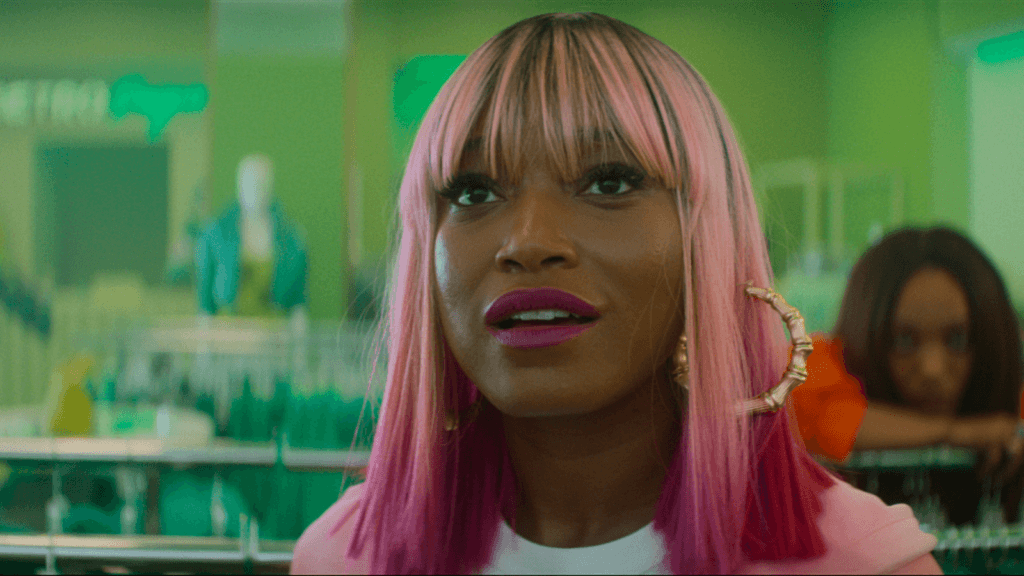
Each of Corvette’s friends has a unique perspective on boosting. Her bestie Sade (Naomi Ackie) cares less about politics or fashion than just earning enough to survive, and their differing beliefs test their friendship. Violeta (Eiza González) wants to organize a union to protest the lousy paychecks and 30-second racetrack lunch breaks that Christie’s employees receive at stores run by snooty managers like Grayson (Will Poulter, hilarious). Another subplot takes place at Christie’s garment factory in Qingdao, China, where worker Jianhu (Poppy Liu) fights for fair compensation and safe working conditions. She hatches a plan to steal clothes from Christie’s stores and transport them back to China, where the workers, many of whom are sick with silicosis from sandblasting denim, can sell them to earn a reasonable wage. After getting jobs at Metro Designers to sabotage the company from within, the boosters unite to crash Christie’s Fall Show.
Similar to Sorry to Bother You, Riley’s latest teems with tangential asides and unpredictable twists that impress in their sheer unconventionality. Corvette’s cohort, Mariah (Taylour Paige), has the unique ability to change her skin color and pass as a white woman while holding her breath, allowing her to enter designer shops without raising suspicion among their prejudiced staff. In the background, Riley details how exploitative systems from finance to the media keep working stiffs down. Don Cheadle appears unrecognizable under a wig and prosthetics that make him look husky, pitching a pyramid scheme called “Friends Being Friendly” in a furniture store after hours. Along with televisions that blare newscasts with headlines such as “Crying Black Mother Demands More Police” and “Upstanding Community Member Praises the Freedom of Lower Pay,” Cheadle’s character is part of a much broader conspiracy, similar to the aforementioned horse-people in Sorry to Bother You. It all leads to a twisted revelation with hints of They Live (1988), involving a secret plot to propagate a controlling-class agenda that unions are bad and that people want higher rents and more police.
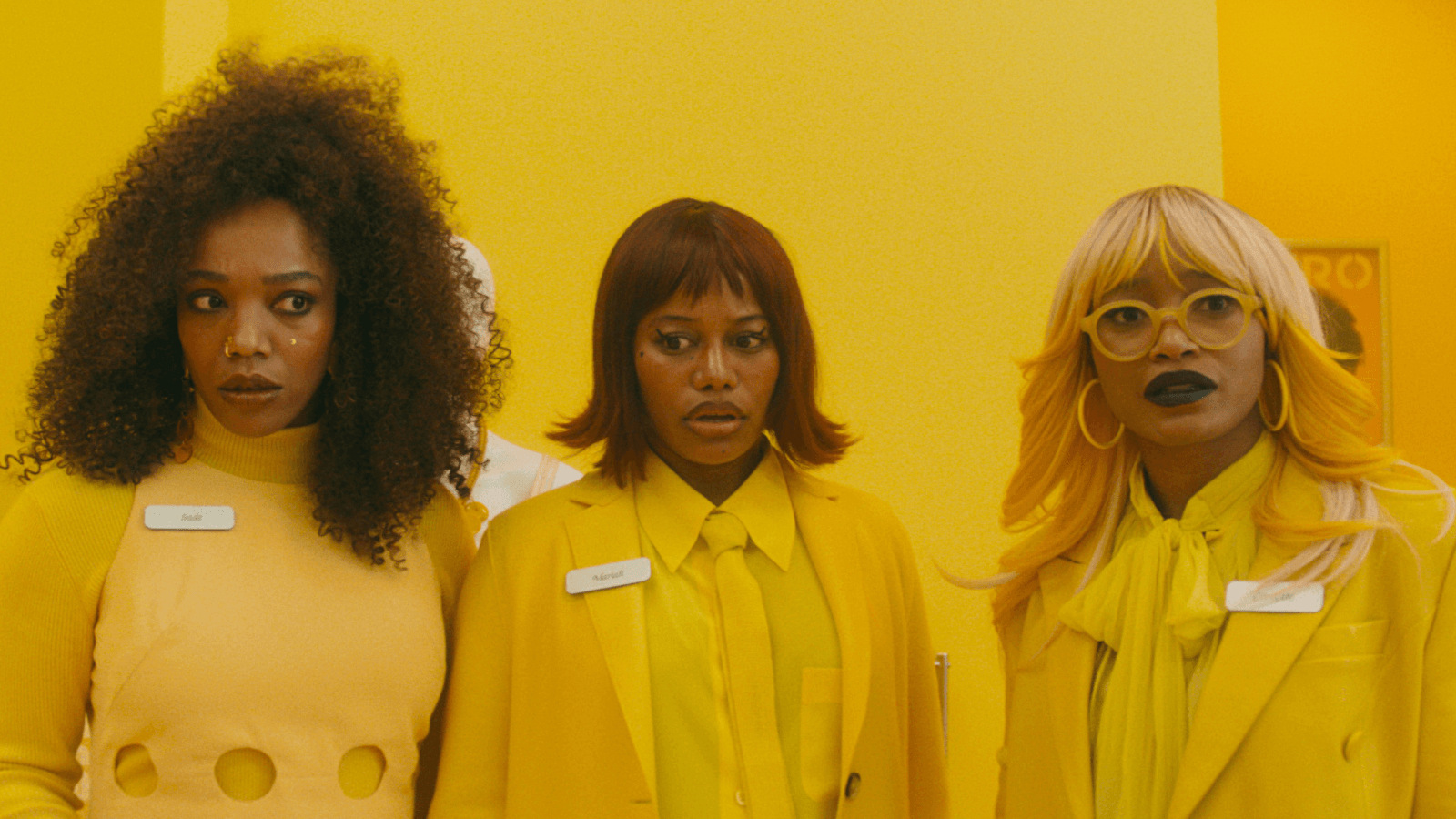
Riley’s inspired ideas necessitate a range of filmmaking techniques to bring the story to life. His production designer, Christopher Glass, turns every sequence into a visually distinct set piece. Take Christie’s office building, which stands at an angle that forces Corvette to run in place like a cartoon. Or note how each Metro Designers location is saturated in a monochromatic color that changes monthly, which keeps consumers buying out of FOMO. Bright greens, yellows, reds, and turquoise (or is it aquamarine?) saturate the frame, while costume designer Shirley Kurata conceives of elaborate attire that riffs on the fashion industry’s excesses. Elsewhere, Riley uses minimal CGI to render a teleportation device that doubles as a “Situational Accelerator,” like a ray gun that creates preposterous fashion designs. But it also has a deconstruction setting that breaks down any object into its base components, such as turning an outfit into the plants from which it was sourced, or a person into the copulating parents who conceived them. The oddities continue with Lakeith Stanfield playing a model, his good looks disguising the fact that he’s a reptilian demon who sucks out women’s souls during cunnilingus—a sharp commentary on how models exploit consumers by selling sex at the cost of human dignity. And the climactic chase is outstanding, employing green screens, stop-motion flesh puppets, and cartoonish model cars, reminding me of Steven Kostanski’s intentionally low-grade effects in Frankie Freako (2024).
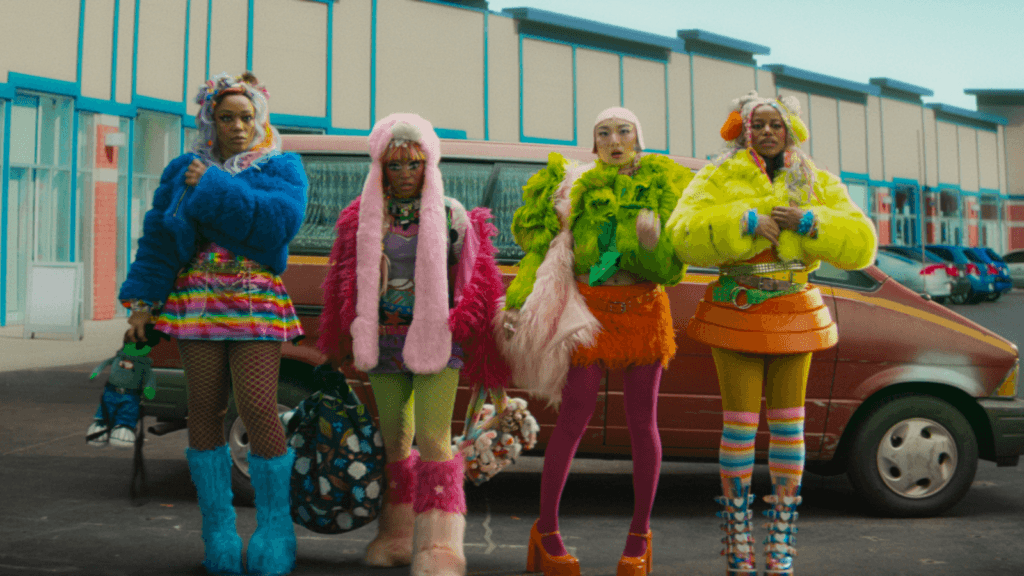
The question for some viewers will be whether they can keep up, and whether Riley can sustain that energy and momentum for nearly two hours. Certainly, Tune-Yards’ carnivalesque circus music maintains a relentless tempo, making the entire film feel like we’re watching a Rube Goldberg machine carry out an overcomplicated series of tasks. As with many maximalist films—from Ken Russell’s The Devils (1971) to Yorgos Lanthimos’ Poor Things (2023)—the experience may begin to wear the viewer down through sheer sensory overload. If one isn’t primed for that sort of assault, films like this begin to feel exhausting. But much like Daniels’ Everything Everywhere All at Once (2022), the unlikely A24 hit that went on to win seven Oscars, including Best Picture, I Love Boosters signals a renewed interest in risk-taking. The distributor, Neon, remains one of today’s most reliable homes for maverick filmmaking, and Riley’s level of free-thinking, boundary-pushing cinema will challenge its audience in satisfying ways. But viewers may need a nap afterward to process and absorb everything they’ve seen.
As Riley applies his earnest call for equality and social justice to the fashion industry, he finds creative ways to explore his concerns. That’s the essence of great political art. I Love Boosters is the kind of film that viewers will want to see again and again. The film works because it finds a strange harmony between its rousing commentary and its infectious sense of play, taking overstimulation to euphoric heights. By contrast, Christie believes she’s giving the world something profound with her “wearable art” designs, and in her mind, that justifies her exploitative labor practices, ridiculous wealth, and generally inflated ego. Her assistant, Jamie (Kerris Dorsey), explains that people don’t want to be mere living mannequins who walk around displaying someone else’s artwork. “They want to be the artist,” she says. Riley’s film declares that moviegoers fed up with exploitation and feeling unrepresented in art should take control of their stories and break the patterns that perpetuate inequality, restoring their power. That he presents this message in such a bold and uninhibited piece of cinema, with an unmistakable authorial voice, makes the experience all the more authentic and imperative.
Thank You for Supporting Independent Film Criticism
If the work on DFR has added something meaningful to your love of movies, please consider supporting it.
Here are a few ways to show your support: make a one-time donation, join DFR’s Patreon for access to exclusive writing, or show your support in other ways.
Your contribution helps keep this site running independently. However you choose to support the site, please know that it’s appreciated.
Thank you for reading, and for making this work possible.
Brian Eggert | Critic, Founder
Deep Focus Review