Tuner
By Brian Eggert |
A few years ago, filmmaker Daniel Roher won an Oscar in the Best Documentary Feature category for Navalny (2022), a portrait of Russian opposition leader Alexei Navalny. Roher’s subject was imprisoned by Vladimir Putin’s regime and, chillingly, died from poisoning two years after the film’s release. Primarily a documentarian, Roher leaps into his first narrative feature with Tuner, an unassuming little movie that holds promise for his future projects. Roher co-wrote the original story with Robert Ramsey, crafting a clever premise about a musical prodigy with hyperacusis, a rare disorder that makes normal sounds feel painfully loud. Roher explores how the condition could be used to crack safes by listening to otherwise imperceptible clicks that hint at the correct combination. But that’s just one facet of this character study, anchored by a solid performance from Leo Woodall.
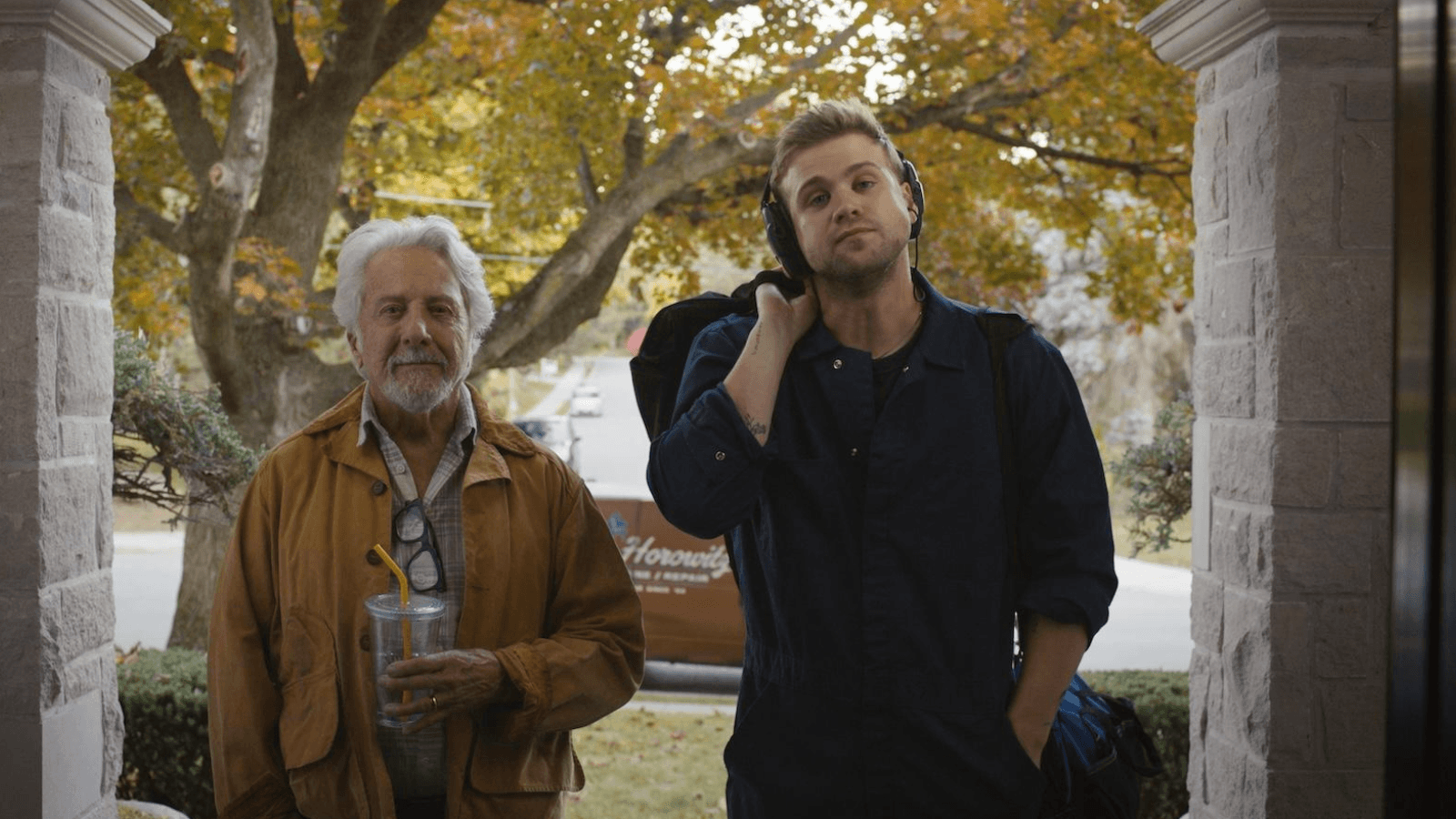
Woodall is a rising talent with a few notable credits to his name, including a role on the second season of HBO’s The White Lotus and last year’s Nuremberg. Affecting a James Dean quality for Tuner, he plays Niki, a moody, disenchanted piano savant who must wear two sets of sound-canceling headphones to prevent his eardrums from rupturing from everyday noise. (Living with hypersensitive hearing and a lifetime of ear problems myself, I found that aspect of the movie relatable.) Niki’s disorder has prevented him from realizing his dream of becoming a pianist. Instead, he works alongside longtime piano tuner Harry Horowitz (Dustin Hoffman), who, with his wife Maria (Tovah Feldshuh), represent Niki’s only family. But Harry is slowly succumbing to dementia, leaving his business in jeopardy and his medical bills piling up. Niki vows to keep the business open and work solo to help.
While on the job, Niki encounters two people who give the story shape: First, there’s Ruthie (Havana Rose Liu), an ambitious piano student who’s practicing for an upcoming performance to impress a famous composer (Jean Reno). After an uncomfortable meet-cute on the job, Niki and Ruthie begin a tenuous romance, with both unsure of where it’s going. She learns that he’s something of a genius with perfect pitch and wants to hear him play. He refuses, not just because it would affect his ears, but also because playing reminds him of what his life might’ve been. Then, Niki meets Uri (Lior Raz), who runs a security company and enlists Niki to access affluent homes to skim from private safes. He assumes that, given their clients’ excessive wealth, they won’t notice anything missing. Niki gets a cut and uses the cash to pay Harry’s medical bills.

Inevitably, Niki’s separate lives collide in formulaic ways. Uri pressures him to go further than he wants, forcing him into a desperate situation. However, Tuner isn’t a slick heist movie where Niki always remains one step ahead of everyone else. The character makes obvious mistakes and must deal with the consequences. Similarly, the bad guys don’t receive their comeuppance as they might in a normal thriller. Roher accepts the unfairness of the universe and doesn’t pretend everything will work out fine. Still, the film’s twists and turns are predictable, if only because Roher overemphasizes certain details. Note the conspicuous insert shot of a security door keypad that anticipates a later development. All the while, sound designer Johnnie Burn puts us in Niki’s head, hearing what he hears at both muffled and deafening extremes, creating a distinct aural experience.
Elsewhere, Roher’s execution needlessly attempts to jazz up the visual presentation with distracting little flourishes by editor Greg O’Bryant. When Niki tunes a piano, for instance, his retrieval of tools and adjustments is presented in a series of jagged cuts. Similar mini-montages are scattered throughout, disrupting the movie’s easygoing flow. Much of the piano playing is also quite unconvincing, with the camera either focused on the hands and keys or on the player from the shoulders up, obscuring the fact that neither Woodall nor Liu actually plays the piano that well. They’ve both been coached to shake their heads and rock back and forth, distractingly, in almost identical ways. The effect is unconvincing. Just as underwhelming is Roher’s half-hearted commentary on the extreme socioeconomic divide between the haves and have-nots, which lingers under the surface throughout but never emerges enough to feel substantive.
After premiering at the Telluride Film Festival, Tuner will have a limited US theatrical opening on Memorial Day weekend, followed by a wider release the following week. Its production company, Black Bear Pictures, recently expanded into distribution, and this modest, mid-budget release may struggle during the summer blockbuster season. Then again, perhaps the company recognizes the demand for this sort of counterprogramming, a worthwhile alternative to the mindless CGI-laden extravaganzas usually offered this time of year. That said, Tuner is more admirable for what it represents than what it is. It’s certainly diverting and, in some areas, made with skill. At the very least, it’s worth checking out as a possible sleeper hit that doesn’t involve superheroes, aliens, sequels, or established intellectual property.
Thank You for Supporting Independent Film Criticism
If the work on DFR has added something meaningful to your love of movies, please consider supporting it.
Here are a few ways to show your support: make a one-time donation, join DFR’s Patreon for access to exclusive writing, or show your support in other ways.
Your contribution helps keep this site running independently. However you choose to support the site, please know that it’s appreciated.
Thank you for reading, and for making this work possible.
Brian Eggert | Critic, Founder
Deep Focus Review