The Definitives
The Sea Wolf (1941)
Essay by Brian Eggert |
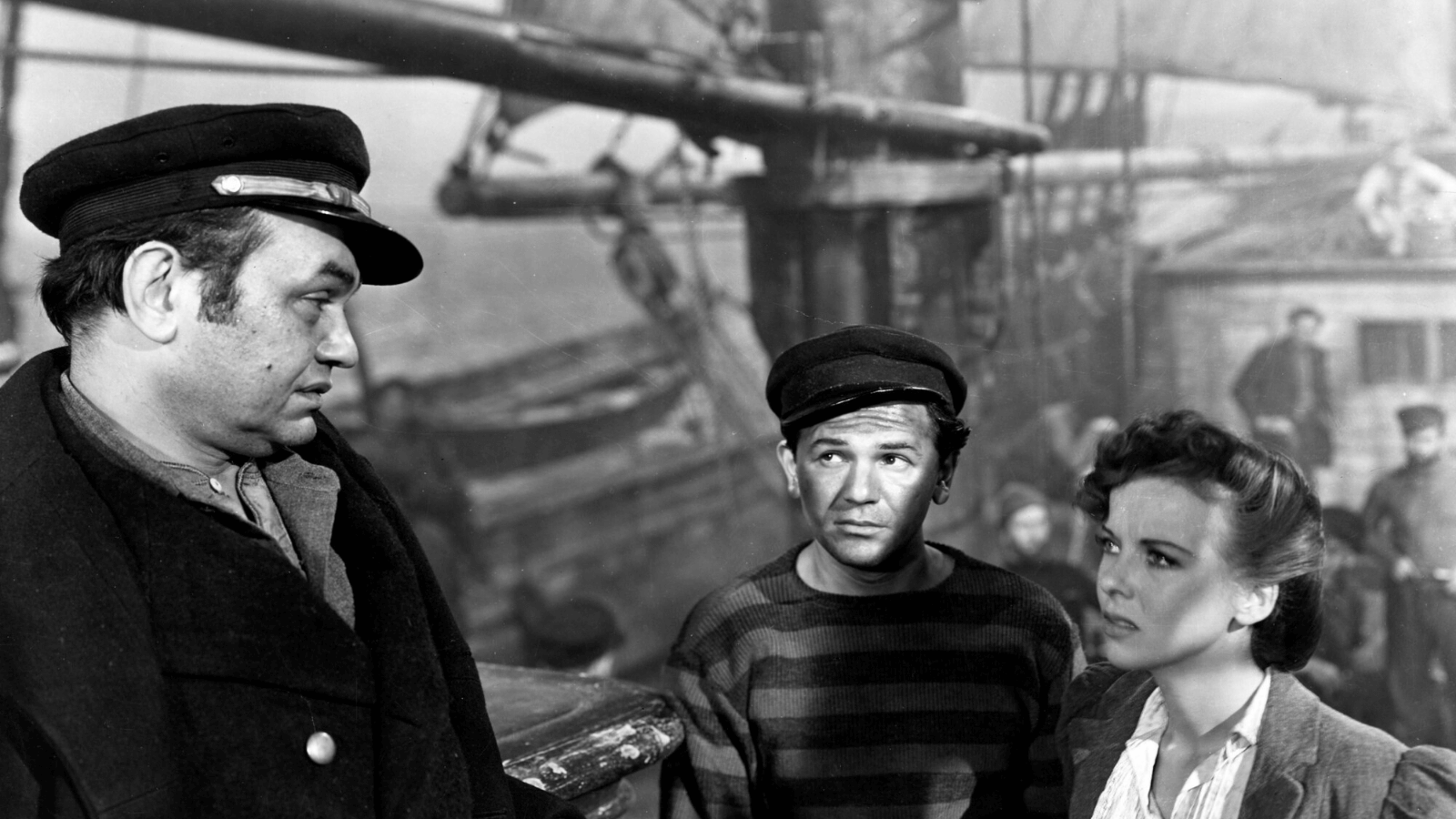
Wolf Larsen, the barbarous, intelligent, and vengeful despot who clings to his authority with cruelty and violence, is the unforgettable villain of 1941’s The Sea Wolf. Edward G. Robinson delivers a combustible performance that dominates the film, just as Larsen dominates his ship, the Ghost. A distinguished entry in Warner Bros.’s many literary adaptations of the era, this film version of Jack London’s novel features a richly baroque visual aesthetic and Oscar-nominated special effects, overseen by the brilliant direction of Michael Curtiz, a taskmaster himself. However, the picture’s voice stems from the talented screenwriter and actors, mindful of how the events onscreen mirrored their contemporary political dynamics. Like many historical and literary adaptations made by Warner Bros. during this period, The Sea Wolf is an anti-Nazi film that never mentions Nazism and an anti-Hitler film that presents a fictional counterpart to Hitler. It supplies a passionate message against the fascist ideologies that fuel authoritarians, and at a time when it mattered most. The Sea Wolf is at once a sterling example of prestige filmmaking in the Golden Age of Hollywood and an impassioned work that demonstrates how even commercial art can have a perspective.
First published in 1904, between two of Jack London’s more popular works—The Call of the Wild (1903) and White Fang (1906)—The Sea Wolf (sometimes stylized as The Sea-Wolf) pre-sold 40,000 copies to book stores before its release. A film version of London’s bestselling novel provided Warner Bros. with a sure-thing investment, or as close to a sure thing as a picture could get. Adaptations of successful literary works often performed well for Hollywood studios due to their built-in audience. Just as studios today develop projects based on established intellectual properties, the studios of the Classic Hollywood era often relied on marketable novels and well-known short stories to pre-sell moviegoers. The Warners alone developed literary adaptations such as Captain Blood (1935), Anthony Adverse (1936), Jezebel (1938), The Private Lives of Elizabeth and Essex (1939), and many others around this time. However, Metro-Goldwyn-Mayer brought the most books to the screen during the Golden Age, maintaining its reputation for prestigious productions based on venerable classics by Charles Dickens, Leo Tolstoy, Jane Austen, and William Shakespeare.
When Warner Bros. set out to adapt London’s book in 1937, David O. Selznick, another major proponent of literary adaptations, owned the screen rights. The studio purchased the rights from Selznick for director Mervyn LeRoy (Little Caesar, 1930) and star Paul Muni (The Life of Emile Zola, 1937), but that project never materialized. A few years later, producer Henry Blanke began developing another version for Edward G. Robinson, who was attracted to the Wolf Larsen role. Robinson wouldn’t be the first to play the part. What Warner Bros. called London’s “immortal saga” had already been made into several pictures with varying degrees of financial success, including four films before the 1941 version: three silent adaptations (in 1913, 1920, and 1926) starring Hobart Bosworth, Noah Beery, and Ralph Ince, respectively, in the Larsen role. Fox Film Corporation distributed an adaptation starring Milton Sills in 1930 as well. Robinson wouldn’t be the last to portray Larsen, either. Raymond Massey played the character in Barricade (1950), Barry Sullivan in Wolf Larsen (1958), and Chuck Connors in Legend of the Sea Wolf (1975), among half a dozen other adaptations, including movies, made-for-TV features, and limited series.
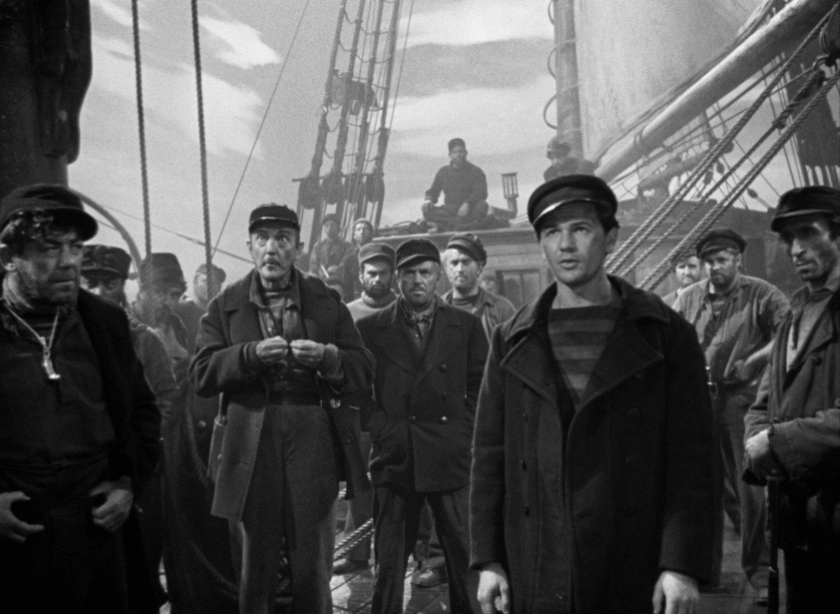
What remains exceptional about the 1941 version is that screenwriter Robert Rossen and producers Blanke and Hal B. Wallis had actively pursued projects that condemned fascist ideologies in both direct and indirect terms. Warner Bros. was unquestionably the most vocal of any Hollywood studio in the prewar years in its disdain for Nazi Germany and the fascistic views that had emerged in America since Adolf Hitler’s rise to power. Their films, such as The Life of Emile Zola, Black Legion (1937), Confessions of a Nazi Spy (1939), and others, addressed both real and allegorical threats that, through their narratives, illustrated the danger and inhumanity of Nazism. The Sea Wolf belongs on a list with The Adventures of Robin Hood (1938), The Sea Hawk (1940), and additional like-minded films that created parallels between contemporary fascists and fictional or historical figures with similar behaviors or belief systems. These films denounce, in nonspecific terms, authoritarianism, blind obedience, fear mongering, isolationism, nationalism, and prejudicial views adopted by Nazis and similar fascist groups at home and abroad. Crucially, The Sea Wolf spoke out before the US government began enlisting Hollywood’s help in the war effort.
The Sea Wolf was released into theaters on March 21, 1941, nine months before the Japanese attack on Pearl Harbor finally convinced the United States to enter World War II. Before December 7, many American politicians and everyday citizens wanted nothing to do with what was perceived as Europe’s problem. Isolationists on the political right vowed to stay out of what they labeled a “Foreign War,” with the devastating casualties from The Great War still fresh in their minds. In May 1937, Congress passed a Neutrality Act to keep the United States out of future conflicts, while Republican politicians and groups such as the America First Committee—whose ranks included famous anti-Semites Henry Ford and Charles Lindbergh—argued that the country’s priority should be protecting US borders and preserving its citizenry. On the other side, President Franklin D. Roosevelt aligned with his colleagues on the left who felt duty-bound to help their European allies fight against fascism. But he walked a political line, pledging to help the Allies with his administration’s “all aid short of war” policy. Along with the Lend-Lease Act, which was passed the same month The Sea Wolf was released and allowed the US to provide military aid to British ships in the Atlantic, the US remained outside of the war until Japan attacked Pearl Harbor.
Nevertheless, few in Hollywood objected to the morality of pacifism in the face of Hitlerism and Nazi Germany. Of course, most Americans, even at the highest levels of government, remained in the dark about the full implications of Hitler’s concentration camps, apart from rumors and unverifiable testimony from those who fled Europe. Some filmmakers took it upon themselves to convince their audiences that entering another war was the moral thing to do. Unlike after Pearl Harbor—when Hollywood worked alongside the US government on propaganda films, often consulting a literal guidebook of suggested language provided by the government to studio scenarists—certain filmmakers made works with antifascist and anti-Nazi sentiments before the attack because they felt personally committed to the message. For instance, Charles Chaplin invested over two million dollars—at the time an enormous sum—to independently produce 1940’s The Great Dictator, an unabashed lampooning of Hitlerism and a general call for humanity and compassion. A more cynical film, Fritz Lang’s Man Hunt, released a few months before Pearl Harbor, portrayed Hitler onscreen and placed him in the literal crosshairs.
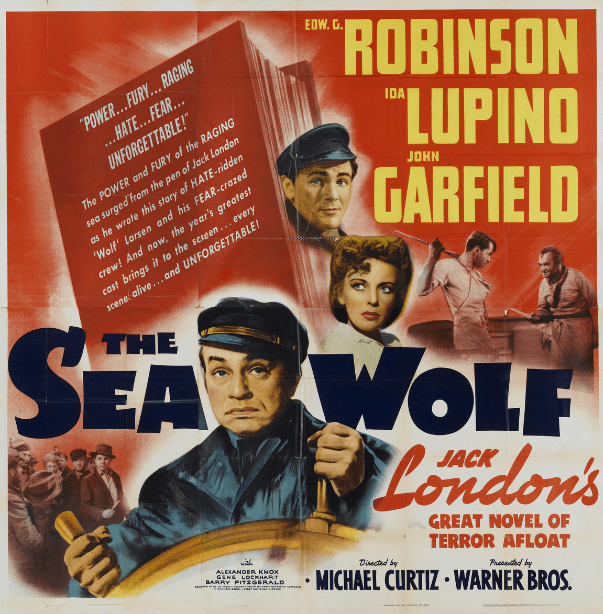
Many of those involved in The Sea Wolf’s production recognized parallels between London’s book, which confronts social Darwinism, Friedrich Nietzsche’s theory of the Übermensch, and, by obliquely equating these concepts through metaphor, Nazism. London’s novel compelled readers with its thrilling narrative about literary critic Humphrey Van Weyden, a spoiled dandy thrust into a perilous situation at sea. Van Weyden survives a shipwreck, only to be rescued and forced to serve as a cabin boy on the seal-hunting schooner the Ghost, captained by Wolf Larsen. His idle, privileged life clashes with Larsen’s, whose manic behavior manifests as dogmatic authoritarianism and cruelty toward anyone on his ship. Yet he’s also well-read and intelligent, intensifying his dangerous blend of savagery and smarts. Although literary critics alternately derided London’s output as populist adventure drivel and celebrated it as the authentic fiction of a “Californian naturalist” who experienced many of the exploits he wrote about during the Klondike Gold Rush, he approached The Sea Wolf with a dose of reality: “It will be almost literally a narrative of things that happened on a seven-months voyage I once made as a sailor,” wrote London before completing the book. “The oftener I’ve thought of the things that happened on that trip, the more remarkable they appear to me.”
Whether London was the genuine article or a self-mythologized hack who died at forty from overindulging in alcohol and drugs continues to spark debate among today’s critics and historians. What becomes apparent upon examining both the author’s life and his book is that he confronted a dichotomy between his intellectual support for a socialist ideology and his continuing fascination with Nietzsche’s Übermensch—ideas that would seem to contradict one another. Even while portraying Wolf Larsen as a monstrous figure, London describes him as possessing “the essence of life in that it is the potency of motion, the elemental stuff itself out of which the many forms of life have been molded.” Van Weyden, too, recognizes his failures as a physical specimen when compared to Larsen and cannot help but admire the tyrannical captain, whose prowess extends far beyond the protagonist’s and who makes full use of his mind and body. Even as Van Weyden remains shanghaied and considers murdering his captor to escape, he understands Larsen and often admires him, both physically and intellectually, through his hatred.
The Sea Wolf continued the author’s interest in the so-called superman concept found in several of his books. The Übermensch proposes an Alpha who rejects social conformity, conquers their weaknesses, and develops resilience, strength, and ruthlessness through self-reliance—all while dispensing with conventional morality in favor of individualistic values. Springing from might-means-right Darwinism and Nietzsche’s aversion to herd mentality, the Übermensch is a master of the Self, rooted in nihilistic self-actualization. London seems to respect and admire examples of Nietzsche’s philosophy in Nature, particularly when applied to an animal ideal, as in his portrayals of Buck the dog in The Call of the Wild and the titular wolfdog in White Fang. However, his exploration of this subject among human characters in The Iron Heel (1908) and Martin Eden (1909) portrays these behaviors as isolating and antisocial. London—who decried the social implications of capitalism, wrote extensively about the poverty resulting from class division, and belonged to both the Socialist Labor Party and the Socialist Party of America at different points in his life—presented the superman as unsustainable in communities and social structures.
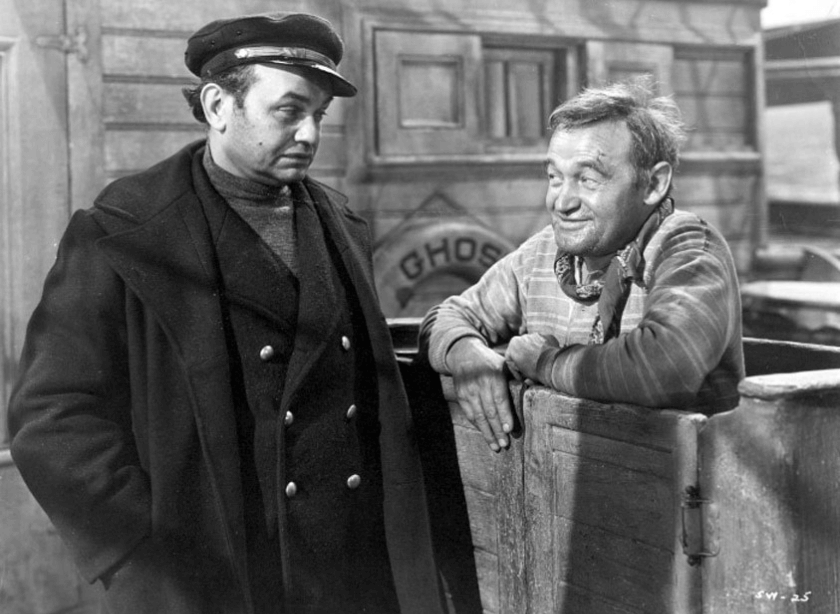
London’s Wolf Larsen is a personification of the author’s beliefs about the superman. Even the character’s name links him to Buck and White Fang, wild and spartan. When Wolf Larsen first appears in the film, he paces like a caged animal ready to snap. As Robinson plays him, he’s one of the most memorable villains in cinema history, a character capable of cruelty far exceeding that of the gangsters he played in Little Caesar and Key Largo (1948). An autocrat, Larsen controls through fear, threats of violence, and vulgar tirades. And he backs up his intimidation tactics with harsh punishments. His megalomania might result from a physical malady Larsen suffers: debilitating headaches, followed by phantom sirens and a loss of eyesight, presumably from some kind of brain tumor or cancer. But one suspects his behavior has always been warped. Watch the pleasure on Robinson’s face when Larsen calls out Cooky (Barry Fitzgerald)—the Ghost’s chef who behaves like a parrot on the captain’s shoulder—as his informant. Outraged and betrayed, the men throw Cooky overboard, leaving him to drag behind the ship on a rope. Just then, a shark appears. The crew scrambles to pull Cooky back aboard, but the shark bites, leaving Cooky down one leg.
A speech given by Van Weyden (Alexander Knox) articulates Larsen’s vile character:
“The first impression one gets is that he is a man—no, a brute—completely without feeling or thought. A cruel, merciless creature who kills for the sake of killing, who tortures for the sake of hearing the anguished cries of his victims. But as this first impression wears off, one realizes that this is a highly complex individual, a mass of contradictions, a man who is tortured by a brain he should never have been given. But with that brain he is able to think, to see clearly that all these things he denies in other men—the need for respect, for dignity—exist in himself. […] The reason for his action then becomes obvious. Since he has found it difficult in the outside world to maintain that dignity, he creates a world for himself: A ship on which he alone can be master, on which he alone can rule. The next step is a simple one. An ego such as this must constantly be fed, must constantly be reassured of its supremacy. So it feeds itself on the degradation of people who have never known anything but degradation. It is cruel to people who have never known anything but cruelty.”
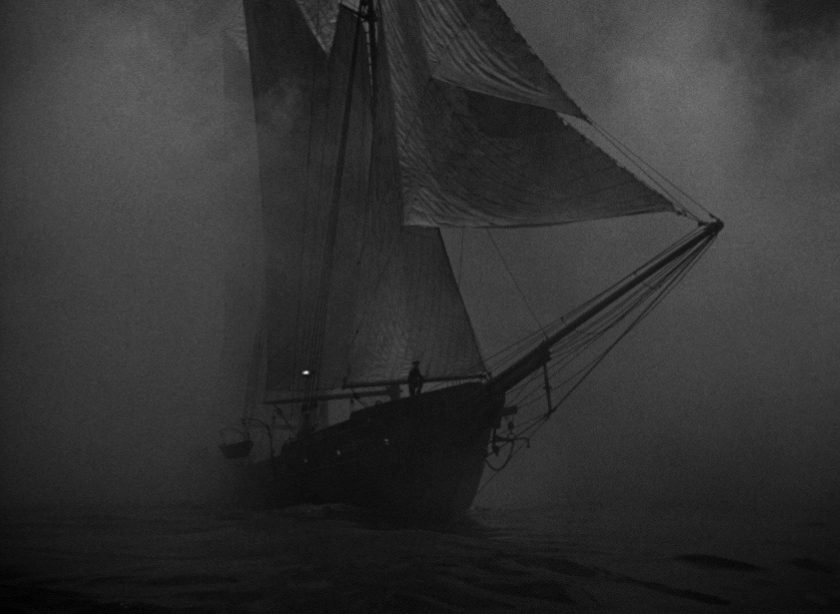
Besides the passionate anti-Nazi sentiments motivating the picture, the production of The Sea Wolf adhered to Warner Bros.’s assembly-line model, albeit backed by some of the studio’s finest contracted talent. Rossen—who began his career writing screenplays, including The Roaring Twenties (1936), before graduating to the director’s chair on Body and Soul (1947) and The Hustler (1961)—adapted the book from an outline by Abem Finkel and Norman Reilly Raine. Producers Blanke and Wallis enlisted their most versatile and reliable director, Curtiz, to helm the production—one of two Curtiz titles released in 1941, the other being Dive Bomber. Composer Erich Wolfgang Korngold, who had narrowly escaped the Nazis in 1938 and had been working regularly for the studio on scores for movies such as Captain Blood, Anthony Adverse, and The Adventures of Robin Hood, provided the music. Wizards Byron Haskin and Hans F. Koenekamp conceived the impressive special effects. Cinematographer Sol Polito, who would collaborate nearly a dozen times with Curtiz and many more with other Warner Bros. house directors, provided the evocative visuals, deploying stark shadows and chiaroscuro lighting below decks to convey the twisted mind captaining the Ghost.
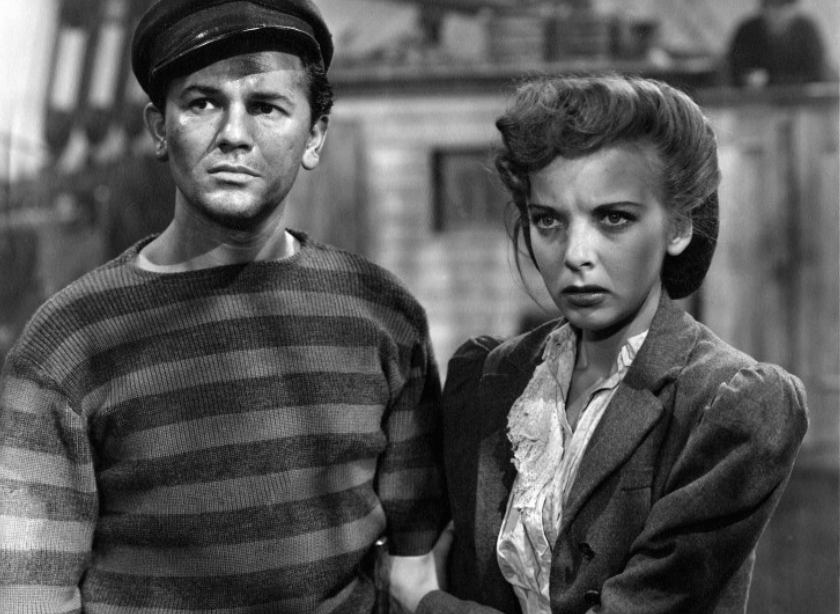
In a departure from the book, The Sea Wolf opens in San Francisco, 1900, with George Leech (John Garfield) on the run from the authorities for reasons never clarified. He heads into a Barbary Coast nightspot filled with pickpockets and hucksters. There, a sailor turns down an offer to work on the Ghost, only to be beaten and shanghaied later by Larsen’s men. Leech doesn’t need such convincing, despite an agent attempting to slip him a Mickey. The Ghost is his ticket out of trouble. The same is true of Ruth Webster (Lupino), an escaped convict who would sooner leap into San Francisco Bay than go back to jail. They both end up on what Cooky calls a “hell ship” under Larsen’s command and control. The other newcomer is Humphrey Van Weyden, who, after meeting Ruth aboard a steamship in San Francisco, is shipwrecked when two ships collide in the fog. Larsen sizes up Van Weyden as a subservient weakling and both Leech and Ruth as former convicts. “She’s one of us!” announces Cooky.
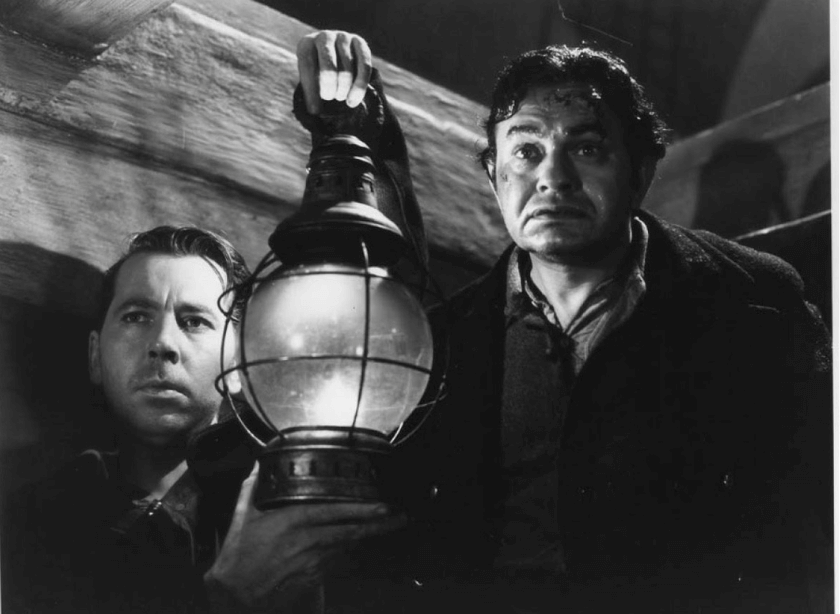
However, Ruth arrives on the Ghost ill and unconscious from the disaster, requiring the ship’s doctor, Louis Prescott (Gene Lockhart), stricken with alcoholic tremors, to perform a blood transfusion. Larsen orders Leech to give blood. Leech should be an apt donor, Larsen reasons, since both he and Ruth are criminals (logic that marks the only dubious moment in the film). His bloodsucker name notwithstanding, Leech agrees, and the moment symbolically binds him to Ruth, foreshadowing their eventual vow to marry and protect one another. When Ruth recovers and emerges from below decks, Larsen initially feigns gentlemanly behavior and treats her like a proper lady. Then he tells the crew to make Ruth feel at home: “Put some bars on her window!” This brand of humiliation is typical for Larsen. Consider Prescott’s fate: After saving Ruth, Prescott stops drinking for a week and regains his composure. He dons his formal attire and tells Larsen that he wants to be called “Dr. Louis J. Prescott” again. He even asks Larsen to instruct the crew to show him some respect. Larsen complies, but follows his order by humiliating the doctor. He kicks Prescott down a few stairs. The men pounce on Prescott, tearing away his respectable garb. Enraged and terrified, the doctor escapes by climbing up the mast, only to call out Larsen’s corruption before leaping to his death.
Afterward, Leech schemes to rid the Ghost of Larsen, compelled by Ruth, who yearns “to be free, to be let alone, to live in peace, if only for a little while.” Unfortunately for Ruth, fascists cannot leave others alone; they constantly need to impose themselves on others to satiate their fragile egos. One night, Leech spearheads a mutiny, and Larsen is tossed overboard. He survives and pulls himself back aboard with a rope, leading to a breathless sequence in which he searches for the culprits by checking the pulses of his sleeping crew. Later, Leech hatches another plan to escape by stockpiling supplies on a dory. Van Weyden resolves to help, revealing to Leech that Larsen’s headaches leave him temporarily blind. During one of Larsen’s spells, Leech, Ruth, Van Weyden, and crewman Johnson (Stanley Ridges) escape on a boat, only to discover that Larsen has replaced their water stores with vinegar to sabotage any attempt to flee with provisions. Drifting aimlessly with minimal supplies, Johnson sacrifices himself so the other three can survive. Then their boat happens upon the Ghost in the fog, her hull damaged, her crew gone. The Macedonia, captained by Larsen’s brother—whose name is Death—whom Larsen planned to rob for his valuable seal skins, has ruined the Ghost. With the ship sinking, Van Weyden confronts Larsen, whose blindness soon overcomes him, but not before the unraveled captain shoots Van Weyden and dooms them both. Leech and Ruth escape on their dory, headed toward the safety of a nearby island.
Rossen’s adaptation marks a pointed shift from the first-person narrative, told from Van Weyden’s perspective, to the romance between Leech and Ruth and their eventual escape from the Ghost. Rossen also changes Larsen’s ship from its seal-hunting expedition in the book to a scavenger vessel in the film. Rather than a bold hunter, Larsen looks for other ships to plunder, a detail that makes him even more villainous. The character of Maud Brewster from the novel, an author and respectable lady whom Van Weyden admires and falls in love with, is changed to Ruth Webster, an escaped prisoner in a romance with Leech. Rossen initially wrote Ruth as a former sexworker, a detail that never would have gotten by Joseph Breen at the Production Code office. The implication remains in some allusive dialogue. Rossen’s screenplay also minimizes Larsen’s conversations with Van Weyden about philosophy and other intellectual subjects. Wallis encouraged Curtiz to keep Larsen “tough and hard,” yet the director managed to strike a balance between the character’s brutish tendencies and his intellect, as evidenced by Larsen’s library, which included selections from Darwin, Nietzsche, Poe, and Milton.
Many in the cast and crew recognized they were making an anti-Nazi film. Rossen, who came from Russian-Jewish parents, maintained fervent antifascist views. As early as 1933, Rossen had directed off-Broadway plays that confronted Nazi ideologies. By the end of the decade, his work on Hollywood screenplays and his tendency to inject left-leaning themes earned him a bad reputation with Jack Warner. During the House Un-American Activities Committee (HUAC) hearings in the late 1940s, Warner and others ousted Rossen as a communist. Although he initially pleaded the Fifth and was blacklisted, Rossen soon named names, freeing him from legal trouble with HUAC but souring his reputation in Hollywood. Before all of that, Rossen’s work on The Sea Wolf gave him a chance to take a jab at Hitler. Nazi propaganda presented its leader as an Übermensch—a heroic figure who was beyond morality because of his strength, willpower, and destiny. While Rossen adhered to the broad strokes of London’s book, his adaptation reconsiders the material for moviegoers in 1941. The writer doesn’t change Larsen’s nature; rather, he amplifies the Hitler-esque behaviors to draw an unspoken connection. Larsen’s fragile ego, performative dogmatism, derision of weakness, pressing need to remain the center of attention, and cruel lashing out disguise his sickness and mental instability. Rossen highlights the downfalls of the faulty Übermensch concept—and, by extension, Hitler.
Robinson recalled in his 1973 autobiography, All My Yesterdays, that he first read The Sea Wolf at age eleven: “I had no idea at the time that the domineering Captain Wolf Larsen was to be characterized by critics as a Nietzsche superman; I just considered him to be a wonderful character. And that’s how I played him.” But Robinson was also ardent in his anti-Nazism, noting that Larsen was a Nazi “in everything but name.” Born Emanuel Goldenberg into a Romanian-Jewish family, Robinson—whose family emigrated to New York to escape rampant anti-Semitism, including an attack that left his brother with permanent brain damage—had a lifelong hatred of fascists. When he became a marquee name, he used his influence and financial resources to support antifascist causes. Although he was not directly affiliated with communist groups as Rossen was, Robinson commended the Soviet Union’s fight against Nazi Germany during World War II, encouraged the boycott of German products, performed in USO tours, sold war bonds, and remained unapologetic in his hatred of Nazism. Sadly, Robinson’s patriotism and antifascist views put him under HUAC’s microscope after the war, citing his loose association with communists via his hatred for Nazis. Robinson was subject to so-called greylisting, which meant he continued to work but no longer in major productions. Garfield and Knox experienced almost identical persecution from HUAC, and their careers also suffered. Knox moved to his home country, England, to act and write novels. Garfield was not so fortunate; he died of a heart attack in 1952, not long after the HUAC show trial questioned him and tarnished his career.
Watching The Sea Wolf today, Curtiz’s absolute control and intention remain palpable, even if the in-studio production values sometimes betray the authenticity of the sea-bound sequences. The film’s pressbook from the era features the director calling The Sea Wolf his most difficult picture to shoot, citing the water-bound production. The film had “not one easy scene,” he said. “There were collisions, fights, storms and special effects from start to finish. […] Nearly the entire picture was on the water, where we needed fog, spray and wind.” In a characteristically hyperbolic assessment for studio promotional material, Curtiz omits that he shot the ship’s interiors on soundstages and its exteriors under controlled conditions, all engulfed in a thick atmosphere courtesy of high-powered fog machines. A massive sequence involving the collision of two scale model ships, captured in a studio tank, showcases Curtiz’s confident handling of large set pieces. The director had mastered such sequences two decades earlier while working in Austria on lavish productions such as The Moon of Israel (1924)—one of the films that prompted the Warners to bring Curtiz to Hollywood. Haskin’s convincing miniatures, along with the 130-foot-long Ghost set, add to the production’s visual luster. Polito’s striking photography and Anton Grot’s art direction, both drawing from German Expressionism, give the film its dramatic visual style. Enhancing the onscreen presentation, Korngold’s score is energetic and piercing, anticipating the sound of Bernard Herrmann.
Before The Sea Wolf debuted in theaters, Jack Warner attempted to change the title to The Law of the Sea, fearing audiences might confuse The Sea Wolf with the studio’s Errol Flynn swashbuckler The Sea Hawk—or even the 1926 silent production, The Sea Beast, based on Herman Melville’s Moby-Dick. Blanke and Wallis convinced Warner that London’s book was popular enough to overcome the competition from similar-sounding titles. Moreover, the promotional department had already begun selling The Sea Wolf to exhibitors across the country. The film premiered on a luxury liner—a first for Hollywood—on a voyage from San Francisco to Los Angeles. When the picture hit theaters, it received widespread acclaim, nabbed an Oscar nomination for Best Special Effects, and recouped almost double its million-dollar budget. Years later, in 1947, the studio re-released The Sea Wolf—on a double bill with The Sea Hawk, ironically—and edited the runtime down from 100 minutes to 86 minutes. The cut removed some anti-Nazi allusions, in part to accommodate the double-bill’s runtime but also to appease the increasing sentiment during the postwar Red Scare period that antifascism was tantamount to communism. For many decades, the shorter version was the only cut available to viewers on television and home video, until the Warner Archive restored the initial theatrical cut from the original 35mm print for a Blu-ray release in 2017.
A gripping thriller on the open sea, The Sea Wolf is propelled by its immediacy and craft, as well as its chilling timelessness. Assembled by top studio talent and technicians, the picture is full of bold performances, shocking scenes, impressive set pieces, a rousing score, and a thoughtfully structured, literate script. One of Rossen’s most striking additions to London’s story finds Van Weyden looking at Larsen’s copy of Milton’s Paradise Lost and finding a passage underlined: “Better to reign in Hell than serve in heaven.” The observation underscores that fascists such as Larsen want to rule no matter the cost, no matter what dread they instill or what lives are lost in that pursuit. They are twisted by their need to control and to justify their existence. Absolute authority is all that matters to men like Larsen, regardless of their inhuman behavior, the protests against them, or the death and harm they cause—even if their actions mean they preside over a hellscape of their own making. They will eventually face an enemy stronger than they are or live long enough to watch their empire crumble around them. Either way, they’re doomed.
(Note: This essay was suggested and commissioned posted to Patreon on June 26, 2025.)
Bibliography:
Barker, Jennifer Lynde. The Aesthetics of Antifascist Film: Radical Projection. Routledge, 2013.
Birdwell, Michael E. Celluloid Soldiers: Warner Bros.’s Campaign Against Nazism. New York University Press, 1999.
Bordwell, David, et al. The Classical Hollywood Cinema. Columbia University Press, 1985.
—. Reinventing Hollywood: How 1940s Filmmakers Changed Movie Storytelling. The University of Chicago Press, 2017.
Brewer, Susan A. To Win the Peace: British Propaganda in World War II. Cornell University Press, 1997.
Ceplair, Larry, and Steven Englund. The Inquisition in Hollywood: Politics in the Film Community, 1930-60. University of Illinois Press, 1976.
Chadwin, Mark Lincoln. The Warhawks: American Interventionists before Pearl Harbor. Norton, 1970.
Dick, Bernard F. The Star-Spangled Screen: The American World War II Film. The University Press of Kentucky, 1985.
Doherty, Thomas. Hollywood and Hitler, 1933-1939. Columbia University Press, 2013.
—. Show Trial: Hollywood, HUAC, and the Birth of the Blacklist. Columbia University Press, 2018.
Jewell, Richard B. The Golden Age of Cinema: Hollywood 1925-1945. Blackwell Publishing, 2007.
Koppes, Clayton R. and Gregory D. Black. Hollywood Goes to War: How Politics, Profits and Propaganda Shaped World War II Movies. University of California Press, 1987.
Powaski, Ronald E. Toward an Entangling Alliance: American Isolationism, Internationalism, and Europe, 1901-1950. Greenwood Press, 1991.
Robertson, James C. The Casablanca Man: The Cinema of Michael Curtiz. Routledge, 1993.
Robinson, Edward G., Leonard Spigelgass Robinson. All My Yesterdays: An Autobiography. Hawthorn Books, 1973.
Rode, Alan K. Michael Curtiz: A Life in Film. University Press of Kentucky, 2017.
Rosenzweig, Sidney. Casablanca and Other Major Films of Michael Curtiz. UMI Research Press, 1982.
Schatz, Thomas. The Genius of the System: Hollywood Filmmaking in the Studio Era. Pantheon, 1988.
Thank You for Supporting Independent Film Criticism
If the work on DFR has added something meaningful to your love of movies, please consider supporting it.
Here are a few ways to show your support: make a one-time donation, join DFR’s Patreon for access to exclusive writing, or show your support in other ways.
Your contribution helps keep this site running independently. However you choose to support the site, please know that it’s appreciated.
Thank you for reading, and for making this work possible.
Brian Eggert | Critic, Founder
Deep Focus Review