Power Ballad
By Brian Eggert |
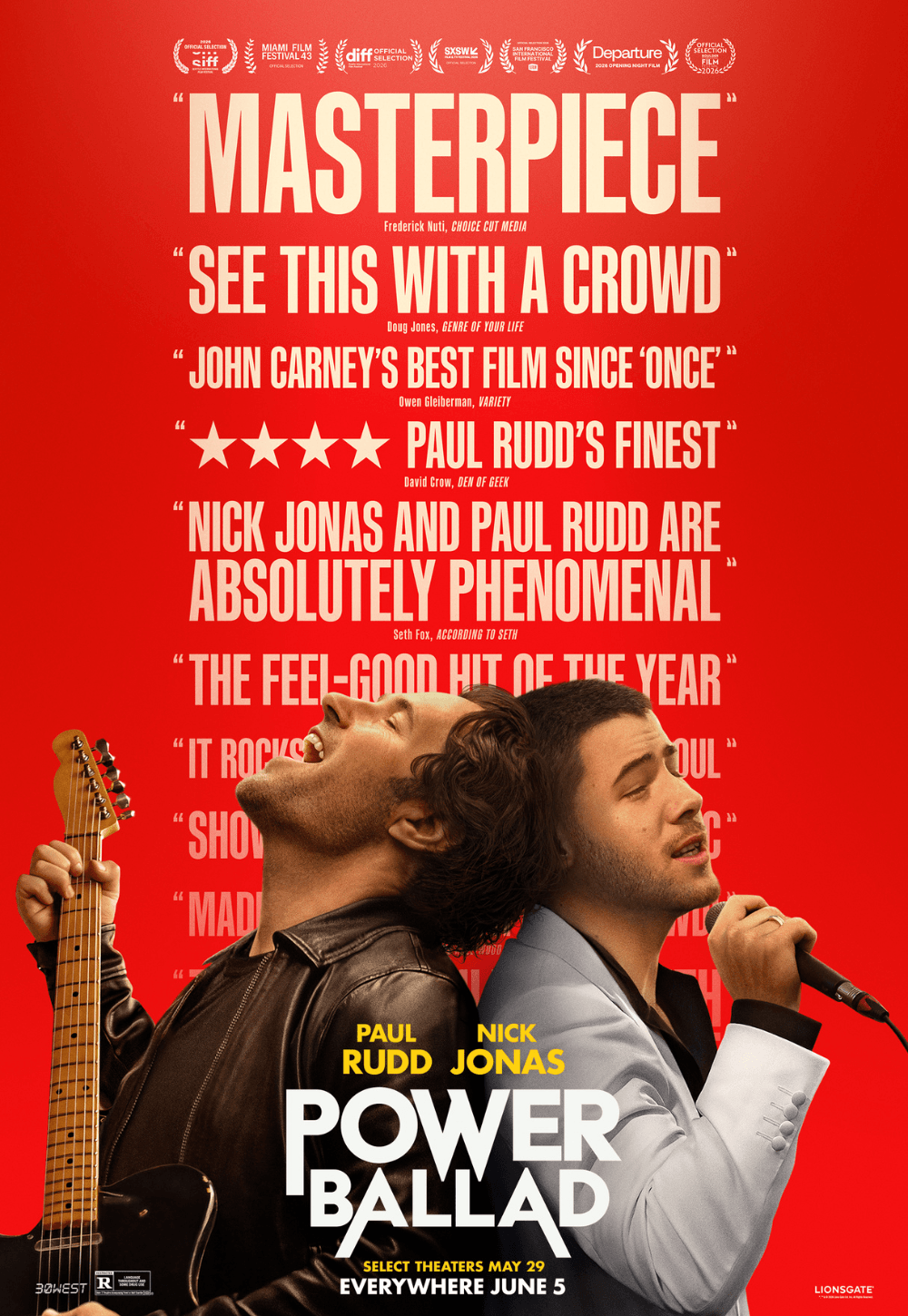
Note: John Carney’s Power Ballad was screened as part of the 45th Minneapolis St. Paul International Film Festival. Visit the MSPIFF site here. The film arrives in limited theatrical release on May 29, 2026, and then will expand everywhere on June 5.
Power Ballad is the latest from Irish writer-director John Carney, who has built his filmography around stories about musicians trying to break out of their personal prisons to become famous. His latest follows an American named Rick, played by Paul Rudd, who headlines an Irish wedding band of fiftysomethings called The Bride & Groove. Self-described as “human juke boxes,” they play the usual smattering of generic hits but sound quite professional. Rick, a never-was, used to play original music and even released an album before settling down to start a family. Now, he yearns to return to his roots. It’s one of many of Carney’s films about musicians who oscillate between artistic passion and domestic life. But unlike the up-and-comer stories in Once (2007), Begin Again (2013), and Sing Street (2016), Rick’s goal is not to become a superstar. Refreshingly, Power Ballad is about finding a balance between artistic integrity and personal fulfillment, with a surprising acknowledgment that superstardom is more appealing to the have-nots than to those who must contend with the constant temptation to sell out.
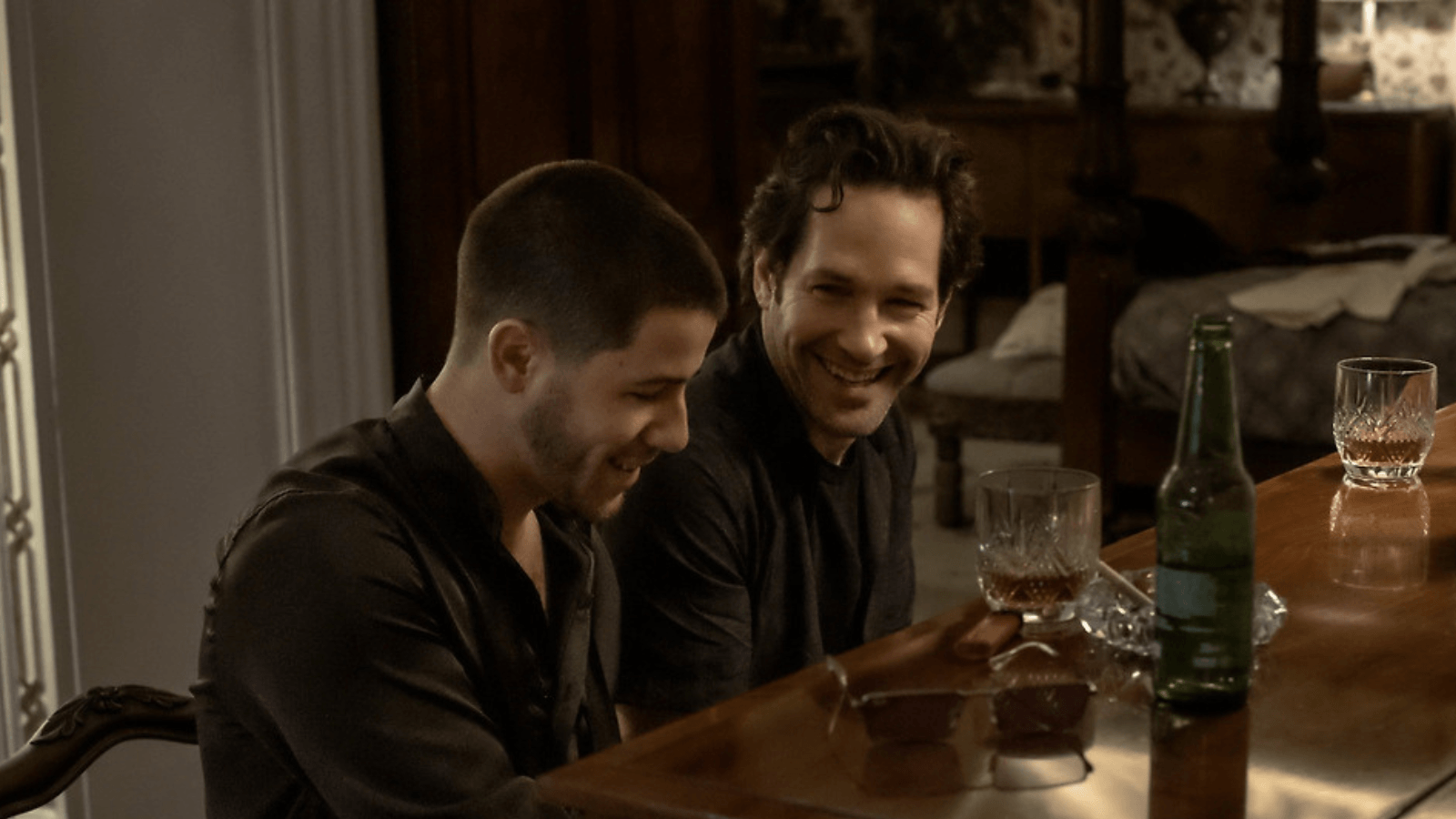
It’s strange to think that Carney’s Once came out almost 20 years ago, the first year I started reviewing movies on this site. Since breaking out, he has remained consistent in his exploration of musicians’ lives. Rudd’s role as Rick Power—a name that sounds like a corny superhero secret identity—is refreshingly grounded. Years ago, Rick gave up touring when he fell in love with and married Rachel (Carney regular Marcella Plunkett). They lead a low-key life, with a modest home and a teen daughter, Aja (Beth Fallon). At a posh gig, Rick’s band plays with one of the happy couple’s famous friends, Danny (Nick Jonas), a former boy-band member who’s trying to redefine his singing career. After the show, Danny and Rick get high and drink spirits while sharing ideas about each other’s music. They clearly work well together, improving each other’s instincts and communicating on supportive, creative terms. Then they part ways.
Six months later, Rick learns that Danny has stolen his song, ironically called “How to Write a Song (Without You),” and it’s a huge hit. At first, Rick doesn’t want to make a big deal out of the issue, believing that Danny is basically a good guy, so there must be some misunderstanding. Enter Danny’s smarmy manager, played by Jack Reynor, who, after Midsommar (2019), embodies another duplicitous, self-absorbed jerk who’s willing to lie, cheat, and steal for success. He plays hardball with Rick, prompting the wedding singer to spiral. Rick doesn’t want what is surely a hefty payday for writing a hit song; he just wants people to know that he wrote it. The reasons why remain touching. In a shallow reading, Danny claims the song is about his girlfriend (Havana Rose Liu). Rick sets out to prove otherwise, accompanied by his most loyal friend from the wedding band, Sandy (Peter McDonald).
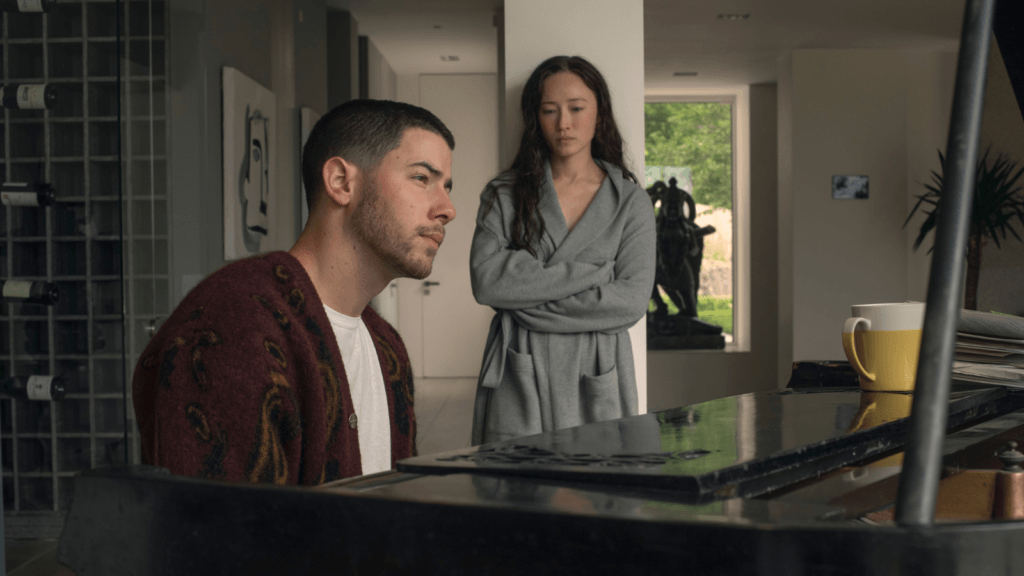
Power Ballad relies perhaps too much on playing “How to Write a Song (Without You),” an admitted earworm written by Carney and Gary Clark that adopts the sound of sappy music from the late 1980s and early 1990s. Like other films about fictional musicians, as recent as Mother Mary, the music is the weakest element of Carney’s film (but it’s better than the songs in his underwhelming Begin Again). Regardless, it’s catchy and believable enough as a hit. Carney at least acknowledges that the musical genre embraced here may sound outdated to younger ears. When Rick plays the song for Aja, she dismisses it. Teenagers don’t want to hear love songs these days, she says. He asks what they want their songs to be about. She replies, “Revenge.” The amount of laughter in the theater at this signals not only how much has changed in the last few decades, but how much art continues to reflect our culture. By contrast, nostalgic music like Rick’s song feels rather simplistic, but no less welcome, in its message.
Much of the film plays better than it might because of the casting. Rudd’s innate charisma and geniality maintain the audience’s sympathy, even during the second act when Rick spirals frustratingly out of control. Jonas humanizes Danny, too, playing him as a figure caught between doing the right thing and his shameless desire for success. “You don’t understand how hard it is,” Danny tells Rick, oblivious to his privilege and unwilling to do the work of creating art. Elsewhere, McDonald is charming as Rick’s friend, who occupies the Rhys Ifans trope of the scuzzy but lovable friend from Notting Hill (1999). Fallon is also solid as Rick’s reason for writing the song in the first place, though Carney underplays her character’s contribution in the finale. Best of all, Carney resists turning any of these characters into clichés, and in a lesser filmmaker’s hands, the story may have played out much differently and predictably.
At the heart of Power Ballad is a theme about where artists place their energy: either in their passion for creating something original or in simply seeking a shortcut to success. Carney’s film grapples with a debate pervasive across countless creative disciplines at the moment, specifically regarding the use of artificial intelligence in art. Good art takes time, talent, effort, and work. AI circumvents that process and is tantamount to pilfering someone else’s song. Danny didn’t author the song and, rather than go through the effort of writing something original, he found it easier to steal to maintain his celebrity. Those who use AI in art have replaced the rigor of mastering an art form with an easier shortcut. Power Ballad recognizes that great art wasn’t created by artists desperate to save time, maximize profits, and cater to commercial demands. Great art, in this case music, is created by people who play the music they want to play. It’s a simple concept, one that is lost on people like Danny and today’s tech bros who keep trying to shove AI down society’s throat.
Thank You for Supporting Independent Film Criticism
If the work on DFR has added something meaningful to your love of movies, please consider supporting it.
Here are a few ways to show your support: make a one-time donation, join DFR’s Patreon for access to exclusive writing, or show your support in other ways.
Your contribution helps keep this site running independently. However you choose to support the site, please know that it’s appreciated.
Thank you for reading, and for making this work possible.
Brian Eggert | Critic, Founder
Deep Focus Review