Digger
By Brian Eggert |
(Editor’s Note: This review contains major spoilers for Digger. For the best experience, read the review after you see the film.)
Digger is the kind of film that will earn a full spectrum of reactions, but maybe after a decade or so, assuming humanity lasts that long, it will be reassessed as a masterpiece. I’m not quite there yet, but I’m already very close. After another viewing or two, it might become an all-timer. For the moment, I still feel exhausted. It’s the same overwhelmed response I often have after the genius films of Ken Russell, Terry Gilliam, or Yorgos Lanthimos; the same way that too much visual information overloaded the original critics of Blade Runner (1982) for a decade. The latest from Mexican auteur Alejandro González Iñárritu is among his most daring films to date—out-weirded only by his underseen Bardo (2022), his most surreal project, now forgotten somewhere in Netflix’s servers. Digger, like many of the director’s other features, could (and probably should) be charged with pretentiousness and artistic self-indulgence. Some have already dismissed it as chaotic, claiming its message is muddled amid high-concept plotting and gotcha marketing. Still, it’s unquestionably one of the year’s most original and unconventional films released by a major studio, and it demands more than contemptuous rejection. Rather, it’s as if a master chef prepared a seven-course meal, though you thought it was just going to be apps and drinks.
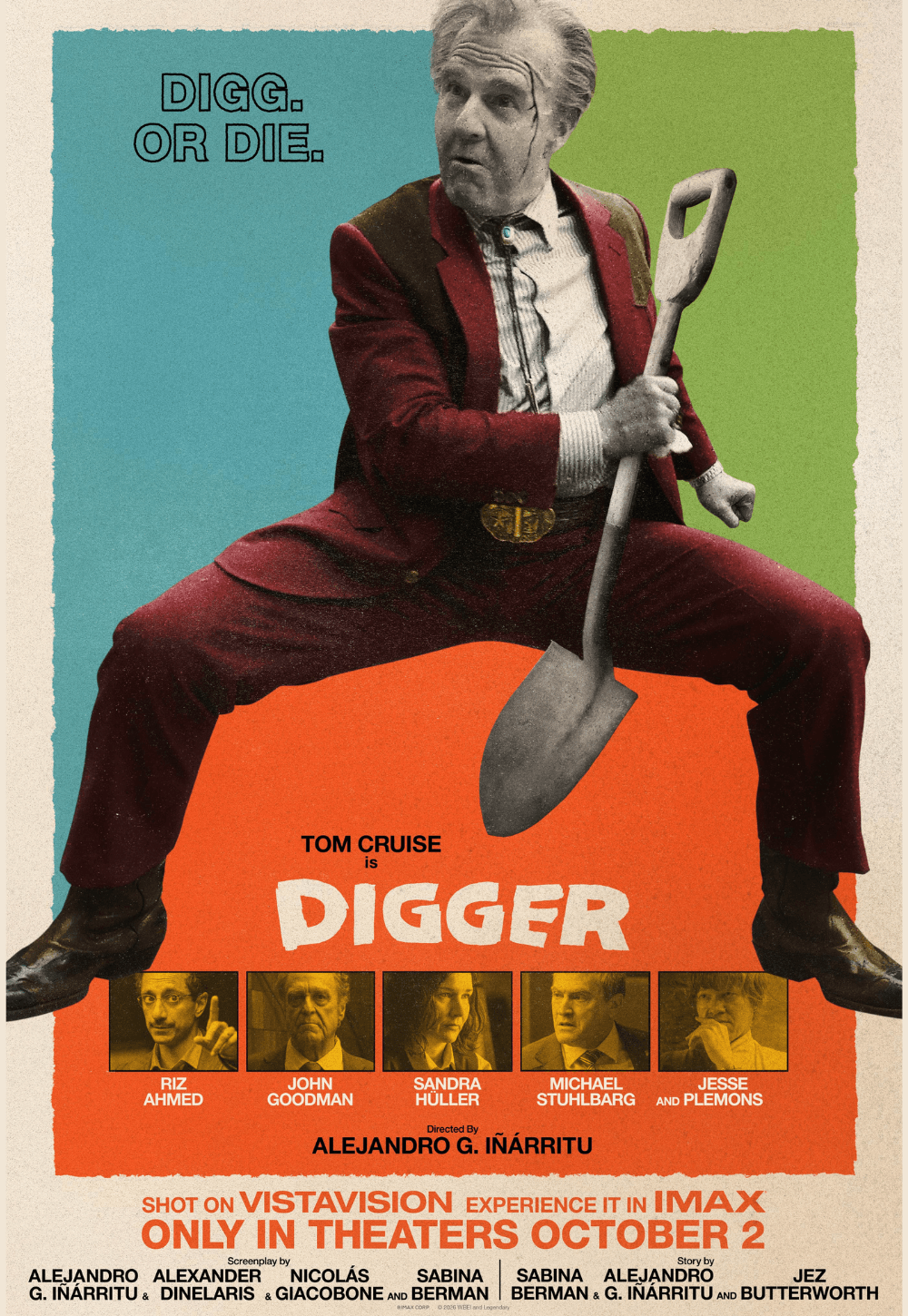
To begin with, Digger is not the film sold to moviegoers in the trailers, and that’s a good thing. After a teaser trailer reminded viewers of the career-long legacy of Tom Cruise, who stars as the titular oil baron, a brash Southerner who’s the power behind the sitting President Compson (John Goodman), the promotional department at the soon-defunct Warner Bros. sold a story in which Digger causes a natural disaster, only to swoop in and save the day. From the outsider’s perspective, it was an absurdist, big-budget disaster movie with Cruise in goofy make-up. The footage looked heightened, but the story pitched was familiar enough. Although Cruise wasn’t playing another age-defying Ethan Hunt or Maverick, he would once again be saving the world. Plus, the trailers sold Cruise going for broke under the direction of a two-time Oscar winner. Indeed, it’s easy to forget that Iñárritu is one of only three directors in film history to win Best Director Oscars two years in a row, first for Birdman (2014) and then The Revenant (2015). Only two other directors, John Ford and Joseph L. Mankiewicz, have earned successive statues in that category.
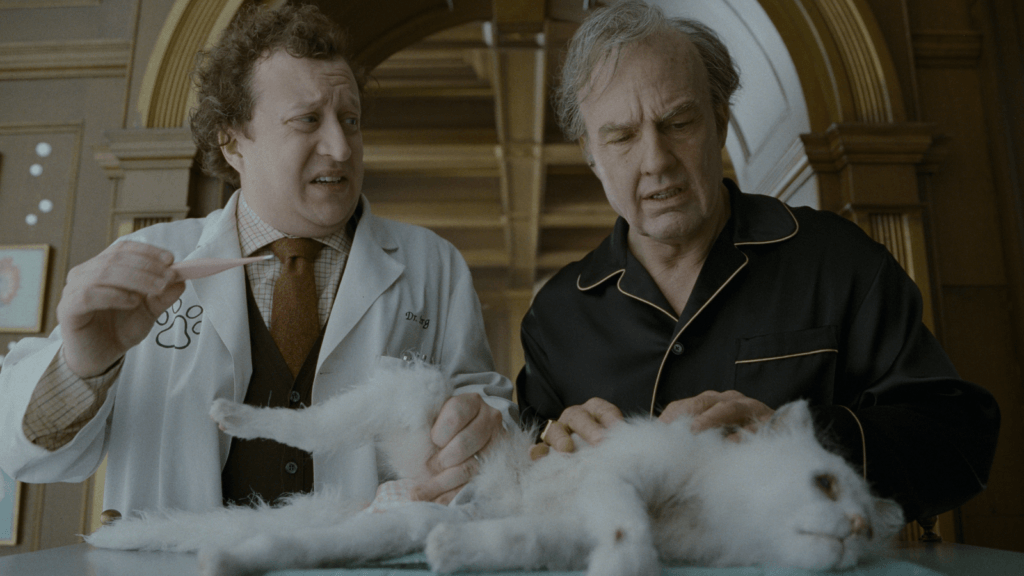
For the film’s first act, Digger plays out as advertised, following the ridiculously wealthy and powerful tycoon whose primary concern is his ailing 30-year-old cat, Maggie, a disgusting puppet that would fit in Meet the Feebles, Peter Jackson’s morbid Muppet riff from 1989. She’s well beyond her nine lives, but he cruelly keeps her alive with the same stubbornness as his commitment to fossil fuels. Although Digger Rockwell wakes up to an Albert Bierstadt scene out of his window, he probably smells like cat piss and old tuna, for reasons I’ll let you discover. Smell aside, he’s the richest oil magnate alive, overseeing millions of barrels a day for his company, Rockwell United. His mansion of excess is filled with taxidermied alligators pinned to the ceiling, a Citizen Kane-style infinity mirror lined with antlers, and a meeting room with a mural worthy of Thomas Hart Benton. Loud and boastful about his granddaddy starting an oil empire with a ten-cent shovel in the 1920s, Digger’s self-confidence is unchecked and only somewhat earned. He trusts his gut more than he does any damned doctor or scientist. And he only respects people who are afraid to disappoint him, who are willing to give him the answer he wants, regardless of the truth.
But his fortune changes when a frantic scientist on his payroll comes to him with bothersome reports that their Greenland drilling operation will likely dislodge a massive ice shelf. The truth is that Digger has ignored warnings that their drilling would unleash methane and trigger a worldwide crisis. Moments later, that’s exactly what happens. Now an iceberg named “Judy” will likely destroy Norway, leaving a death toll in the hundreds of thousands and property damage in the trillions. Although he’s supposed to be touting Verdant, an environmentally conscious company launched by his sister (Sandra Hüller), Digger instead puts on the spin cycle and tries to control the narrative. He has the backing of the ass-cancer-ridden POTUS, whose Christian nationalist cabinet includes the brain-dead Veep (Michael Stuhlbarg) and the bomb-monger military head (Robert John Burke)—all of whom are more concerned about the optics of their willful negligence than the millions who will die. With the obvious scent of Dr. Strangelove (1964) in the air, none of them wants to hear the incessant ifs and coulds from the resident scientist, Ganesh (Riz Ahmed), despite their factual basis. They’re dealing in narrative control.
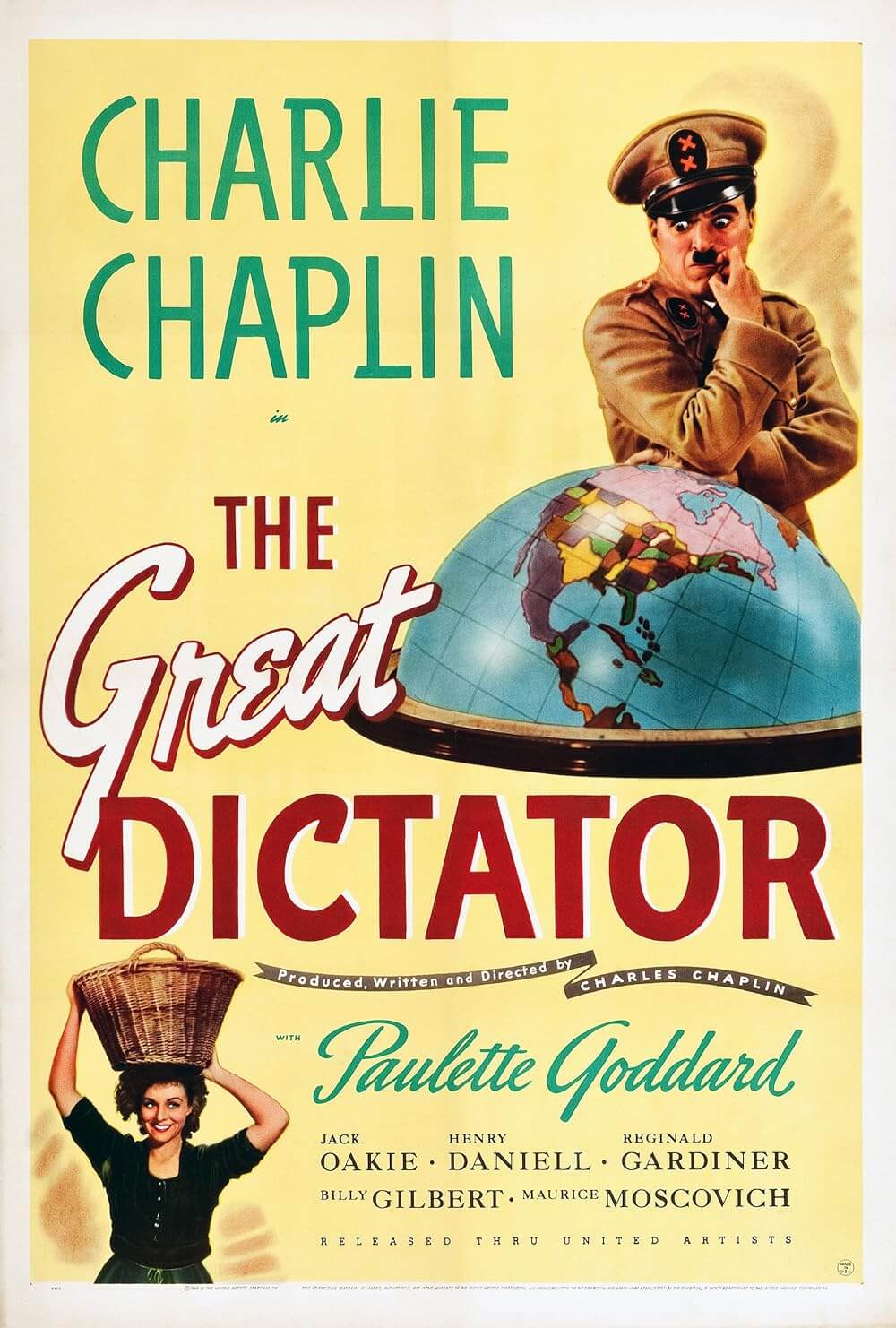
And that’s precisely what Iñárritu does around Digger: an elaborate metatextual trick on viewers, who were sold a silly, arty Tom Cruise spectacle, only for the film to shift into a fictionalized intertextual take on artists trying to justify their efforts. With more than a hint of Iñárritu’s backstage Broadway drama Birdman, the film steps back about 30 minutes in, revealing that everything we’ve seen so far has been part of a stage rehearsal before an opening-night performance, mounted some 30 years from now, overseen by a talented new stage director (Sophie Wilde), and based on real-life events. Cruise is actually playing Curtis, a renowned theater actor inhabiting a famous role in a play called Fossil Fools, a farce that makes light of a disaster that has left the world in a post-apocalyptic state. Digger is a vile figure in real life, deemed almost solely responsible for a global environmental collapse. And Curtis, who’s distracted by the disappearance of his daughter’s flight from Jamaica, remains uncertain about his role. Should they be making light of such a contemptible figure? One can imagine Charlie Chaplin wondering the same thing during the production of The Great Dictator (1940).

Even before Iñárritu drops this narrative bomb, it’s evident that Digger is a formally bold work. The director once again works with cinematographer Emmanuel Lubezki, who shoots on 35mm celluloid with VistaVision cameras. This gives the film a tangible quality, with the desaturated, yellowish-green look of callused skin—appropriate for the play-within-the-film’s almost exclusively grotesque senior-citizen politicians who look about as lively as Mitch McConnell. Lubezki’s standard wide-angle lenses and slow-roving camera turn every scene up to eleven, creating a dreamlike aura that aligns with the film’s sneaky structure and amped-up performances. It’s fitting that production designer Dennis Gassner has worked on Blade Runner 2049 (2017) and several Daniel Craig-era James Bond movies; Digger has a similar scope and ambition. Meanwhile, the delightfully bizarre avant-garde score by Cosmo Sheldrake lends the film a quirky, discordant tempo, with a persistent organ-grinder melody underneath notes punctuated by chirping birds, croaking frogs, and dripping water.
Then there’s Cruise, another oddball element, who manages to disappear into his role completely and also weaponize his sometimes uncomfortably intense persona. There’s an underserved side of Cruise that I suspect wants to become an Eddie Murphy-like chameleon, donning fat suits and playing multiple characters in the same film. Putting on those prosthetics, designed by sculptor and make-up artist Kazu Hiro, lets him become someone else and show a side of the actor audiences seldom get to see. Every few years, Cruise takes a major risk, outside of his default action-hero mode. He embodies a tragic manosphere creep in Magnolia (1999), hides behind furry Popeye forearms and male-pattern baldness to play a Harvey Weinstein-esque producer in Tropic Thunder (2008), and commits to playing a hair-band legend in Rock of Ages (2012). Here, dressed in Cosby cardigans and cowboy suits designed by Jacqueline West, Cruise manages to draw attention away from the rest of the cast. Ahmed and Hüller give strong performances in their Fossil Fools scenes, which continue to unfold throughout the film’s intermittent backstage breaks. A sickly-looking Goodman gives the most over-the-top performance as Compson, but then, that’s the point.
Iñárritu’s film defends both farce and satire as poetic license, arguing that they both can achieve catharsis, even when the story draws on inconvenient truths and tragic events. Curtis struggles with how the long-celebrated play doesn’t reflect reality, and how the playwright got some details wrong. But he learns that people need to laugh at horrible things; the alternative is too depressing. It’s a lesson that Ridley Scott would love, given his go-fuck-yourself attitude toward detractors who quibble about the historical inaccuracies in his productions (see Napoleon, 2023). As in Birdman and Bardo, Iñárritu sees the all-consuming value of the creative process, while recognizing that the people who create have their own lives, and their work is an extension of them. The artists behind Digger are many, with story credit going to the director, Sabina Berman, and Jez Butterworth, and the screenplay to Iñárritu, Berman, Alexander Dinelaris, and Nicolás Giacobone. Given all this, there’s good reason to suspect that Digger is packed with disparate ideas from multiple voices. And perhaps it is. But there’s an insidiously clever method to the madness.

Digger is constantly grappling with reality and fiction in various forms. We never see the reality of Digger Rockwell, but we hear about it; he was reportedly severe and calculating. That differs from his representation in Fossil Fools, where he’s a cartoonish blowhard. The play’s portrait of Digger also differs from how Curtis wants to play him. Curtis’s nagging dissatisfaction with the role is partly informed by the crisis involving his daughter’s missing plane, a thread that imbues the climactic moments of both the film and play with welcome relief—the former from his daughter’s safe landing, the latter from Digger’s on-stage suicide, which brings the audience to simultaneous joyful tears and applause, overjoyed that the one responsible for their misery is dead. And why are they so miserable? The disaster Digger caused spun wildly out of control, turning the future world into an overheated, waterlogged dystopia that requires everyone to wear high-tech masks to breathe safely outside. The film’s interest in the dynamics of reality and fiction is further symbolized by Digger’s narrative layers, Cruise’s two identities in the diegesis, and the make-up Cruise and Curtis wear to disguise themselves.
Most impressive is how Iñárritu convinced the Warner Bros. promotional department to show only the film’s topmost layer, allowing the audience to peel away and investigate what’s underneath for themselves. Even better, Digger’s marketing not only conceals its mysteries but reflects the film’s theme of narrative control by those in power. (Doubtlessly, for years to come, film marketing classes will use Digger as a case study in how a campaign can serve as an extension of its narrative and themes.) The marketing strategy isn’t just to conceal plot details. It also illustrates the cautionary tale at the center of Fossil Fools: for decades, politicians have sought to control narratives around the scientific evidence of climate change for short-term financial gain. In the play, Digger addresses an assembly of ghoulish pale world leaders, confronting them with the reality that people “want freedom to bask in their unsustainable lives.” They condemn him for irresponsibly puncturing the planet; he accuses them of wanting him to keep drilling. Politicians have denied the science, manipulated the media, and turned climate change into an ideological debate for their own profit, just as Iñárritu has sold the audience a bonkers disaster movie only to give them something far more complex. Iñárritu seems to say that if viewers feel upset about the director’s switcheroo, they should be even more outraged by politicians and oil companies who have been deceiving them for years.
Digger likely won’t be a love-it or hate-it experience; instead, it’s bound to be generally seen as an ambitious failure. I suspect many won’t be able to make heads or tails of it. Others won’t be able to restrain their contempt for its artistic agenda and multiple haughty commentaries. But those who loved Ari Aster’s Eddington last year may embrace its audacity, if only to watch Cruise nail his riskiest role of the twenty-first century—a film-long stunt of incredible skill that’s a blast to see. Admittedly, watching Digger isn’t as rewarding as the hours I spent thinking about it afterward. At 129 minutes, the film loses some of its momentum in the last third; it’s never quite laugh-out-loud funny, and it should have spent more time with Curtis for a more substantive emotional payoff. However, after other films from 2026 have faded, Digger will be at once unforgettable, somewhat unresolvable, and subject to furious debate. That, to me, is the definition of great art. Not perfect. But great.
Thank You for Supporting Independent Film Criticism
If the work on DFR has added something meaningful to your love of movies, please consider supporting it.
Here are a few ways to show your support: make a one-time donation, join DFR’s Patreon for access to exclusive writing, or show your support in other ways.
Your contribution helps keep this site running independently. However you choose to support the site, please know that it’s appreciated.
Thank you for reading, and for making this work possible.
Brian Eggert | Critic, Founder
Deep Focus Review