
Bitter Christmas
By Brian Eggert |
It must be strange to be friends with Pedro Almodóvar. Many of his films have an autofictional quality, with the Spanish auteur turning his personal history and the lives of those around him into sublime cinema. Imagine reading about a painful chapter of your life in a screenplay or watching your friend’s new project only to realize that he’s turned your tragedy into a movie. That’s precisely what happens to a character in Bitter Christmas (Amarga Navidad). Returning to his native language after his English debut with The Room Next Door (2024), the director looks inward and interrogates his process. He works through his creative doubts, blockages, and betrayals in a film of naked honesty, with his narrative probably doing the very thing that inspired it: telling a story about writer-directors, both fictional and real within the context of the film, whose autofiction tests the limits of their relationships. But beneath the self-examination of his process, the 77-year-old filmmaker makes a heartening confession: his creative reserves aren’t always full, and he sometimes relies on the lives of those around him for inspiration in ways that make him perhaps a difficult friend to maintain.
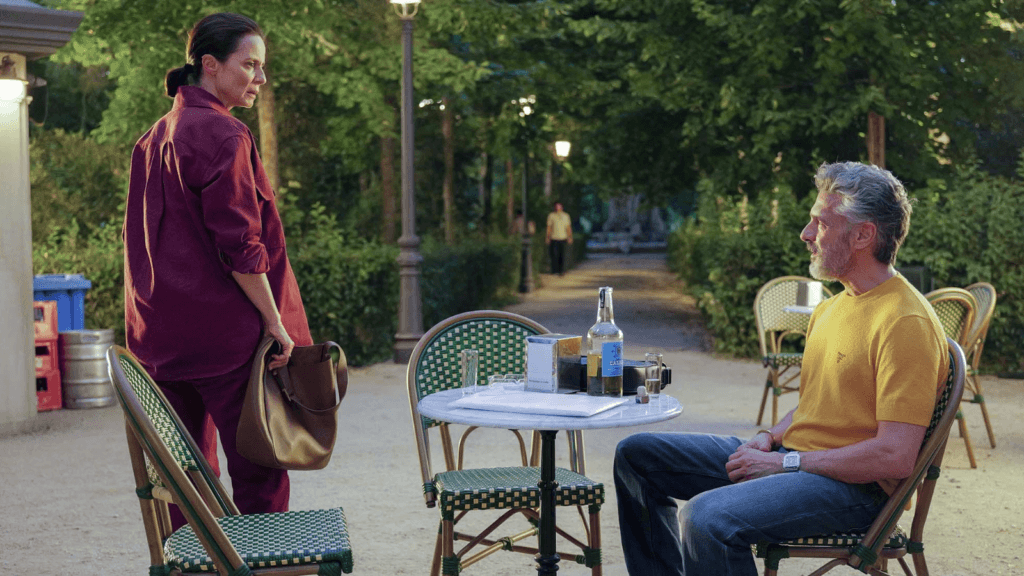
Almodóvar regularly uses his life as material for his films, none more so than Pain and Glory (2019), his intimate portrait of a filmmaker, with an extraordinary Antonio Banderas starring as the director’s onscreen counterpart. Here, Almodóvar’s analogue is Raúl, played by Argentinian actor Leonardo Sbaraglia. Raúl hasn’t made a feature in five years, and he feels alive only when he’s shooting a movie. But with no new ideas coming, he begins to write about himself and the people in his life. There’s Mónica (Aitana Sánchez-Gijón), his assistant for twenty years, who will be taking an extended sabbatical to care for her friend Elena, whose son has just died. In her place, Santi (Quim Gutiérrez), Raúl’s live-in lover, will take over arranging his schedule and handling all the duties she normally would. But upon reading an early draft of his latest—called Bitter Christmas, of course—Mónica is shocked to discover that he put aspects of Elena’s situation into his screenplay.

In a parallel plot, Raúl’s screen story unfolds in his mind’s eye, recounting how he was stricken with a series of panic attacks in 2004. The fictionalized version of himself is Elsa (Bárbara Lennie), a director with only two cult films to her name. Her lover is Bonifacio (Patrick Criado), a firefighter whom she first met dancing a striptease to Grace Jones’ intoxicating “I’ve Seen That Face Before.” He stands in for Santi. And with this subplot, Raúl acknowledges that he’s been selfish and often puts Santi second, as Elsa does to Bonifacio. Having all but given up on filmmaking, Elsa works in advertising and wants to make a new film, but her anxiety derails her plans. She soon begins writing while on vacation with her sister Patricia (Victoria Luengo) on the volcanic island of Lanzarote, incorporating aspects of her sibling’s life into her screenplay. Later, her friend, Natalia (Milena Smit), who lost a child and has been too stricken with grief to continue her work as a model, becomes part of her story too. And like Raúl, Elsa’s willingness to use the lives of her friends and family in her work gets her into trouble.
Neither of the two parallel stories unfolds in separate, self-contained sections as I’ve described. Almodóvar and editor Teresa Font intercut them in a manner that effortlessly flows between the two periods, while folding reality and fiction into each other in ways that may scramble the viewer’s brain. What’s unmistakable in Bitter Christmas is Almodóvar’s depiction of his own process vis-à-vis Raúl, who types out “Elena” in one moment and then replaces it with “Natalia,” exercising only the most thinly veiled fictional disguise. But Mónica finds these touches insensitive; she confronts Raúl, enraged, and threatens to use her two decades of intimate knowledge against him should he continue using her friend’s life as dramatic fodder. Like Lennie, whose role is inward yet compelling, Sánchez-Gijón gives a superb and fiery performance (in her second collaboration with Almodóvar after 2021’s Parallel Mothers). Besides using reality as a basis for fiction, Almodóvar also acknowledges that inspiration comes from music, evidenced in his uses of star Amaia Romero and a recording of his late, longtime friend, Mexican ranchera singer Chavela Vargas.
After the relatively muted colors of The Room Next Door, the director’s work on Bitter Christmas restores the vibrant color schemes that make his films so distinctive, yet with a similarly morose tone. Production designer Antxón Gómez and costumer Paco Delgado give life to one brimming shot after another, making a story that’s somewhat less heightened than Almodóvar’s usual scenarios feel alive. Beyond the metatextual layers, the film has no end of intriguing details. What should we make of his seemingly random asides, such as the two coked-up ER patients who appear after Elsa checks into the hospital? Or the club where the owner explains to Elsa that stripteases have been replaced with live sex acts? Curious as these particulars may seem, they add to the flavor of Almodóvar’s world. Perhaps he recently learned that his favorite strip club now only showcases actual fucking, and maybe he witnessed two strung-out guys at the hospital, and he wanted to include those details in a film, so here they are.
Many critics have called the film a disappointment. Whenever a master’s work isn’t among their very best, some tend to come down on the film for not being a magnum opus. But I find it helpful to step back and gain perspective. Even an Almodóvar effort ranked in the bottom half of his filmography is better than most of what I see in a year. That’s the case with Bitter Christmas, a film whose plot machinations and thematic intentions meander wildly in the first half, only to leave the viewer with a fuller picture by the final moments. Part of watching the film is journeying alongside Almodóvar as he finds the story. It’s fitting, then, that Bitter Christmas opens with its title typed onscreen and ends with a view of Raúl’s fingers keying letters on a laptop. It’s about how the creative process can surprise the artist, resulting in a work that takes unexpected turns and yet feels vital once it’s committed to the page.
To be sure, the film is among Almodóvar’s most winding narratives, but the spirit of intention is embedded in every scene by Alberto Iglesias, the director’s longtime composer whose music carries a conspiratorial undercurrent that binds each scene to the next. Bitter Christmas doesn’t have the farcical or even melodramatic quality of Almodóvar’s most celebrated films; however, it has the intense feeling and interiority of an artist evaluating and critiquing his methods. He acknowledges his personal downfalls and how his work may affect those close to him, yet he’s also resigned to his process and desperate to prove that he hasn’t lost his spark. Even so, Almodóvar seems to know, and even openly state through Raúl, that he’s struggling and not doing his best. As Mónica tells Raúl, his new screenplay “will be a minor film, but your followers will be grateful.” Consider me grateful for the earnest, confessional quality of Almodóvar’s latest, a decidedly personal film, and another stunningly made look inward by one of our finest directors.

Like DFR? Support us.
This site exists because readers like you care about film. If DFR has enriched your experience with movies, I’d be grateful for your support. You have a few options:
• Join DFR’s Patreon community
• Make a one-time donation on PayPal
• Buy me a coffee
Whatever option you choose, it helps keep my work independent. And it means a lot to me.
Thank you for reading, and for making this work possible.
Brian Eggert | Critic, Founder
Deep Focus Review