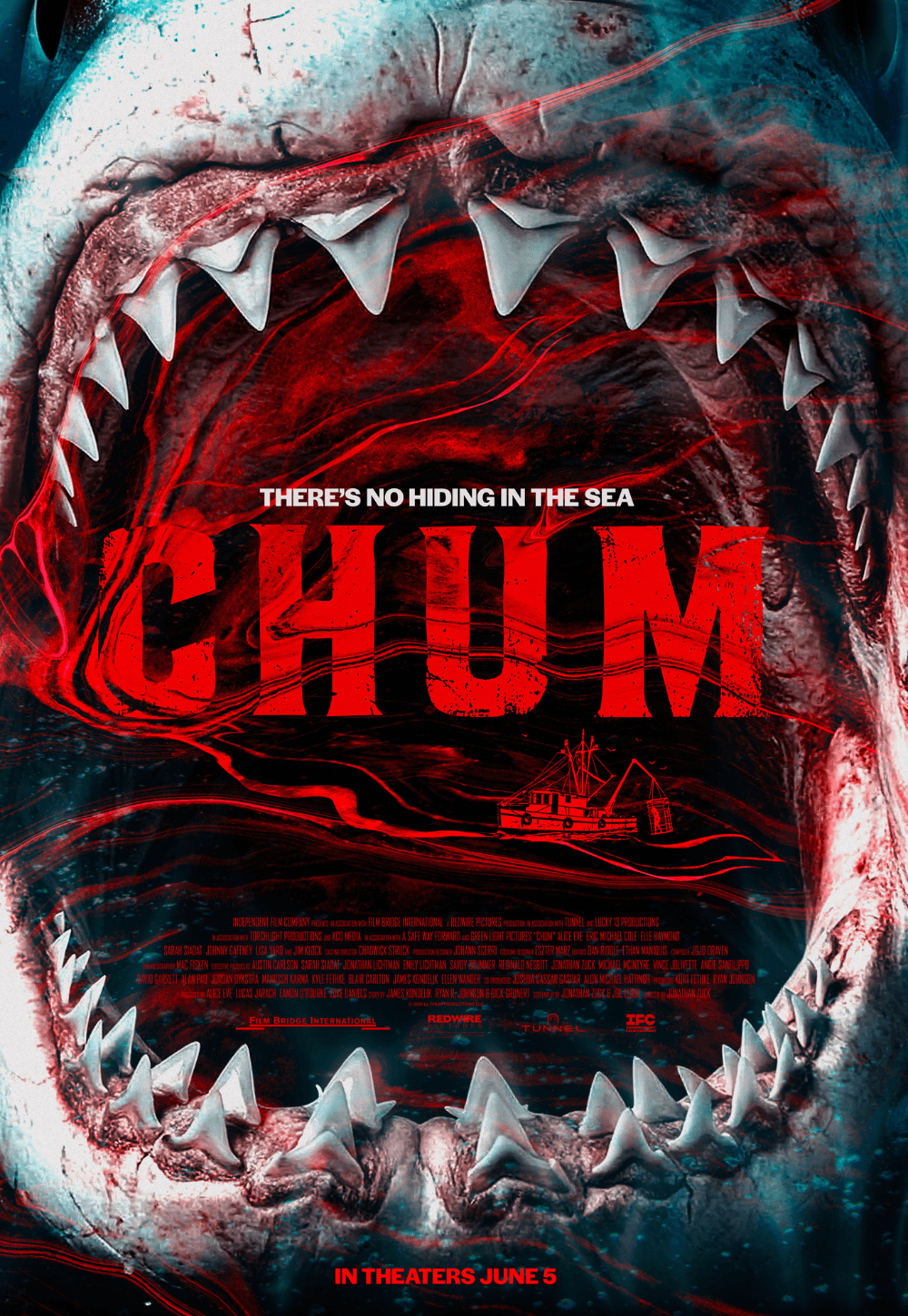
Chum
By Brian Eggert |
Chum is incredible for how bad it is. Seldom do I see movies as inept as this. And when it happens, it always feels like a slap in the face, awakening me from a dream that movies can’t really get that bad anymore. It belongs in a discussion with recent releases, such as Corporate Retreat and Wet Paper Bag, that have been executed with a shameful level of incompetence. Although I cannot call three random movies watched in relatively close succession evidence of a pattern, part of me questions whether this reflects a trend of declining standards among production companies and distributors. Of course, there have always been awful movies, especially in the killer-shark subgenre. But at least the Sharknado series has the good sense to realize it’s cheesy trash and share that with its audience. Despite the B-movie title, Chum resolves to take itself seriously, painfully so. Worst of all, it’s so shoddily assembled that there’s no room in the experience even for ironic fun.
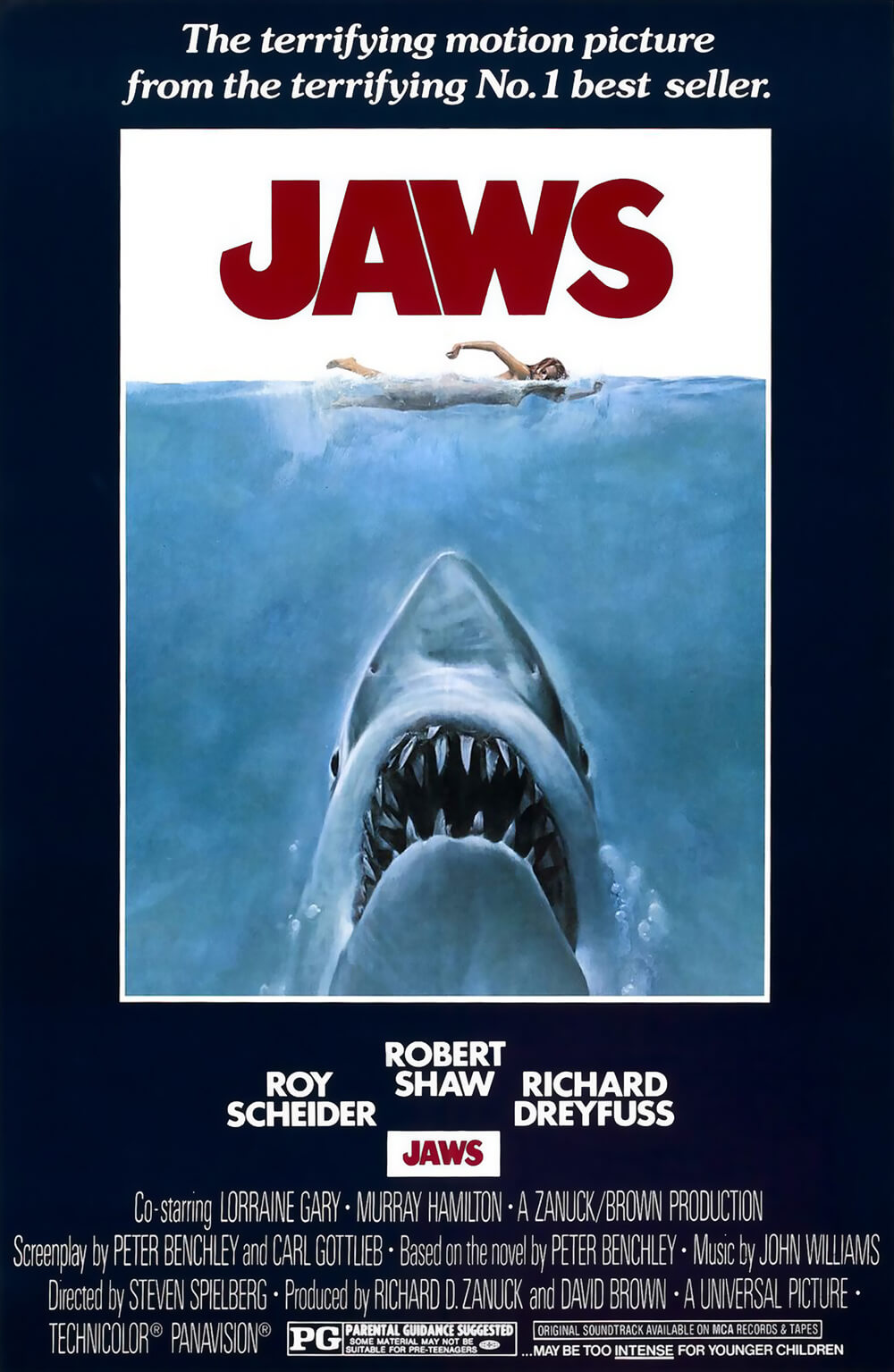
Killer shark movies have been the stuff of made-for-TV movies and direct-to-streaming fare for the last twenty years or so, since the Discovery Channel’s annual Shark Week became a cultural phenomenon. In most cases, these campy flicks pay homage to Steven Spielberg’s Jaws (1975), which remains the granddaddy of them all—often imitated but never replicated. I cannot say there’s been a genuinely good shark movie since, although last year’s Dangerous Animals came close and received widespread praise from critics and moviegoers (I found it disappointing). Even so, its box-office success doubtless inspired the distributor, Independent Film Company, to release Chum as well. In comparison, Chum makes Dangerous Animals look like a masterpiece.
It took only a couple of seconds before Chum made me realize I was in for something terrible. The trouble starts in the opening minute, when Roy (Jim Klock) provides a confusing, nonsensical voiceover against random shots of a boat in the Mediterranean. Roy’s wife has apparently died, and he ruminates about the sun in her hair and the stormy seas like a noir protagonist. “The sea takes what it wants and leaves the rest of us to pick up the pieces,” he says. “But I am not the sea. I am a man. And a man does not forget.” I can say with some certainty that no one in the audience listening to Roy’s narration will think he’s the sea. And isn’t it elephants who never forget? Men forget stuff all the time. I often forget items from my mental grocery list. And when I come home, my wife asks whether I made a list before I went shopping. No, honey, I forgot to.

Anyhow, producer and star Alice Eve plays Tina, whose picturesque wedding reception with her husband Tom (Eric Michael Cole) is shot in such a way that clunkily covers up how the production couldn’t afford extras. The disembodied off-screen clapping and chatter of guests have clearly been added in post-production. It’s far from a happy ceremony, with Tina and Tom showing no chemistry and, that night, discussing an annulment. The particulars of their relationship barely register, with their vague disagreements hinting at their nonspecific differences. The next morning, their wedding party friends, a gaggle of vapid types (Elle Haymond, Lisa Yaro, Sarah Siadat, Johnny Gaffney), encourage the couple to take a boat ride. This becomes the stage for some strained relationship drama before a shark attack causes some panic. They’re soon rescued by Roy, who’s out hunting the Great White culprit, believing this particular fish ate his wife. But Roy has ulterior motives: He plans to use them as bait to lure the shark.
Prior to its release, Chum was criticized for using artificial intelligence to complete its subpar VFX. The term “AI slop” applies here. The shark, the bloody ocean water, and some fire all look like shoddy AI-generated effects. Corporate interests more invested in profits than in turning out a good product have praised AI for its speed and cost-saving measures. The result here looks lazy and cheap, lacking the consideration that comes with a human laboring over practical or traditional computer-generated imagery. The laziness extends to other areas as well. The story, dialogue, character development, acting, editing, and shot compositions all look thrown together by director Jonathan Zuck, who co-wrote the screenplay with Joe Leone. The writers have no idea how to establish characters, and actors are forced to give stilted line readings of unconvincing dialogue. Meanwhile, editors Ethan Maniquis and Dan Riddle seem to have no understanding of shot-for-shot logic, how to establish a scene, or how to create tension. Only cinematographer Mac Fisken delivers some pretty imagery shot on location in Malta, but it often looks like generic stock footage.
That Chum has been distributed by the Independent Film Company, a usually reliable source for under-the-radar releases, indicates a possible shift in artistic priorities. Whereas IFC often used to take chances on festival darlings, the company has since gravitated to more genre fare, which often earns a small profit in theaters before ending up on the horror-themed streaming service, Shudder. However, independent films often feel as if the filmmakers have a story they need to tell. Not so with Chum. Instead, it feels like the filmmakers wanted to capitalize on the shark movie craze for a cash grab, and so they quickly threw together ideas, injected a half-hearted commentary about how climate change has driven sharks into the warming northern waters, and slapped the thing together with the help of AI. There’s no passion or skill onscreen, making Chum a chore to finish. It’s not just a bad movie; it’s an embarrassment.
Like DFR? Support us.
This site exists because readers like you care about film. If DFR has enriched your experience with movies, I’d be grateful for your support. You have a few options:
• Join DFR’s Patreon community
• Make a one-time donation on PayPal
• Buy me a coffee
Whatever option you choose, it helps keep my work independent. And it means a lot to me.
Thank you for reading, and for making this work possible.
Brian Eggert | Critic, Founder
Deep Focus Review