The Wizard of the Kremlin
By Brian Eggert |
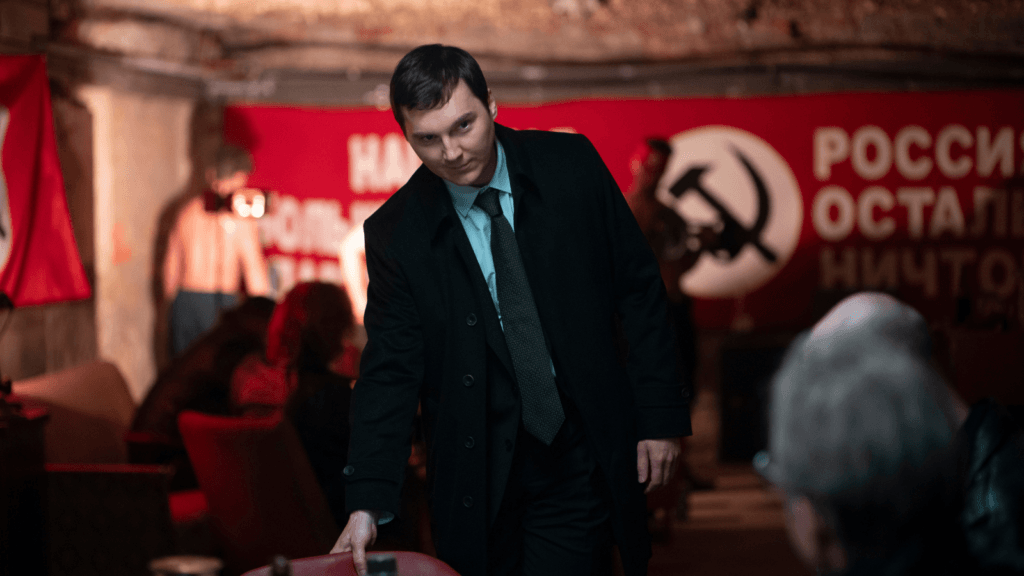
Olivier Assayas’ The Wizard of the Kremlin is about Vladimir Putin’s Machiavellian advisor and strategist, Vladislav Surkov, here presented under the fictionalized identity of Vadim Baranov. Indeed, the film opens with a disclaimer that what we are about to see is a work of fiction, crafted with poetic license. Its fictional origins stem from the 2022 novel by Giuliano da Empoli. However, the screen story follows Baranov, played with chilly detachment by Paul Dano, as he orchestrates Putin’s rise to Russia’s autocratic leader, much as Surkov did. The subject matter spans decades and is politically tangled, detailing, in a kind of shorthand, how Baranov’s kingmaking of Putin helped turn Russia into “a prison the size of a country.” While Assayas has enough material for a full miniseries, the film’s comparatively short runtime forces his complex, novelistic approach into an overly compacted format. The result is a political thriller that feels far too condensed yet also remains quite compelling.
The film needs more room to breathe than Assayas can allow. When it premiered at the Venice Film Festival last year, the runtime was 152 minutes. Assayas evidently cut the picture down further, as the US version distributed by Vertical (the cut screened for this review) runs just 136 minutes. Doubtlessly, both versions feel truncated. Assayas has grappled with this sort of substantial political material before with uneven results. The Wizard of the Kremlin might have been as intricate as Carlos (2010), the director’s sprawling five-hour masterwork that somehow feels like it’s just scratching the surface of Venezuelan Marxist and international terrorist Carlos the Jackal. Instead, his latest aligns more with his 2019 feature for Netflix, Wasp Network, about spies attempting to liberate Cuba from Fidel Castro. Like that film, the standard length of a feature film does The Wizard of the Kremlin a disservice, even as it presents a fascinating story that will prompt moviegoers to read the source material for a more detailed account.
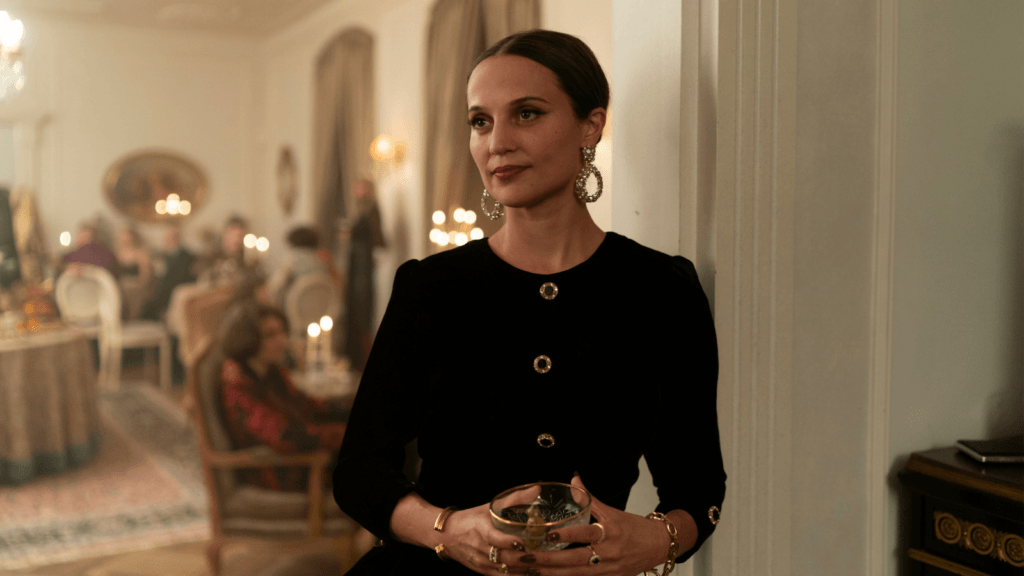
Assayas and co-writer Emmanuel Carrère frame the story with a meeting between Baranov and Lawrence Rowland (Jeffrey Wright), an American journalist and academic who specializes in Russian political history. Rowland’s article in Foreign Affairs, “Vadim Baranov and the Invention of Fake Democracy,” has drawn Baranov’s attention. Years after stepping away from politics, the so-called “New Rasputin” invites Rowland to his secluded estate for a meeting. Rowland’s initial narration gives way to Baranov’s commentary, an unfocused and underdeveloped framing device. Baranov explains that, as a former advisor to the “Tsar,” he schemed to elevate Putin. His account begins with the fall of the Soviet Union, ushered in by Assayas’ animated neon titles flashing “The New Russia.” The college-age Baranov, who despises what Mikhail Gorbachev accomplished, finds himself in unfamiliar surroundings, teeming with the kind of freeing liberalism that usually follows the end of a fascist regime. Here, he meets Dmitri Sidorov (Tom Sturridge), a schemer who starts Russia’s first commercial bank and introduces capitalism to the country. Dmitri captures the attention of Baranov’s lover, Ksenia (Alicia Vikander), a rebellious artist who delights in decadence and “money-centric activities.”
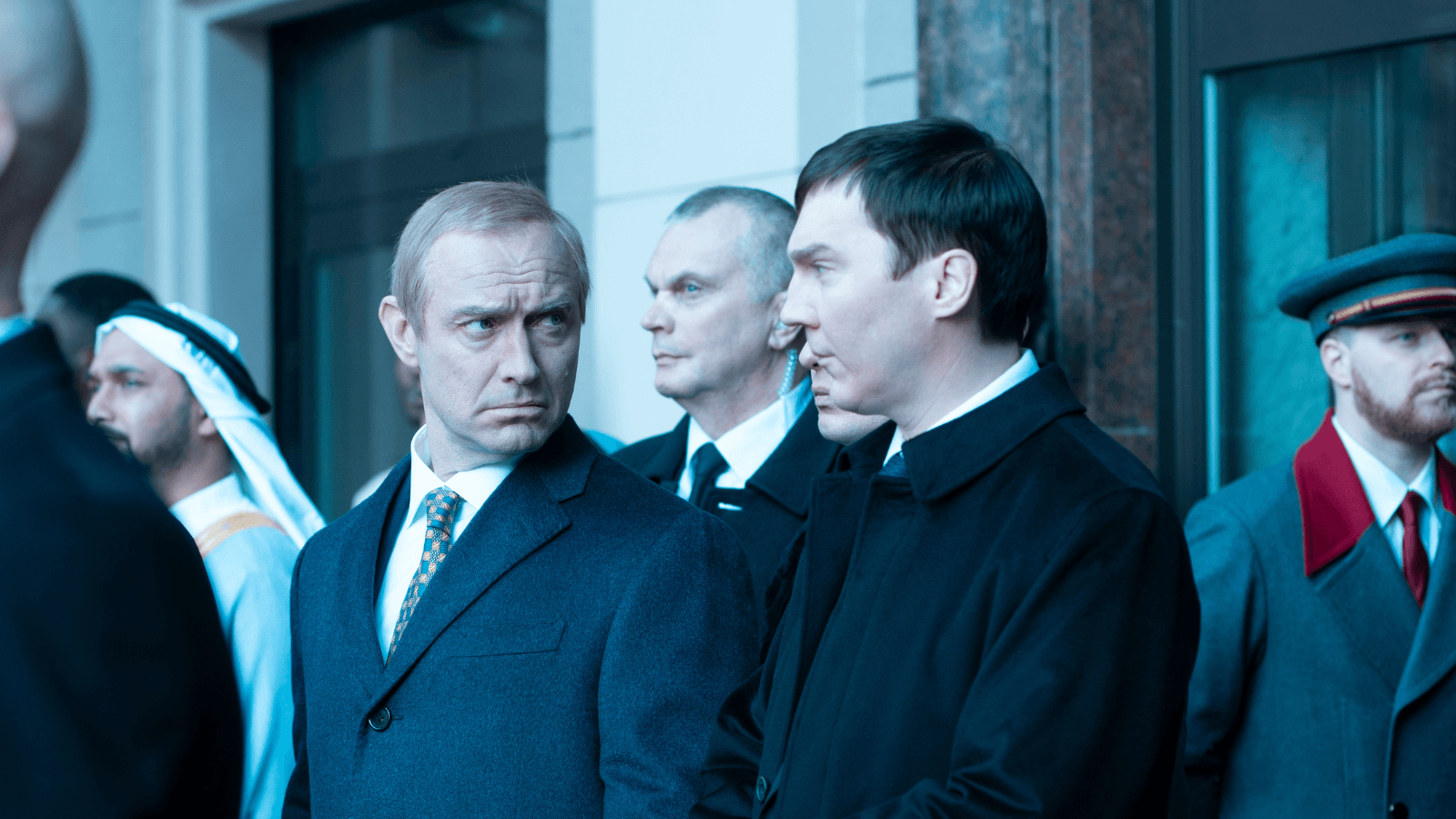
The early scenes have the same rambunctious energy as Assayas’ Something in the Air (2012), his film about a French student who dabbles in political rebellion. But The Wizard of the Kremlin soon becomes an intricate look at Baranov’s rise from a television producer determined to provide Russia with a cultural blueprint to a political puppetmaster. His entry point into politics is Boris Berezovsky (Will Keen), an advisor to Boris Yeltsin—Russia’s president throughout the 1990s. A stooge backed by the country’s secret rulers, the oligarchs, Yeltsin must be replaced. Berezovsky invites Baranov to “Stop making stories. Start inventing reality with me.” Sure enough, they work to establish Putin, the chief of the Federal Security Service of the Russian Federation (FSB), formerly the KGB, as Yeltsin’s replacement. They sell him as a “different kind of politician.” Jude Law plays Putin behind a familiar frown and hairpiece, while not quite capturing Putin’s stature or lifeless eyes. It’s more of a not-bad impression than a full embodiment.
All of this is made stranger by Assayas’ clear intent to address English-speaking audiences, who, at the moment, seem most at risk of repeating the same mistakes depicted in The Wizard of the Kremlin. The director has some of his Russian characters speaking with British accents, though the choice is inconsistent. Some characters speak in English with Russian accents, and at other times, they speak or sing in Russian with no subtitles to translate the dialogue. There doesn’t seem to be a logical reason for these variances, at least not that I could discern. Once the viewer gets over that odd choice, they can settle in to Dano’s excellent, controlled performance, with a low, buttery voice conveying Baranov’s absolute composure. By contrast, Law over-animates his Putin, capturing his fragile ego without the steely persona usually associated with him. Assayas’ production also benefits from Yorick Le Saux’s sharp lensing, but one seldom gets to luxuriate in the cinematographer’s work or the dozens of locations, extras, and vehicles required for the shoot. After all, Assayas and editor Marion Monnier must rush to the next chapter, each announced with cheap-looking digital titles, to make room for everything. This leaves the film feeling not exactly choppy—that’s too strong a word—but disorientingly relentless. Throughout, the viewer scrambles to keep up with how fast the film leaps over major world events.
Baranov’s scheme to “restore the verticality of power” places more control in Putin’s hands—a scary thought, given that Putin praises Stalin, or rather, how the people admired Stalin’s killings (or so Putin claims). Only Berezovsky sees an authoritarian future for Russia under Putin and warns Baranov of that inevitability. Baranov doesn’t listen. What follows is a series of episodes that briefly touch on Baranov’s deceptions and Putin’s cruel ambition, no matter the collateral damage: the FSB’s alleged attacks on the Moscow suburbs to instill fear and justify the Second Chechen War (1999-2009), the Kursk submarine disaster of 2000, the Sochi Olympics, and the banishment of oligarchs from Russia. The list could go on. Baranov is so pleased that, when the USA and the UK announce that he cannot enter their countries, he describes it as an “Oscar” for his political career. Among the most disturbing chapters is Baranov’s meeting with the head of the Internet Research Agency, which incites Baranov to influence Western social media users in the West, exacerbating the culture war to extreme heights. He compares the approach to bending a wire both ways until it breaks. The metaphor feels especially apt from an American perspective, where the last decade has seen much bending of the wire.
Although the film cannot be called strictly factual, it captures the essence of how Surkov masterfully manipulated the media, the internet, and global politics. Instead of facts, The Wizard of the Kremlin deals in the more abstract concept of truth through Baranov. Assayas wrote in the press notes that “truthfulness is non-negotiable” as part of his adaptation. And so, his film is less about dates and direct quotes than an attempt to cut through the minutiae and get to the root of what occurred. From a dramatic perspective, Dano plays a man who attempts to improve his country in earnest, only to experience a disturbing degree of moral and ethical erosion, ultimately becoming complicit in Putin’s many crimes. With each scheme, he reaches a new low, until there is no bottom. It’s a cautionary tale for the world, with obvious parallels to the modern-day United States. Along with an almost impenetrable structure, the film feels like it needs another hour (or seven) to adequately tell this story. But capped with a disquieting conclusion, it thoughtfully illustrates what one character observes: democracy is to Russian democracy as a chair is to an electric chair. Because the same can be said in so many other countries as of late, The Wizard of the Kremlin feels like a germane, if flawed, reflection of our times.
Thank You for Supporting Independent Film Criticism
If the work on DFR has added something meaningful to your love of movies, please consider supporting it.
Here are a few ways to show your support: make a one-time donation, join DFR’s Patreon for access to exclusive writing, or show your support in other ways.
Your contribution helps keep this site running independently. However you choose to support the site, please know that it’s appreciated.
Thank you for reading, and for making this work possible.
Brian Eggert | Critic, Founder
Deep Focus Review