Teenage Sex and Death at Camp Miasma
By Brian Eggert |
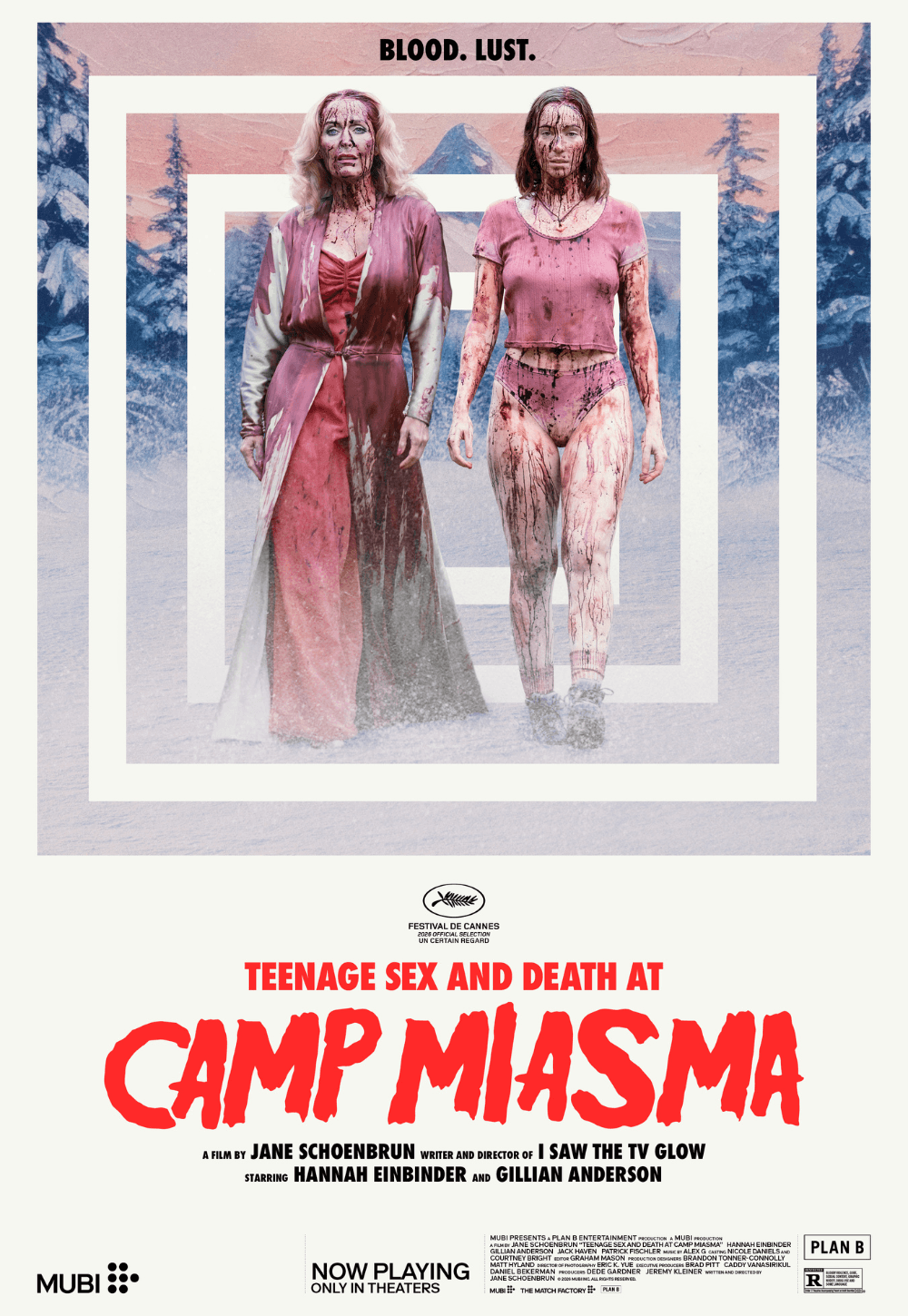
If Jane Schoenbrun ever stops telling original stories and goes Hollywood, no doubt the result will be an assured, thoughtful film. However, here’s hoping the director keeps turning out wonders like Teenage Sex and Death at Camp Miasma, unclassifiable works of art that delve into our relationship with the media we consume and how it can inform our lives, from the choices we make to the longings we have. The protagonist of their new effort might even be Schoenbrun’s fictional counterpart. Kris (Hannah Einbinder) is a 29-year-old Sundance darling whose debut boasted a final third from the perspective of the shower curtain in Alfred Hitchcock’s Psycho (1960). A major studio has hired Kris to reboot a long-running slasher franchise from the 1980s: Camp Miasma, a Friday the 13th-esque setup involving an unstoppable killer named Little Death, who wields a double-bladed spear and wears a boxy air vent as a mask (it looks as silly as it sounds). The young filmmaker sets out to convince Billy Presley (Gillian Anderson), the reclusive star of the original, to give the project her blessing and possibly even appear in a cameo. But like Schoenbrun, Kris is drawn to the fervid allure of horror cinema with its overwhelming blend of terror and desire.
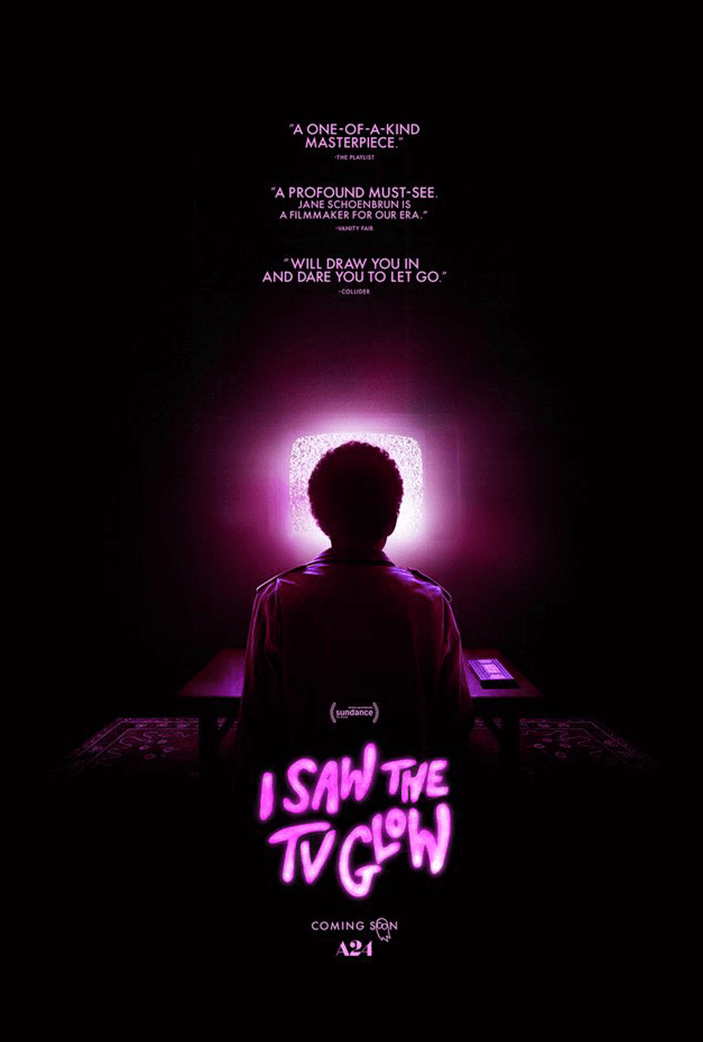
Teenage Sex and Death is Schoenbrun’s third, most ambitious, and most accessible film to date, while also solidifying, even clarifying, themes explored in their previous two features. It’s clear they’ve grown as a storyteller; the characters feel richer and more alive, and the story has a linear progression even with its surreal touches. Similar to Kris, Schoenbrun made their directing debut with a microbudget Sundance premiere, We’re All Going to the World’s Fair (2021). It followed an isolated teen immersed in a digital world of online forums and creepypasta games, only to have a disembodied awakening. A similar situation unfolds in I Saw the TV Glow, released in 2024, about several millennials fanatical about a fictional young-adult television show from the 1990s called The Pink Opaque. Both films have a wormy way of embedding themselves in the viewer’s unconscious, just as various forms of media do to Schoenbrun’s characters, revealing a gender-dysphoric revelation that they feel more at home in these artificial spaces than in their physical bodies. The auteur’s interest in how the intangible worlds of mimetic art capture some perspectives better than the real world invites potent trans allegories.
Teenage Sex and Death is less concerned with trans symbolism—although that’s present, too—than with a personal, queer sexual epiphany brought to its climax through the most primal of genres: horror. Only in horror does the viewer experience heightened levels of fear and arousal with an almost instinctual, primitive reaction. Its ability to frighten and titillate in one sitting can leave a formative mark. Watching Alien (1979) far too young, for instance, I was terrified but also felt mild erotic sparks during the film’s somewhat shameless climactic sequence in the space shuttle, as Sigourney Weaver’s Ripley completed a pre-stasis check in her underwear, unaware that the alien hid nearby among some pipes. Kris had a similar experience with the first Camp Miasma film, watching the slasher’s Final Girl, Billy (played by Amanda Fix in the film-within-the-film), lose her virginity and survive a Little Death killing in the same instant. Kris hasn’t yet cracked the story on her four-decades-later remake of Camp Miasma. Her work, centered on “the intersection of queerness and cultural depictions of monstrosity,” was influenced by her viewing of the cheap slasher as a kid and the queer breakthrough it caused.
Schoenbrun specializes in crafting elaborate fictional mythologies for their characters to obsess over, and Teenage Sex and Death is no exception. It’s Kris’ job to resurrect what she calls “zombie IP,” which isn’t a way of describing AMC’s The Walking Dead, but rather a now “problematic” franchise that has been dormant and needs a modern update, usually imbued with political correctness and a social consciousness. An example might be Black Christmas, a franchise that began in 1974 with a group of college girls stalked and killed by a maniacal boyfriend. In the 2019 remake, writer-director Sophia Takal refashioned the setup with a feminist ensemble who exposed and put an end to their university’s patriarchal legacy and the rape culture it enabled. That movie, which I will happily defend, bombed at the box office and took criticism for its blatant “woke” ideology. Kris learns that by declawing horror IP and making the experience palatable for progressive audiences, a remake’s filmmaker loses touch with what made the material special in the first place—its ability to turn on and disturb its viewers.
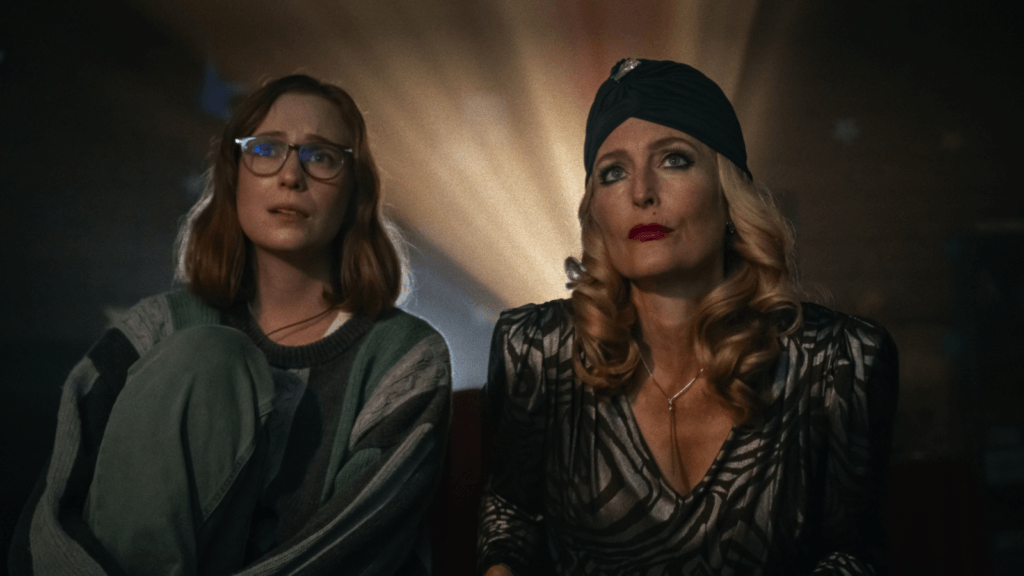
When Kris sets out to meet Billy, who lives alone at the abandoned Camp Tivoli, where Camp Miasma was shot, Schoenbrun risks reducing the film to a meta-centric take on Hollywood’s vapid approach to horror remakes. Note when Kris meets a gas station employee (Patrick Fischler) who fulfills the stereotypical role of a harbinger of danger, warning Kris not to visit Billy. And when Kris eventually arrives in a snowstorm, she finds that the Southern-accented, sultry Billy has some Norma Desmond qualities, including an outdated wardrobe and her own private cinema where she shows her own movie. Wonderfully played by Anderson, Billy is in full control of her sexuality; besides keeping movie candy around the house for whenever she wants to indulge in a gummy treat, she radiates sexual confidence that makes Kris nervous. However, Schoenbrun has more on their mind than a riff on Sunset Boulevard (1950), complete with a dreamy former starlet who now lives in solitude. She also beguiles her live-in visitor. With no other options, Billy serves Kris a platter of KFC on her first night, leading to the sexiest fried chicken scene ever filmed. “Speaking of desire,” says Billy. “Do you like dipping sauce?” Kris does. And the two chow down, the camera lingers on the slow-motion chicken being dipped into various sauces before framing their mouths in close-up as each woman takes a bite.
Teenage Sex and Death’s genre self-awareness is a minor feature next to the psychosexual dynamic between Kris and Billy, and the former’s realization that over-intellectualizing horror might miss the point of a movie like Camp Miasma. Billy explains that horror is about “flesh and fluids,” an aspect that Kris has overlooked in favor of a more cerebral interpretation. She wants to rethink the transphobic source material of Camp Miasma, whose villain, Little Death, was a nonbinary camper (Jack Haven), parented by hermaphroditic mental patients, then bullied and killed by fellow campers, only to return from a kind of hellhole at the bottom of the lake to exact revenge. Kris hasn’t figured out exactly how to modernize the original story in a way that satisfies her social consciousness. Making it about sex and violence isn’t enough for Kris, who is riddled with anxiety over physical intimacy, which has always been a “distraction” for her rather than a passion. She avoids real intimacy in her relationship with Mari (Jasmin Savoy Brown), who is also dating Thor (Aren Buchholz) in a polyamorous throuple. Even after making a bold pass at Billy, Kris cannot lose herself in the moment.
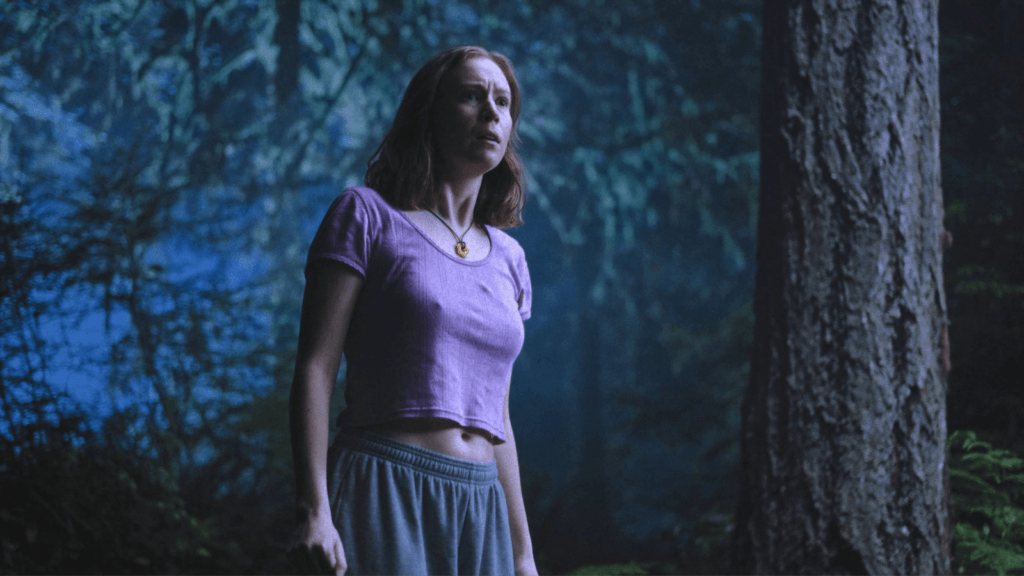
By this time, Schoenbrun has thoroughly immersed moviegoers in Billy’s “private, alternate universe,” which production designers Brandon Tonner-Connolly and Matt Hyland give an otherworldly look. The snowy surroundings at Camp Tivoli look like scenes from Masaki Kobayashi’s Kwaidan (1965)—and just a hint of Elf (2003)—with stagey, elaborately decorated matte-painting skies and brush-stroked trees for a twisted storybook appeal. One might speculate that Kris has somehow entered the world of a slasher, but as the score by Alex G and a rather soft ’90s alt-rock soundtrack suggest, this is less a creepy horror setting than a different world of self-discovery. Cinematographer Eric Yue lends the material a heightened reality by drawing on visual genre tropes and, along with editor Graham Mason, intermingles reality and reverie in hypnotic ways. One of the most visually distinct sequences takes place at the bottom of the lake, where Little Death lives inside a fleshy abode. There, the killer watches the world on VHS tapes, feeding each into a gummy opening on Cronenbergian walls, like James Woods inserting a cassette into his abdomen in Videodrome (1983). When Little Death sees some voyeuristic image, the killer is drawn out of their hole. With the euphemistic origins of Little Death’s name and the imagery involved, it gradually becomes apparent that Schoenbrun’s film is less about slasher movies than about Kris learning to accept voyeuristic aspects of her sexuality that, intellectually, may be questionable.
But it’s not the voyeuristic male gaze that Kris, or Schoenbrun, adopts. It’s an alternative, multifaceted queer perspective, symbolized through both the exploited victim’s and the killer’s eyes. Kris learns to identify with both. When Billy screens her print of Camp Miasma for Kris, we see a long section of the gory ‘80s movie, with Little Death slicing off limbs and producing geysers of blood to Counting Crows’ tonally offbeat “A Long December.” But then comes the moment when Billy’s character loses her virginity in an awkward sex scene, while Little Death approaches. Billy, an artist who exclusively paints geometric shapes that resemble Little Death’s air-vent head, is lost in automatic drawing as Kris watches the scene and grapples with her own sexual trauma and cravings in that moment. Much later in Teenage Sex and Death, Kris imagines herself as a busty victim fleeing the pursuing killer, acting out a scene to appease Little Death and bring about her own sexual gratification—a sharp metaphor for how cinema is designed to tantalize and thrill. Watching such movies has helped Kris understand her sexuality, providing a conduit to escape her own head long enough for an orgasm. Schoenbrun thoughtfully conveys how movies have just the right amount of feeling and fantasy to allow audiences to learn about themselves in a safe, nonjudgmental environment.
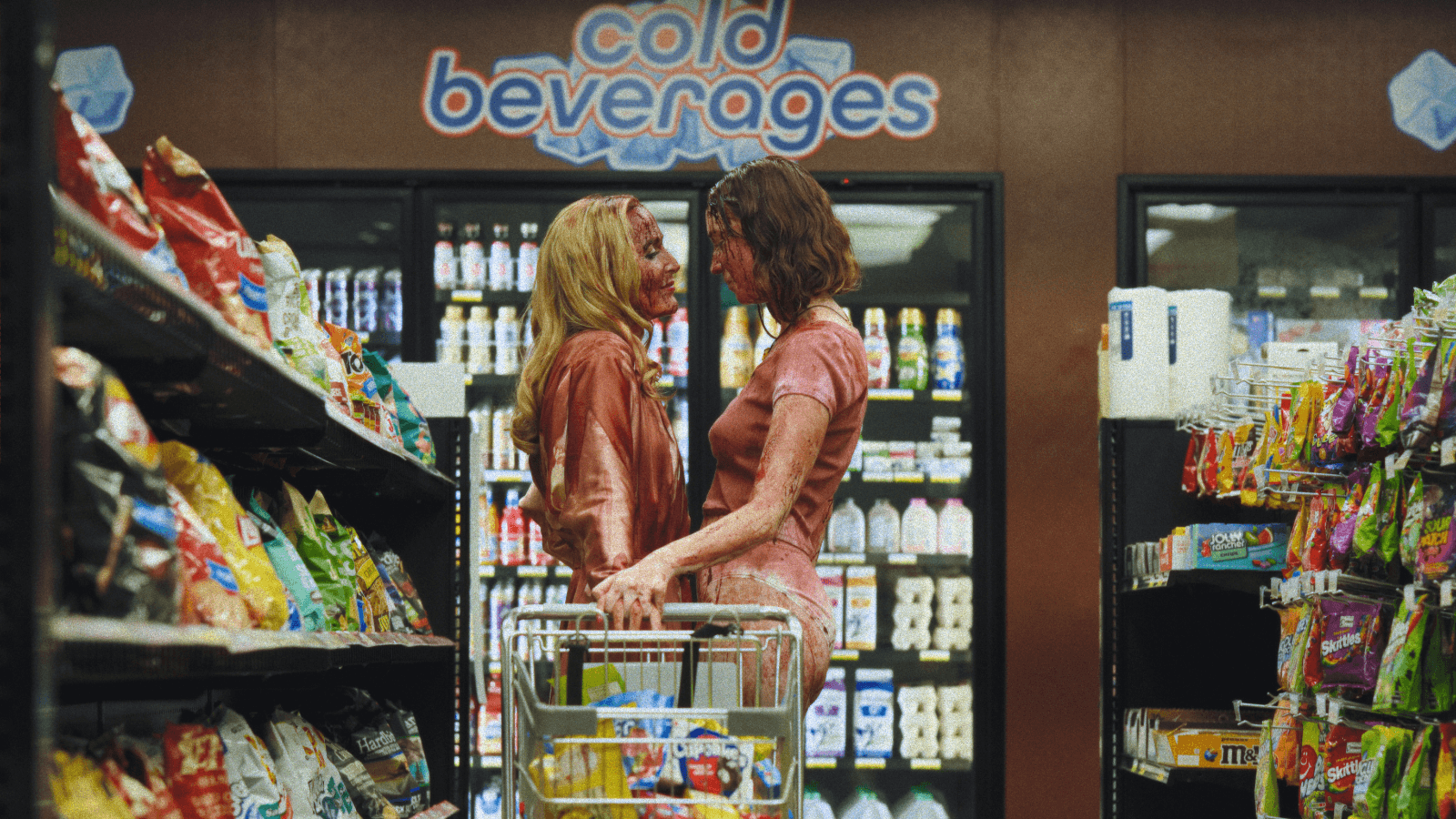
To be sure, the film’s refrain is an apt promotional line from Camp Miasma, one Billy displays on her property: “If it gets too real, you can always turn it off.” Title notwithstanding, Schoenbrun’s film isn’t a horror movie; it’s about sexual introspection and learning to use fantasy to experiment in a healthy way. Both Anderson and Einbinder play their roles terrifically, performing in scenes full of vulnerabilities and defenses that gradually fall away, only to be replaced with self-understanding and a deep affection for one another. Einbinder’s Kris recalls her character from HBO Max’s Hacks (2021–2026) and, while suited for the role, the performer feels somewhat typecast—but no less effective. Anderson, fantastic, is a bolder choice as Billy, whose eerie confidence and dark humor bewitch Kris (and the viewer). Billy learned long ago to welcome Little Death, with all of the associated anxiety, pleasure, uncertainty, and surprise. And when Billy and Kris discover this together, Schoenbrun renders their experience in sexualized horror terms. When Little Death arrives, they are not literally slain, of course, despite the gallons of symbolic blood pouring out of their mouths and wounds, and drenching them from head to toe.
Schoenbrun’s film also takes on the culture clash happening at the movies lately. The influence of Gen Z viewers, some of whom find sex in cinema distracting and unnecessary, has led to a strain of sexless movies and a general decline of nudity and sex in film. But other filmmakers have made bold attempts to remind audiences that sex is part of life, and that, if cinema is meant to reflect who we are, it should occasionally explore sexuality. Films such as Olivia Wilde’s The Invite, Gregg Araki’s I Want Your Sex, and Kate Dolan’s SOULM8TE have open discussions and representations of sex, almost in defiance of this many-layered anti-sex movement. Schoenbrun’s screenplay addresses the debate while weighing how depictions of sex and violence in movies can be individually mind-expanding, even if their sociological meaning proves harmful. The unresolved tensions between these elements serve a purpose, prompting the viewer to parse out what they think and feel about what they’ve seen. One thoughtful image in the film shows Kris as a child, watching Camp Miasma alone in the dark. Atop the TV, a stack of VHS tapes includes multiple-personality films such as Primal Fear (1996) and Identity (2003), as though Kris is searching for an identity in the movies.
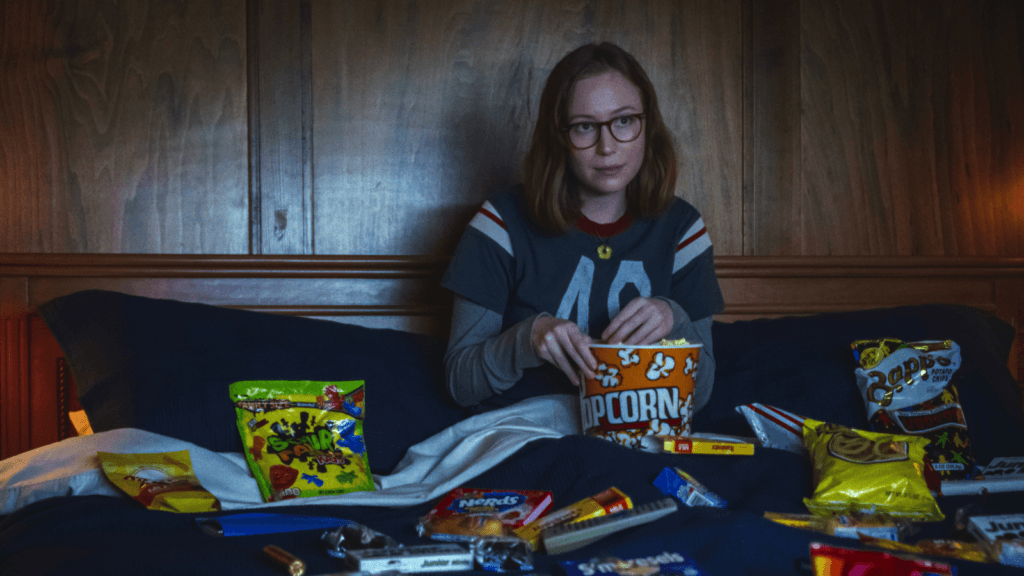
Schoenbrun’s first two films anticipated their own transition with thoughtful stories about finding oneself through media transcendence—a frightening, unnerving process. By contrast, Teenage Sex and Death at Camp Miasma is often hilarious and playful, delighting in its investigation into two of the writer-director’s favorite topics: sex and horror. Schoenbrun is nostalgic for 1980s horror and reclaims aspects of gender and sexuality in those movies that those movies have stigmatized: the omnipresent scantily clad victim or the trans monster trope in films such as Dressed to Kill (1980) and Sleepaway Camp (1983). The director avoids outright condemning them and instead acknowledges the friction, which can be destructive or productive depending on what the viewer takes away from it. Just as feminist film theorists such as Carol J. Clover, who coined the term “final girl” in her seminal book Men, Women, and Chain Saws, argue that the link between sex and violence in slashers could be demeaning or empowering, a horror film can demonize trans people or lead to a queer awakening. Indulgent in the best way, Schoenbrun’s film embraces the messy reality of many horror movies from yesteryear. It’s an idea epitomized by an early image of Kris surrounded by mounds of candy in her hotel room, watching a Camp Miasma sequel that she purchased from a gas-station DVD rack. Kris pours a box of Raisinets into her popcorn, creating her own snack from two others: salty and sweet. For Schoenbrun, that’s what sex and horror movies are all about.
Thank You for Supporting Independent Film Criticism
If the work on DFR has added something meaningful to your love of movies, please consider supporting it.
Here are a few ways to show your support: make a one-time donation, join DFR’s Patreon for access to exclusive writing, or show your support in other ways.
Your contribution helps keep this site running independently. However you choose to support the site, please know that it’s appreciated.
Thank you for reading, and for making this work possible.
Brian Eggert | Critic, Founder
Deep Focus Review