Reader's Choice
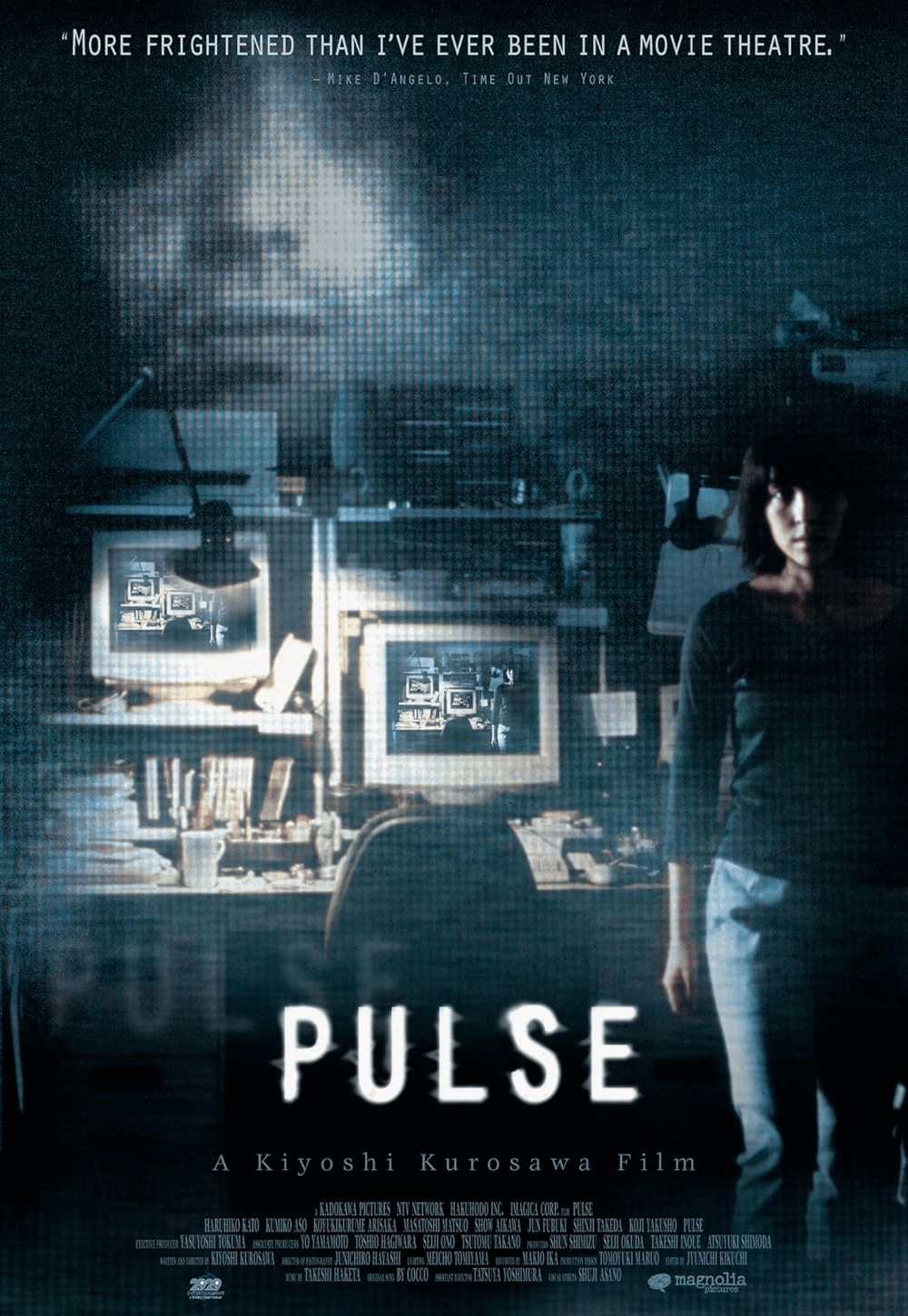
Pulse
By Brian Eggert |
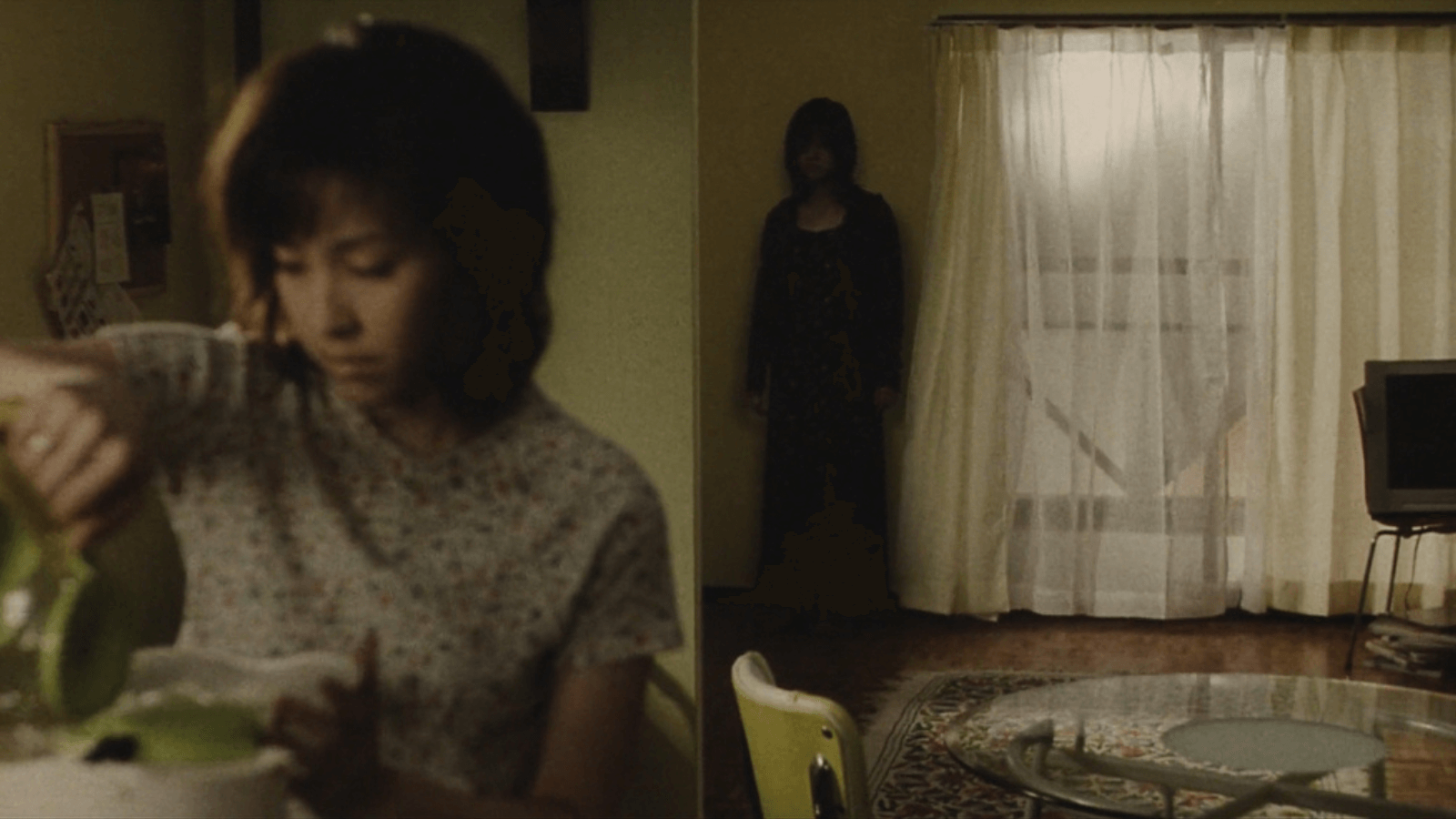
“Something’s definitely not right,” says a character in Pulse. That’s an understatement. This film contains a chilling blend of ghosts, multiple suicides, a computer virus, mass disappearances, and the apocalypse. If the story offers little more than a cursory explanation of how these factors are linked, a brief scene about a student’s screensaver at least hints at how to unlock the film’s central theme: Several white dots move around a black screen. A college student explains, “If the dots get too close, they die. But if they get too far apart, they’re drawn close.” She calls it “a miniature model of our world.” Indeed, people strive to be emotionally available for social connection, yet they often resist engaging with the world, choosing to retreat into a virtual space instead. This internal conflict stems from a contradiction: a desire to associate with others, coupled with an urge to withdraw—a dynamic that suggests the burden of loneliness is overwhelming and unresolvable. “People don’t really connect,” remarks the student. “We all live totally separately. That’s how it seems to me.” Technology only amplifies the problem, leaving people to float through life like ghosts, disconnected from their lives and any real sense of human contact.
Kiyoshi Kurosawa’s Pulse opened in Japan in 2001, coinciding with a J-Horror surge that began in the early 1990s with low-budget productions that became substantial hits, such as Hideo Nakata’s Ringu (The Ring, 1998). But the film does more than adopt J-Horror tropes for a commercial winner; Kurosawa’s metaphysical tale explores how technology, specifically the internet, amplifies “eternal loneliness” and drives humanity toward the end of days. The haunting film explores our troubling relationship with online environments, where individuals sit with eyes fixed on screens, severed from contact with others while yearning to connect. The Japanese master of tone and genre considers the overwhelming alienation that technology spreads and how it seizes control over the user. It’s easy to believe that we command the devices on our desks and in our pockets, and not the other way around. And yet, most of us remain beholden to these gizmos and feel their irresistible pull, even though they leave us feeling empty and alone afterward. Technology promises to improve our lives and facilitate our human need to connect with others, but the outcome is often the opposite of what we hoped.
Pulse emerged in the internet’s relative infancy, before the general public grasped either its potential or its downfalls. Films such as The Net and Hackers (both from 1995) imagined, with little interest in technological realism, how the internet might be weaponized. Kurosawa’s film preys on the viewer’s association with cyberspace as a realm of the unknown, where anything can and does happen. His interest lies in the relationship between people and technology through simultaneous and somewhat nebulous narratives. One involves ghosts that begin to appear more frequently in the world because the afterlife, wherever that may be, has run out of space. The other entails a mysterious website that appears on computers at random, infecting users with a compulsion to withdraw from society before they finally commit suicide and disappear into a realm between cyberspace and the spirit world. Articulating how these two ideas connect or overlap may be impossible, but that’s by design. Pulse is all the more unnerving for its intended narrative ambiguities.
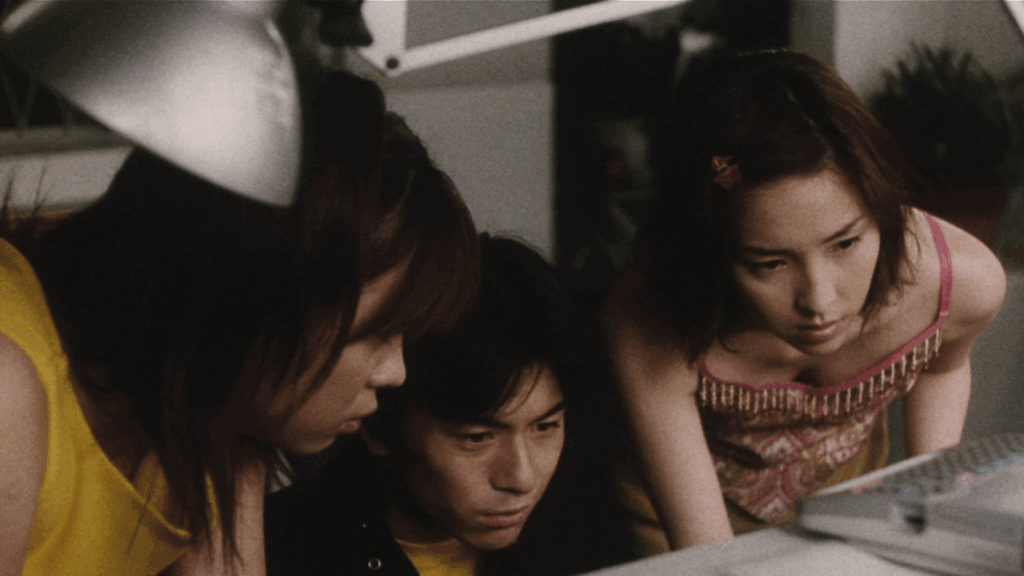
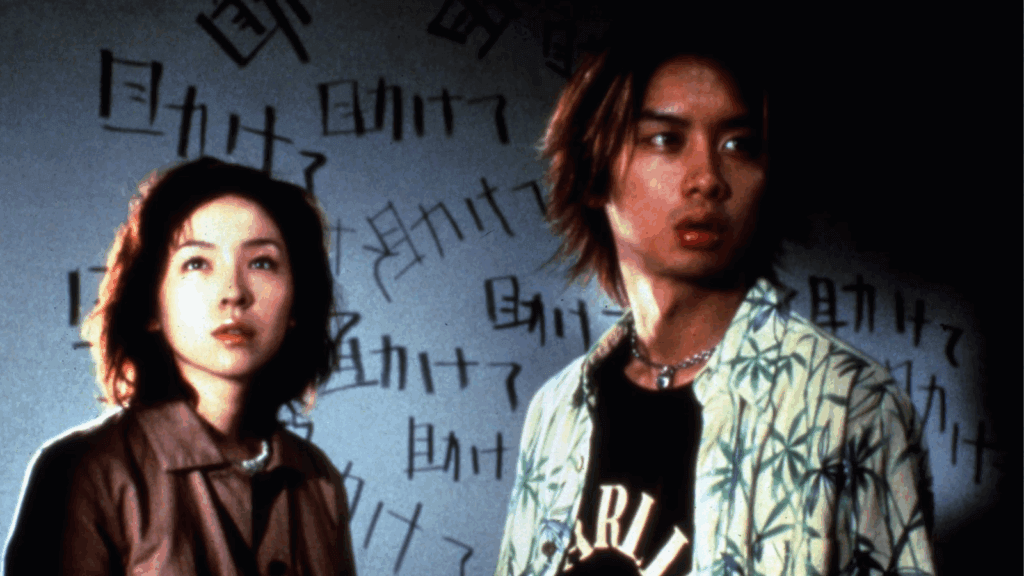
Kurosawa doesn’t tie these threads together into a neat bow. Instead, they flail about like the stringy black hair on the film’s typical-looking J-Horror ghosts, reaching for something to cling to but also nothing in particular. One story follows Michi (Kumiko Aso), who works alongside several others on a rooftop nursery in Tokyo. Gradually, each of her coworkers goes missing, compelled to suicide by some ghostly presence on their computer, after which the only evidence of their death is a black splotch where their corpse had been. Haunted by calls from her missing or dead coworkers’ digitized voices, begging “Help me” in a flat, scrambled sound, Michi plans to leave the city. At the same time, college student Ryosuke (Haruhiko Kato) signs onto the internet (on a service provider disc called “ur@nus,” complete with maddeningly long terms and conditions that he clicks without reading, because some things never change). While online, Ryosuke sees a website featuring strange, supernatural imagery of isolated people in dark rooms, with “Help Me” written on the walls. “Would you like to meet a ghost?” a voice from the computer asks. Terrified, Ryosuke quickly switches the machine off. Later, he seeks advice from a computer science student, Harue (Koyuki), who helps him investigate the site. Together, they draw a connection between the web page and a string of disappearances around Japan.
Despite its narrative obscurity, what’s unmistakable about Pulse is Kurosawa’s refusal to offer unequivocal answers to the questions he raises. The narrative and specific plot details defy universal interpretation, even more so than most Kurosawa features. He provides no clarity about the origins of his ghosts and the computer virus, nor about the meaning of “The Forbidden Room” and its protective red tape—a place where people go after they have seen things online they cannot unsee. The story structure might even be described as abstract or Lynchian, given its dreamlike imagery and underdeveloped bookend scenes set on a boat. However, the power of Kurosawa’s frightening images remains undeniably disturbing. Even an early question about the potentially vast number of ghosts—“How many ghosts have existed since prehistoric times?”—and the notion of a “finite capacity” to the afterlife implants a horrifying concept. It recalls a line from George A. Romero’s Dawn of the Dead (1978) that also appeared on the film’s poster: “When there’s no more room in hell, the dead will walk the earth.” Yet, ghosts aren’t the primary threat. Rather, the danger lies in technology turning people into veritable ghosts. As Harue remarks, “Ghosts and people are the same.”
Although he had dabbled in horror and supernatural tales before this, Kurosawa told scholar Mitsuyo Wada-Marciano that he considers Pulse the only one of his films that was actually produced with a conscious intent to jump on the J-Horror bandwagon of the time. Popular for their low-fi presentation of jarring visuals—with examples from Norio Tsuruta’s Scary True Stories series to Takashi Shimizu’s Ju-On (The Grudge, 2002) and its many offshoots—J-Horror movies of this era focused on wronged ghosts and curses that spring from trauma. These forces appear as personified figures with pale skin and dark hair, often draped downward to cover the vacant or wildly exaggerated eyes. They move with jumpy, jittery motions and make unearthly sounds. Juxtaposing supernatural elements with a flat, untextured video look became a formal hallmark of the subgenre. Eventually, the content of such films mirrored their aesthetics. This is evidenced in Ringu, about a VHS tape cursed with the malignant spirit of a wronged girl that, when watched, leaves the viewer with seven days to live. Its mise-en-scène often takes on the appearance of a scratchy tape that’s been recorded and re-recorded.
Kurosawa’s filmmaking proves just as elusive as his story, but it aligns with Pulse’s themes. Many J-Horror films of this period at the turn of the century introduced digital editing techniques that reflected their discussion about our relationship with newer forms of media. This appealed to younger generations of this era, who connected with the material because they had already adopted the requisite technology (home video, computers, video games, the internet, etc.) into their everyday lives. J-Horror filmmaking choices echoed the look and feel of this tech. A similar dynamic of technology informing how films are made is evident in recent “desktop horror” films, such as the Unfriended movies or Host (2020), where the action unfolds entirely on a character’s computer and dictates the aesthetic. Elsewhere, films such as Cam (2018) and Spree (2020) recreate live-streamed or social media experiences. In Pulse’s case, the film opens with the distinct sound of a dial-up connection, which, in the age of WiFi, immediately evokes nostalgia for a specific time. Kurosawa and editor Junichi Kikuchi also present glitchy sequences that portray reality as though it were filtered through a digital medium, resulting in a skipping effect with jump cuts and patchy movements.
Unlike the lo-fi work of many of Kurosawa’s contemporaries, however, his production boasts some compelling imagery that continues to haunt. Kurosawa and cinematographer Jun’ichirô Hayashi move the camera as if it were a ghost roving about, trying to gain perspective on a situation. Some shots are more unmistakably captured from a ghost’s point of view. The eerie figures walk in slow motion, flickering like so many J-Horror ghosts, but in a way that suggests they’re somehow inextricably linked to the technology they inhabit. Sometimes, Kurosawa drops all sound from a shot with a ghost, and it is, appropriately enough, disquieting. Subtle VFX render ghosts as unfocused blobs or fuzzy black shadows, with an indiscernible level of blackness that feels otherworldly. Kurosawa replaces the subgenre’s typical jump scares and ghosts that leap at the screen with long, brooding shots that evoke a sense of dread—techniques that would later inform iterations of online horror fiction, known as creepypasta. Some of Pulse’s effects have not aged well, such as the fiery plane that crashes into a building. But one scene features a woman stepping off a ledge and falling to her death, and it’s dreadfully convincing.
Pulse comes alive not during the two-hour runtime but in the hours, days, and weeks that follow a screening, when the viewer cannot shake its imagery or ideas, regardless of the confounding plot. At several points, characters ride a bus, and Kurosawa executes the shot using the same rear-projected image—similar to a strategy he deployed in Cure (1997) and the end of Cloud (2025)—where the pointed unreality of the background adds to the film’s overall surreal atmosphere. To be sure, much of Pulse unfolds with the slow-burning pace and quiet tone of a dream, simultaneously haunting the viewer and lulling them into a half-conscious, almost mesmeric state. The viewer watches entranced, unable to piece together a fully formed plot; they might even forgive themselves for dozing off if it weren’t for the nightmares the film might spread through the unconscious mind. Whatever the film lacks in conventional storytelling structure, it welcomes the viewer into a twilight zone, where one’s loneliness and dissatisfaction with life inevitably lead to questions about ghosts, death, and suicide—forces that, with enough searching, just might answer.
(Note: This review was commissioned by Dave and posted on Patreon on August 2, 2025. Many thanks to Dave for suggesting one of Kiyoshi Kurosawa’s most popular and complex films.)
Bibliography:
Brown, Steven T. Tokyo Cyberpunk: Posthumanism in Japanese Visual Culture. Palgrave Macmillan, 2010.
Wada-Marciano, Mitsuyo. “J-Horror: New Media’s Impact on Contemporary Japanese Horror Cinema.” Canadian Journal of Film Studies, vol. 16, no. 2, 2007, pp. 23–48. JSTOR, http://www.jstor.org/stable/24408470. Accessed 30 July 2025.
White, Jerry. The Films of Kiyoshi Kurosawa: Master of Fear. Stone Bridge Press, 2009.
Thank You for Supporting Independent Film Criticism
If the work on DFR has added something meaningful to your love of movies, please consider supporting it.
Here are a few ways to show your support: make a one-time donation, join DFR’s Patreon for access to exclusive writing, or show your support in other ways.
Your contribution helps keep this site running independently. However you choose to support the site, please know that it’s appreciated.
Thank you for reading, and for making this work possible.
Brian Eggert | Critic, Founder
Deep Focus Review