Musk
By Brian Eggert |
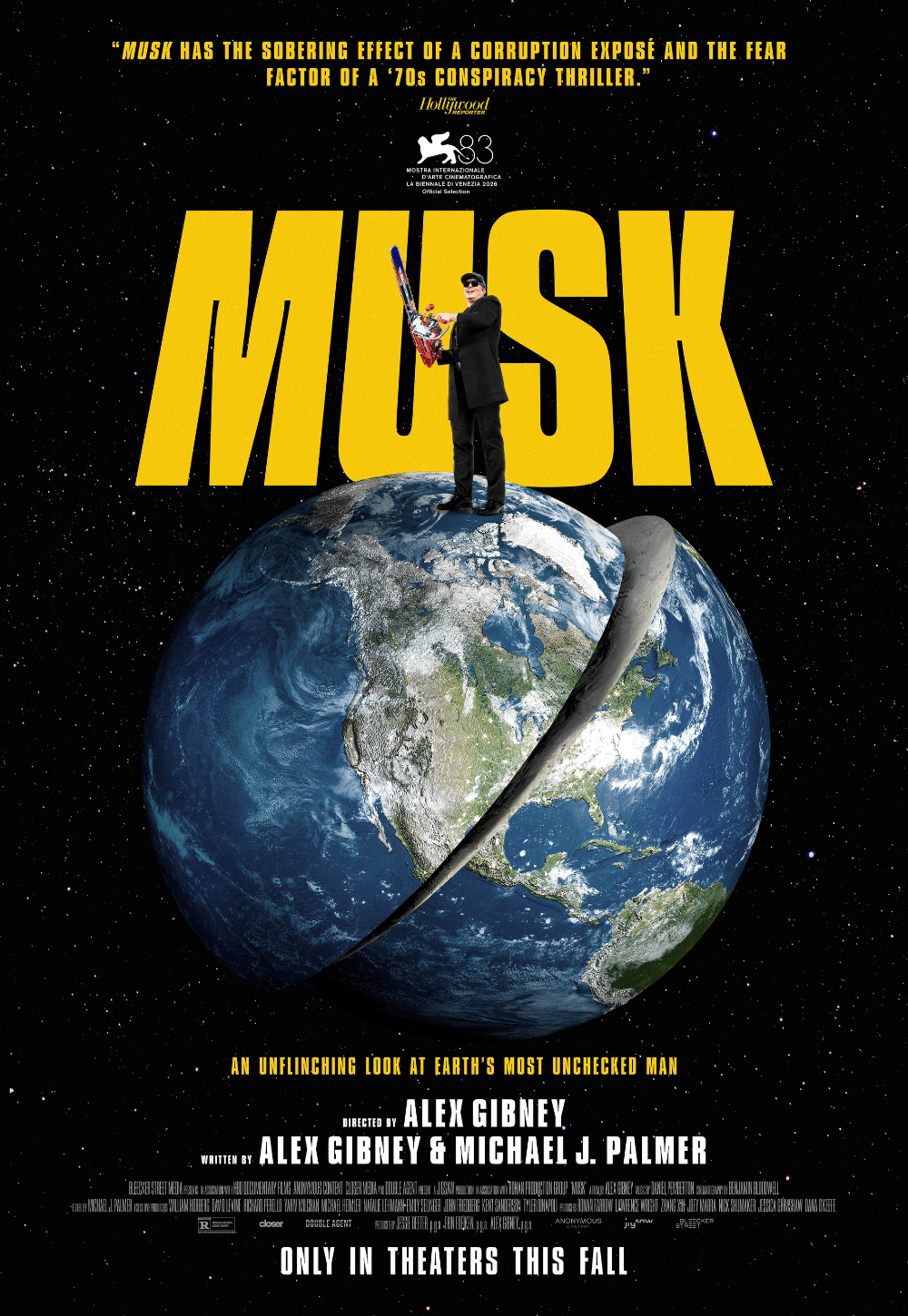
An alternate title for Alex Gibney’s new documentary about Elon Musk could be X instead of Musk. The richest man in the world has a thing about branding his businesses and even his child with what he apparently believes is the coolest letter, symbolizing the unknown in an equation. Early in his career, he helped found X.com, an online banking service that later became PayPal. He takes credit for founding SpaceX, which started in private space travel and now includes telecommunications and artificial intelligence. Of course, when he purchased Twitter, he renamed it X, much to the annoyance of everyone who now must say “X, formerly Twitter.” Musk even had a kid with the musician Grimes named X Æ A-Xii, whom he calls “X” for short, because, as the boy’s father admits, he’s the favorite among Musk’s “legion” of untold children. While searching for the X-factor that drives his subject, Gibney finds that Musk has few creative ideas of his own; he’s more concerned with selling himself than with actual follow-through. Gibney’s incisive doc explores Musk’s rise from a slippery, egomaniacal Silicon Valley entrepreneur to a political bankroll for Donald Trump. After the four-hour watch, you cannot help but feel uneasy about Musk’s power and influence over the world.
For the last twenty years, Gibney has made documentaries about people, corporations, and phenomena that represent corrupt and even dangerous power structures. He detailed the insider trading, fraud, and embezzlement that led to the downfall of a major energy corporation in Enron: The Smartest Guys in the Room (2005). He exposed the unsettling, culty aspects of Scientology with Going Clear: Scientology and the Prison of Belief (2015). In Citizen K (2019), he examined how Russian oligarch Mikhail Khodorkovsky influenced post-Soviet politics. More recently, with The Inventor: Out for Blood in Silicon Valley (2019), Gibney uncovered the story behind convicted felon Elizabeth Holmes and her bogus medical company Theranos. Given his past interests, Gibney’s making Musk seems only natural. The film reveals Elon Musk to be a compendium of the director’s earlier subjects: Musk is no stranger to dubious business practices; he has a devoted following that fuels his god complex; he has successfully infiltrated the political realm; and he often makes promises he doesn’t deliver on.
Keeping up with Musk’s antics over time is difficult, but Gibney condenses his unthinkable impact on the world into an essential film with disturbing implications. Gibney opens by admitting that, like me, he once admired Musk’s daring and ability to get things done. “He inspired people because he didn’t play by the rules,” says Gibney. Musk built electric cars with Tesla, invested in solar energy, and launched private rockets into space. Gibney saw him as a “climate savior who wants to go to Mars.” But after Musk’s turn to right-wing politics during the COVID-19 pandemic, followed by a reckless venture into American government with DOGE, Gibney sets out to answer a question: “How could Musk assume so much power, and why did we give it to him?” Predictably, Musk refused to participate in Gibney’s project; however, the filmmaker spoke with former colleagues and romantic partners. He also does something unique: he creates a massive database of everything Musk has ever said, then uses an AI-generated simulation of Musk that speaks only in actual quotes for what Gibney calls a “video-game documentary” interview.
Video games are central to Musk, surprisingly. Early on, Gibney delves into Musk’s belief in Simulation Theory: the concept that we’re all living in a simulation indistinguishable from reality, à la The Matrix (1999). The self-obsessed Musk—who once claimed empathy would be “suicidal” for humans—behaves like a sociopath and sees himself as humanity’s savior. He’s willing to sacrifice untold numbers as collateral damage to ensure the species’ continuation. Gibney considers the dangers of a man who sees himself as the sole player in a video game, while the rest of us are NPCs. It means nothing to him to terminate thousands of jobs at Twitter or various government agencies—not if it reinforces his government ties and eliminates roles and whole departments that targeted him in the past. That lack of empathy means, for instance, Musk is unaffected by the fact that an estimated 14 million people will die, with 4 million of them being small children, because DOGE canceled funding for USAID.
Gibney charts a pattern of oversold bullshit and lies that has sustained Musk from one lucrative deal to the next. Like Holmes and Jobs before him, Musk has manufactured the persona of an engineer-magician—not only the head of his enterprises, but the technology’s inventor. But Gibney discovers he’s little more than “a skilled inventor of his own value” who takes credit for work he didn’t do. The most staggering instance occurs after the death of his first child with his ex-wife Justine. He claims he was holding their baby in her last moments, but Justine was. Justine says she “learned the term ‘gaslighting’ from my relationship.” From declaring himself the “alpha” in his relationships to his plan to spread his seed like Genghis Khan (with the help of female “breeders”), Musk sees himself as an Übermensch. He sees it as a personal responsibility to “Occupy Mars,” however unlikely, to ensure humankind survives itself. Everyone in his romantic and professional partnerships must worship at the altar of Elon, or they become an enemy, and anything that doesn’t reinforce his mission is deemed morally wrong.
The doc provides a fascinating, can’t-look-away watch that explores various chapters in Musk’s life to understand his agenda, including his deeply racist upbringing in South Africa, cover-up of Tesla autopilot failures, influence over military conflicts with Starlink, claim that his very much alive trans child died from the “woke mind virus,” political investment in the second Trump campaign (because he probably would have gone to jail if Kamala Harris won), role in likely rigging US elections, and integration of his AI platform Grok (which once declared itself MechaHitler) with the so-called Department of War. It paints him as yet another in a long line of Silicon Valley’s billionaire snake-oil salesmen; he keeps promising to go to Mars or, quite stupidly, make a “historically accurate” version of Christopher Nolan’s The Odyssey with Grok, but he doesn’t deliver. Gibney blends his taped interviews and archival footage with his production’s AI version of Musk, which comes straight from the Uncanny Valley with real, mostly unnerving quotes, spoken by a simulation that’s just as hollow, awkward, and creepy as the man himself.
Most effective is Gibney’s inclusion of animated sequences designed to look like a first-person-shooter video game from Musk’s point of view, capturing Musk’s worldview that he’s “Ready Player One” in a game with no other players, only obstacles to overcome, enemies to zap, and billions in cheat codes to get what he wants. In his patient, even-tempered style, Gibney builds a convincing argument that Musk makes shit up as he goes—he’ll say or do anything to secure the adulation and success he wants. Beneath his false front, Musk’s most troubling qualities are his incomparable power and his narcissism, which amplify his worldview. At one point, an interviewer asks why Musk wants the world to have a “collective consciousness.” Musk struggles to articulate his reasons in an embarrassing moment, but one suspects he wants the world to reflect him—it’s his world, after all.
Musk thinks he can play it fast and loose with AI, politics, and even war, because if humanity ends, it doesn’t matter. It’s all just a simulation anyway, right? The implications of Musk are almost unfathomable, yet the film is essential for everyone to see, preferably before voting in the 2026 midterm elections. Gibney hasn’t hidden his desire for audiences to see his film before the elections. Given that, perhaps he should have negotiated for his film to be available on a streaming platform by the time voting begins, since most unconverted, ticket-buying moviegoers may find the prospect of a four-hour exposé a hard sell. But as his own film demonstrates, Gibney’s effort may be too little, too late. By the end, Gibney leaves us with an unshakable feeling that—because Musk can buy or otherwise rig an election, and because he’s so thoroughly embedded in our politics, technology, and infrastructure—we’re already cooked.
Thank You for Supporting Independent Film Criticism
If the work on DFR has added something meaningful to your love of movies, please consider supporting it.
Here are a few ways to show your support: make a one-time donation, join DFR’s Patreon for access to exclusive writing, or show your support in other ways.
Your contribution helps keep this site running independently. However you choose to support the site, please know that it’s appreciated.
Thank you for reading, and for making this work possible.
Brian Eggert | Critic, Founder
Deep Focus Review