The Odyssey
By Brian Eggert |
Christopher Nolan’s The Odyssey is an epic worthy of that name. Great artists from James Joyce to Stanley Kubrick have evoked Homer’s enduring poem, drawing on the text’s episodic storyline and existential searching. Nolan’s adaptation is just as grand in scope and ambition. The film cost $250 million, runs nearly three hours, and boasts an absorbing IMAX presentation that demands to be seen on the biggest screen available. While igniting widespread awareness and enthusiasm about shooting on celluloid and exhibiting in 70mm, the director’s impressive showmanship is matched only by his film’s thematic dimensions. He reaches far deeper than the typical sword-and-sandals fare, usually revolving around men who seek glory or fulfill their duties on the battlefield, while wives and mothers wait for their husbands and sons to return home. Nolan revitalizes Homer for a modern audience, deploying a sophisticated and richly considered structure that feels more like the filmmaker weaving a tapestry than unrolling a narrative. And while it’s easy to be skeptical of a film that has dominated the cultural conversation for a solid year since ticket presales first started selling out theaters, believe the hype. The Odyssey is a masterpiece, with enough ideas and emotion to uphold the sheer scale of Nolan’s incredible technical achievement.
The Odyssey isn’t another peplum film drained of life by blind obedience to the genre’s traditions. Although cinema has always featured historical epics going back to the silent era, the genre reached its zenith in the late 1950s to mid-1960s, when major Hollywood studios and film industries from other countries, Italy in particular, released dozens of movies based on Homer’s epic poems, various Greco-Roman mythologies, and major historical events. The genre made a brief comeback at the beginning of this century, launched by Ridley Scott’s Oscar-winning Gladiator (2000). Several copycat productions followed, such as Wolfgang Petersen’s Troy (2004), which depicted the Trojan War, albeit without Homer’s interest in how the gods manipulated the game board. Troy is characteristic of many 2000s-era epics, telling the same old story in the same old way: British accents, expensive costumes, brightly lit scenes, sweeping battles, and lofty speeches. Petersen’s by-the-numbers period drama somehow renders every potentially striking facet, including its star-studded ensemble, exceedingly dull.
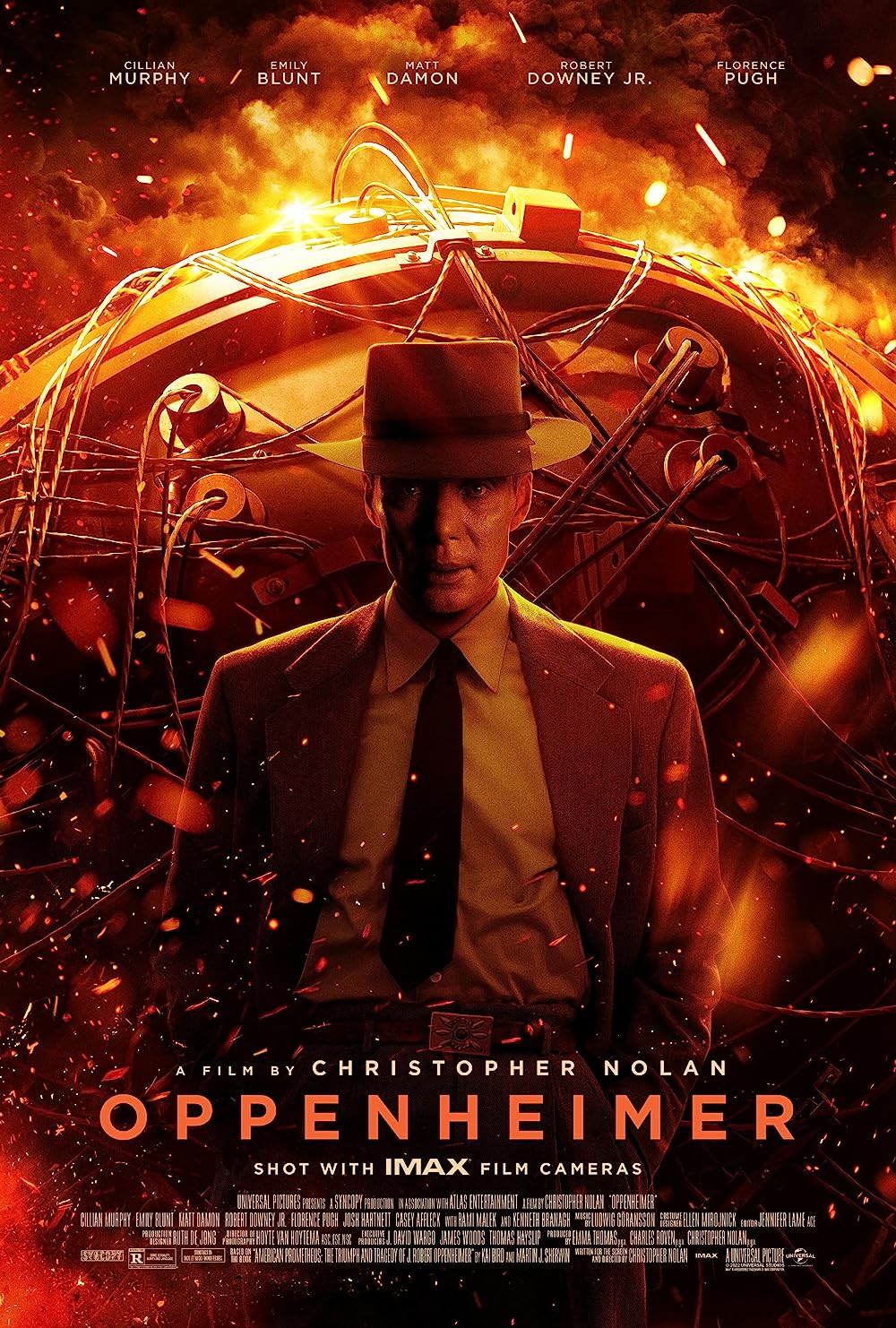
Nolan’s approach brings new life to the familiar story, delivering The Odyssey with a postmodern structure that’s both linear and nonlinear in inspired ways. Alongside editor Jennifer Lame, Nolan arranges scenes in a way that borders on impressionistic, leaping between several points in time over the first half-hour. Nolan and Lame employed a similar technique on Oppenheimer (2023), but Nolan has been experimenting with this discontinuous narrative shape since his earliest work. For instance, Memento (2000), Batman Begins (2005), and The Prestige (2006) each fluidly blend their timelines into an irregular linearity. The effect can be discombobulating at first, as the viewer must unconsciously arrange the events in order. But with Nolan’s temporal obsessions at work, he forces the viewer to pay closer attention. Even those in the audience who have read the epic poem or seen any number of the earlier adaptations—the Kirk Douglas starrer Ulysses (1954), the Coen brothers’ O Brother, Where Art Thou? (2000), or the 1997 television miniseries The Odyssey—will feel a sense of discovery given Nolan’s thoughtful sequencing of narrative threads.
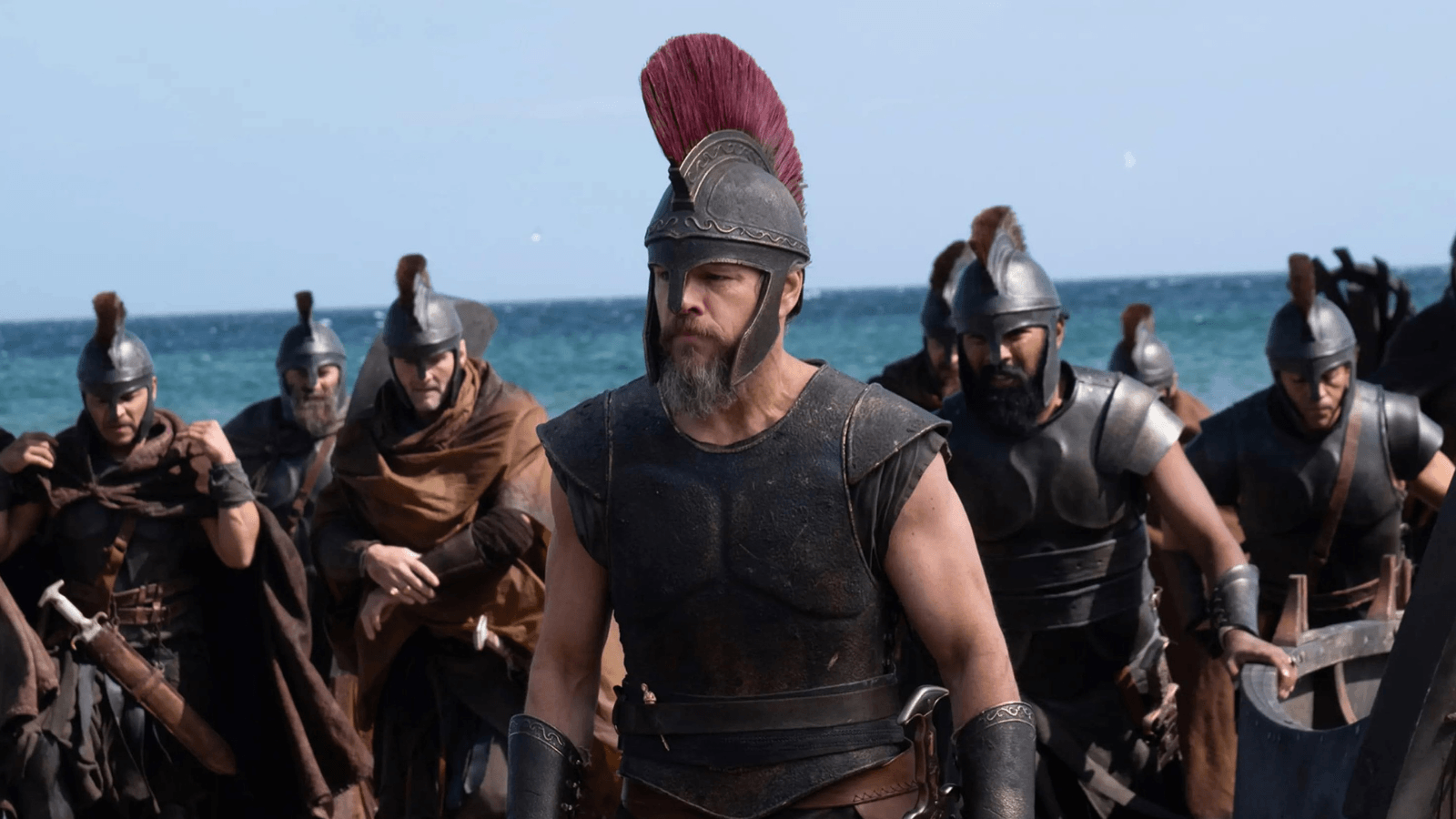
Nolan circulates the narrative, disseminating fragments across three timelines. In one, eight years have passed since King Agamemnon (Bennie Safdie) of Mycenae claimed victory over Troy, aided by Odysseus (Matt Damon), the king of Ithaca. After spending ten years on a Trojan beach, Odysseus devised the legendary hollow wooden horse that carried soldiers inside Troy’s impenetrable walls and enabled their victory. After, Odysseus leads his men home through unknown waters, wanting to take a route different from Agamemnon’s. They become lost along the way. In another timeline, a much older Odysseus recounts his war years and postwar adventures to Calypso (Charlize Theron), a mysterious woman who has kept the amnesic warrior on her island for years. And finally, at home in Ithaca, Odysseus’ wife Penelope (Anne Hathaway) waits for her husband’s return. Her castle hall has filled with rapacious suitors, headed by the devious sleazeball Antinous (Robert Pattinson) and his aggressive cohort Polybus (Corey Hawkins), who hope she will accept that Odysseus is dead and remarry one of them. Penelope’s son, Telemachus (Tom Holland), who has no memory of his father, searches for a way to protect her. He plans to seek out news of Odysseus’ return from Menelaus (Jon Bernthal), the Spartan king whose wife, Helen (Lupita Nyong’o), had a face that launched a thousand ships. Now her eye and cheek are scarred, presumably by Menelaus as a punishment for running off with Paris, and she remains a veritable prisoner.
Besides establishing timelines, Nolan nods to the fact that Homer’s Iliad and Odyssey (Homer was the original “drop the ‘The’” guy) were initially passed down in the oral tradition by rhapsodists to a largely illiterate audience. Rapper Travis Scott appears as a bard amid Penelope’s suitors at court in Ithaca, spinning a yarn about the Trojan War. Storytelling also plays a role when Telemachus learns from Menelaus’ account that his father conceived the Trojan horse, prompting a flashback sequence. And in the most sweeping of these framing devices, Odysseus recounts to Calypso his journey from Troy to several mysterious islands, where his crew encounters Polyphemus, a gigantic cyclops and son of Poseidon; a race of enormous, armored warriors; and the tentacled beast Scylla. Eventually, a storm washes him up on the beaches where Calypso found him. It’s there that he processes his wartime regrets, effectively self-medicating his PTSD by eating lotus flowers to relieve himself of the mental anguish and willfully forget. He’s not yet ready to confront his past or his desire to return home. Though Calypso loves him and yearns for him to stay, she knows he will remember eventually. Once Odysseus decides to leave Calypso, the story charges into its final act. Nolan sets aside his temporal puzzlework, following the straight line of Odysseus’s homecoming and his bloody reckoning with the suitors.
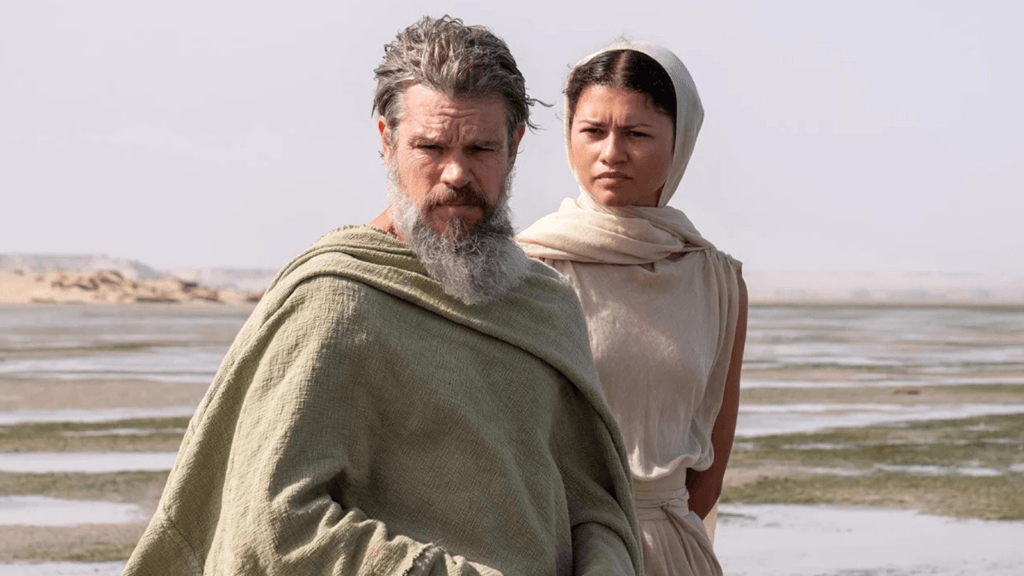
Nolan modernizes his characters with contemporary-sounding dialogue and performances that straddle the expanse between the past and present. With the cast delivering their lines in American accents—rather than the lofty, classical British tongue heard in most traditional productions—their characters feel relatable without becoming outright anachronisms. Damon, of course, shows his range as the weary and lost king, who will travel to hell and back to return to Penelope, even as he weighs his guilt over what occurred in Troy. The actor’s turn in the famous Sirens chapter, where Odysseus hears “the song of all the promises [he] failed to keep,” is devastating. Though her character has the least to do, Hathaway’s raw performance as a prisoner in her own castle, trapped by patriarchal traditions, resonates with her unwavering love for her husband. When they’re reunited, it’s among the most moving moments Nolan has ever directed. The supporting cast consists of a staggering array of skilled actors, making every role memorable. Pattinson is weaselly, disappearing into his detestable schemer role. John Leguizamo has a small but significant part as Eumaeus, a blind servant whom Odysseus left in Ithaca to look after his family and devoted hunting dog, Argos. Himesh Patel also makes the most of Eurylochus, Odysseus’ second-in-command, who’s often critical or baffled by his orders. Zendaya appears to Odysseus as Athena, the goddess who haunts him like a ghost—in this “Time of Apparent Magic,” Nolan portrays how the gods and sacrifices to them play an unmistakable role in our hero’s fate.
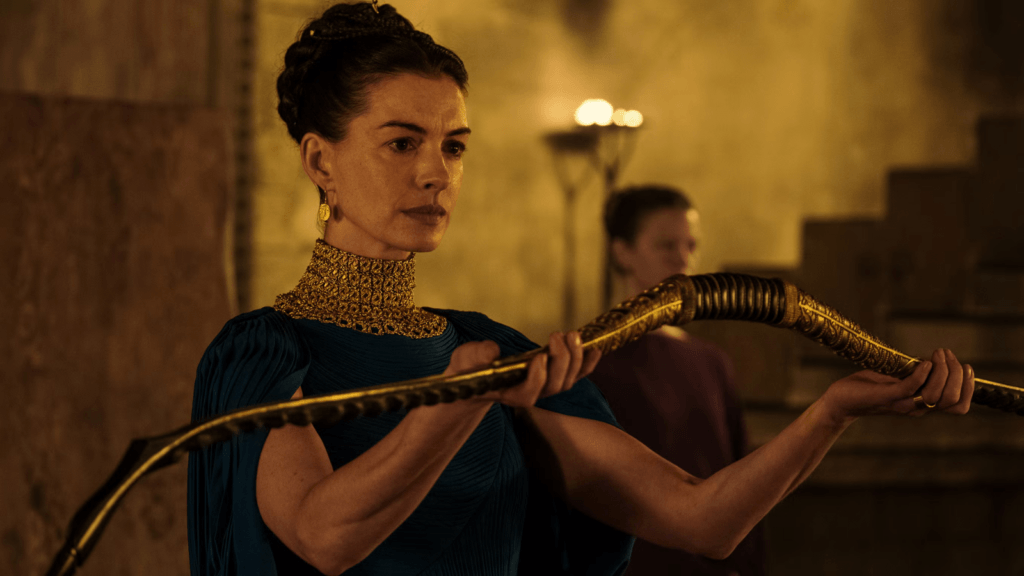
Nolan creates a harmony between the timeless story and his modern sensibilities, resulting in a dynamic that enriches and updates the material. He holds no dogged allegiance to the source material, evidenced by his omissions from the text, colorblind casting, Ellen Mirojnick’s stunning costumes, and the deprioritization of period-appropriate accuracy. This is, after all, a fantasy, not a historical document. The remarkable magnitude and beauty of Nolan’s production are breathtaking, and every technical choice feels aligned with Nolan’s postmodern agenda, as opposed to the predictable Hollywood standards established by less daring filmmakers. Just as Ludwig Göransson’s score imbues each sequence with an aural gravitas, it also sounds downright surreal during Odysseus’ journey into Hades—a sequence unnerving in its simplicity. The sound design quakes the theater seats and reverberates through the viewer’s body, above all during a close encounter with a cyclops. The creature is a sight worthy of Francisco de Goya’s Saturn Devouring His Son and cries out in layered, almost metallic sounds, courtesy of Nolan’s regular sound designer Richard King. Much of the atmospheric lighting in cinematographer Hoyte van Hoytema’s immersive IMAX frame looks natural, albeit color-timed in firelight amber and Nolan’s beloved shades of blue.
But if there’s a single sequence that lingers more than the others, it’s when Odysseus’ men visit Circe (Samantha Morton), a witch who, convinced men are more naturally pigs, bewitches them. Then, like a potter, she molds their flesh into that of swine. The way Nolan portrays her magic is an unforgettable, grotesque detour into body horror, recalling Guillermo del Toro’s work in his blend of practical and digital effects. However, Morton’s haunting interlude illustrates how Nolan is interested less in a simple retelling of the legend than in locating the germane ideas and relating them to our world. Consider who he cast: Morton is famous for speaking out against Harvey Weinstein before many others, and since #MeToo, she has continued to raise awareness about the entertainment industry’s complicity in sexual abuse. Nolan draws on this, casting her as a wronged woman who takes preemptive revenge and believes all men intend to rape and pillage. Odysseus understands her; he has seen as much in Troy. And in Homer’s text, Odysseus orders raids on villages so his men can steal women and provisions (he also spends a year as Circe’s lover). But Nolan reframes these ancient events to safeguard the hero’s integrity for a modern audience. In doing so, he interrogates the era’s hardships for women, the psychological toll of PTSD, and the erosion of civilization by human hubris. This threat of collapse hangs over the film’s world, with characters dreading a mysterious “people from the sea” who herald the end of Greek civilization.
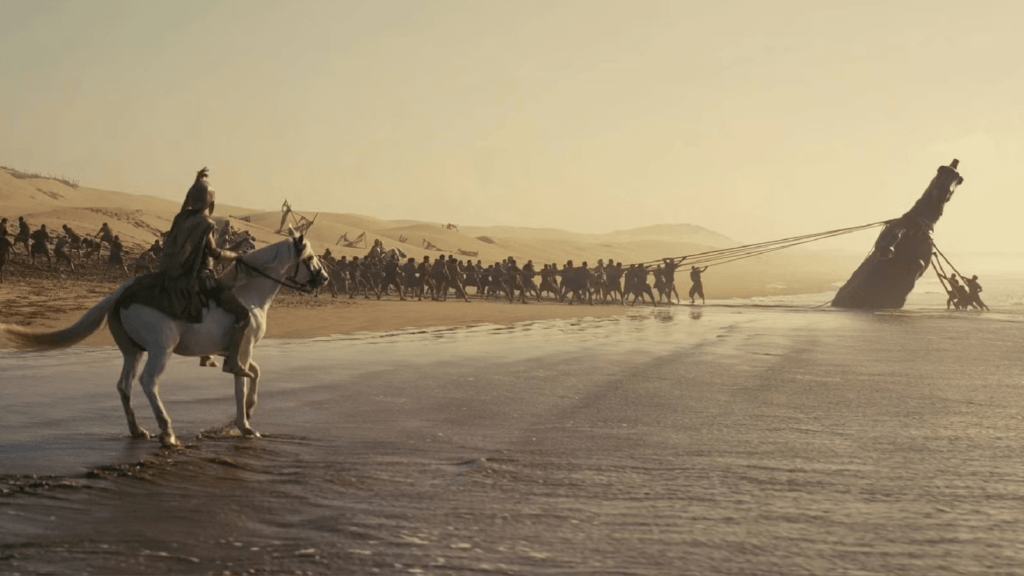
At The Odyssey’s center is Zeus’ Law, which requires people to treat others as they would be treated. In Ancient Greece, hosts were required to welcome and feed visiting strangers. (Despite his shenanigans on Mount Olympus and on Earth, Zeus was also the Greek god of hospitality.) Hosts and guests alike were expected to be gracious and accommodating. To break the sacred code is to welcome the wrath of the gods, who were believed to test humanity’s compliance by disguising themselves as nomads and vagrants asking for food and shelter. This mandate fostered healthy social exchanges and buttressed a civilized culture. However, much of the film’s conflict arises out of characters who break this Law, from Penelope’s suitors overstaying their welcome to Circe deceiving her guests. Odysseus, too, exploited the custom, predicting that unsuspecting Trojans would bring a gift inside their walls. Nolan highlights the claustrophobia of hiding inside the wooden decoy left on the shore. By forcing the Trojans to drag rather than wheel the massive structure inside, he offers a clever, more plausible variation on the legend. More than anyone else, Odysseus is troubled by his deception and the breaking of Zeus’ Law. How fitting, then, that Nolan opens and closes his film with images of the Trojan Horse and Troy, the physical totem and location of Odysseus’ crime.
Nolan argues that once people stop treating each other with generosity and dignity, civilization crumbles. It’s a powerful concept for our xenophobic, intolerant climate, and Nolan’s message proves just as timeless yet modern as his entire production. The Odyssey frames the campaign in Troy as the beginning of the end. It was an unnecessary war, fought, on the surface, for love. Underneath, the motivations were far more corrupt and about ownership, anticipating the grim fate of Greek kingdoms at the hands of a mysterious, seafaring people—a self-fulfilling prophecy of sorts. If some scenes register as familiar given how many iterations have been depicted in paintings, literature, films, and television, Nolan’s interpretation reinvigorates them in a stunning work, his best and most affecting film in over a decade. Although released during the summer blockbuster season, it’s rare that moviegoers ever see an epic so smartly conceived and executed. Few living directors can balance this level of human drama, social commentary, and cinematic bravura with such monumental vision. True to its name, The Odyssey is one for the ages.
Thank You for Supporting Independent Film Criticism
If the work on DFR has added something meaningful to your love of movies, please consider supporting it.
Here are a few ways to show your support: make a one-time donation, join DFR’s Patreon for access to exclusive writing, or show your support in other ways.
Your contribution helps keep this site running independently. However you choose to support the site, please know that it’s appreciated.
Thank you for reading, and for making this work possible.
Brian Eggert | Critic, Founder
Deep Focus Review