Masters of the Universe
By Brian Eggert |
There’s a photo of me (below) from the mid-1980s, when I was around age 5, standing on the hood of an old Plymouth in the overgrown field behind my childhood home. I’m holding He-Man’s shield in one hand and his sword, made of yellow plastic, in the other. (Unrelatedly, I’m also wearing an Incredible Hulk shirt in the picture.) And I’m grinning with pride because I have thoroughly conquered the jalopy. The vehicle never ran again, probably because I fucking destroyed it with my sword and shield. Around that time, I also had a He-Man birthday cake and a sizable collection of Mattel’s Masters of the Universe action figures. They were my first foray into toys of this kind, later replaced by G.I. Joe, Teenage Mutant Ninja Turtles, and X-Men. However, my nostalgia for He-Man remains almost nonexistent today, perhaps because, looking back at the material, the mythology remains at once weird and unmemorable, and neither the popular animated series nor the 1987 film, Masters of the Universe, starring Dolph Lundgren and Frank Langella, holds up well.
Over the years, Mattel has tried to revive the toy line and cartoon, but the company’s biggest effort thus far is the new feature from Amazon MGM Studios, which reportedly spent upwards of $200 million on a blockbuster-sized Masters of the Universe. If the 1980s versions of this franchise unabashedly targeted the preadolescent boy demographic, the new iteration has been reconfigured (by a sausage fest of credited screenwriters: Chris Butler, Aaron Nee, Adam Nee, and David Callaham) to adopt a more conventional mold. The movie also incorporates the last three decades of ironic reassessment: the series’ very 1980s obsession with bulging muscles; the loincloth-centric costumes, all of which look like rejected designs from Zardoz (1974); the vague eroticism between He-Man and several characters, including his nemesis, Skeletor; and the eccentricities of the cartoon, from the many heads thrown back in laughter to the bizarre characters—all of which started first as action figures (Stinkor, Mantenna, etc.), around which the writers built a lame storyline.
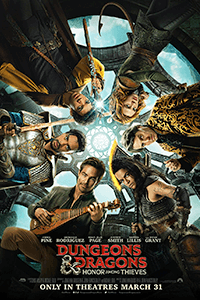
Despite its origins, Masters of the Universe sets out to become a four-quadrant feature, appealing to everyone, and in that, no one in particular. The story is too bloated for little children, with a 142-minute runtime that challenged the attention spans of the kids in my prescreening, who became restless after an hour. Admittedly, so did I. The material’s self-awareness and humor aren’t memorable enough to distinguish it from other, better examples in this genre, such as Dungeons & Dragons: Honor Among Thieves (2023)—a movie that I enjoy more with each subsequent viewing. And director Travis Knight can’t decide whether the audience should take these characters seriously or laugh at their inherent silliness. He attempts both and does neither very well. The result did not rekindle my nostalgia for this chapter of my childhood; it didn’t create an exciting new take for audiences of all ages, either.
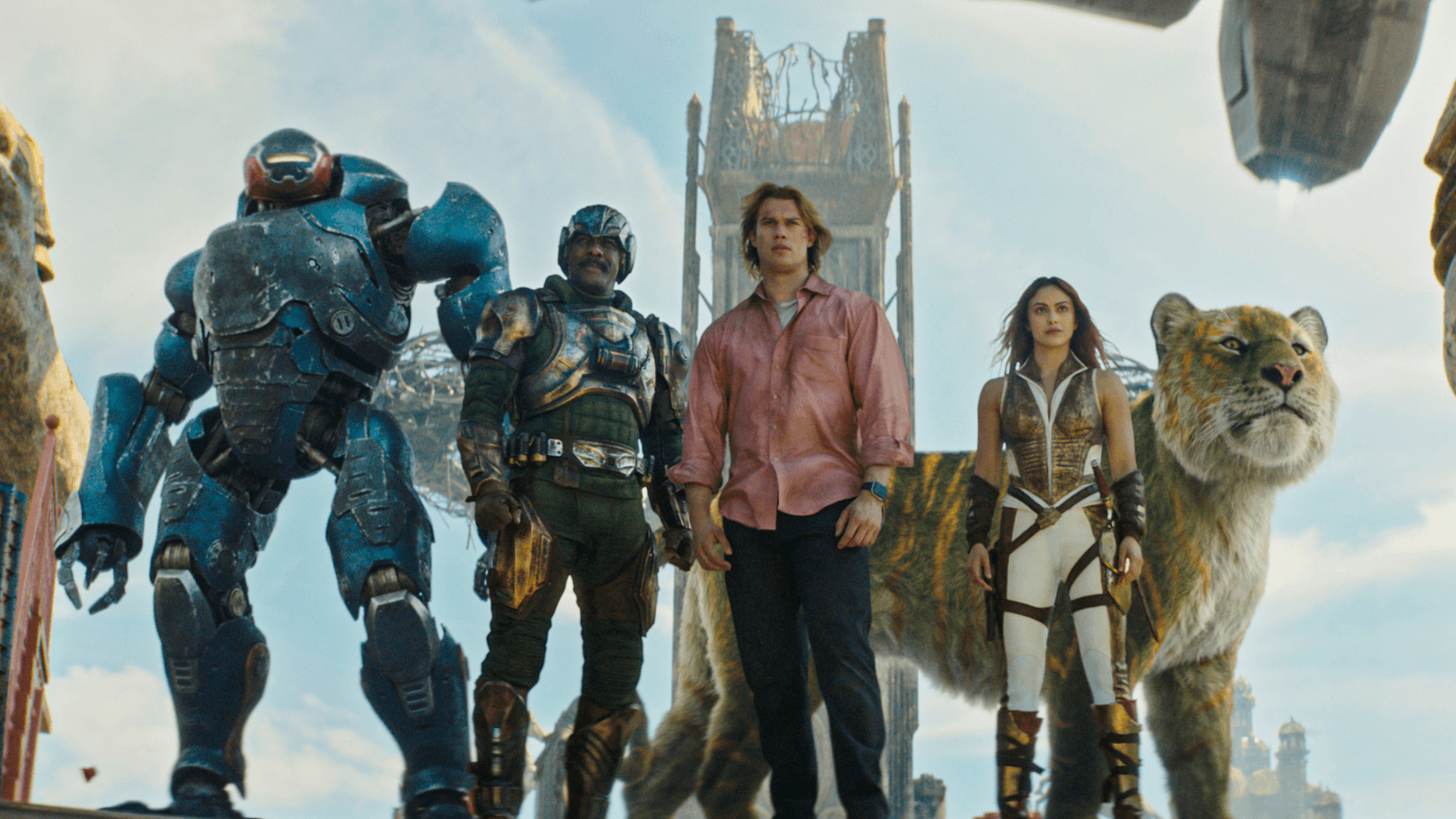
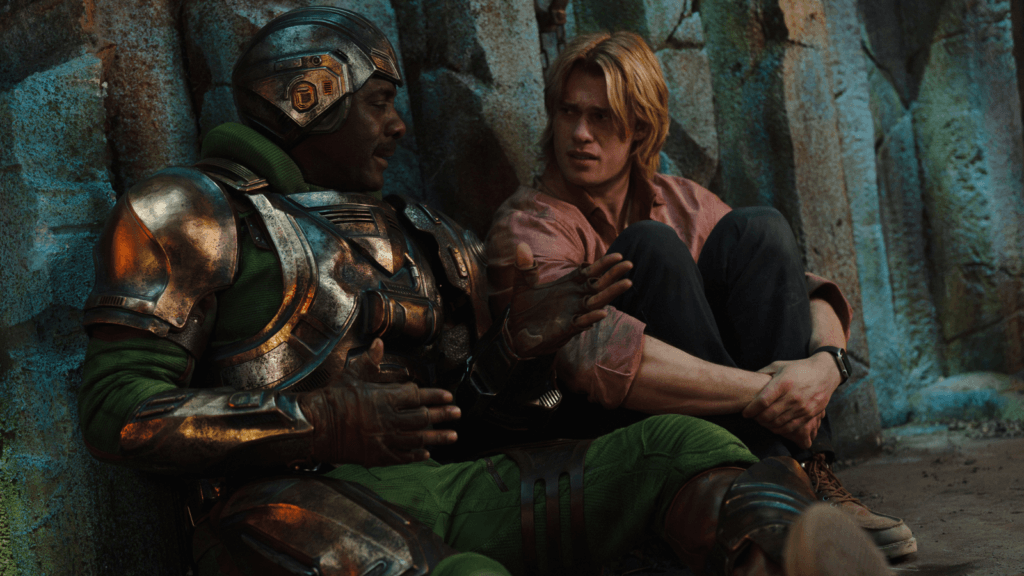
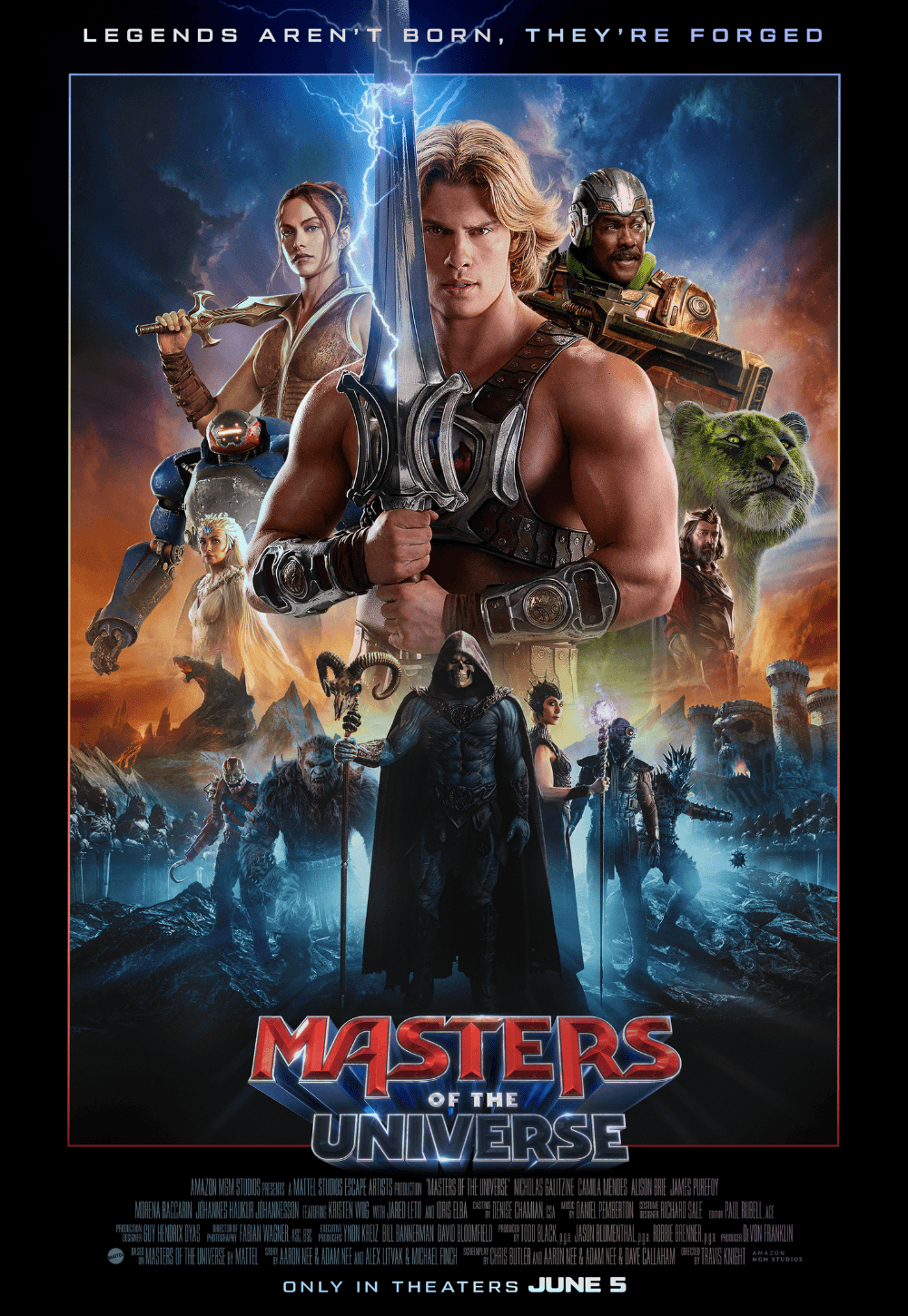
A protracted opening establishes the distant realm called Eternia, where sword-and-sandal heroes stand alongside robots and flying ships with laser guns. Eternia’s resident baddie, Skeletor (voiced by Jared Leto, doing an R-rolling master-thespian thing), wants the Sword of Power, which imbues its wielder with, as you might guess, power. But it’s kept in Castle Grayskull, home of King Randor (James Purefoy), who’s disappointed by his son, Adam (Artie Wilkinson-Hunt), a young boy more interested in goofing around than learning to fight. When Skeletor attacks the castle and proves victorious, the Enchantress (Morena Baccarin), the magically inclined protector of Grayskull, sends Adam away to Earth along with the coveted sword. What happens then? Did a couple of farmers adopt him à la Superman? Or did he grow up in the foster system? The writers ignore such practical questions, picking up the story years later, when the adult Adam (now a hulking Nicholas Galitzine) works in corporate human resources. After Adam finally locates his sword, which was lost when he was transported from Eternia to Earth, he eventually finds his way home with the help of his childhood friend, Teela (Camila Mendes), to retake Grayskull from Skeletor.
Knight’s main source of inspiration, besides the cartoon and earlier movie, seems to be the similarly themed cult classic Flash Gordon (1980). Masters of the Universe’s music features identical-sounding Howard Blake-style guitar riffs and, to echo the original songs Queen wrote for Flash Gordon, the production uses Queen’s “Princes of the Universe” on the soundtrack. In other areas, Knight directs a conventional franchise movie with choppily edited and CGI-heavy battle scenes full of anonymous violence, lifeless chase sequences, digital backdrops resembling video-game environments, and shameless product placements for Coca-Cola and Amazon. The VFX sometimes look impressive; at other times, they look cheap and generic. Fortunately, Knight’s production also offers practical effects and prosthetics for some characters, most memorably the cyborg Trap Jaw. Knight’s secret weapon is costume designer Richard Sale, who visualizes the inherently absurd look of these characters, for better or worse, in tangible garb. The actors inhabiting the excellent costumes don’t have much to do, though. Ask yourself why they hired Kristen Wiig to voice Roboto, a bland robot character whose dialogue could have easily been performed by anyone else, or even just replaced with the beeps and boops of a Star Wars droid. When you have Kristen Wiig, use her.
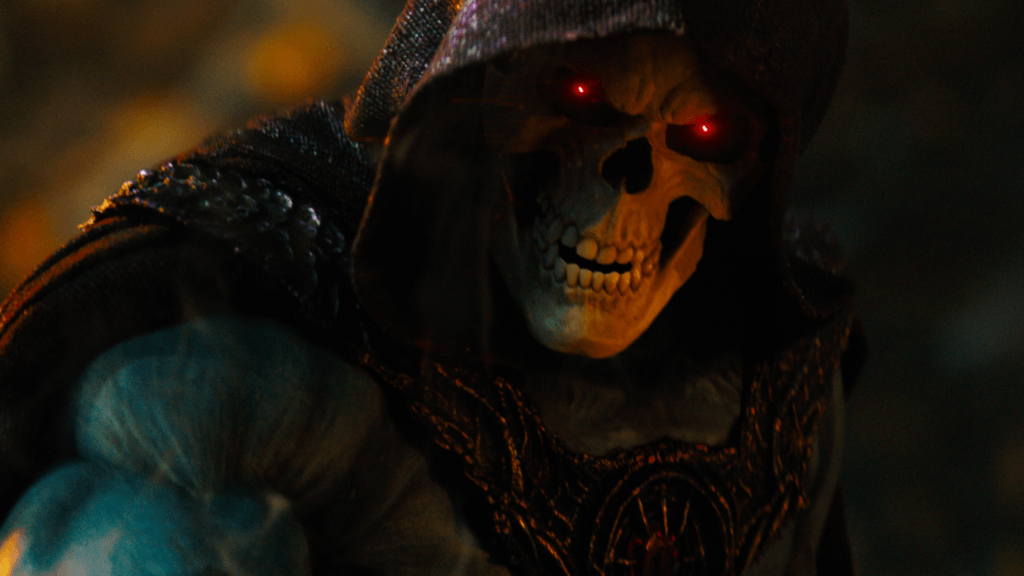
Elsewhere, Masters of the Universe attempts to be self-aware in its irony and sexually suggestive underpinnings. There’s a running gag about how practically everyone can’t keep their eyes off Adam after he becomes his heroic alter-ego, He-Man, given his oiled-up muscles and blonde locks. But under Adam’s pink shirt, he still looks buff, making his eventual Hulk-like transformation into a muscle-bound barbarian unremarkable. Elsewhere, I liked the detail of Adam growing up on Earth and forgetting everyone’s names on Eternia, so he makes up their names based on their physical characteristics. A man with a big metal hand becomes Fisto (Jóhannes Haukur Jóhannesson), and another with a metal head-butting helmet becomes Ram-Man (Jon Xue Zhang). The writers take advantage of this with veiled dirty jokes about fisting and Ram-Man “giving head” to Skeletor’s goons. That’s about as clever as the movie gets. As for character development, there’s almost none. Skeletor, for instance, wants to be bad for the sake of being bad. His motivations are nonexistent, resulting in an obvious, uninteresting, and one-dimensional villain.
A key series in the conservative, Reagan-era 1980s, the Masters of the Universe cartoon and previous movie valued strength and power, muscles and might. Today, that message has negative, regressive associations with the political right, which often looks at this period from a fond standpoint. To avoid alienating any part of their audience, the filmmakers desperately try to please everyone with a mild progressive commentary to counter the franchise’s original themes. Adam’s character must learn to “be a man” to please his father, King Randor, and his makeshift father figure, Man-at-Arms (Idris Elba, in a chummy reformed drunk role). But there’s also a half-hearted message that Adam, having worked in human resources, knows the value of empathy and emotional intelligence. For a while there, the movie even claims you can’t solve every problem with muscles—that is, until He-Man resolves the conflict by pummeling Skeletor with his fists. The movie’s message is ultimately nonexistent. The committee making this movie has carefully avoided any line-in-the-sand worldview, all in an attempt to manufacture a box-office hit that will please everyone and offend no one.
That’s exactly the problem with Masters of the Universe. It’s so afraid to have a perspective or be about something that nothing onscreen has an impact. This is not to say every movie must have a substantive message. Sometimes, a mindless adventure is enough. However, even on those terms, there’s no tension or danger here because Skeletor is never all that menacing, and Adam alternates between self-parody and earnest heroism. None of the emotional beats land, not the many father-son dynamics nor the hero’s journey. And the production’s competing tones, from its intentional camp to its sword-swinging adventure, lack the balance of wit and scope that Dungeons & Dragons: Honor Among Thieves so delightfully captured. For much of the runtime, I felt bored and, aside from a few chuckles at the childish humor, disengaged from everything happening. Perhaps Roboto describes the movie best when referring to life as “a series of absurdities leading to infinite nothingness.”
Photo: Brian the Barbarian

Like DFR? Support us.
This site exists because readers like you care about film. If DFR has enriched your experience with movies, I’d be grateful for your support. You have a few options:
• Join DFR’s Patreon community
• Make a one-time donation on PayPal
Whatever option you choose, it helps keep my work independent. And it means a lot to me.
Thank you for reading, and for making this work possible.
Brian Eggert | Critic, Founder
Deep Focus Review