I Play Rocky
By Brian Eggert |
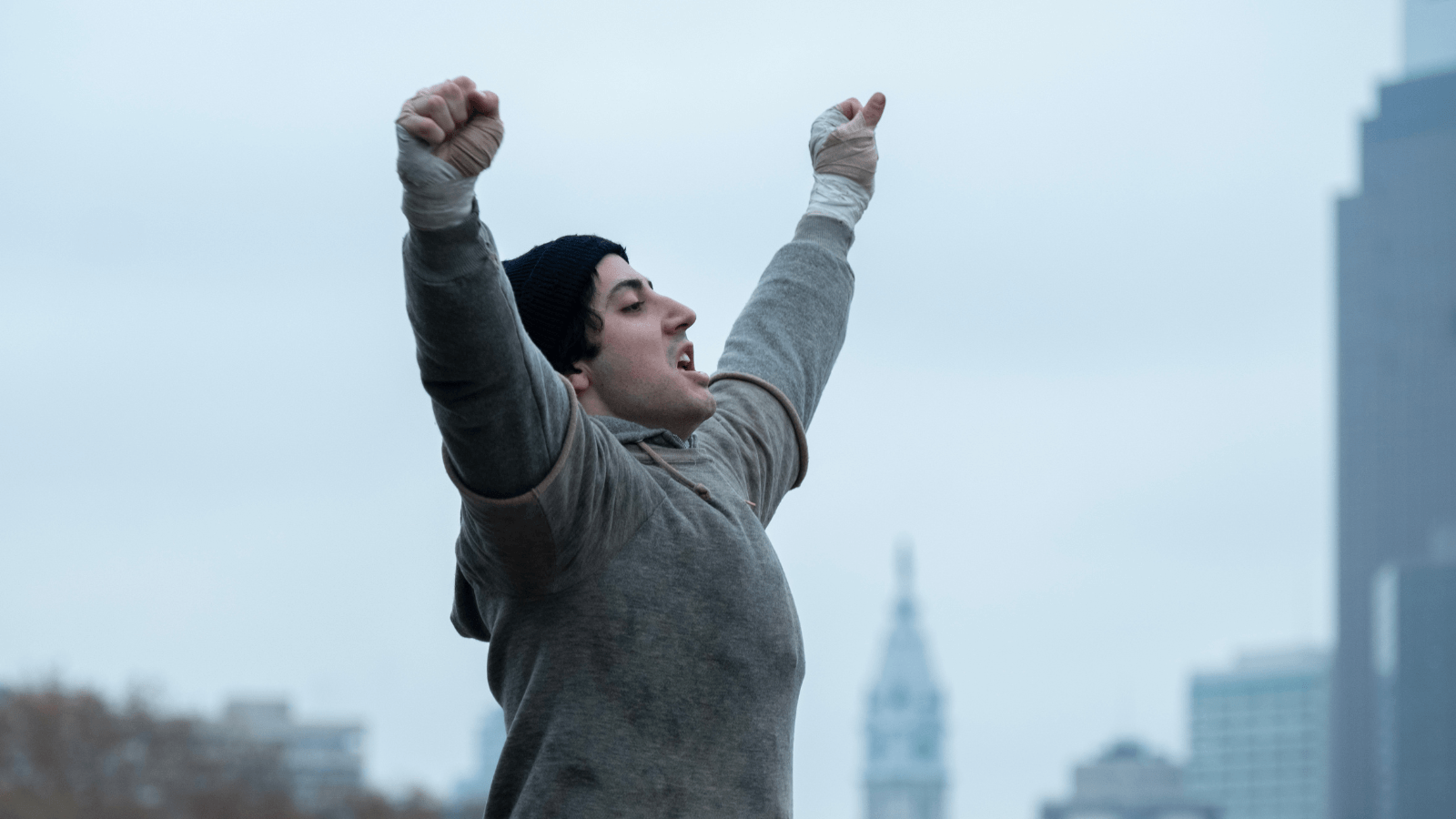
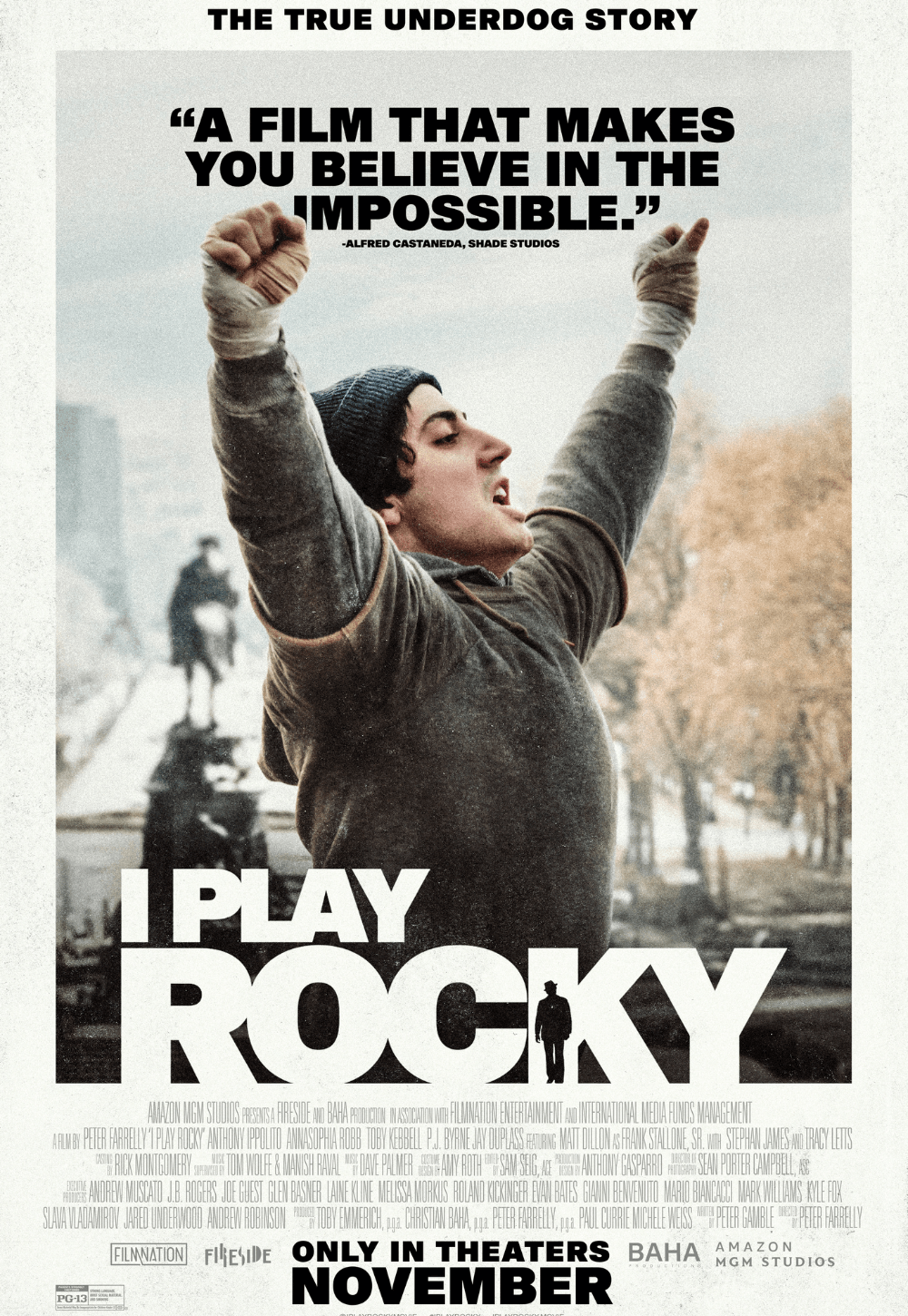
I Play Rocky is a crowd-pleaser about the making of a crowd-pleaser. Peter Farrelly directs this story about the making of Rocky (1976), and how the iconic boxer from Philly was mirrored by the actor-screenwriter who invented him: Sylvester Stallone. It’s a story about art imitating life, tracing Stallone’s journey from a homeless wannabe actor to the man who writes his own legacy, just as Rocky Balboa goes from “another bum from the neighborhood” to an underdog who defies expectations. Like Rocky, whose relationship with the awkward young Adrian stabilizes him, Stallone has a devoted wife, Sasha, cheering in his corner. Rocky is one of those rare films, like Werner Herzog’s Fitzcarraldo (1982) or Terry Gilliam’s Brazil (1985), where the filmmakers faced many of the same challenges as their characters. And even though I’m admittedly no great admirer of the Rocky movies, I enjoy films about filmmaking, and this one tells a pretty fascinating behind-the-scenes story.
The movie stars Anthony Ippolito as Stallone. The performance reaches greatness at times, but in early scenes, it feels like a parody or a convincing impression, not an embodiment. We see Stallone driven by Hollywood aspirations, even after getting laughed out of auditions. He gets kicked out of his New York City apartment and spends a night on the street, and then resorts to soft-core pornography to pay the bills. After he lands a job as a ticket-taker at a movie theater, his earnestness and passion charm the box-office worker who will become Stallone’s first wife, Sasha Czack (AnnaSophia Robb). Sasha encourages him to write his own screenplays, which he does. The couple soon moves to Los Angeles, where he struggles to sell his scripts. One night, while lamenting his failures at a bar, he sees a boxing match between Chuck Wepner, a hopeless but resilient contender, and the heavyweight champ, Muhammad Ali. Wepner’s unexpected fifteen-round fight inspires Stallone to write Rocky in three days, which Farrelly depicts in a screenwriting sequence stylized after Rocky’s training montages.
I Play Rocky finds its groove when Stallone begins negotiations with producers Irwin Winkler (P.J. Byrne) and Robert Chartoff (Toby Kebbell), after slipping his scripts into a pile on their assistant’s desk. They love it, imagining a vehicle for Burt Reynolds or Ryan O’Neal. No, Stallone says, “I play Rocky”—an unshakable position that leads the actor to turn down a wildly escalating payday from a frustrated studio exec (Tracy Letts, acerbic and hilarious). After all, Stallone is Rocky. Soon, a low-budget production is underway, with Jay Duplass delivering a vigorous turn as John G. Avildsen, the no-bullshit director who must keep Rocky on budget and on schedule, or the studio will take over. Some of the production’s wilder moments make for riotous laughs. I’ve always felt that Rocky has some of the worst fight choreography in the genre, full of big swings and unguarded faces. It’s kind of embarrassing to watch. Well, that’s because Stallone coordinated them with his costar, Carl Weathers (Stephan James), who plays the champ Apollo Creed, and neither knew anything about boxing.
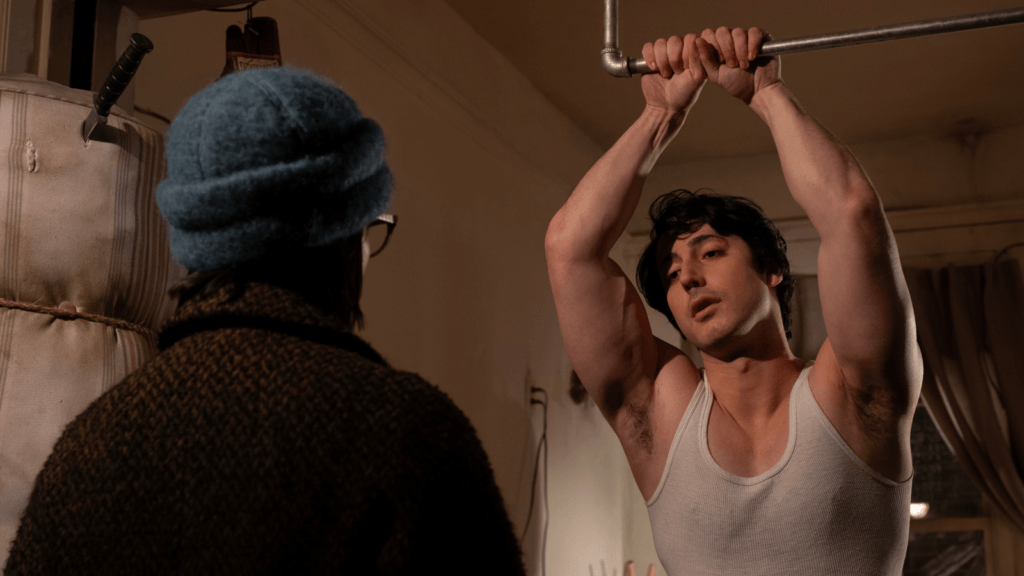
A vein of fan service runs through I Play Rocky, and Peter Farrelly digs around it to extract every ounce of paydirt. Peter Gamble seems to have scoured the IMDb trivia section for the neat production details in his screenplay. For instance, filming in New York was too expensive, so the shoot moved to Philadelphia, a chance decision that left that city inextricable from the movie. On the first day of production, the producers hoped the intense running scenes would injure Stallone, giving them an excuse to replace the no-name with a bankable star. Despite bloody feet and torn tendons, Stallone kept going. Later, someone forgot to thaw the slabs of meat Rocky punches, and with no time to soften them, Stallone unleashes his fists on ice-solid beef, breaking his knuckles in the process. Another trivia-worthy gag throughout the film reveals how actors often lie about their skills to secure jobs. Talia Shire couldn’t ice skate, but neither could Stallone. This raises the question: Why did he write the ice-skating scene if he intended to star but couldn’t skate?
The movie doesn’t quite get to the core of Stallone, apart from framing him as a real-life counterpart to Rocky. It’s a flattering portrait, one you might suspect Stallone had a hand in crafting (he didn’t). Stallone comes off as a smart and prideful guy who came from nothing but kept fighting for his dream. The reality, particularly in the ensuing years as his ego took over, is far more complicated. But one effective subplot involves his disapproving father (Matt Dillon), who’s bitter because he gave up on his acting aspirations to become a barber. When Sly introduces him to Sasha, the old man calls his son a “moron” and the “stupidest person in the city,” then casually mentions that he once beat his son unconscious. This pays off later when Stallone improvises a powerful scene where Rocky bares his soul to Mickey, and the actor taps into his feelings about his father. However, it’s hard to take Dillon seriously in the role, given his silly prosthetic nose.
To be sure, Farrelly directs a production filled with bad wigs and overblown costume choices. I Play Rocky doesn’t look like the 1970s; it looks like a bunch of people at a back-to-the-’70s party. Ippolito sometimes appears buffoonish as Stallone. But in a testament to his uncanny resemblance and the effectiveness of the storytelling here, the actor disappears into Stallone and Rocky in the second half, during the filming scenes. (Curiously, Ippolito also appeared in The Offer, playing Al Pacino in the miniseries about the making of 1972’s The Godfather.) With heaps of muscle added to his frame, Ippolito’s appearance becomes convincing, shaped by a staggering body transformation—the kind that gets Oscar attention. It would be a cruel irony if Ippolito won an Oscar for his role, since the award eluded Stallone’s performance as Rocky twice, once for the original film, and again for Creed (2015).
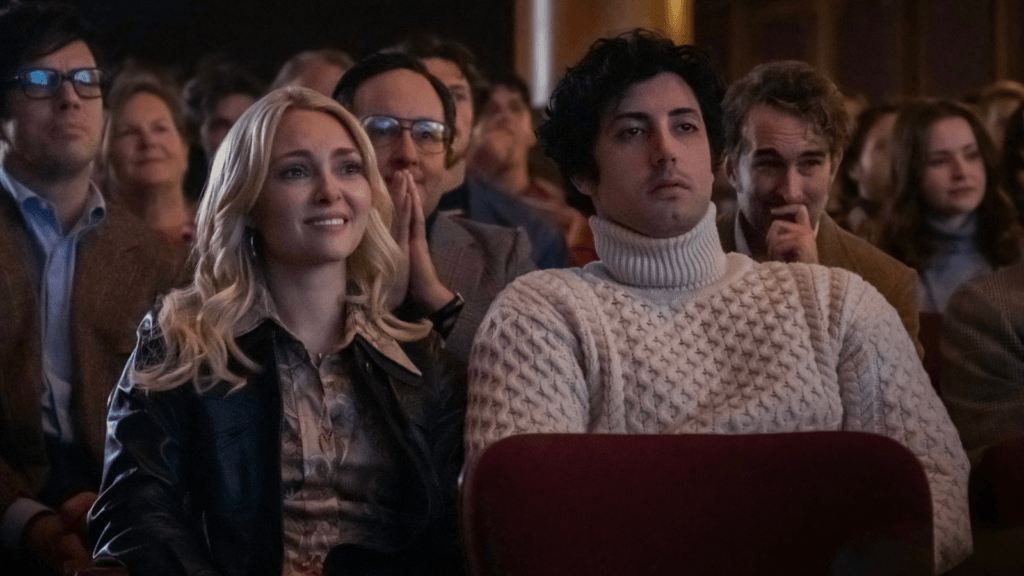
Of course, Rocky became an inspirational classic and an all-timer in some circles. After their film became 1976’s biggest box-office earner, Winkler and Chartoff took home Oscars for Best Picture, and Avildsen won Best Director. Some look back and call those victories justified. But some, like myself, would have rather seen statuettes go to one of the other nominees that year: Sidney Lumet’s Network, Martin Scorsese’s Taxi Driver, Hal Ashby’s Bound for Glory, or Alan J. Pakula’s All the President’s Men. Its victory signaled a shift in Hollywood, replacing the cynical, gritty cinema that had defined the New Hollywood sensibility with a crowd-pleasing era of blockbusters and sequels. Sure enough, Rocky spawned a franchise with five more entries and a spinoff series about Apollo Creed’s son. Stallone’s celebrity skyrocketed over the next two decades. He divorced Sasha and married Brigitte Nielsen, became an action hero and Reagan-era icon, and decades later, he starred in a reality series about his family and became Donald Trump’s Special Ambassador to Hollywood (whatever that means).
There’s a lot we have to set aside while watching I Play Rocky. Worse, it ends at Rocky’s premiere. It’s an abrupt conclusion that would have benefited from another fifteen minutes of falling action. Instead, the movie isolates Stallone’s victory, spinning a yarn about “going the distance” and “believing in yourself,” but ignoring what came after. It’s a bit like Farrelly’s Green Book (2018) in the way it presents a sanitized version of reality. And as much as the movie echoes Rocky’s themes, its ending isn’t as bittersweet as the original. Rocky loses the match, but it’s a triumph of his ambition and endurance. For this version of Stallone, it’s just a triumph. Still, as movies about movies go, I Play Rocky entertains. With any luck, it will remind people that unforgettable cinema doesn’t require megabudgets and AI solutions; original, personal stories require only the conviction to see them through.
Like DFR? Support us.
This site exists because readers like you care about film. If DFR has enriched your experience with movies, I’d be grateful for your support. You have a few options:
• Join DFR’s Patreon community
• Make a one-time donation on PayPal
• Buy me a coffee
Whatever option you choose, it helps keep my work independent. And it means a lot to me.
Thank you for reading, and for making this work possible.
Brian Eggert | Critic, Founder
Deep Focus Review