The Definitives
All About My Mother (1999)
Essay by Brian Eggert |
All About My Mother (Todo sobre mi madre) stands out among Pedro Almodóvar’s many films about the complexities of women—their ability to endure, reinvent themselves, and use performance as a means of discovering an authentic sense of self. Released in 1999, it remains the Spanish auteur’s most celebrated film in terms of critical appraisal and awards. It is also the picture that marked Almodóvar’s transition from Spain’s most internationally recognized and sensational enfant terrible to a measured and thoughtful dramatist. During the 1990s, the director adopted new tonalities and a pointedly melodramatic temperament. In All About My Mother, he softens the ostentatious mise-en-scène that defined his earlier work to explore, with intimate service to his characters, a theme articulated by Agrado, a transgender woman in the film: “A woman is more authentic the more she resembles what she dreams herself to be.” Whether occupying, for the moment, the role of a mother, nun, diva, or sex worker, women defy such simple labels in Almodóvar’s hands. All About My Mother celebrates the performative nature of selfhood that intermingles art and life, not only as a testament to the actresses to whom Almodóvar dedicates the film but also as a celebration of the layered identities of women.
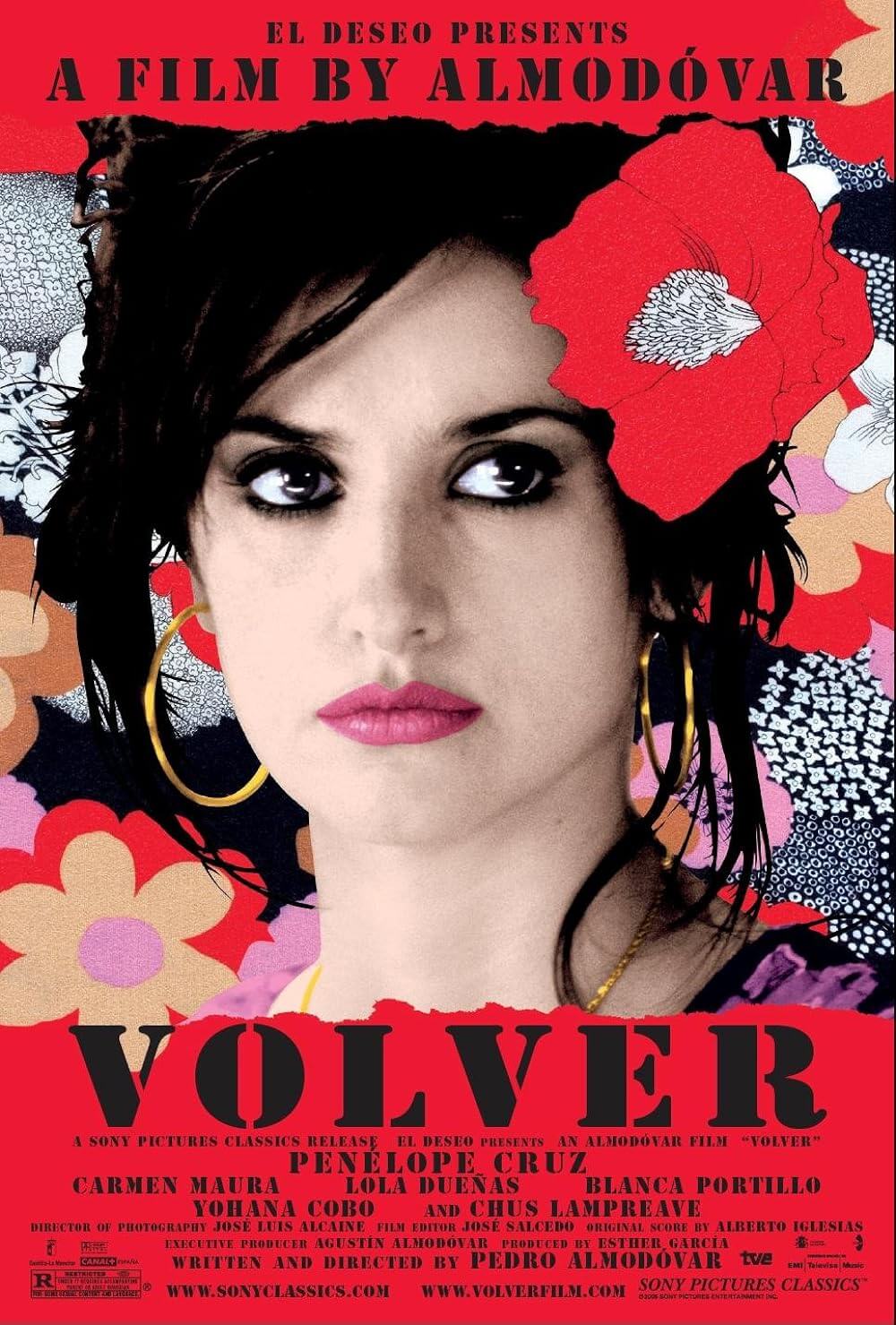
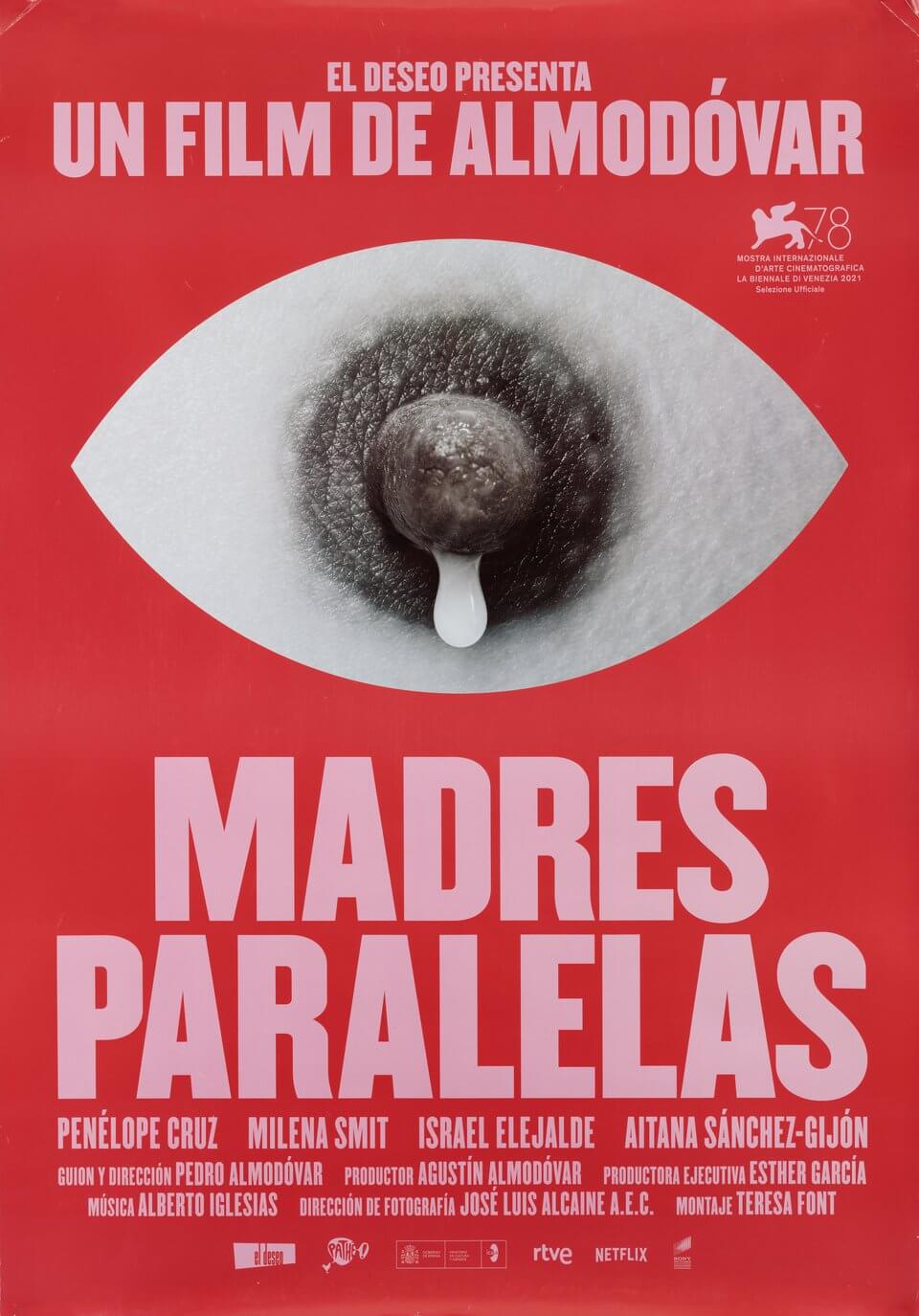
All About My Mother was the director’s most sober work to date in 1999, coming after his output during La Movida Madrileña (aka Movida)—a period of gleeful counter-culture transgression that emerged in the early 1980s between dictator Francisco Franco’s death in 1975 and the new era of democracy in Spain. During this radical era of social and political change, Almodóvar made several short films and revolutionary features such as Pepi, Luci, Bom and Other Girls Like Mom (1980), Labyrinth of Passion (1982), and Dark Habits (1983), which confronted the restrictive politics of the moment. Even after he set aside his most blatant confrontations with Francoist ideology, he nonetheless dabbled in the farcical, sensational, and flamboyant entertainments that earned him an international reputation—Law of Desire (1987), Women on the Verge of a Nervous Breakdown (1988), and Tie Me Up! Tie Me Down! (1989). “I am still in recovery from that time,” he told Lynn Hirschberg in 2004, referring to the indulgence and rage of the era. His need to heal from Spain’s volatile and fascistic past has not softened, however. Almodóvar continued exploring these ideas in later examples such as Volver (2006) and Parallel Mothers (2021).
Given his status as an openly queer filmmaker reacting against a period of sociopolitical oppression by challenging societal norms, it’s worth noting that Almodóvar never occupies the perspective of a “gay militant,” as he told June Thompson. He resists political correctness, for instance, seeing the ever-moving target of appropriate rhetoric as anathema to his artistic desire to provoke diverse reactions—not all of them positive—and to reinforce the necessity of artistic freedom. “There’s a dictatorship about what’s politically correct that I always seem to violate,” he told José Solís in 2013. Rather, Almodóvar operates from the perspective of unbridled creativity. “Inspiration demands absolute freedom,” he argues, which has sometimes resulted in censure for his embrace of taboo subject matter and refusal to conform to the accepted terminology or expectations for representation of the moment. However, like any author or filmmaker with a perspective befitting the auteur label, specific themes and preoccupations reappear throughout Almodóvar’s body of work. Certainly, historical trauma plays a role in many of his films, but they also demonstrate his fascination with women characters and those who play them.
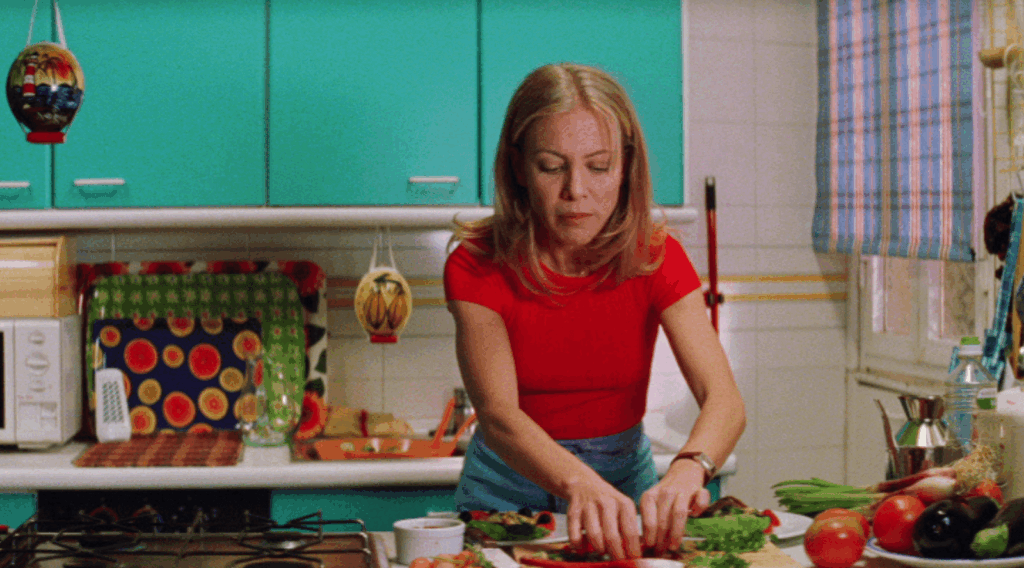
All About My Mother ends with this dedication: “To Bette Davis, Gena Rowlands, Romy Schneider … to all actresses who have played actresses, to all women who act, to all men who act and become women, to all the people who want to be mothers. To my mother.” Almodóvar’s films often center on a female protagonist steeped in family dynamics, female friendships, performance, sex work, and queer identity. He admitted to interviewer Frédéric Strauss, “You could make a thousand different films” from these elements, but in All About My Mother, “I treat them differently.” His inspiration came from one of his earlier films, The Flower of My Secret (1995), which he describes as the “engine that generated All About My Mother.” Both films begin with similar scenes: The filming of a hospital video in which staff members try to convince a mourning mother to donate her late 16-year-old son’s organs. It’s a less critical detail in the earlier film, where the cold open sequence is revealed as a film-within-the-film, leading to a committee discussion about how to approach such conversations. However, the concept of a mother honoring her deceased son’s memory by helping others is central to All About My Mother, where the hypothetical scenario in the video becomes a reality for Manuela (Cecilia Roth), whose son Esteban (Eloy Azorín), an aspiring writer, dies early in the film.
In a broader sense, both films also consider the intricacy of female friendships between mother and child and between friends and colleagues. The Flower of My Secret contains themes of motherhood and grief, yet Almodóvar explores them with more depth and nuance in the later film. All About My Mother opens in Madrid on Manuela, who helps facilitate organ transplants at Ramón y Cajal Hospital. On Esteban’s seventeenth birthday, they watch a Spanish-dubbed version of All About Eve (1950), she gifts him a copy of Truman Capote’s Music for Chameleons (1980), and they attend a local production of A Streetcar Named Desire, starring famed actress Huma Rojo (Marisa Paredes) as Blanche DeBois. What Esteban really wants for his birthday, he admits, is to know “all about my father.” Manuela promises that, after the play, they can return home, and she will tell him the complicated backstory. Instead, after the show, Esteban races into a rainy street to get Huma’s autograph, and a car strikes him dead. With some irony and reluctance—given that she just played a woman who decided to donate her son’s organs—Manuela agrees to allow Esteban’s organs to be used for transplants.
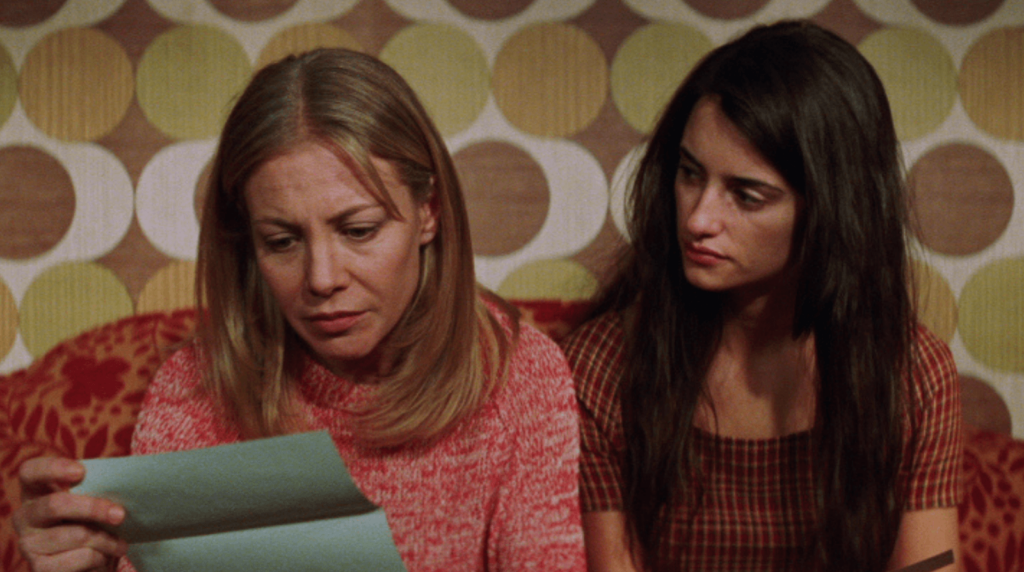
Weeks later, Manuela arrives in Barcelona to locate her son’s biological father, who was once named Esteban as well but has since transitioned into Lola (Toni Cantó). If All About My Mother marks a tonal shift toward seriousness for the director, it also features a geographical change to Barcelona, whereas his films up to this point were almost exclusively situated in Madrid. So devastated by her son’s death that her own life no longer interests her, Manuela pours herself into helping others. She feels no fear or hesitation; she cannot lose more than she already has. She rekindles her friendship with an old friend, Agrado (Antonia San Juan), who directs Manuela to Rosa (Penélope Cruz), a nun who works to help transgender sex workers in Barcelona. But Rosa has not seen Lola—even though she’s not only carrying Lola’s child but has also contracted the AIDS virus from her. Manuela invites Rosa to stay in her apartment during the pregnancy since Rosa’s parents disapprove, but she eventually dies during childbirth. Only at Rosa’s funeral does Lola appear, frail from the effects of the virus, and learn of her son with Manuela. Esteban, the name of Rosa’s child, is somehow miraculously cured of AIDS over the two years that Manuela raises him in Madrid, before returning the child to Barcelona to be raised by Rosa’s parents.
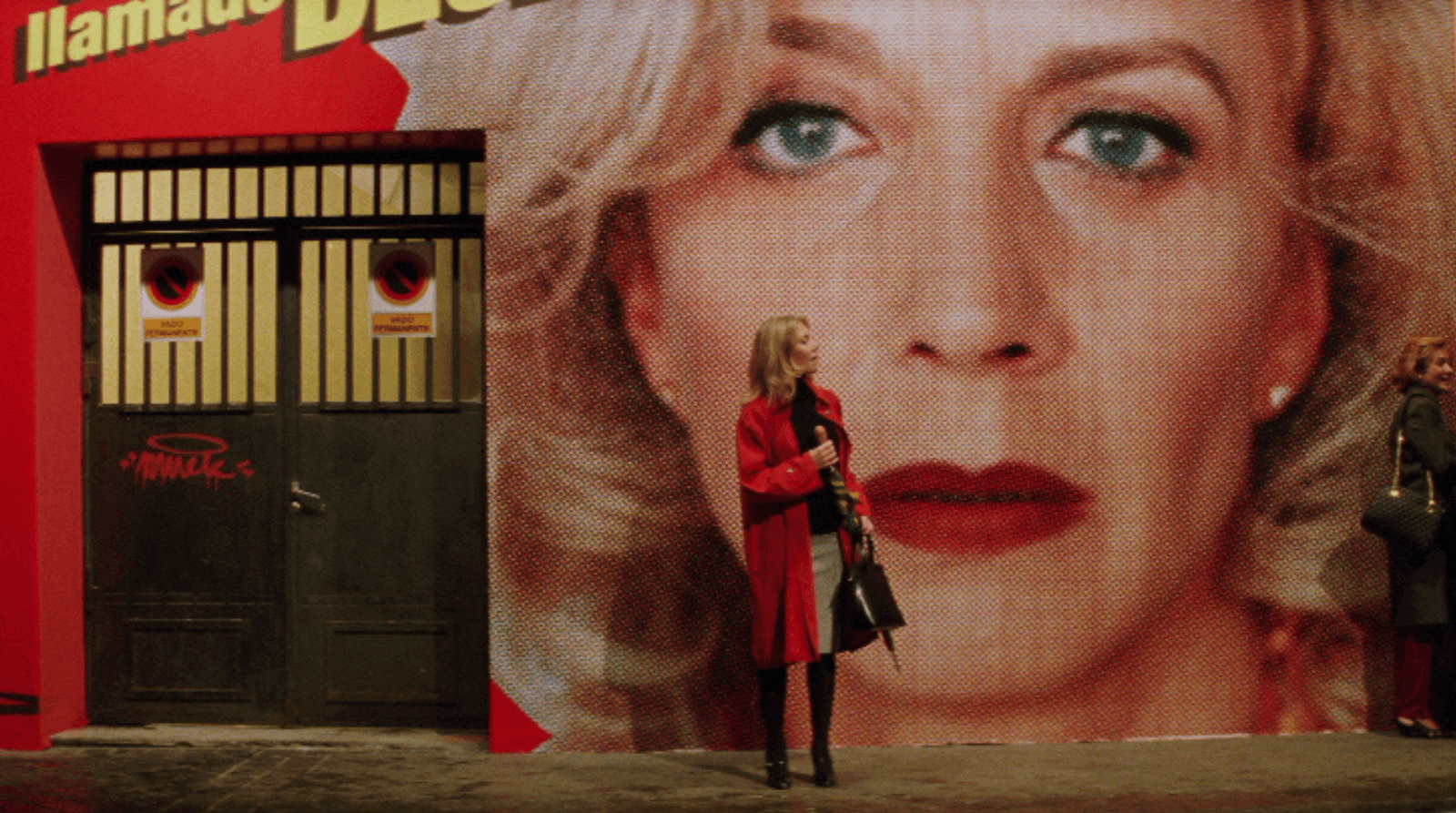
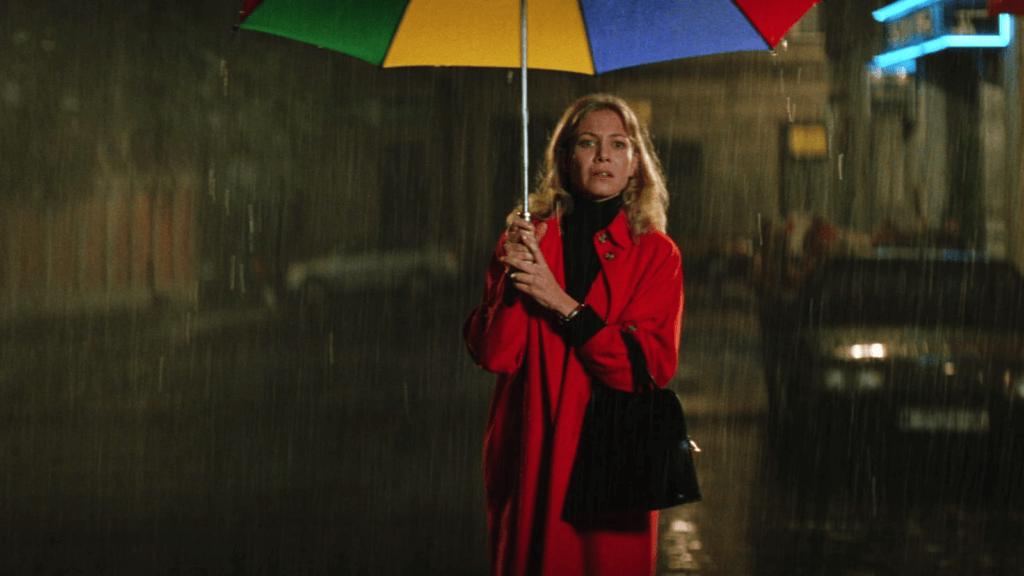
Almodóvar draws inspiration from other dramatic sources, as he does with all his films, lending All About My Mother a rich intertextuality that invites interpretation. Early on, when Manuela meets Esteban for the stage production of A Streetcar Named Desire, she stands before a wall advertisement featuring Huma’s face—an iconic image from the film. Combined with Esteban’s creative ambitions, his mother’s history in acting, and the overwhelming image of Huma in the scene, this moment links womanhood and creativity. After all, Manuela performed A Streetcar Named Desire with her son’s father many years before, playing Stella no less, in an example of life imitating art (and vice versa). The same is true of Joseph L. Mankiewicz’s All About Eve. Later in the film, Manuela notices Huma’s A Streetcar Named Desire production has moved to Barcelona and seeks out Huma backstage. Manuela appears in a raincoat, like Anne Baxter in Bette Davis’ dressing room in All About Eve. Eventually, she understudies for the role of Stella, played by Huma’s addict-lover Nina (Candela Peña).
One could tie themselves in knots trying to disentangle the many ways Almodóvar nods to earlier dramas while grappling with history and yearning for healing through self-discovery. However, where the director usually links his films to Spanish history, All About My Mother references similar political conditions in Argentina, such as how Manuela and the elder Esteban emigrated from Argentina to Paris before he transitioned. Argentina’s history from this period bears similarities to the right-wing conservatism of Spain under Franco’s regime. During Argentina’s Dirty War—overseen by the Proceso de Reorganización Nacional (National Reorganization Process), the military dictatorship that ruled from 1976 to 1983—the government carried out a junta that targeted leftists and political dissidents in a campaign of torture, extrajudicial killings, and forced disappearances. Tens of thousands went missing or were killed. Manuela and Esteban escaped Argentina to France, making All About My Mother an after-the-fact immigrant story. After Rosa gives birth, Manuela observes how the child’s birthday coincides with the arrest of General Jorge Rafael Videla, one of the military leaders who facilitated Argentina’s dictatorship. Although Videla had been arrested in 1983 after Argentina returned to democracy under President Raúl Alfonsín, he was arrested again in 1998—presumably, the date referenced in the film—for his systematic kidnapping of babies born to detained political prisoners in detention centers during the Dirty War.
The political and historical backgrounds of Almodóvar’s characters contribute to their nontraditional lives and family dynamics. Part of what the director hoped to achieve with All About My Mother is a sense of the versatility and flexibility of families. “If there is something that characterizes the end of the twentieth century, it’s the rupture of the traditional family,” he told Strauss. “Now you can form families with other members, other ties, other biological relations that need to be respected. The most important thing is that the members of the family love each other.” However, Almodóvar did not intend to weigh the traditional family against the so-called unconventional or nontraditional family. His films have no boxes or qualifiers, only the expectation of love. And he hoped moviegoers would accept all models within the makeshift family of Manuela, Lola, Huma, Rosa, and Rosa’s child. His ambition was not “for the audience to tolerate it,” he told Strauss, “but [for viewers] to see it as something natural.” This would be a recurring theme in Almodóvar’s work, with films from Dark Habits to Parallel Mothers exploring how unconventional families operate on the same foundation of love and acceptance as conventional ones.
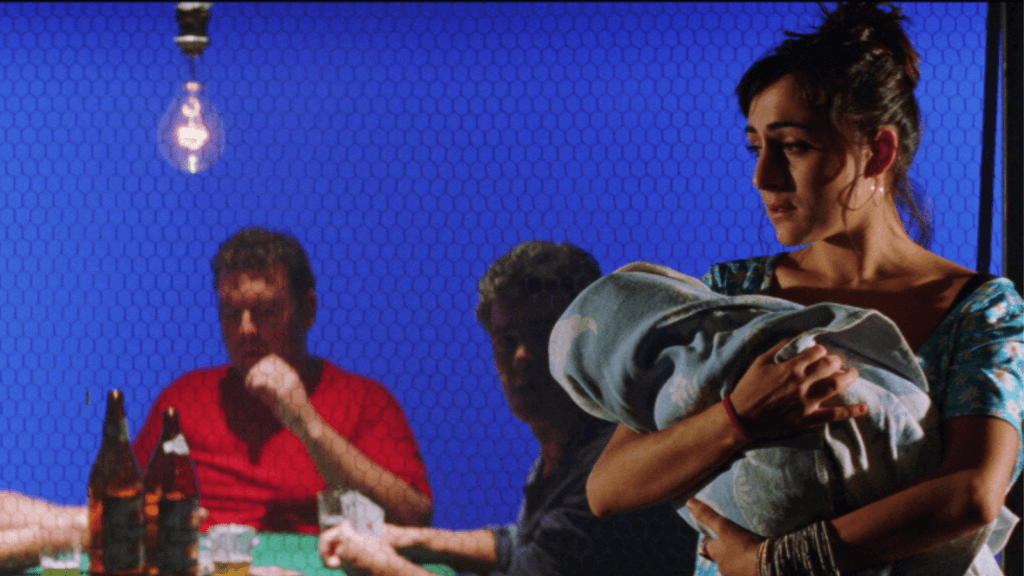
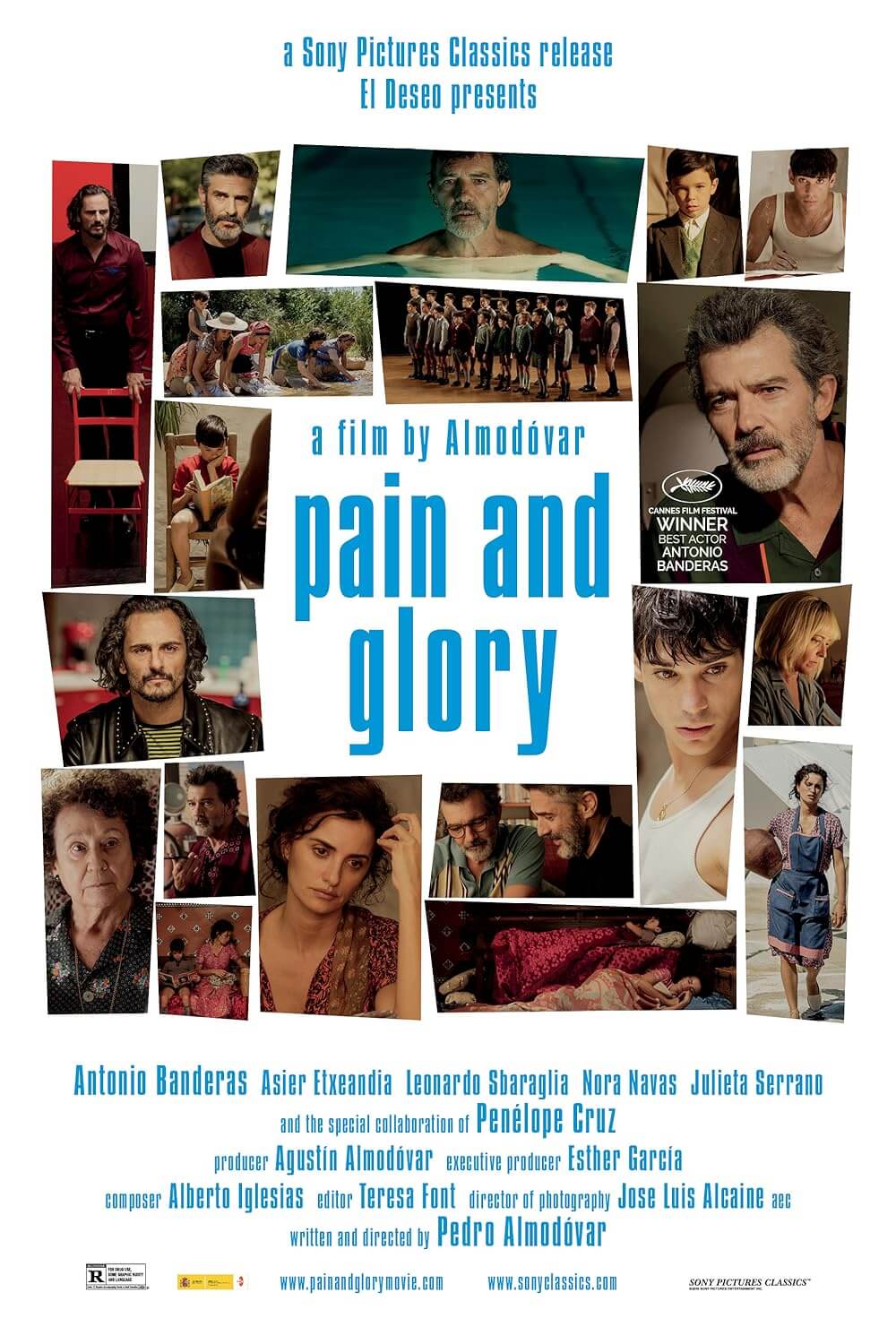
If the stereotypical traditional family is headed by a father, the center of Almodóvar’s families is usually a mother, with examples from What Have I Done to Deserve This? (1984) to Julieta (2016). He described All About My Mother as a film “about the pain of motherhood.” The director spent much of his upbringing around women and mothers in his village, something he explores in his brilliant autofictional drama Pain and Glory (2019). As a child, he listened to women talking in the courtyard outside his window, inspiring his first experiments with fiction writing. Though Almodóvar has acknowledged that he risks living up to the bogus Freudian stereotype about close relationships between gay men and their mothers, he draws from a personal place. Having left home when he was 17, Almodóvar, as a gay man, felt apprehension toward the heterosexual male world and masculine bonding rituals. “I found comfort with women,” he told Thompson. “Seeing them live their lives and solve problems, that really was my education as a person.” Manuela embodies the strength Almodóvar witnessed in her capacity to shift fluidly between maternal and artistic roles. Inspired by Huma’s enduring self-discovery as a performer, Manuela faces motherhood, grief, and artistic expression with resilience, supported by the solidarity of her female friends.
All About My Mother is also less aesthetically playful than Almodóvar’s other films, though he works with several regular collaborators behind the scenes. Spanish composer Alberto Iglesias—who began writing music for the director on The Flower of My Secret and has provided the scores to most of Almodóvar’s films since—supplies mercurial music that sets the dramatic mood with a lush yet emotive sound. Brazilian cinematographer Affonso Beato ended his short-lived association with the director on The Flower of My Secret and Live Flesh (1997) after their third and final collaboration here. Informed by the director’s strong visual sense, interest in bold aesthetics, and hands-on approach to production design, Beato delivers stunning compositions with few movements that call attention to themselves. Whereas Almodóvar deployed flashy camerawork and nimble cutting on earlier films such as Matador (1986) and Women on the Verge of a Nervous Breakdown, Beato’s series of three films with the director has a comparatively straightforward mise-en-scène (though they look expressive compared to any other filmmaker’s output). Apart from a few exceptions—such as a paper’s-eye-view shot and the heightened sequence of Esteban’s death—the film finds Almodóvar restraining himself in service of his melodrama.
All About My Mother would become Almodóvar’s most acclaimed film and remains so as of this writing. One suspects that’s in part because his earlier work had been too queer-coded, too willing to confront taboos, and too ostentatious in tone compared to its more serious mood, regardless of how much his flamboyant films such as Women on the Verge of a Nervous Breakdown connected with audiences and helped establish his reputation. All About My Mother received the Academy Award, Golden Globe, and César Award for the Best Foreign Language Film; Almodóvar won the Best Director prize at the Cannes Film Festival; and the production took home seven wins at Spain’s Goya Awards, including Best Film and Best Director. Only Talk to Her (2002) and Pain and Glory came close to amassing as many awards. Moreover, in Almodóvar’s filmography, the film stands as the centerpiece of what Marcia Kinder coined as his unofficial “brain-dead” trilogy, preceded by The Flower of My Secret and ending with Talk to Her—all about characters who are physically or emotionally trapped.
If All About My Mother’s reputation has been dampened at all, it’s due to commentators and critics who have looked at the film through modern-day sociopolitical lenses and held it to today’s standards. Some have questioned the film’s casting of cisgender performer Antonia San Juan as a trans character in a typical supporting role—i.e., the queer best friend—along with perpetuating the stereotypical links between trans women and sex work in films. There’s a certain freedom in the language surrounding trans identity in the film as well, obviously removed from modern discourse. However, it’s important to remember that every film is an artifact of its time. For whatever Almodóvar gets wrong by today’s standards, he treats Agrado and Lola with warmth, empathy, and humor, giving such characters far more dignity and agency than they had received in the past. More than any other filmmaker of this time, Almodóvar treated the lives of LGBTQ+ characters with a humanity uncommon for the period, and his empathy for the individual—tantamount to Jean Renoir’s adage “everyone has their reasons”—amid mutable identity politics remains intact.
Almodóvar’s film belongs on a shortlist with Dog Day Afternoon (1975) and The World According to Garp (1982) in its sympathetic portrait of transgender women. Transgender characters would regularly appear in his work, such as the junkie in Bad Education (2004) and the rapist forced into becoming a woman by the mad scientist in The Skin I Live In (2011). But the examples go back to his earliest features—including Pepi, Luci, Bom and Other Girls Like Mom and Labyrinth of Passion. For instance, in Law of Desire, he cast transgender actress Bibi Andersen as a cisgender woman and Carmen Maura, a cisgender woman, in a transgender role. These choices might enflame present-day discussions about authentic or representational casting. Still, for Almodóvar, the fluidity of these choices spoke to his desire to break taboos through personal freedom in his creative work. He had no other agenda in such choices nor a willingness to make transgender identity the topic of his film other than to acknowledge that “they exist and their lives are as legitimate as any other.”
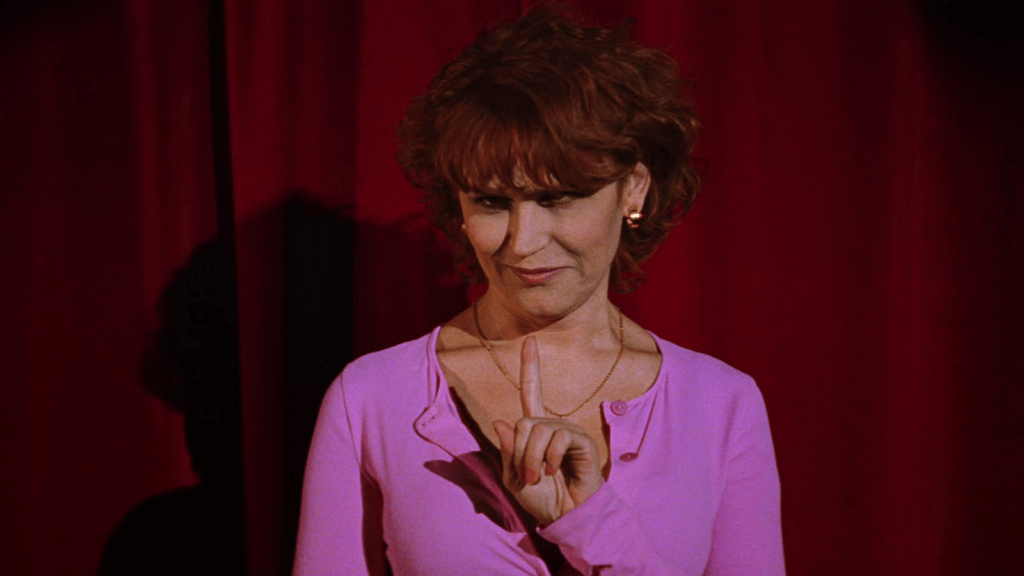
Central to this discussion is Agrado. Roger Ebert’s review of All About My Mother observed that “Manuela is the heroine of the film and its center, but Agrado is the source of life.” This becomes most apparent when Agrado addresses the audience when an evening’s A Streetcar Named Desire production is canceled. Resolving to put on a brief, impromptu one-woman show, she declares, “They call me Agrado because all I want to do is make life agreeable for others. Besides agreeable, I’m also very authentic.” Then, she details each surgical procedure she has undergone and their costs in her pursuit of authenticity. While some audience members cheer and clap for her performance, others stand up and leave. Almodóvar drew many of the film’s details about transgender women from real-life encounters with people who, much like Agrado and Lola, went to Paris to receive gender-affirming care and returned to Barcelona for sex work. However, the scene gets to the root of Almodóvar’s theme that while women’s roles and identities may shift, these changes ultimately lead them to a fully realized sense of self. This selfhood is deliberately shaped through self-construction and performance—not as a disguise, but as a way of achieving an authentic identity.
Almodóvar’s films often involve women and mothers because of their fluidity and adaptability. Women occupy several roles in All About My Mother, including parent, maternal figure, sex worker, savior, and nun, but each character also defies such reductive descriptions. As scholar Marvin D’Lugo observes, for Almodóvar, multifacetedness is the “quintessential expression of creativity” in womanhood and evidence of women’s depth, resilience, and emotional complexity. Almodóvar celebrates that, as much as society tries, women cannot be so easily categorized into prescriptive roles. Women transcend typical gender roles in what Almodóvar equates to authenticity through personal art. He shows no interest in distinguishing between biological and adoptive parents, cisgender and transgender, madonna and whore. Each role is limiting; each woman is more dimensional. Manuela is a mother, a nurse, an actress, a redeemer, and much more. Working with transgender women and attempting to get them free of sex work, Rosa is similar to the nuns in Dark Habits, who try to save young women. But Rosa is also sexually curious, given her relations with Lola, and she evolves in the film from a savior figure to someone who needs saving by Manuela. Each role may be distinct, but they’re fleeting. Each character fulfills her current authentic self in the moment, and no character neatly fits into an imposed gender role.
All About My Mother continues Almodóvar’s interest in marginalized characters—not only as an extension of La Movida’s reaction to Francoism, which sought to liberate and celebrate suppressed artists, but also as a testament to the boundless empathy that defines his cinema. An achingly tragic, often funny, powerfully acted, pivotal work in his career, the film signals a transition from the provocative edge of his earlier films to a more measured, emotionally resonant exploration of womanhood, history, performance, and reinvention. While these themes appeared in his first two decades of output, All About My Mother brings them to a dramatic apex, serving as a tribute to women, actresses, mothers, and the many roles they inhabit. Ultimately, the film affirms authenticity is not about adhering to a fixed identity but embracing the fluidity of self—recognizing that people change, adapt, grow, transition, and perform. In each of these states, as long as they are true to themselves, they remain authentically human.
(Note: This essay was originally posted to DFR’s Patreon on February 18, 2025, and was commissioned by Harry. Thank you for your continued Patronage!)
Bibliography:
Campbell, Hugh. “Open Heart City: Intimacy and Spectacle in the Films of Pedro Almodóvar.” AA Files, no. 51, 2005, pp. 30–35. JSTOR, http://www.jstor.org/stable/29544783. Accessed 20 January 2025.
D’Lugo, Marvin. Pedro Almodóvar. Contemporary Film Directors. University of Illinois Press, 2006.
Ebert, Roger. “All About My Mother.” RogerEbert.com, 22 December 1999. https://www.rogerebert.com/reviews/all-about-my-mother-1999. Accessed 20 January 2025.
Eggert, Viki Zavales. “Authentic Monsters and Artificial Mothers: Maternal Frustration in Pedro Almodóvar’s ‘All About My Mother.’” Literature/Film Quarterly, vol. 42, no. 1, 2014, pp. 386–97. JSTOR, http://www.jstor.org/stable/43798969. Accessed 20 January 2025.
Gutiérrez-Albilla, Julián Daniel. Aesthetics, Ethics and Trauma in the Cinema of Pedro Almodóvar. Edinburgh University Press, 2017.
Hirschberg, Lynn. “The Redeemer.” The New York Times. 5 September 2004. https://www.nytimes.com/2004/09/05/magazine/the-redeemer.html?smid=nytcore-ios-share&referringSource=articleShare. Accessed 1 February 2025.
Kinder, Marcia. “Reinventing the Motherland: Almodóvar’s Brain-Dead Trilogy.” Film Quarterly, 2004, pp. 9-25.
Richards, Arlene Kramer, et al. (editors). Pedro Almodóvar: A Cinema of Desire, Passion and Compulsion. International Psychoanalytic Books, 2018.
Sofair, Michael. “All About My Mother.” Film Quarterly, vol. 55, no. 2, 2001, pp. 40–47. JSTOR, https://doi.org/10.1525/fq.2001.55.2.40. Accessed 20 January 2025.
Solis, Jose. “Pedro Almodóvar Considers If ‘I’m So Excited’ Is His Most Political Film.” Pop Matters. 27 June 2013. https://www.popmatters.com/pedro-almodovar-interview-so-excited. Accessed 2 February 2025.
Strauss, Frederic (editor). Almodóvar on Almodóvar. Faber & Faber, 1996.
Thomas, June. “Pedro Almodóvar’s Serious Side.” Advocate. 10 November 2016. https://www.advocate.com/current-issue/2016/11/10/pedro-almodovars-serious-side. Accessed 20 January 2025.
Willoquet-Maricondi, Paula (editor). Pedro Almodóvar: Interviews. Conversations with Filmmakers Series. University Press of Mississippi, 2004.
Thank You for Supporting Independent Film Criticism
If the work on DFR has added something meaningful to your love of movies, please consider supporting it.
Here are a few ways to show your support: make a one-time donation, join DFR’s Patreon for access to exclusive writing, or show your support in other ways.
Your contribution helps keep this site running independently. However you choose to support the site, please know that it’s appreciated.
Thank you for reading, and for making this work possible.
Brian Eggert | Critic, Founder
Deep Focus Review