Primetime
By Brian Eggert |
Although Lance Oppenheim is best known for his documentaries—see the Hulu feature Spermworld and HBO’s limited series Ren Faire, both released in 2024—he attempts something new with Primetime. A dark media satire tinged with horror, it’s loaded with potential readings and underdeveloped ideas about the nature of evil, both within and outside the “entertainment industry”—the realm in which NBC’s Chris Hansen, host of the hit reality show To Catch a Predator, categorizes his controversial program about confronting would-be offenders. It’s not news or journalism; it’s gotcha TV, rooted in sensationalism. A terrific Robert Pattinson plays Hansen as an ambitious, self-obsessed personality who sees himself as a “superhero” for “saving children.” Neither the film nor Hansen seems particularly concerned with interrogating the moral implications of the show’s warped version of justice with any considerable depth. However, Oppenheim, adapting “Tonight on Dateline This Man Will Die,” Luke Dittrich’s 2007 Esquire article, frames Hansen as a twisted metaphor for the predatory nature of entertainment masquerading as journalism.
If you watched To Catch a Predator when it originally aired as part of Dateline NBC in the mid-2000s (I did not), it played like segments from Candid Camera, except instead of practical jokes, it acted like a sting operation. The first scenes in Primetime establish the formula. The process is like fishing. Xavier (Matthew Maher), the founder of a group called Perverted Justice, goes into chat rooms and pretends to be an underage kid, dangling the bait for online creepos. Eventually, the suspect (Tony Revolori) speaks over the phone to a young-looking adult actor named Del (Phoebe Bridgers), who plays the “Decoy.” The mark is invited to a house rigged with hidden cameras. After he arrives, Hansen emerges and confronts him about what he’s doing there. Then, after performing his self-righteous routine, Hansen tells him, “You’re free to go”—at which point cops outside arrest the suspect. Those arrested through the show’s vigilante entrapment became impossible to prosecute because of insufficient evidence, but since they appeared on television, their lives were essentially over anyway.
The real story is covered in Predators, David Osit’s documentary from last year, a high-level overview of how To Catch a Predator irresponsibly combined criminal justice with show business. Oppenheim and writer-producer Ajon Singh aren’t after factual accuracy or analysis here. Primetime exaggerates and embellishes, unabashedly dramatizing this cautionary tale and casting Hansen as a narcissistic lunatic. Pattinson has the voice down pat, uncannily embodying a grotesque monster who loses his cool with his beleaguered, gum-chewing producer (Merritt Wever) to splendidly cartoonish effect. He’s a ghastly character who always uses his onscreen voice and only talks about his career, even to his estranged wife (Anna Faris) and two young boys. No wonder all Hansen’s partner can do is offer a consoling foot when he apologizes for past infidelities and vows to change. Hansen wants to be a star but also resents not being taken seriously as a journalist. When an NBC executive puts his show in a primetime slot against ABC’s Lost, Hansen sees it as an almost life-affirming boost.
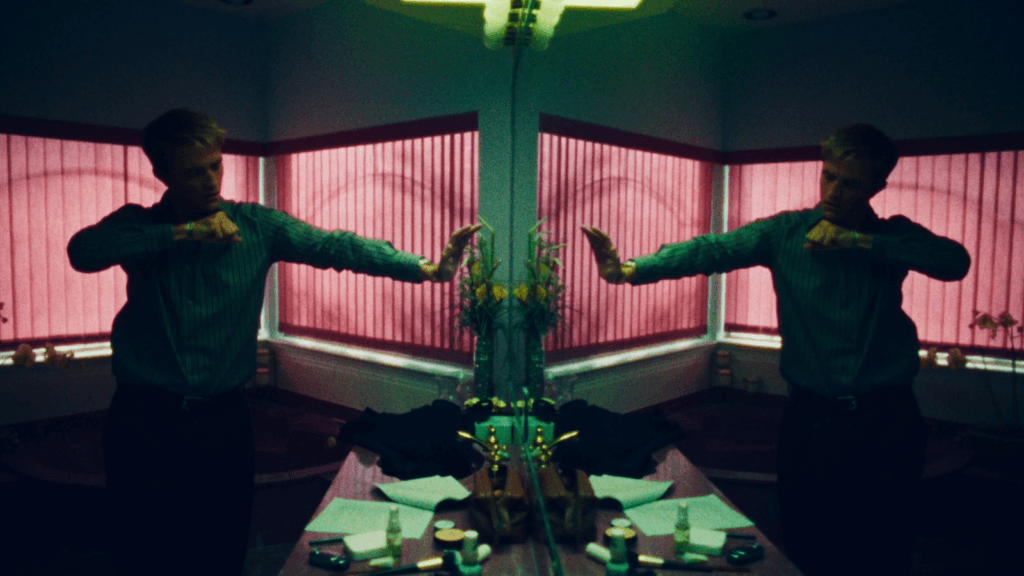
Pattinson has the flashiest performance, at once chilling and hilarious. His Hansen is an ethical void reminiscent of Kirk Douglas in Ace in the Hole (1951) and Jake Gyllenhaal in Nightcrawler (2014). More sympathetic is Dan (Skyler Gisondo, in his best role to date), an aspiring actor who lands a role as a Decoy on the show. Excited about the gig because now he’ll finally get a SAG card, Dan arrives on the set without fully grasping what comes next. In his first episode, he lures a man (Jonathan Lipnicki) who unexpectedly drops his pants, freaking Dan out. Afterward, Hansen must cajole the rattled Dan back to set with a lofty speech about the greater purpose of their work. “Nothing I do is acting,” he tells Dan, just before he scurries off to see his mistress. To be sure, Hansen isn’t the bastion of virtue that he presents himself to be, and for Oppenheim, the host’s duplicity makes him a hypocrite, even if infidelity isn’t the same offense as sexual predation.
Primetime features distracting visual choices, with footage altered to resemble early-2000s techniques. Its fuzzy, pre-high-def look appears in the boxy aspect ratio of most televisions from the era. Some scenes have a handheld camera look, while others resemble consumer-grade digital and filmic footage, all captured by cinematographer David Bolen and deployed unevenly. Oppenheim’s expressive approach has thriller notes, with Hansen as a crazed maniac who, while bonding with Dan in their curious father-son dynamic, recalls a 1996 trip to India. He recounts a series of missing Indian children and blames their disappearances on a demon—the same demon inhabiting the predators on his show. “We’re cleansing the world of an ancient evil,” he explains to Dan. “If you had children, you would understand.” Oppenheim exposes Hansen’s delusion in scenes where he perceives his targets as literal monsters. Primetime embraces this horror flourish with a jump scare as Hansen appears suddenly on a dark and stormy night.
Oppenheim’s sometimes glib approach to the subject matter largely ignores the predators’ subjectivity, and casting former child actors (Lipnicki, Revolori) as offenders is a prankish choice. That’s the problem with the original show as well, which isn’t trying to get these people help or understand why predators do what they do. Instead, it’s about ratings, with Hansen playing judge and jury, and cops sacrificing their role’s integrity for a chance to be on TV. But in both the film and real life, Hansen’s desire for ratings ultimately led to his show’s cancellation. Xavier convinces Hansen that someone in the government of Murphy, Texas, is a potential predator—whom Hansen calls The Whale because a high-profile target will get huge ratings. The outcome is a predictable tragedy that leaves everyone fully aware of Hansen’s mania. Dan, meanwhile, offers a moment of poignancy and sympathy with his rendition of “Seasons of Love” from Rent.

The question is whether audiences will recognize the commentary. Two men seated next to me in my preview screening seemed to purr with moral satisfaction during each dramatized capture. Maybe they misunderstood the film’s critique of Hansen, finding his antics funny and charmingly incorrigible rather than disturbing, because, in the end, he exposed dangerous people on the internet. And while Primetime certainly has some intentional laughs, it also confronts an uneasy reality about American television, its viewers, and their tendency to dehumanize people for entertainment. Hansen’s editors and producer famously cut around how the would-be predators sometimes break down and beg for help, preferring to show them as nothing more than ghoulish figures. Dan finally realizes the implications, and he questions whether what he’s doing makes him a bad person. He just wants to act, committing to his transformation into a teen boy with the same craftsmanship he admires in Billy Bob Thornton’s memorable lead role Sling Blade (1996). Most effectively, the film shifts perspectives from Hansen to Dan over its 110-minute runtime, with the former giving up his humanity and the latter just barely escaping with his.
Despite his documentary background, Oppenheim has no reason to devote his film to the facts here; it’s a work of fiction, and the story has been widely altered for dramatic effect, as the end titles explain. The irony, intentional or not, is that Primetime exaggerates the situation to entertaining extremes, especially in the climactic scenes. Maybe that’s the joke, that they’re doing what Hansen did, which in turn underscores how To Catch a Predator was presented as journalism but wasn’t. Or maybe the filmmakers are hypocrites, scolding the sanctimonious Hansen for putting his program first and the criminal cases second, while presenting a version of the truth marred by poetic license. Primetime’s overall effect may be questionable, but Pattinson, Gisondo, and Wever deliver marvelous performances, and the visuals have their moments. Still, many of the most compelling questions about the show and its host linger after Oppenheim’s simplistic but fascinating film, leaving viewers with plenty to consider, if somewhat unsatisfied with how it all comes together.

Thank You for Supporting Independent Film Criticism
If the work on DFR has added something meaningful to your love of movies, please consider supporting it.
Here are a few ways to show your support: make a one-time donation, join DFR’s Patreon for access to exclusive writing, or show your support in other ways.
Your contribution helps keep this site running independently. However you choose to support the site, please know that it’s appreciated.
Thank you for reading, and for making this work possible.
Brian Eggert | Critic, Founder
Deep Focus Review