I Want Your Sex
By Brian Eggert |
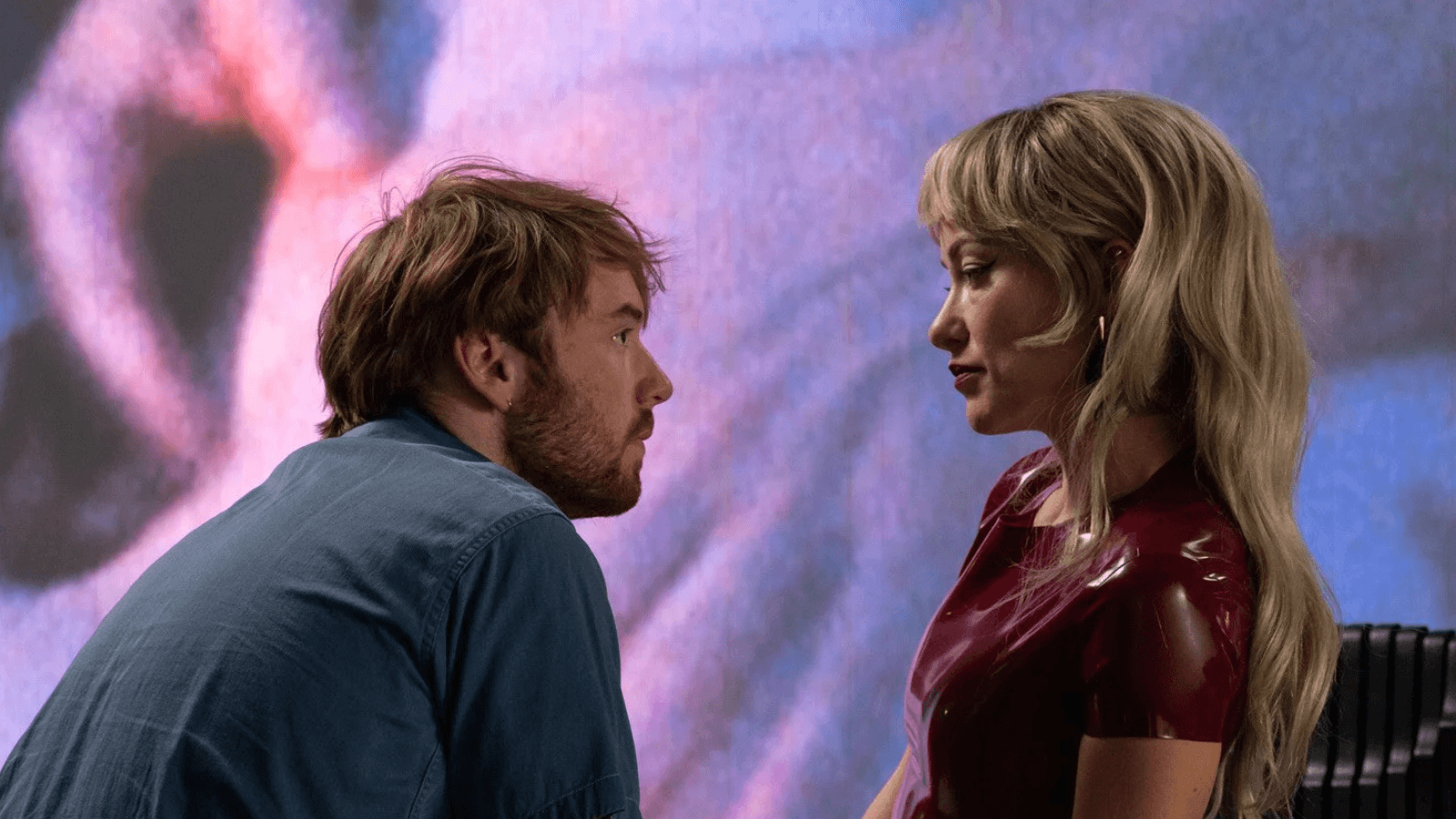
The first images of Gregg Araki’s I Want Your Sex prime us for the chaotically horny noir setup that follows. Cooper Hoffman stumbles out to the pool behind a lavish Los Angeles home. The sight is something to behold: Bruised and discombobulated, Cooper’s dazed character Elliot has just regained consciousness. The crimson lipstick smeared on his face makes his mild nosebleed look even worse. And he’s naked, save for a crooked pink bra and matching panties. Before him lies Erika, played by Olivia Wilde, Elliot’s neo-pop artist boss with whom he’s been having a not-so-secret, kinky dom-sub, May-December workplace fling. She’s naked and face down in the pool, seemingly as dead as William Holden in the first scene of Sunset Boulevard (1950). Later, he shares the details of what happened with two detectives (Margaret Cho, Johnny Knoxville) in an interrogation room. With playful glee, Araki cuts to “9 ½ weeks ago”—a nod to Adrian Lyne’s sultry drama from 1986—to start at the beginning. But the film is far from a shadowy, moody piece of pulp; it’s a candy-colored dark comedy in the filmmaker’s puckish style, driven by two outstanding lead performances.
Araki’s mission with I Want Your Sex, his first film in more than a decade, is to confront Gen Z’s “retro-sex negativity.” Co-scripted with Karley Sciortino, who writes for Slutever and Vogue about relationships and sex, Araki’s film tackles how many zoomers suffer from hang-ups about physical intimacy, stemming from a confluence of social and world factors, some out of their control. They came of age during the pandemic, when teens, the responsible ones anyway, were isolated from one another, which instilled anxiety about physical contact. Even when they can hang out, today’s surging housing market keeps them living with their parents well into their twenties, while inflation makes a traditional date unaffordable. Digital alternatives, from social media replacing real interactions to the widespread availability of dating apps and porn, hamper in-person socializing. The ideological chasm splitting people on political and gender lines, the marked decline in reproductive rights and the growing risks for women, and the increasing awareness of safety concerns have also amplified younger generations’ deprioritization of sex.
Hollywood’s recent prudishness and conservatism haven’t helped either. Whereas “sex sells” once served as a producer’s motto, the movies have responded to the cultural shift with fewer casual sex scenes, once a staple of R-rated entertainment between the 1970s and 1990s. However, along with violence, sex has always been a component of cinema, going back to nineteenth-century peep-show machines. Pauline Kael once remarked that “kiss kiss bang bang” represented “the briefest statement imaginable of the basic appeal of movies.” If that’s no longer true for many filmmakers, it’s an enduring concern for Araki, who has always been interested in exploring the perverse and unhindered desires of American youth, with a prankster’s tendency to smash taboos and toss the pieces at his audience. See his Teen Apocalypse Trilogy: Totally F***ed Up (1994), The Doom Generation (1995), and Nowhere (1997).
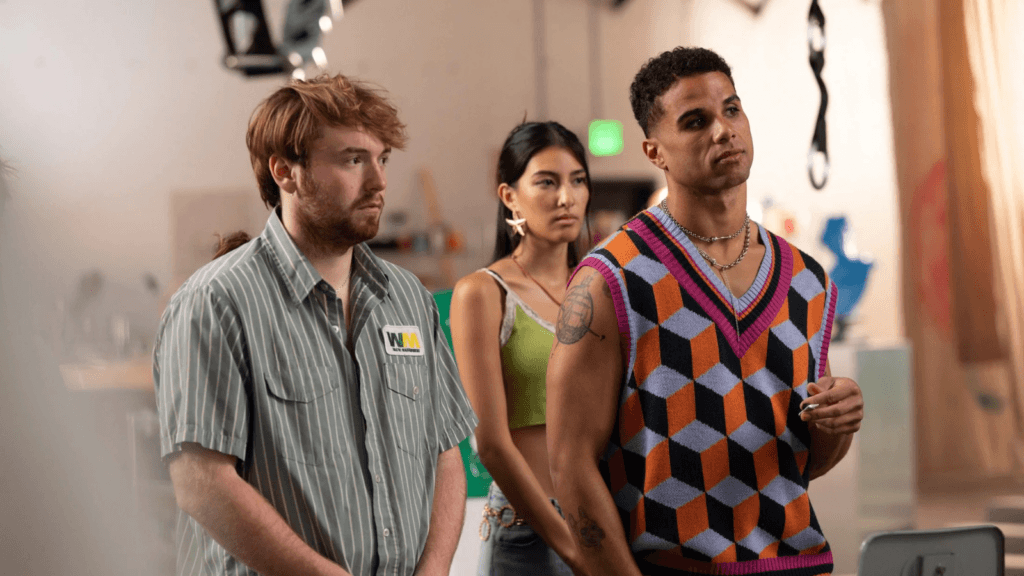
For the 23-year-old Elliot, sex is something he desires but seldom has a chance to enjoy. His girlfriend, Minerva (Charli xcx), always has her nose in a book, studying for her PhD. She dismisses his new assistant gig with Erika, calling him a “pretentious artist peon.” And when Minerva does agree to sex, it’s with begrudging exasperation and utter disengagement. His platonic BFF and roommate, Apple (Chase Sui Wonders), isn’t an option, perhaps because he’s drawn to women who dominate him. She eventually becomes envious of Elliot’s wild stories about Erika: “Why does all the cool sex-deviant stuff always happen to you?” she asks. Even in the job interview for the coveted role at Erika’s studio, the artist toys with him, at once grooming Elliot and testing the limits of what he’ll endure. But after he gets the job and spends time alongside co-worker Zap (Mason Gooding), painting pink plaster penises and masticating for a vaginal gum collage, the repressed Elliot leaps at Erika’s suggestion of a no-strings-attached hookup.
Araki isn’t trying to titillate his audience with I Want Your Sex. The scenes between Hoffman and Wilde aren’t particularly sensual or erotic (at least for this critic). They’re more like frenzied nympho BDSM montages of humiliation, spanking, bondage, piggy masks, and sex toys, with both performers down to expose themselves in absurdist play. She’s in leather and masks. He’s on all fours or bent over her lap, his butt cheeks paddled raw. This is nothing new for Erika, as her studio manager (Daveed Diggs) points out to Elliot. She’s done this with employees before. Her predatory behavior is a reflection of her sexual exhibitionist work as an artist. But even she admits her art is performative. In casual remarks to Elliot, she confesses, “The real art is convincing people you’re making something real and complex instead of just intellectual masturbation,” and later, “I just say bullshit sometimes to see if anyone’s listening.” She can be monstrous, but perhaps she’s just deeply insecure and desperate for control. Wilde’s performance goes a long way to humanize her, despite some atrocious behavior in the final third.
But as much as the film paints an unflattering portrait of Erika, Araki doubtless agrees with her that Elliot’s generation is “dying to fuck but too chickenshit to admit it.” Still, Elliot leaps in and learns about himself, and it’s not all to his delight. At one point, Erika passes him along to her friend from Paris, Yvette (Roxane Mesquida), as her “boy whore.” Yvette turns him down, preferring eroticism over humiliation, sensuality over submission. But the eager-to-please Elliot finds his limit after an ugly scene in which Erika convinces him to talk Apple into a threesome. Erika channels her anxiety about an upcoming show into an uncomfortable domination, exposing an underlying crack in Elliot and Apple’s friendship (Wonders is heartbreakingly good in this scene) and revealing just how callous she can be. And yet, Elliot somehow deludes himself into thinking he can have a meaningful emotional connection with her. Even though she burns Elliot in the end, and even though she takes it disturbingly far, Araki sees the value in the experience. That, it turns out, is the point.
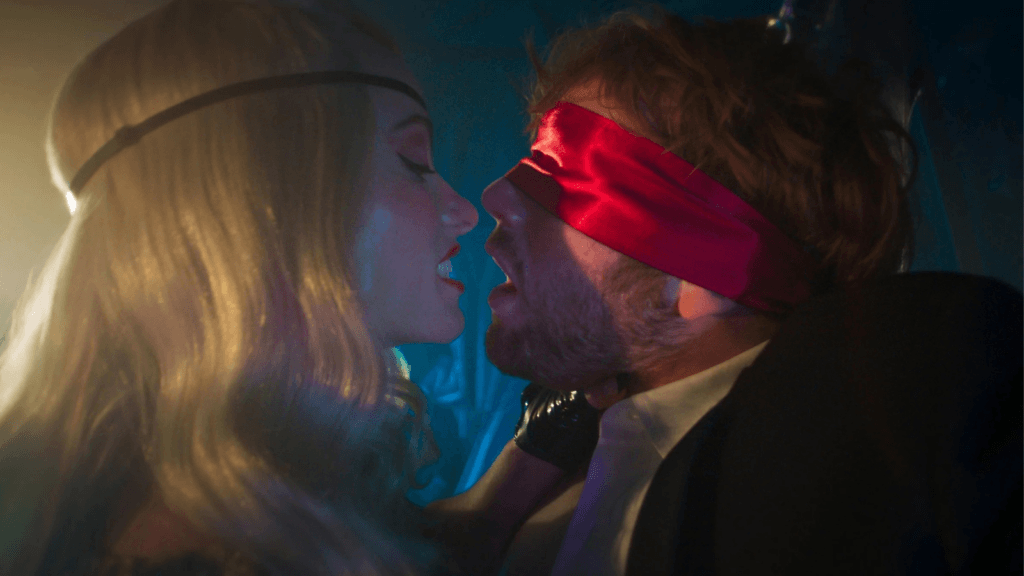
Bursting with fluorescent colors and cut with zippy maneuvers by editors Araki and Victor de la Parra, I Want Your Sex is a sensory explosion, recalling the aesthetic of Boots Riley’s recent I Love Boosters. The film looks sharp and bright, with cinematographer Tucker Korte’s intense lighting and Angelique Clark’s vivid production design—particularly the heightened spaces of Erika’s studio with giant ball gags and anal beads hanging from the ceiling. Similar to Araki’s underrated stoner comedy Smiley Face (2007), the director dabbles in fast-forwards and dream sequences with a particular irreverence. And his use of animation, from Jessica Rabbit breasts on Minerva to fireworks over Elliot masturbating, has all the subtlety of a teenage boy with sexual brain rot. If the film threatens to be too much at times, it’s at least refreshingly short at 90 minutes (and shockingly devoid of the titular George Michael song). Fortunately, Araki directs two of the best performances in his oeuvre. Wilde and Hoffman are outstanding, with his eyes earnest and open, and hers almost manic. Hoffman got his start in another role opposite an older woman in Licorice Pizza (2021), and he’s just as charismatic and alive here, proving that he’s an affable screen presence and an actor willing to take risks. Wilde, who just gave one of her best performances to date in The Invite, which she also directed, appears to be having fun playing such an insatiable but surprisingly fragile character.
All of Araki’s mischief might derail a more self-serious film about a BDSM relationship between age-gapped partners; his techniques certainly wouldn’t align with Babygirl (2024) or this year’s Pillion. The filmmaker’s impish tendencies give way to a messed-up twist that undercuts the solid character work and dimensional performances in I Want Your Sex, adding a layer to Erika that he doesn’t explore much afterward. However, the twist does fit with the noirish plot structure. Among the multiple endings that follow the big reveal, Araki punctuates his film with a non-sequitur that takes a jab at marriage and the notion of limiting yourself to one partner. These rather flippant touches feel removed from the film’s earlier tone, particularly the twist’s rascally but plot-centric motivations. Filtering out Araki’s more random choices, the viewer may stumble upon his lesson that exploring your limits, rather than avoiding risk, is essential to leading a full life. It’s a message that feels essential to the 66-year-old director, who shows no signs of slowing down or softening his edges.
(Editor’s Note: Corrected the spelling of Gregg Araki’s first name.)
Thank You for Supporting Independent Film Criticism
If the work on DFR has added something meaningful to your love of movies, please consider supporting it.
Here are a few ways to show your support: make a one-time donation, join DFR’s Patreon for access to exclusive writing, or show your support in other ways.
Your contribution helps keep this site running independently. However you choose to support the site, please know that it’s appreciated.
Thank you for reading, and for making this work possible.
Brian Eggert | Critic, Founder
Deep Focus Review