Late Shift
By Brian Eggert |
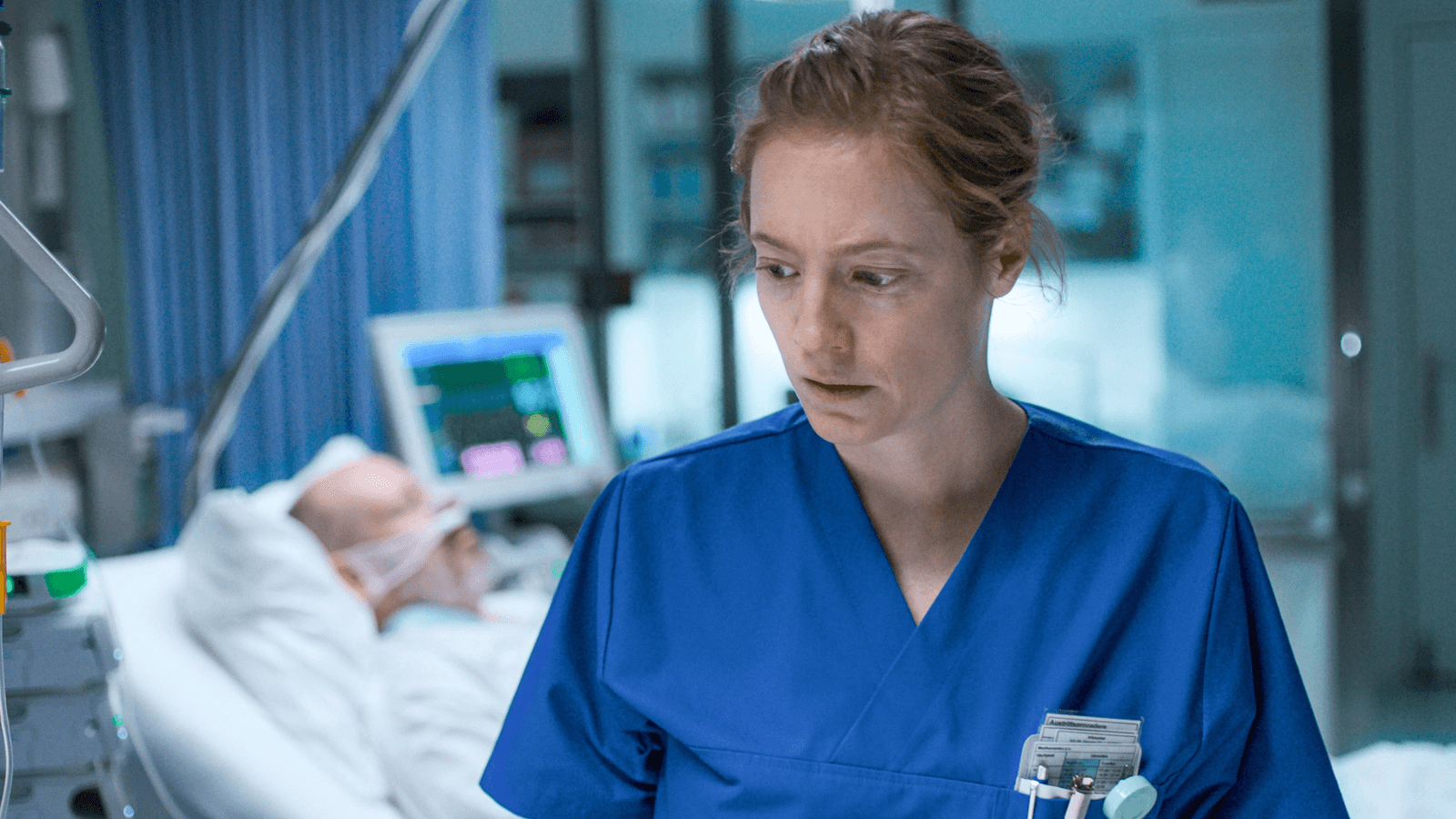
Anyone who’s spent time in a hospital in the last six years has probably asked the question, “Where’s my nurse?” The Swiss drama Late Shift tries to answer that question in a roundabout way. The answer: “It’s just the two of us today,” nurse Floria Lind explains to her patients. “I haven’t forgotten you.” But she’s spread thin. She’s one of two nurses on duty, along with an inexperienced trainee, overseeing a full ward. Her 25 patients have life-altering illnesses, await surgery, and recover from procedures. Some wait hours—even days—to have a consultation with their doctor. The film takes place in the trenches of Floria’s world, where nursing shortages place an unthinkable burden on understaffed hospitals everywhere. A World Health Organization statistic shared in the film’s epilogue claims that by 2030, the nursing shortage will reach 13 million worldwide. And while we’re accustomed to needing nurses to give us a shot, bring us medication, or wheel us to surgery (and bring us some ice water and a cookie when it’s over), and feeling annoyed when they don’t, Late Shift shows us another perspective and asks us to have a little more understanding.
Writer-director Petra Volpe’s interest in the nursing crisis began even before the COVID-19 pandemic brought the problem into sharp focus. But it wasn’t until she read Our Profession is Not the Problem: It’s the Circumstances, a 2020 nonfiction book about the experiences of German nurse Madeline Calvelage, that the filmmaker began developing her ideas into a feature. Volpe shadowed nurses in Swiss hospitals as part of her research. She also enlisted both Calvelage and nursing specialist Nadja Habicht to provide input on the script and production to ensure authenticity. Although Volpe’s efforts haven’t resulted in anything as dramatic as your typical hospital show—ER, House, The Pitt, take your pick—the film’s grounding in reality helps shine a light on a problem that extends well beyond Switzerland’s more than 275 hospitals, which will be short 30,000 nurses in four years.
Floria is played by the excellent Leonie Benesch, from The Teachers’ Lounge (2024) and September 5 (2024). According to the press notes, Benesch completed an internship in a Swiss hospital to prepare for the role. She’s terrific as Floria, who works alongside fellow nurse Bea (Sonja Riesen), while the twentysomething Amelie (Selma Aldin) learns the job. Floria switches between German, French, and Italian in her rounds, which begin with an incontinent woman and include several patients “at the door.” She sanitizes her hands upon entering every room and fields an onslaught of calls from staff and even patients. While treating one patient’s nausea before a needed CT scan and getting painkillers for another, she’s interrupted by a call from a mother whose daughter left her glasses in a room. She could tell the woman to call someone else, that she’s not the goddamn lost-and-found, but instead she writes down the number and will get back to her. It’s not until later that we learn that Floria is also a mother in the midst of a separation from her husband.

Floria’s work isn’t played for melodrama. Rather, it’s the smaller moments, when she must treat her patients more as a counselor than a nurse, that prove most memorable. In one scene, she calms a disoriented patient by singing with her. Another heartbreaking subplot involves Mr. Leu (Urs Bihler), a man who’s been waiting for a diagnosis since Floria’s shift the day before. She knows he has colon cancer, but procedure requires a doctor to tell him. He grows impatient, wanting to get home to his old dog. Floria assures that the doctor will come as soon as she can. But she takes a moment to look at a photo of Mr. Leu’s furry friend. Despite being overtasked, she’s never too busy to stop and ask if a patient is feeling okay or offer a gesture of consideration. No wonder the film’s title in German (Heldin) translates to Heroine, the feminine form of the noun. Fortunately, Volpe resists portraying Floria as a saintly woman. Under constant high-stress conditions, she makes a frightening mistake; later, she loses her temper with a snobby patient who, because he pays for the perks of private insurance, thinks he can treat her like his “assistant.”
Given that women occupy the majority of nursing roles, Late Shift cannot help but take on a feminist slant, even though it never makes any outright statements. That’s true behind the camera as well. As Floria navigates the overstuffed hospital, overworked colleagues, and patients who all want a private room, Volpe’s formal treatment is so engrossing that the viewer could be forgiven for overlooking just how marvelously it’s shot. Cinematographer Judith Kaufmann arranges long takes with a really-there sense of observational realism. Underneath the fluid camerawork, Emilie Levienaise-Farrouch’s pulse-like score creates a persistent, unrelenting tension. Production designer Beatrice Schulz and costume designer Linda Harper employ a sterile but familiar color palette of blue, white, and silver in the hallways and costumes. It feels like we’re with Floria for every moment. However, Late Shift isn’t a real-time feature. We see a mere 90 minutes of her day. But given that she takes only one short break and never eats onscreen, we can assume her shift never slowed.
Late Shift was Switzerland’s official entry to the Academy Awards. Although it wasn’t nominated, it’s a moving, fast-paced film that will leave you wanting to give your healthcare provider a hug. Throughout the film, Floria races down hallways and juggles patient needs, only to calm when she actually engages a patient. It’s no stretch—though it might be a cliché—to describe the tone as a rollercoaster, constantly going up and down. Still, Late Shift has a refreshing lack of sensationalism throughout its runtime. Those accustomed to watching doctor shows will find a decided lack of extreme cases and shock value. Volpe is content to follow Floria on her rounds, limiting the heightened drama to a couple of brief moments. If there’s a false note, it’s the sentimental song that plays over the final scenes, leading to the last shot that spoils the film’s realism for something unnecessarily spiritual. It deflated my enthusiasm for what was otherwise an immersive portrait of a practical problem that affects everyone. This flourish aside, Late Shift honors healthcare providers who put so much of themselves on the line to help others.
Thank You for Supporting Independent Film Criticism
If the work on DFR has added something meaningful to your love of movies, please consider supporting it.
Here are a few ways to show your support: make a one-time donation, join DFR’s Patreon for access to exclusive writing, or show your support in other ways.
Your contribution helps keep this site running independently. However you choose to support the site, please know that it’s appreciated.
Thank you for reading, and for making this work possible.
Brian Eggert | Critic, Founder
Deep Focus Review