Animal Farm
By Brian Eggert |
Andy Serkis has been developing a passion project for the last fifteen years, and the conceptual framework is curious yet full of potential. He sought to present George Orwell’s 1945 novella Animal Farm in a family-friendly, computer-animated format. Orwell intended his grim story, populated with talking animals like a storybook (or a Disney cartoon), as a fairy tale. And though the story has been adapted to the screen a couple of times before, in 1954 and 1999, Orwell has never felt so mainstream as he does in Serkis’ film. With its remarks against authoritarianism, the story couldn’t be timelier. However, Serkis, whose underwhelming directorial efforts include Mowgli: Legend of the Jungle (2018) and the forgettable Venom: Let There Be Carnage (2021), teams with writer Nicholas Stoller, perhaps best known for directing Forgetting Sarah Marshall (2008) and Bros (2022), for a garish production that feels about as subtle as a captive bolt to the skull. This says nothing of the animation style, which has a generic quality that many direct-to-streaming efforts today far surpass. Overall, it’s a well-intentioned production that arrives on screens with a lot of baggage and a tedious pop-entertainment aesthetic.
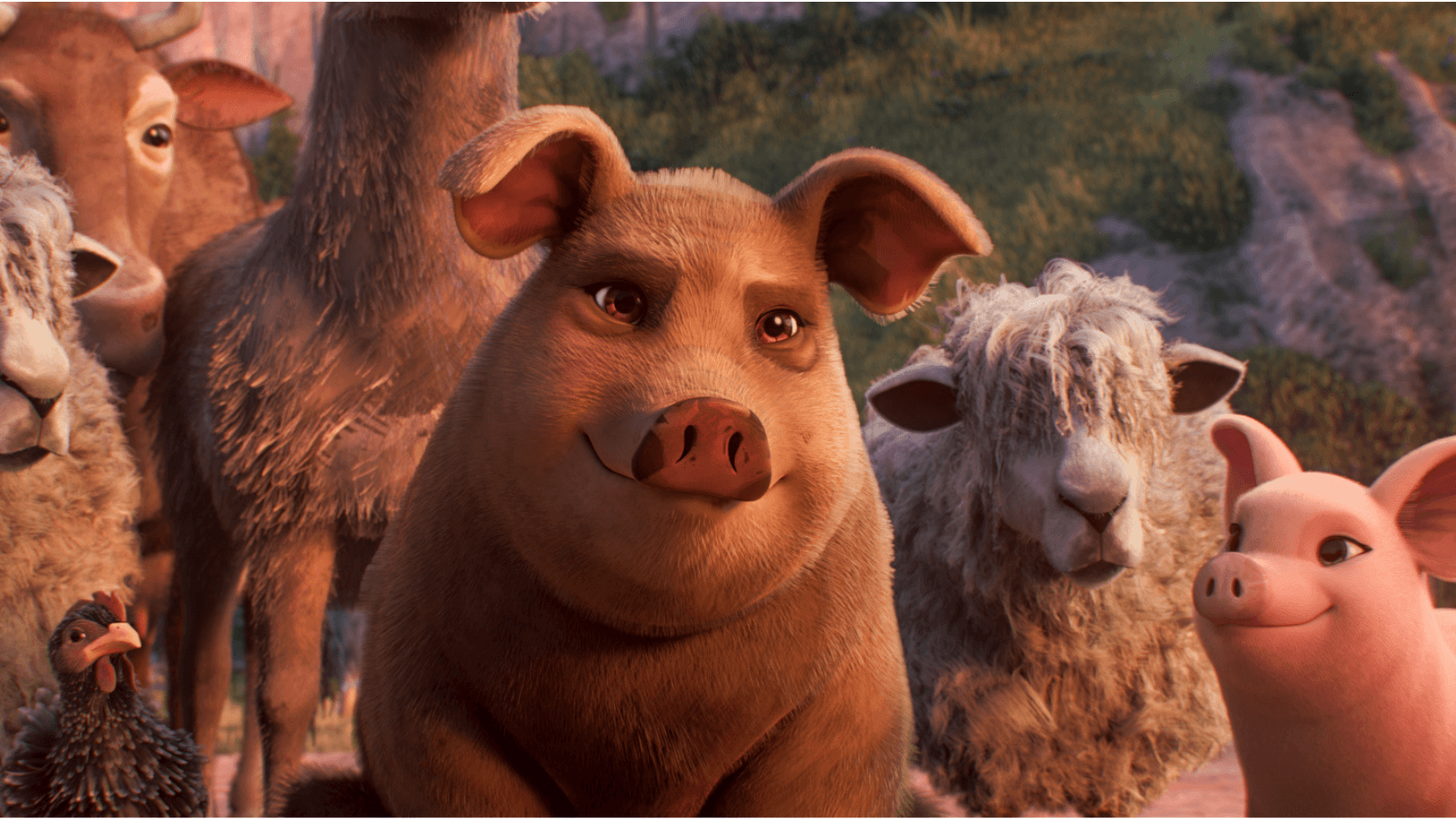
As presented, Animal Farm plays like a story set on the rural outskirts of Disney’s Zootopia movies. Seth Rogen voices Napoleon, a boar who starts out by championing animal freedoms only to become a corrupt despot. Napoleon recalls a more insidious counterpart to Rogen’s role in Sausage Party, the R-rated 2016 animated feature that skewers religious beliefs. He voiced a hot dog who led an anthropomorphized food exodus from a grocery store. Here, after a fellow boar and compatriot, Snowball (Laverne Cox), passes down the Seven Commandments of animaldom and banishes humans from the farm, Napoleon seizes power. He promises to support equality and enrich animals’ lives, but he and his fellow pigs (a pointed choice) soon take over, exploiting everyone else for personal satiation and glory. Our moral compass is Lucky (Gaten Matarazzo), a piglet who can’t decide if Napoleon is a father figure or an autocrat who must be stopped. The name should tell Lucky everything, but something tells me these farm animals don’t read much French history.
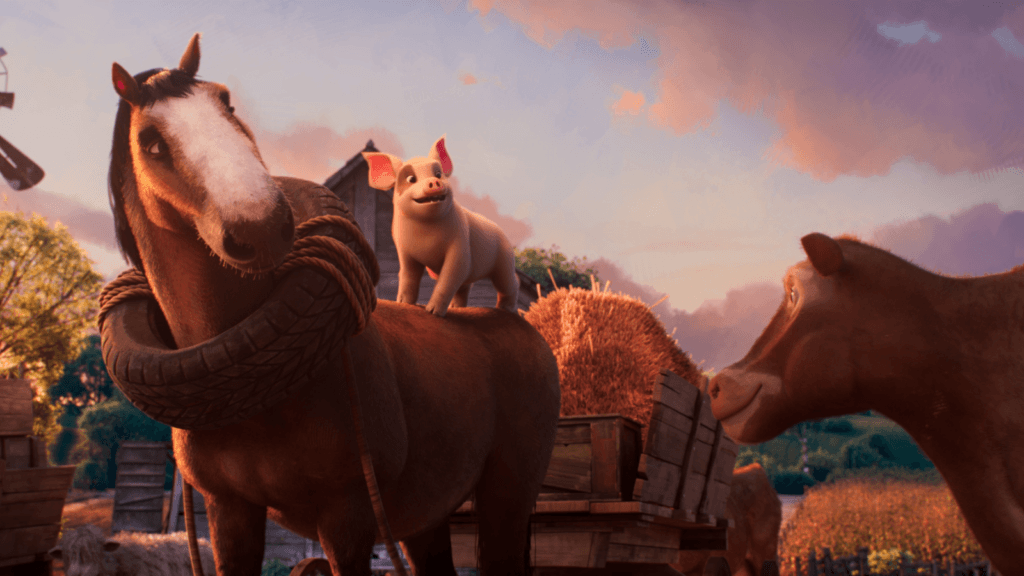
The movie is saturated with cloying narration performed by Woody Harrelson, who voices a horse named Boxer as though he’s reading to five-year-olds at story time, with a delivery so slow it seems as though he’s stopping to show storybook illustrations to a rapt daycare audience. Boxer reinforces every theme by over-explaining what’s happening. The dialogue elsewhere is just as obvious. When the animals take control of their commerce by opening an animal-run farmer’s market, the human guests proclaim their feelings out loud to no one in particular. “Animals? Running a farm? I had to see it for myself!” one human announces. “I can’t believe I’m buying eggs from a chicken!” says another. Serkis and Stoller’s interpretation might seem overly concerned with how Napoleon turns the farm into a venal corporation, diluting the political implications of Orwell’s story. But then again, capitalism and politics seem to walk hand in hand these days.
In his director’s statement about the film, written in response to early negative feedback, Serkis insists, “Orwell would have approved.” Watching Napoleon unleash a fifteen-second fart, I wondered if that could really be true. Would Orwell also have enjoyed the film’s crude humor, punchy montages set to pop music, and references to The Price is Right? Who can say? Fortunately, Animal Farm still contains the author’s remarks about how freedom and equality can be corrupted by those in power, along with warnings about the realities of industrialization, exploitation, and propaganda. Orwell wrote his novella in response to Joseph Stalin’s rise after the Russian Revolution of 1917, to explore how even the most idealized political systems can be corrupted by charismatic leaders who grow drunk on power until they become dictators. Some scholars of the book and critics of the new movie have read the text as anti-capitalist. “Our characters enthusiastically embrace capitalism,” writes Serkis in his statement. “What they rebel against is corruption.”
The distributor, Angel Studios, further complicates Serkis’ film. The company was formerly VidAngel, a service that allows users to access Hollywood movies with all explicit content either edited out or rendered skippable. Framing themselves as David fighting Goliath, Angel Studios hopes to disrupt the traditional studio model by relying on its “Angel Guild” of two million members worldwide. Founded by the Harmon brothers, a Latter-day Saint family, the studio takes pitches, called “torches,” and the Guild votes on whether to produce a “value-based” production. However, their crowd-funded company’s language registers as culty and often has Christian underpinnings. Their mission, according to their website, is to “amplify light”—an intentionally vague term that stands in for their belief system. Indeed, Angel Studios contains more than a whiff of faith-based filmmaking and right-wing nationalism, given its distribution of Sound of Freedom (2023), several biblical stories, and an upcoming political thriller about Ronald Reagan negotiating a nuclear arms deal with Mikhail Gorbachev. Given that their organization seems less about supporting good artists than a particular set of ideas, it’s worth meeting any Angel Studios production with a degree of skepticism.
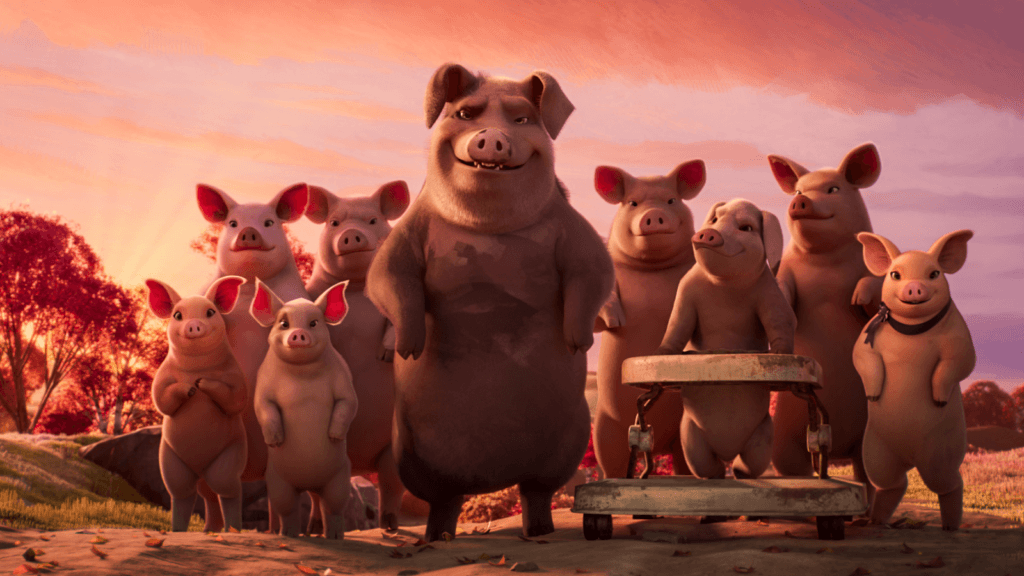
Setting aside the distributor, Animal Farm was produced by Aniventure, a lesser-known animation house behind Riverdance: The Animated Adventure (2021), Hitpig! (2024), and Stitch Head (2025). The animation is uneven, alternating between atmospheric lighting, stunning landscapes, and generic designs. Much of the scenery (particularly the luminous skies) makes gorgeous use of color, while the character modeling is uninspired, particularly in the flat-looking eyes and expressions. The production relies on the considerable celebrity voices to make up for the animation. An extended opening credits sequence conspicuously highlights the big-name voice cast, including Steve Buscemi, Glenn Close, Kieran Culkin, Jim Parsons, Kathleen Turner, and Iman Vellani. Good as they are, the actors can’t distract from Animal Farm’s underwhelming look and telegraphed emotions, over-accentuated by needle drops and Heitor Pereira’s heavy-handed score.
Animal Farm isn’t strong enough to overcome the distractions posed by its unusual distributor and uninspired visual presentation. Never once did I feel involved in what was happening onscreen, though it will surely play better with small children. Orwell’s allegorical implications remain intact, if overshadowed by the production’s flash and acquiescence to modern viewers’ short attention spans. Then again, what feels obvious and pandering to those well-versed in the story may be new to the uninitiated. At the very least, the power of Orwell’s themes will be unmistakable. Napoleon’s crowd of followers chants, “We’re all equal!” He adds the caveat, “But some are more equal than others!” The message is clear, ironic, and unequivocal. And yet, more telling is the end credits sequence, with a series of painting-like stills depicting a timeline of how human history—albeit with pig stand-ins—has seen a succession of dictatorial leaders whom people have fought for freedom. The procession, including pig versions of ancient Egyptians and Marie Antoinette, ends with a piggish Stalin. Apparently, the filmmakers felt portraying pig-Hitler and any number of today’s right-wing autocrats would have been going too far. I’m not sure Orwell would agree.
Thank You for Supporting Independent Film Criticism
If the work on DFR has added something meaningful to your love of movies, please consider supporting it.
Here are a few ways to show your support: make a one-time donation, join DFR’s Patreon for access to exclusive writing, or show your support in other ways.
Your contribution helps keep this site running independently. However you choose to support the site, please know that it’s appreciated.
Thank you for reading, and for making this work possible.
Brian Eggert | Critic, Founder
Deep Focus Review