Hokum
By Brian Eggert |
Note: Damian McCarthy’s Hokum was screened as part of the 45th Minneapolis St. Paul International Film Festival. Visit the festival’s site here. Neon will release the film on May 1, 2026.
Irish filmmaker Damian McCarthy reminds us that the tricks many horror filmmakers use to scare us only become tiresome in the hands of the unskilled. A talented filmmaker can turn jump scares, shadows passing in front of the camera, and unreliable light sources into the stuff of nightmares. Hokum is McCarthy’s third feature after the independent Caveat (2020) and Shudder production Oddity (2024)—both worth checking out—and finds the writer-director breaking into Hollywood with a major release courtesy of Neon. The modestly budgeted picture features a well-liked leading man, Adam Scott, and impressive, atmospheric production values that feel like an extension of McCarthy’s earlier work. Like Oddity, for instance, much of Hokum finds its protagonist in isolated spaces where, at any moment, something horrifying may start scratching at doors or leap out from the dark. However standard these devices may sound, McCarthy deploys them within a patient, moody film that’s both frightening and affecting.
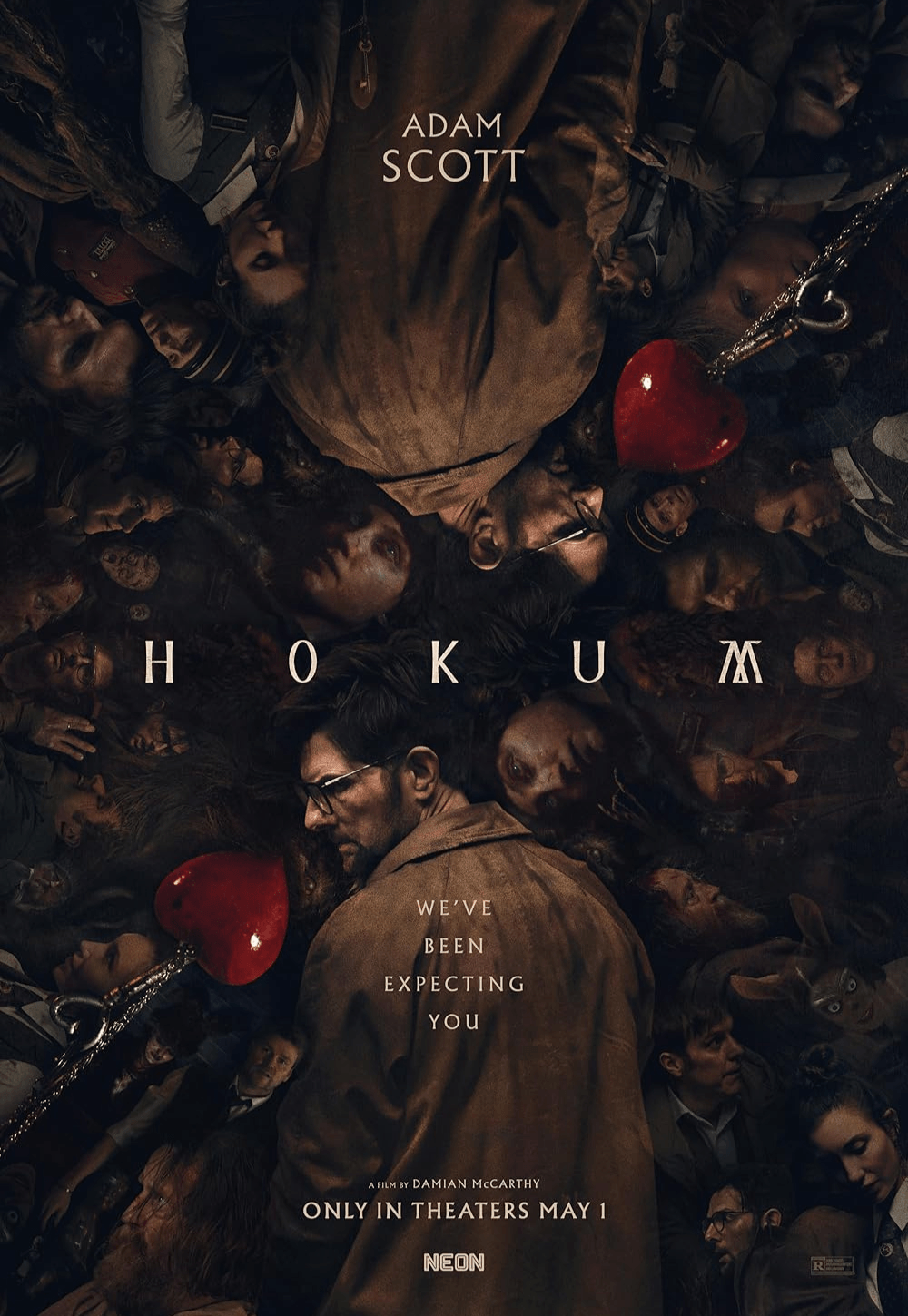
Scott plays Ohm Bauman, a famous, albeit depressive and alcoholic American author on the verge of finishing his Conquistador Trilogy, when a dark shape from his past suddenly spooks him. Compelled to get away from home and finish his book, he chooses an isolated spot, the quaint Billberry Woods Hotel in Ireland, where his parents honeymooned. He plans to scatter their ashes in a nearby forest, at a tree his mother was photographed beside during that same honeymoon trip. Upon his arrival, the generally cantankerous writer immediately needles everyone he meets, getting into their business: he questions Fergal (Michael Patric), the owner’s son, about crossbowing a goat in the hotel parking lot. He’s unpleasant to the appropriately named front desk manager, Mal (Peter Coonan), and downright cruel to Alby (Will O’Connell), a chummy bellhop with literary ambitions whom Ohm thinks is too thin-skinned to be a writer. But Ohm’s irritability is only somewhat softened by Fiona (Florence Ordesh), a bartender who takes pity on him.
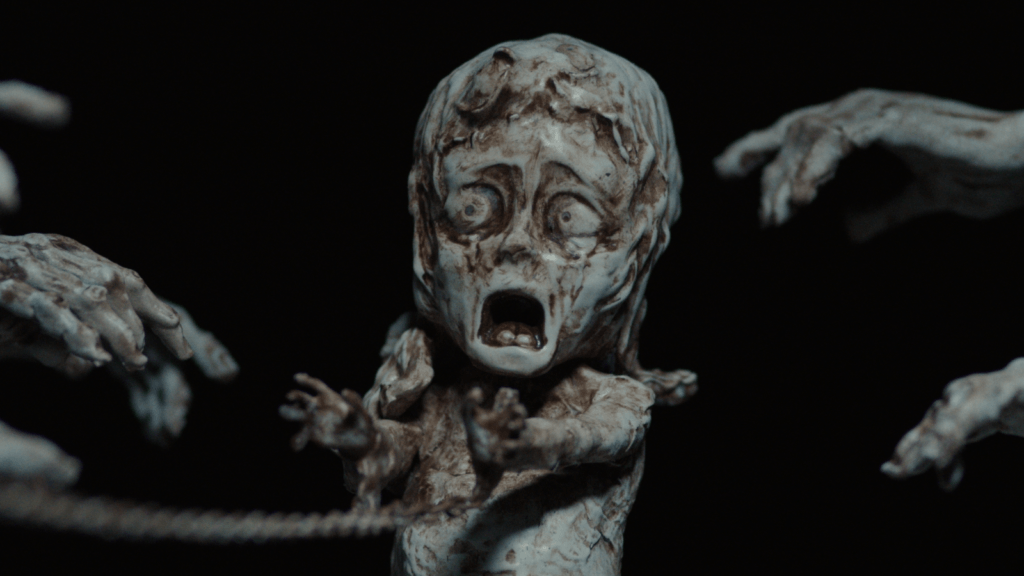
Shot on location in West Cork, the film features picturesque scenery, and the local folklore is rich and alive, especially if you’re like Jerry (David Wilmot), a loner who lives in the woods and drinks magic mushroom juice to open his mind to supernatural forces. Among the local legends is one that the hotel owner, Mr. Cobb (Brendan Conroy), tells some kids: about a witch who chains up children and drags them through the underworld. The hotel’s owner believes the witch has been trapped in the off-limits Honeymoon Suite, so when Fiona goes missing, everyone refuses to check the locked-up room. Ohm resolves to investigate himself, feeling partly responsible for Fiona after she saves him from a suicide attempt in his room. With the hotel closed for the season, Ohm and Jerry resolve to team up and search for her in the forbidden suite. Their sleuthing reveals both the secret of what happened to Fiona, which is much more grounded than one might guess, and also the terrible reality of the witch.
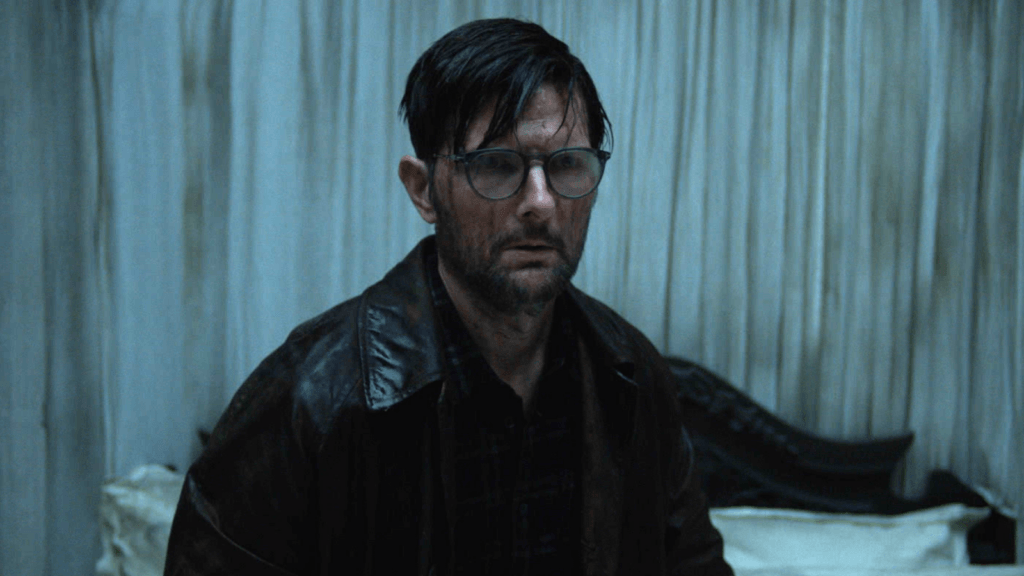
Bookending the film, we see scenes from Ohm’s last Conquistador book play out in his mind as he writes the finale, his hands displaying a slight tremor as he sips whiskey and punches out words in an underlit room. Austin Amelio plays Ohm’s protagonist, appearing in the desert in sixteenth-century armor and accompanied by a young boy. Following a map to buried treasure, the man faces an impossible decision that becomes an allegory for Ohm’s relationship with his parents. The symbolism serves as a framework for decoding his mental state; after exploring it, we begin to understand his prickly demeanor. Scott perfectly handles Ohm’s dry sarcasm and American entitlement, even while preserving the character’s potential for redemption. Scott is an actor who can switch from a deplorable prick (Step Brothers, 2008) to a likable dork (Parks and Recreation, 2009-2015) to a complicated everyman (Severance, 2022-) quite effortlessly. McCarthy makes the most of that, preserving our investment in Ohm while recognizing he can be an asshole.
McCarthy’s script is ripe with literary symbolism to the extent that it’s apparent he’s just as interested in exploring Ohm’s headspace as he is dishing out scares. Though Hokum has plenty of those, too. McCarthy conjures nightmare imagery with a messed-up rabbit-man whose crazed eyes and taunting lines prove jarring. Most horrifying is our brief glimpse of the underworld, a dreadful flash teeming with greedy black figures with reaching hands and reflective eyes. McCarthy doesn’t give us a full picture, just enough to implant terror. The same is true of the witch, who never becomes a CGI character, like so many supernatural figures in horror movies these days. Indeed, Hokum operates with a unique visual language, rendering its terrors with imagery that doesn’t feel like another tired variation of the James Wan and Blumhouse production modes.
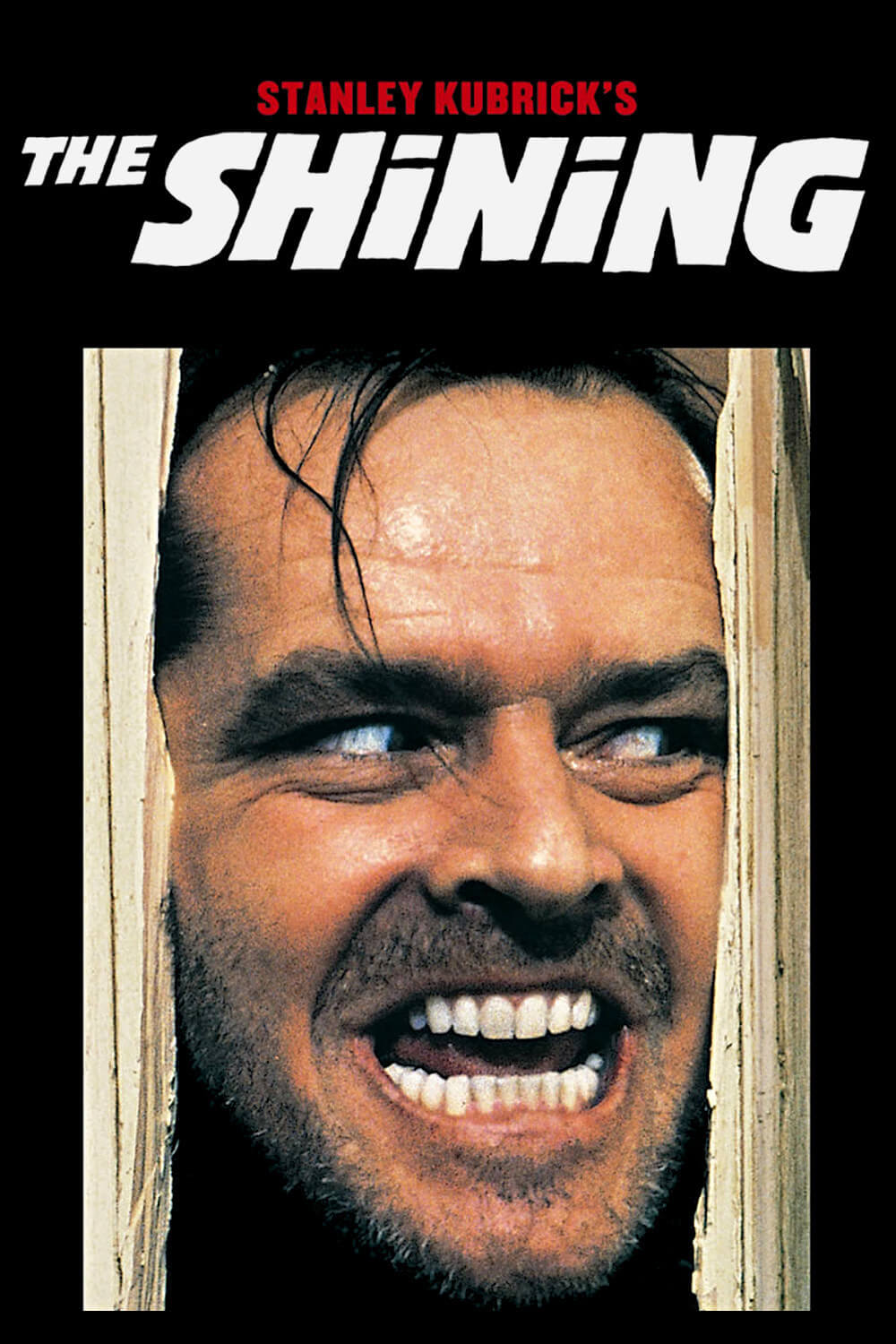
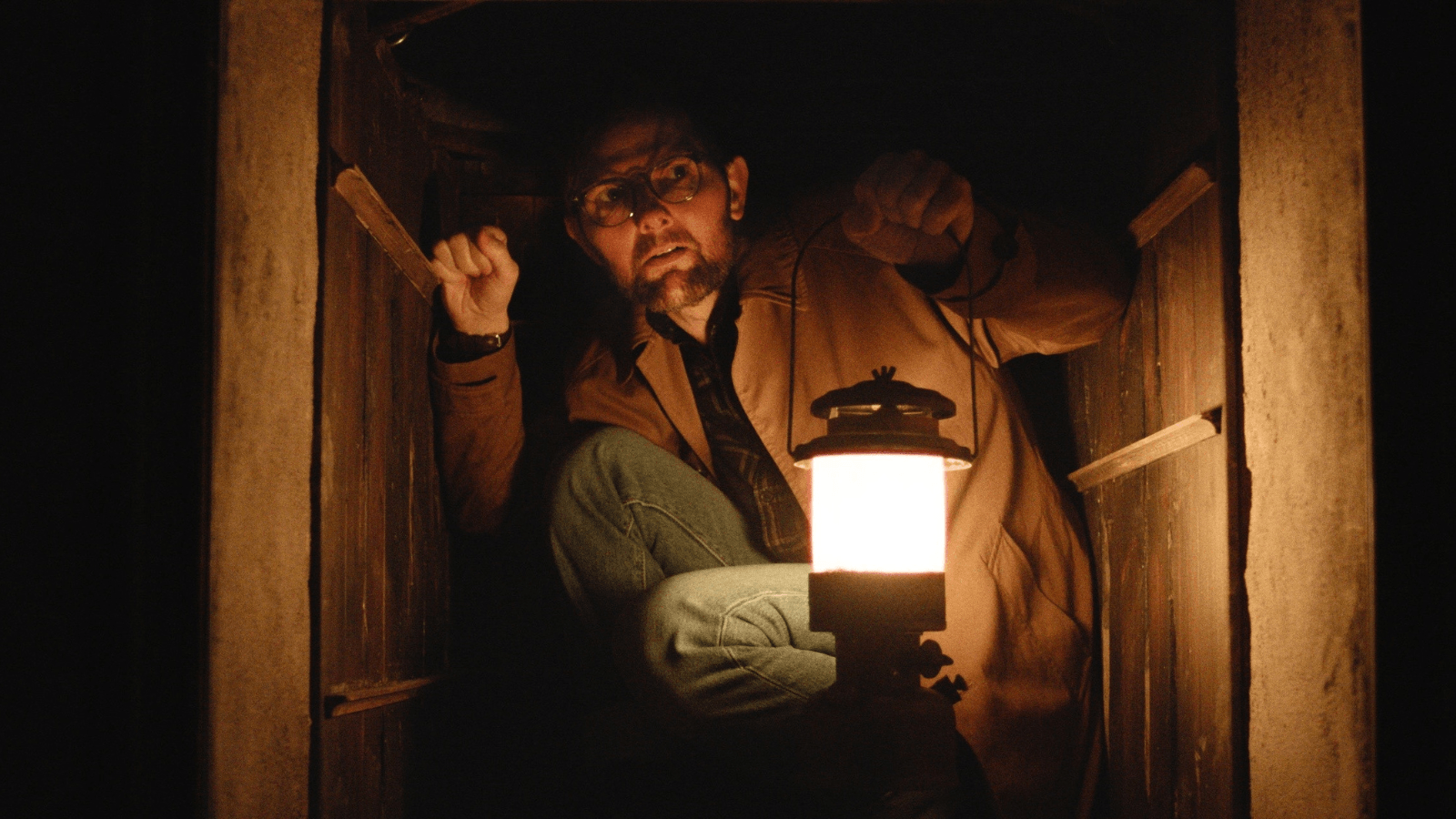
Although McCarthy faintly winks at Stanley Kubrick’s The Shining (1980), the ultimate haunted hotel film—particularly with his tormented, alcoholic writer character and Joseph Bishara’s haunting score of choral moans—he doesn’t resort to direct homages. But The Shining was clearly on his mind when he conceived Hokum. He also deploys several chilling devices, such as a broken dumbwaiter that requires some rigging before it can return from the hotel’s forgotten, sealed-off basement. The Honeymoon Suite is a microcosmic haunted house, with figures moving in the background and a jacuzzi tub filled with rancid green water. Of course, Ohm’s lantern proves unreliable, but for every cliché McCarthy employs, he keeps the viewer guessing with the unexpected. Hokum is effective because it’s not just about a witch; there’s a human element to the horror that proves twisty and thrilling, recalling Robert Zemeckis’ What Lies Beneath (2000).
McCarthy’s execution is near perfect. The ending feels a tad long, but whatever doesn’t work could be mere nitpicks on my part. For example, an unnecessary callback in the final scenes shows how Ohm’s mind may have been opened to the experience, giving us a redundant reminder of information already established (a critical pet peeve of mine). The final scene also evokes the original coda of The Shining, which is set in a hospital. Kubrick cut that scene because it seemed overly expository. It might be somewhat pandering here, too, except it also gives Ohm closure regarding his parents. And more than folk horror or supernatural terror, Hokum thrives on its character work. McCarthy’s smart script and Scott’s layered performance tie each facet of the story to Ohm in some way. Venerable works of horror, from Rosemary’s Baby (1968) to The Babadook (2011), find ways to take internal psychological concerns and externalize them. They last because their narrative thrust is compelled by more than base shocks. Hokum does this thoughtfully, which only enhances the scares.
Thank You for Supporting Independent Film Criticism
If the work on DFR has added something meaningful to your love of movies, please consider supporting it.
Here are a few ways to show your support: make a one-time donation, join DFR’s Patreon for access to exclusive writing, or show your support in other ways.
Your contribution helps keep this site running independently. However you choose to support the site, please know that it’s appreciated.
Thank you for reading, and for making this work possible.
Brian Eggert | Critic, Founder
Deep Focus Review