The Definitives
M (1931)
Essay by Brian Eggert |
M, Fritz Lang’s 1931 masterpiece, follows a manhunt to catch a child murderer named Hans Beckert, played by Peter Lorre. When he’s eventually identified—by a blind man, no less—it is because Hans unconsciously whistles notes from Edvard Grieg’s “In the Hall of the Mountain King” theme, from music written for Henrik Ibsen’s 1867 play, Peer Gynt. Drawing on folktales, Ibsen’s fantastical drama features a frenzied scene in which trolls chase the hero. “Eat him!” the creatures shout. “Tear away both his ears and his eyes!” Lang undoubtedly saw a popular Berlin production of Peer Gynt in 1928 and found the sequence evocative. He includes a similar moment in M, when a vigilante mob ensnares Hans, clamoring, “Kill the rabid dog!” and “Kill the monster!” The twist is that, by the end, the most monstrous figure in the film isn’t Lorre’s character but the crowd—a bloodthirsty mob of grotesque faces worthy of Pieter Bruegel the Elder. Lang’s film, one of the most influential and enduring in German cinema, demonstrates a sympathetic understanding of Lorre’s tormented character, while the mob draws Lang’s ire. Through subtle implications so slight that the Nazis in the Weimar Republic missed them, Lang associates the mob’s actions with the National Socialists, who were emerging as a volatile political force in Germany.
When looking at any classic movie, the question always arises: Is the film vital because it’s a historical artifact, has some contemporary relevance, or influenced subsequent films? M transcends these questions. As we will see, the film is a product of its time that reflects present-day sociopolitical realities, and it has also influenced countless films about serial killers, missing children, and police investigations since its release. M has often been seen as a precursor to the wave of serial killer thrillers that became mainstream Hollywood fodder with The Silence of the Lambs (1991). However, the genre has been constant since Lang’s film, making it evergreen. Alfred Hitchcock’s Shadow of a Doubt (1943) and Psycho (1960), Michael Powell’s Peeping Tom (1960), Tobe Hooper’s The Texas Chain Saw Massacre (1974), John Carpenter’s Halloween (1978), and John McNaughton’s Henry: Portrait of a Serial Killer (1986) stand out among the countless cinematic serial killer offerings. Our fascination with morbid crimes and those who perpetrate them—and why they do so—has been an unsolved case of human curiosity, thoroughly explored in cinema.
However, Lang’s film isn’t a traditional serial killer yarn or detective story. The scenario, written by Lang, who goes uncredited, and his collaborator-wife, Thea von Harbou, resists the usual thriller tropes in favor of something more reflective of Germany’s sociopolitical backdrop. It’s not a mystery or procedural, though many of the associated elements are present in the film; rather, M identifies the killer early on, and the investigation is more of a chaotic dragnet than driven by a trail of clues. Lang had more on his mind, setting out to portray Germany as a country at war from within, divided between the downtrodden public that swung to the right and the leftists who produced much of the country’s cultural products—from the vibrant theater scene of socially conscious plays to its visually expressive cinema. Lang started planning M in 1930, the same year that his country, struggling with the recession, unemployment, rising crime rates, and the political volatility resulting from these factors, voted in the national election and made the Nazi Party a major player in the German Parliament.
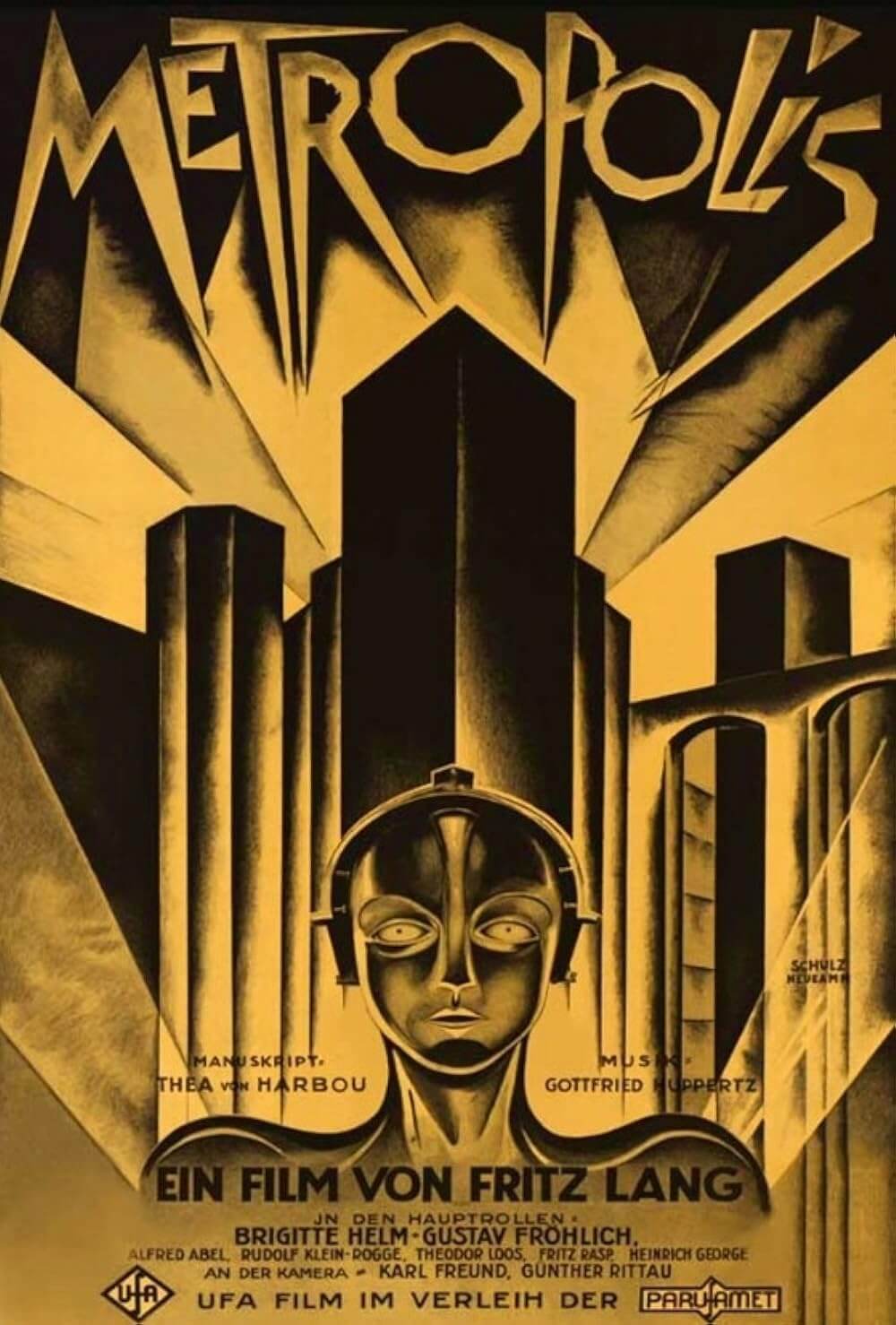
M also comes out of a transitional period in Lang’s career: It was his first sound production, his first feature made by the production company Nero-Film, and one of his last films made in Germany. He completed M, followed by The Testament of Dr. Mabuse (1933), just before escaping to France, then Hollywood. Lang made M after letting his contract with Germany’s largest studio, Universum Film AG (UFA), expire. UFA had released most of his silent work—Destiny (1921); Dr. Mabuse, the Gambler (1922); Die Nibelungen (1924); Metropolis (1927); Spies (1928); and Woman in the Moon (1929). The latter two releases were box-office disappointments, in part because Lang was the last major German director to adopt the newfangled invention of sound. He had been criticized for making a sci-fi adventure, Woman in the Moon, and with out-of-date silent-era filmmaking technology, delivering a retrograde movie about the future. Working with new distributors at Nero-Film, he turned M into a hybrid of silent and sound cinema, using evocative visuals and purposeful audio.
On the surface, M addresses the morality of capital punishment, the treatment of mental illness, and the recent emergence of violent crime in recent headlines—both committed by individuals and groups. Lang’s film drew from various real-life criminal cases. Take Georg Karl Grossmann, a butcher arrested in 1921 for killing several prostitutes and selling their flesh on the black market. There was also Fritz Haarmann, known as “The Butcher of Hanover,” who was convicted of killing twenty-four victims and died by guillotine in 1925. Chief among them was Peter Kürten, dubbed by the press as the “Vampire of Düsseldorf,” who—though he was captured after von Harbou and Lang completed M’s screenplay—was convicted of nine murders, including sexual assaults and murders of young girls. The investigation, capture, and trial of Kürten coincided with M’s production and doubtlessly influenced Lang and von Harbou. Some critics even accused the film of exploiting and capitalizing on mass murder. Lang responded to such allegations by publishing an article titled “Mein Film M,” in which he defended the film and argued that he hoped to characterize the “epidemic series of mass murders of the last decade” with an “authentic representation of a mass murder complex.” Lang had been fascinated by criminology since reading the theoretical work of Cesare Lombroso, who inspired the director with his adage, “There are no criminals, only crimes.”
Serial killers weren’t the only murderers on Lang’s mind; he also drew from a 1930 case concerning Konrad Pietzuch to underline the links between the film’s destructive vigilante mob and Nazism. Pietzuch was a member of the German Communist Party who was stalked and killed by five members of the Sturmabteilung—Hitler’s Stormtroopers. During the Weimar Republic, Berlin’s streets teemed with gangs of these Brown Shirts who targeted perceived enemies of the Nazis, using politically and ideologically motivated violence to intimidate and eliminate their opponents. Though convicted over Pietzuch’s death, the killers’ light sentences, followed by the subsequent pardons they received when the Nazi Party took over in 1933, mirror the fates of January 6th insurrectionists in the United States. Lang’s censures extend to the German bourgeoisie as well, portraying a group of self-satisfied fat cats in a barroom, drinking, smoking cigars, and wolfing down sausages before they start accusing each other of murder and slander. Even in the so-called civilized quarters of society, it doesn’t take much for people to leap at each other’s throats.
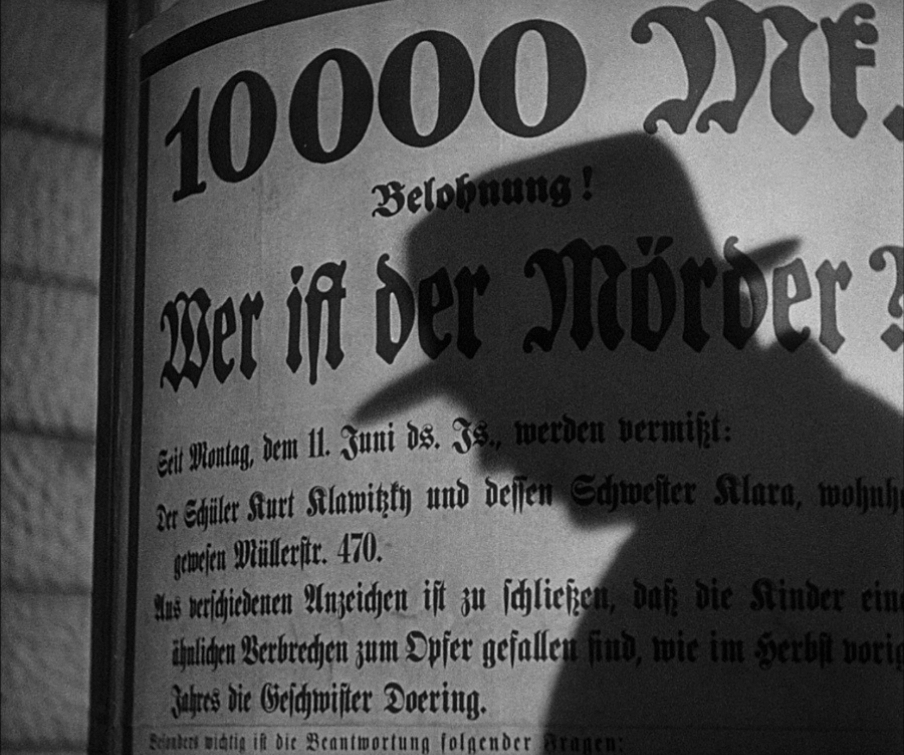
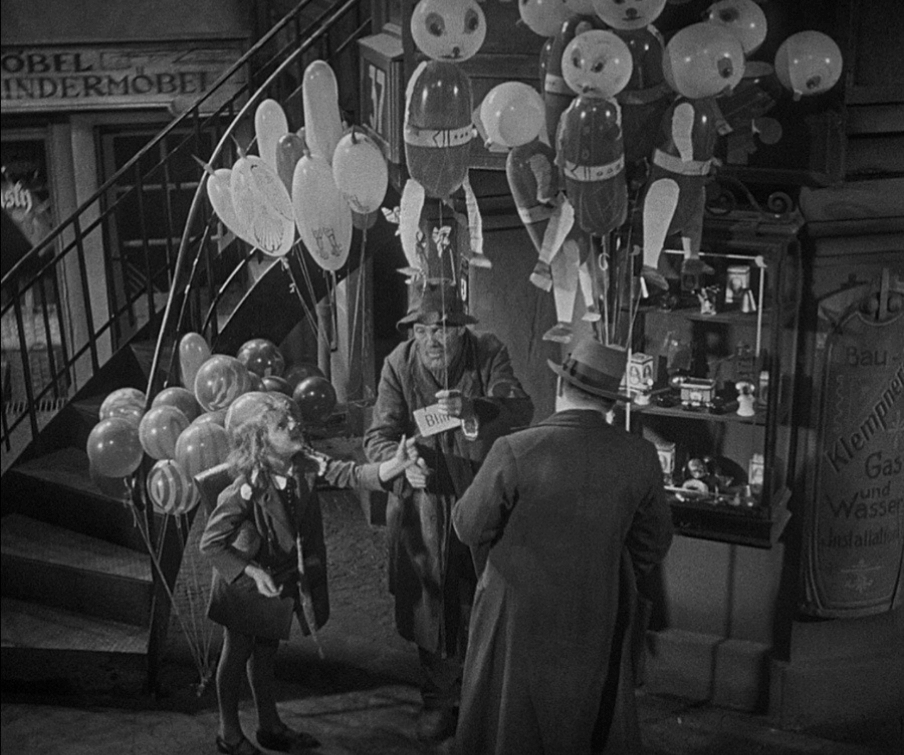
M opens with an overhead shot of children playing a macabre elimination game: “The man in black will soon be here,” announces a girl in the middle of a circle of children, pointing clockwise at each child with each new word. “With his cleaver’s blade so true, he’ll make mincemeat out of you!” Enter Elsie Beckmann (Inge Landgut), a young girl on her way home from school. She stops on the sidewalk, where a policeman helps her cross the street, unknowingly bringing her closer to her killer. All the while, Lang cross-cuts between Elsie and her mother, who is at home preparing a meal. Each cut emphasizes the vast space between them, underscoring the danger. Bouncing her ball against a Morris column, Elsie doesn’t notice the shadow projected onto a wanted poster—Hans’ shadow and wanted poster. His silhouette appears over the sign reading, “10,000 Marks Reward. Who is the Murderer?” His outline looming like a phantom over Elsie, he draws the girl’s attention and offers to buy her a balloon. Meanwhile, at home, Elsie’s mother receives a delivery: the latest “thrilling new chapter” of a crime serial—a macabre genre of fiction given that the subject of her hobby will soon bleed into her life.
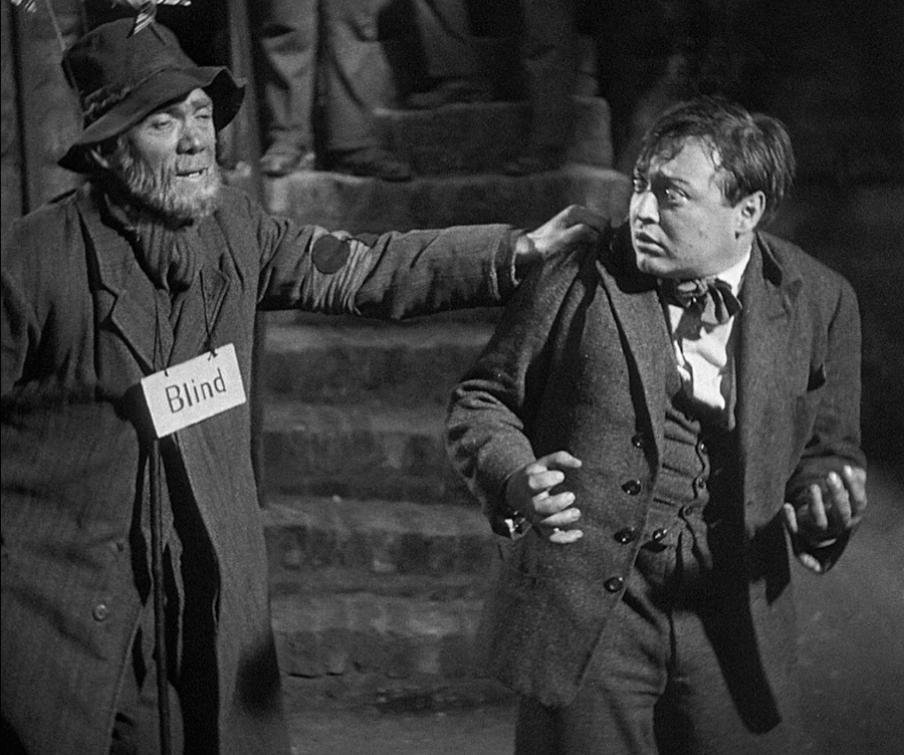
With Elsie’s murder—followed by Hans’ desperate letters to the police and press, where he anonymously confesses and begs to be caught—Berlin launches a frantic manhunt for the killer. Inspector Karl Lohmann (Otto Wernicke), inspired by real-life detective Ernst Gennat (who coined the term “serial murderer” over three decades before the FBI), orders aggressive raids on underground hotspots, upending the city’s criminal underworld. Berlin’s crime syndicates take matters into their own hands, furious that the heightened police presence disrupts their illicit operations. They organize a private manhunt to capture the killer and divert police attention elsewhere. But it’s the blind balloon seller (Georg John) who recognizes Hans’ eerie whistling of the Peer Gynt theme, leading the criminal mob to seize their prey. While the vigilantes succeed where the police fail, they rush to judgment and condemnation, dragging Hans into a nightmarish kangaroo court inside a former basement cognac distillery. Desperate, Hans insists he had no control over his actions, that the murders were unconscious acts, and even questions his guilt—staring at his wanted poster and asking, “Did I do that?” But the criminal gang refuses to listen, unmoved by his trapped-animal pleas. In the end, only the police’s last-minute arrival spares Hans from their swift, merciless justice, leaving him to face the courts.
By the final scenes, the viewer comes away with a sense of Lang’s loathing for humanity’s mobs and groupthink that led to Nazism. Although he initially considered himself apolitical and ignored the Nazis, Lang eventually became outspoken in his hatred for them. Von Harbou joined the party in 1932, and this helped alert Lang to how corruptive the Nazi influence could be. Their divorce was finalized the following year. According to an oft-shared story by Lang, he left the country after Joseph Goebbels asked him to run the German film industry. They would ignore Lang’s Jewish lineage (“We decide who is Jewish or not,” Goebbels said, according to Lang), make him an “honorary Aryan,” and enlist him to make high-quality propaganda films. Lang left the country shortly thereafter but kept his newly ignited hatred for Nazis burning in Hollywood. The director’s first effort for Metro-Goldwyn-Mayer was Fury (1936), another story about the inhumanity of vigilante justice, complete with allusions to American lynch mobs, which, in the 1930s, often served as stand-ins for Nazis (see also Black Legion, 1937). Lang would continue making anti-Nazi films, such as his Hitler-in-the-crosshairs thriller Man Hunt (1941), his European resistance drama Hangmen Also Die! (1943), and his spy yarn Ministry of Fear (1944). Among the co-founders of the Hollywood Anti-Nazi League, Lang also sent money to help stranded immigrants fleeing Hitler and contributed to the European Film Fund, which helped filmmakers escape the war for Hollywood.
Even so, Lang never clarified his reasons for making M, leaving any perceived commentary on the Nazis purely speculative. But the parallels between the angry mob in his film and Nazis remain palpable today. Writing in 1997, Roger Ebert observed, “What I sense is that Lang hated the people around him, hated Nazism, and hated Germany for permitting it.” Consider that Lang’s original title was Mörder unter uns, which can be translated as either singular or plural, Murderer Among Us or Murderers Among Us. The title’s ambiguity hints at Lang’s careful negotiation of Germany’s political situation. However, the title changed three weeks before the film’s premiere. Lang claimed in subsequent interviews that the Nazis believed the title was about them, so he was forced to change it. Though, most of the evidence to back Lang’s claims has been deemed dubious by scholars. The director was no stranger to exaggerating or inventing stories to entertain his audience and build up his ego.
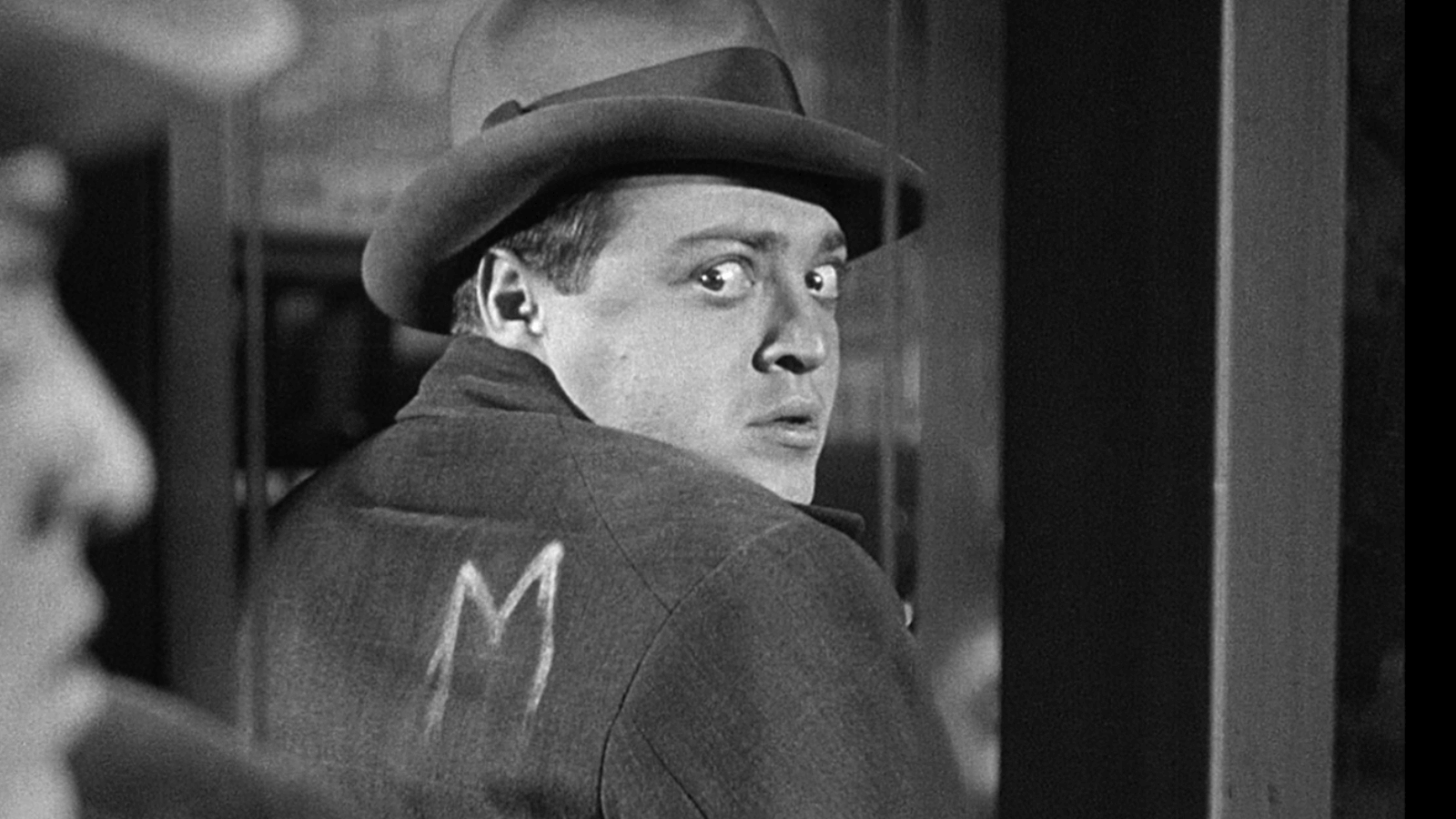
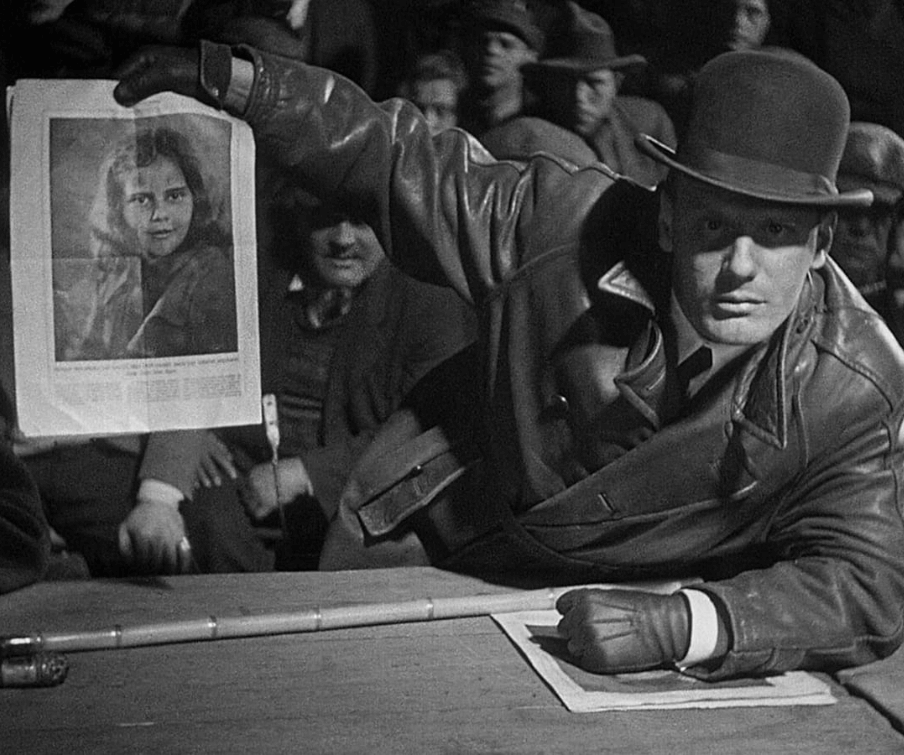
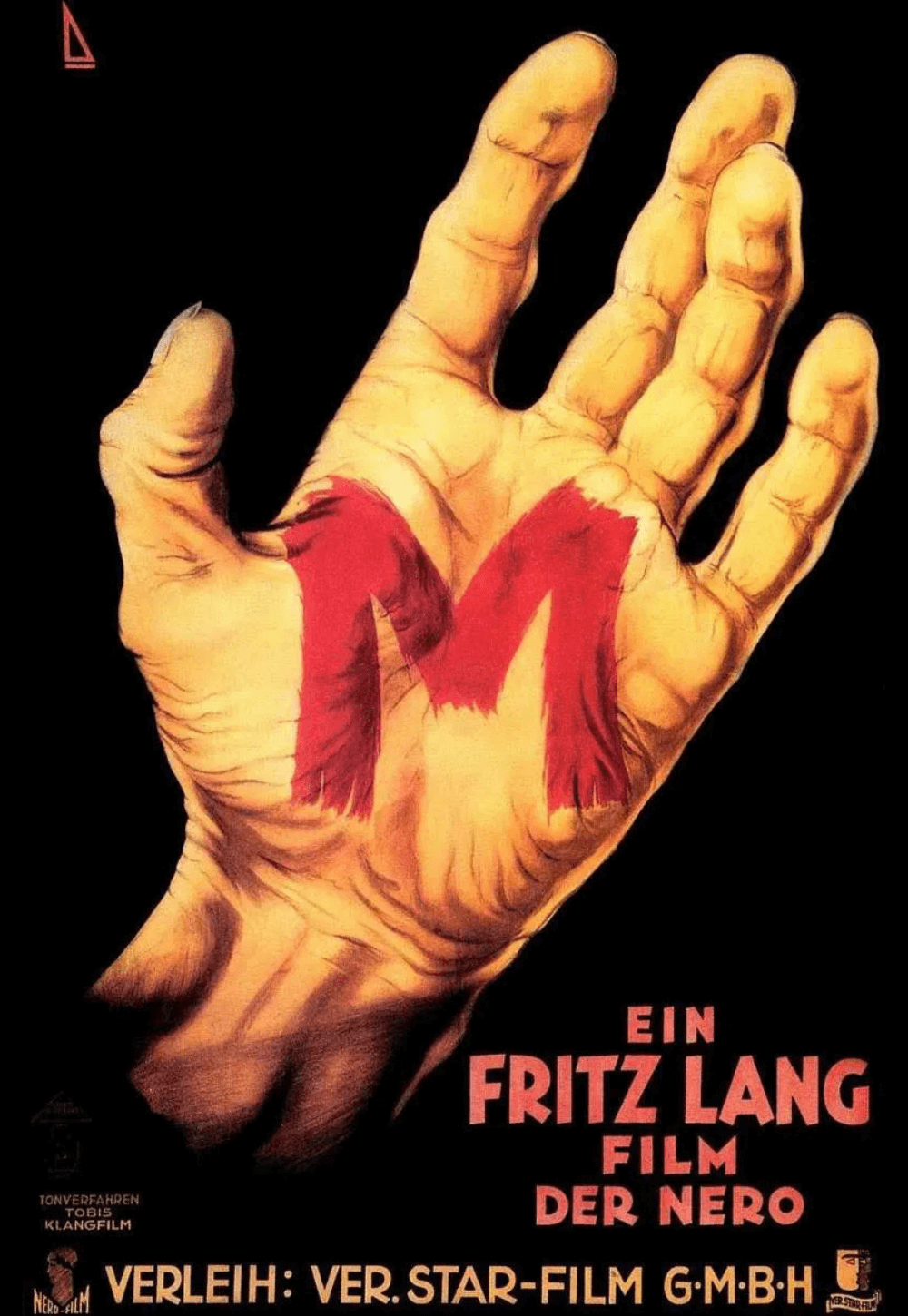
In one frequently shared anecdote, Lang recounts trying to secure shooting space for the climactic scene in Staaken—a zeppelin hangar converted into a film studio after World War I. The official in charge refused to allow a film called Mörder unter uns to shoot in the space, and when Lang gripped the man by the collar and asked why, he noticed the swastika pin on his lapel. Lang calmed himself and convinced the man that the title referred to the child murderer, not the Nazis. In his monograph on the film for the British Film Institute, Anton Kaes suggests an alternative reason for the title change: the distributor, Vereinigte Star-Film GmbH, felt there were too many features with the word “murderer” in their titles, and releasing another would hurt its box-office potential. Instead, the promotional department advertised a far more ambiguous M with an image from the film—a hand with a red “M” written on the palm. The image would serve as a symbolic title, allusive in meaning yet representative of the film’s most iconic moment.
Stamped with the “M” is Hanz, played by Lorre in one of his greatest performances. He’s unforgettable with his round, cherubic face and portly body that give him an innocent, childlike appearance. Except, his imposing eyes reveal something corrupt inside, bulging from the pressure of his murderous impulses, like two boils ready to pop. At once a fragile figure yet also a tormented predator, Hans cannot resist his vile compulsions. But the character also embodies la bête humaine, the German everyman at the time, epitomizing the country’s self-destructive drive and potential for unthinkable violence. Understandably, the performance was exhausting for the actor, and Lorre incurred Lang’s wrathful sadism after pleading for a respite. While shooting the climactic sequence in the underground distillery, Lorre asked his director why he must act with the same draining ferocity when the camera wasn’t on him but on the kangaroo court. Lang would not hear him out; instead, he targeted the actor. Lang insisted they shoot the scene when Hans is tossed down the stairs to face the court upwards of ten times, leaving Lorre bruised and begging for the filming to stop. Lorre wouldn’t be the only victim of Lang’s petty retribution on a film set.
Born László Löwenstein in 1904, Lorre was the first of three sons of a Hungarian Jewish couple. After Lorre’s mother died, his father remarried, had two more children, and moved the family to Vienna to avoid an impending war in the Balkans, which contributed to Lorre’s lifelong Austro-Hungarian accent that defined his unique voice. Finally arriving in Berlin in his early twenties, Lorre explored art and theater. Bertolt Brecht first discovered the actor and cast him in stage plays, most notably 1929’s Pioneers in Ingolstadt, where Lorre played a sexual predator. Lang saw the play and immediately wanted to cast the actor. Despite Lorre promising Lang that he wouldn’t accept any other film roles in the meantime, he made a few uncredited appearances in motion pictures. Still, Lang’s M would be the actor’s first major credit. Like Lang, Lorre eventually ended up in Hollywood after fleeing Nazi Germany, becoming a memorable character actor in classics such as The Maltese Falcon (1941), Casablanca (1942), Arsenic and Old Lace (1944), and 20,000 Leagues Under the Sea (1954).
While Lorre’s performance in M remains iconic mainly due to his unhinged expressions, the faces of the anonymous grotesques in the vigilante mob are far more chilling. When Hans discovers that he has been trapped by the criminal underworld, the camera pans over more than a hundred criminals and sex workers—self-proclaimed “experts in law,” given their histories—all staring at him in silent condemnation. Lang’s camera focuses on their cracked, wrinkled, and rough faces; their eyes are encased in dark circles, their teeth are crooked, their clothes are worn and shabby. After telling Hans he will never escape, their spokesperson, “Der Schränker” (The Safecracker, played by Gustaf Gründgens) explains how they will be his judges in their world-turned-upside-down mock court. But remember, their cause is not noble. Their almost caricatured perspective seeks not to reinforce law and order; they want a quick return to the streets, where criminals can resume their activities without the oppressive oversight of police on the manhunt for Hans.
As Kaes notes, with the underground’s hateful calls for Hans’ death, Lang wields a double-edged sword. He alludes to the German people, who in August 1914 blindly mobilized to fight much of the world in the First World War. The violent crowd further symbolizes Germany’s worst impulses with the Nazi gangs dominating the streets of Weimar Germany. To be sure, when Goebbels banned The Testament of Dr. Mabuse in Germany, he told Lang that Hitler wanted a different ending, claiming the titular supervillain should have been “killed by the fury of the outraged mob.” This brand of Nazi justice is precisely what M condemns. Lang lashes out at courts and judicial systems that have little use for truth as well. In Lang’s view, the Weimar courts were more concerned with retribution and punishment—and the sensationalized newspaper and radio attention such sentences would bring—than notions of truth, justice, or understanding criminality.
Furthermore, European anti-Semites often perpetuated hateful links between Jews and sexualized criminality. In 19th-century Britain, anti-Semitic publications speculated that the Jack the Ripper killings, carried out in Whitechapel in London’s East End and exclusively against prostitutes, were the actions of an Eastern European Jew. A Jewish man named John Pizer, commonly known as “Leather Apron,” was a suspect in the murders, and though cleared, he had committed a series of robberies at knifepoint. Newspapers and public figures spread the idea that Jack the Ripper might be a Jewish immigrant, and a Polish Jew named Aaron Kosminski was also a suspect. These associations, fueled by anti-Semites, found their way into Fritz Hippler’s Nazi propaganda documentary The Eternal Jew (1940), which blamed “Jew Lorre” for making a child murderer look sympathetic in M. Gründgens’ character The Safecracker calls for Hans to be “exterminated, without pity, without scruples,” sounding an awful lot like Nazi rhetoric about Jews. “This man should be snuffed out like a candle,” he adds, in a line that cannot help but conjure images of the Holocaust. In an additional historical irony, Gründgens remained in Germany during World War II and was appointed as head of the Theatre Chamber of the Reich.
M may feature sound in the crowd’s calls for Hans’ death and his desperate pleas for mercy, but it looks and feels like a silent film. The production’s absence of a musical score focuses the viewer’s attention on the imagery. Several long passages unfold without sound effects, and dialogue proves infrequent, recalling Charles Chaplin’s late adoption of sound in Modern Times (1936)—and even then, only marginally so. Lang uses sound sparingly but always with a clear purpose. Whole sequences may pass without sound, but when sounds occur, they represent what Hans hears. Sound pierces Hans’ mind. He whistles Grieg’s Peer Gynt in response to his compulsion, which consumes him in a series of delirious waves bordering on a fugue state. The tune instills dread in the viewer, a sign of his warped mindset. Later, the voices of the vigilante mob also overwhelm him. The most pronounced use of sound in the film comes at Hans’ makeshift trial; he grabs the sides of his head and screams, “Don’t want to!” then “Must!” as though having a volatile internal debate. His eyes practically pop out of his skull.
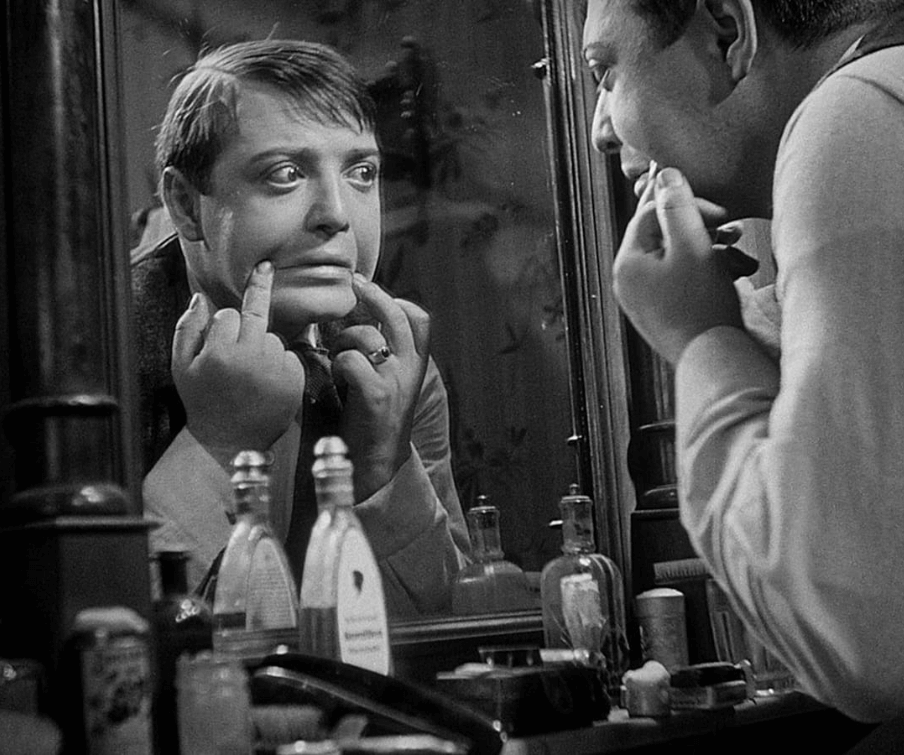
Besides Lorre’s unforgettable expressions, Lang’s film is full of iconic imagery: There is an early montage that elegantly signals Elsie’s absence and murder with an empty table setting, her mother calling down the stairs, a ball rolling from the bushes, and a balloon floating away into power lines, implying her murder. Later, Hans examines his face in the mirror, revealing himself to the viewer for the first time. Pulling down the corners of his lips and bulging his eyes, he does not recognize the person reflected back at him. Later, while on the street, he sees a potential victim reflected in a shop window, her appearance framed by geometrically arranged cutlery—a loaded sight that reinforces Hans’ claim that his murderous impulses are unconscious. Above all images, Hans’ horrified expression when he sees in a reflection the “M” written on his shoulder in chalk remains the most cited. The director hired Fritz Arno Wagner as cinematographer, enlisting a talent who had shot F. W. Murnau’s Nosferatu (1922) and G. W. Pabst’s Westfront 1918 (1930), in addition to Lang’s Destiny and Spies. As a result, M has a dynamic visual style, deploying high and low angles to capture the warped world on display, home to a disturbed child murderer and a vengeful throng. Inevitably, M’s use of stylish angles, pointed symbolism, and shadow would inspire film noir cinema.
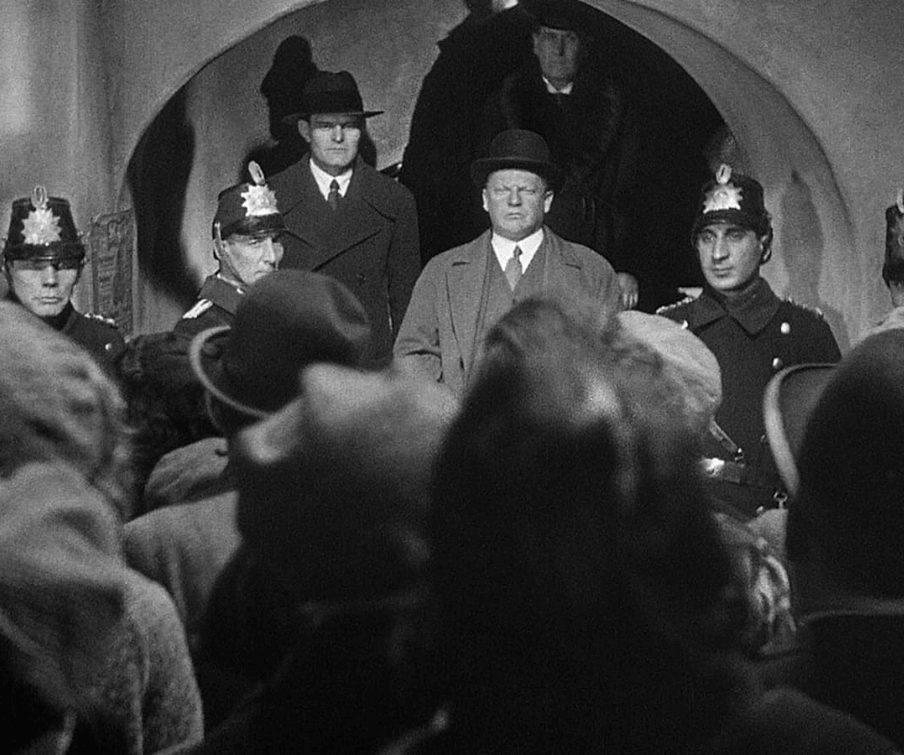
When Lang submitted the completed film to the Berlin Censorship Board in April of 1931, M passed without a fuss—perhaps only because the Nazis were not yet in power. The film opened in Germany the next month, earning only modest box-office receipts and mixed reviews from critics. Somehow, the film’s veiled association between Nazi-esque bullies and vigilantes went unnoticed, leaving journalists and critics to wrestle with M’s commentary on capital punishment. Indeed, the film’s release sparked public debate about the death penalty and the fate of the Vampire of Düsseldorf. Kürten was not proven to be mentally incapable, and he was executed in July 1931. Some interpreted Lang’s intended message: an argument against Hans’ execution, given that the lawyer at his mock trial argues for his placement in a mental institution. Others, most notably Goebbels—who wrote in his diary that M was “Against humanitarian sentimentality. For the death penalty.”—missed the point entirely. After all, the film’s final scene settles on the mothers of Hans’ victims, who plead, “This will not bring our children back.”
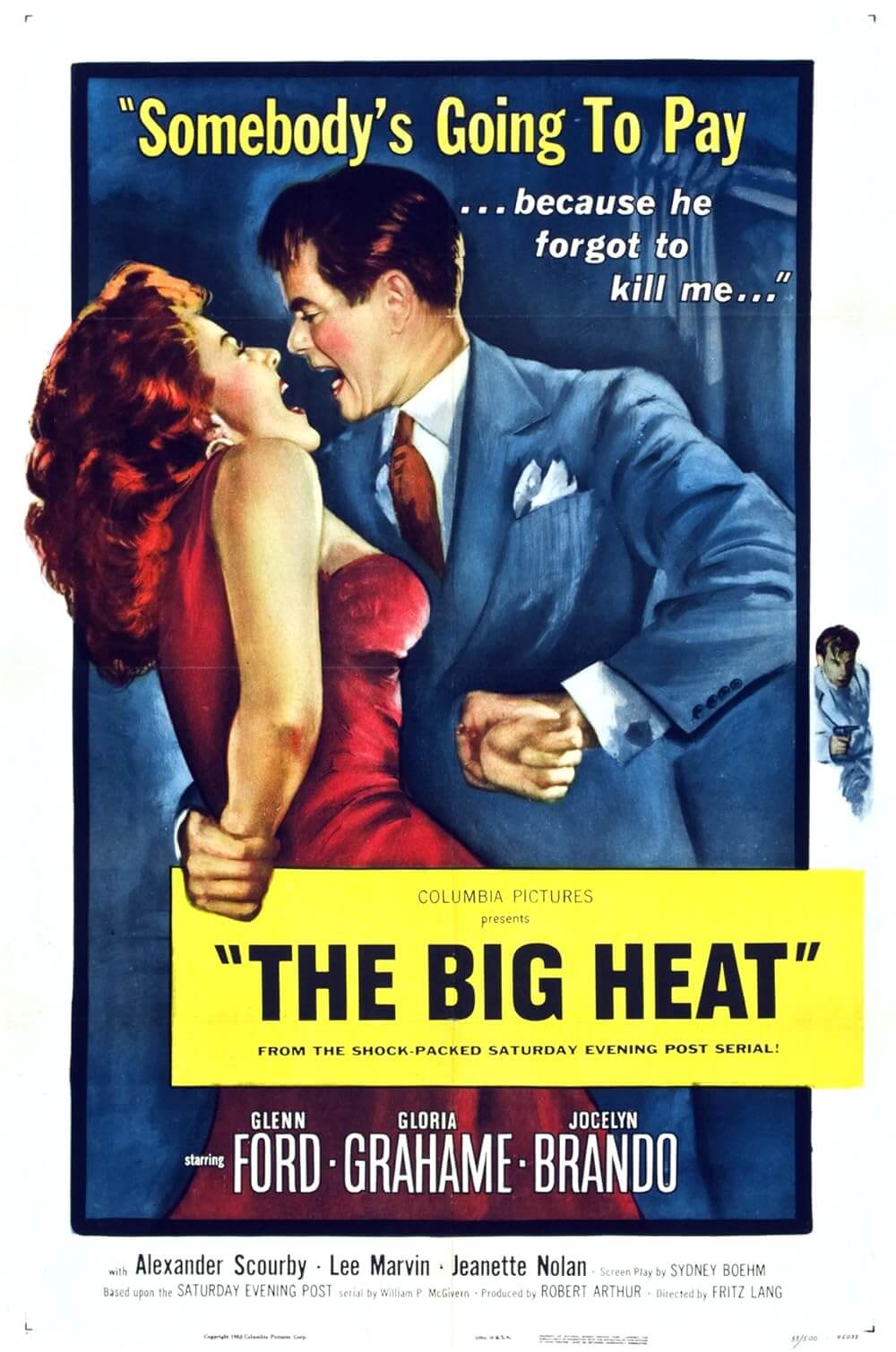
M would go on to influence countless thrillers and film noir pictures, though few consequents ever came close to matching Lang’s visual bravado, confronting themes, and lasting place in the world cinema canon. In 1951, Joseph Losey set about remaking the film for producer Seymour Nebenzal and Columbia Pictures. Although he employs a stylistically straightforward presentation, Losey, whose political leanings were under investigation by the House Un-American Activities Committee (HUAC), turned the scenario into a ripe metaphor for Communist witch hunts of McCarthyism. In Losey’s hands, the criminal gang hunting the killer is headed by mobsters in organized crime rackets. Two years after his version of M hit theaters, Losey had been blacklisted in Hollywood, and he worked the remainder of his career in Europe, primarily the UK. While other films—from Woody Allen’s paranoid comedy Shadows and Fog (1991) and Bong Joon-ho’s Memories of Murder (2003)—have paid homage to Lang’s film, few directors have been more influenced than David Fincher, whose work, such as Se7en (1995) and Zodiac (2007), often explores the minds of serial killers. Even Lang’s innovative camera push through a window in one scene would be adopted by Fincher, whose camera in the thriller Panic Room (2002) could travel just about anywhere—through newel posts, into locks, and yes, through windows.
In a 1967 interview for the French television series Cinéastes de notre temps, Jean-Luc Godard asked Lang which of his films he thought would last. Lang picked M without hesitation, offering no explanation or second choice. How odd, since, in the grand scheme of the director’s career, M remains a transitional film, linking the unhindered visual expressiveness of Lang’s silent-era work with his pulpier film noir output in Hollywood. It’s neither wholly representative of one nor the other; even so, it might represent the best of both worlds. Watching the film today, the viewer will notice camera movements, genre flourishes, and social debates that have persisted into the twenty-first century. But experiencing M isn’t a mere voyage into the past or a distanced appreciation of a historical relic, especially given how recognizable its portrait of a vengeance-hungry mob is today. Lang’s film remains an urgent and engaging experience that still feels vibrantly made and acted—the product of a specific place and time in history, of course, but also vital, exciting, and timeless.
(Note: This essay was commissioned by Dave and originally posted to DFR’s Patreon on March 12, 2025. Thank you for your continued Patronage and support, Dave!)
Bibliography:
Garncarz, Joseph. “Fritz Lang’s ‘M’: A Case of Significant Film Variation.” Film History, vol. 4, no. 3, 1990, pp. 219–26. JSTOR, http://www.jstor.org/stable/3815134. Accessed 2 February 2025.
Kaes, Anton. M. (BFI Film Classics). British Film Institute, 2000.
Kreimeier, Klaus. The Ufa Story: A History of Germany’s Greatest Film Company. University of California Press, 1999.
Lange, Horst. “Nazis vs. the Rule of Law: Allegory and Narrative Structure in Fritz Lang’s ‘M.’” Monatshefte, vol. 101, no. 2, 2009, pp. 170–85. JSTOR, http://www.jstor.org/stable/20622187. Accessed 2 February 2025.
McGilligan, Patrick. Fritz Lang: The Nature of the Beast. St. Martin’s Press, 1997.
Stevens, Dana. “Writing, Scratching, and Politics from M to Mabuse.” Qui Parle, vol. 7, no. 1, 1993, pp. 57–80. JSTOR, http://www.jstor.org/stable/20685989. Accessed 2 February 2025.
Werner, Gösta. “Fritz Lang and Goebbels: Myth and Facts.” Film Quarterly, vol. 43, no. 3, 1990, pp. 24–27. JSTOR, https://doi.org/10.2307/1212633. Accessed 2 February 2025.
Thank You for Supporting Independent Film Criticism
If the work on DFR has added something meaningful to your love of movies, please consider supporting it.
Here are a few ways to show your support: make a one-time donation, join DFR’s Patreon for access to exclusive writing, or show your support in other ways.
Your contribution helps keep this site running independently. However you choose to support the site, please know that it’s appreciated.
Thank you for reading, and for making this work possible.
Brian Eggert | Critic, Founder
Deep Focus Review