The Hunger Games: Sunrise on the Reaping
By Brian Eggert |
The Hunger Games: Sunrise on the Reaping is a prequel that tells the story of Haymitch Abernathy, played by Woody Harrelson in the original four films. Given what we know about Haymitch later in life, this story cannot end well for him. When he meets Katniss Everdeen (Jennifer Lawrence), the franchise’s reluctant rebel, he’s an alcoholic, sarcastic, and all but spiritually defeated. What turns a promising, tenderhearted young man from the Appalachian-coded District 12 into a thoroughly soused, embittered champion skulking alone in Victors’ Village? The tragedy that unfolds continues the Hunger Games franchise’s thoughtful look at autocracies and how they operate, maintaining power and control by instilling fear and, through it, submission. The series, based on Suzanne Collins’ books, is the most accomplished of Hollywood’s many YA adaptations, largely for its thematic heft and staging of how people become pawns for despotic governments. But it’s also a compelling dystopian melodrama with an unflinching, visceral edge that never feels like mindless genre escapism.
When Lionsgate dipped its toe back into the Hunger Games pool with Collins’ last prequel, The Ballad of Songbirds and Snakes (2023), the origin story of the series villain, President Snow, it did so cautiously. Doubtless, the studio wasn’t sure whether audiences still wanted to return to this ugly world after nearly a decade, especially when it’s a dark reminder of reality in the USA—with masked goons patrolling the streets, garish opulence on display at the Capitol, and a tyrannical leader. Made for $100 million, Ballad became a massive hit, earning nearly four times its cost. For Sunrise, the studio reportedly doubled the budget, and it shows. There’s also more pomp and spectacle in the new movie, with the Capitol having emerged out of the postwar misery of Ballad and prospered into a ‘70s-style excess. Of all the Hunger Games movies, this one best captures the Capitol’s freak-show vibe, where Caesar Flickerman (Kieran Culkin, a smarmier version of the character originally played by Stanley Tucci) hosts the fiftieth annual Hunger Games on a stage that looks like a deranged version of Bob Barker-era The Price Is Right.
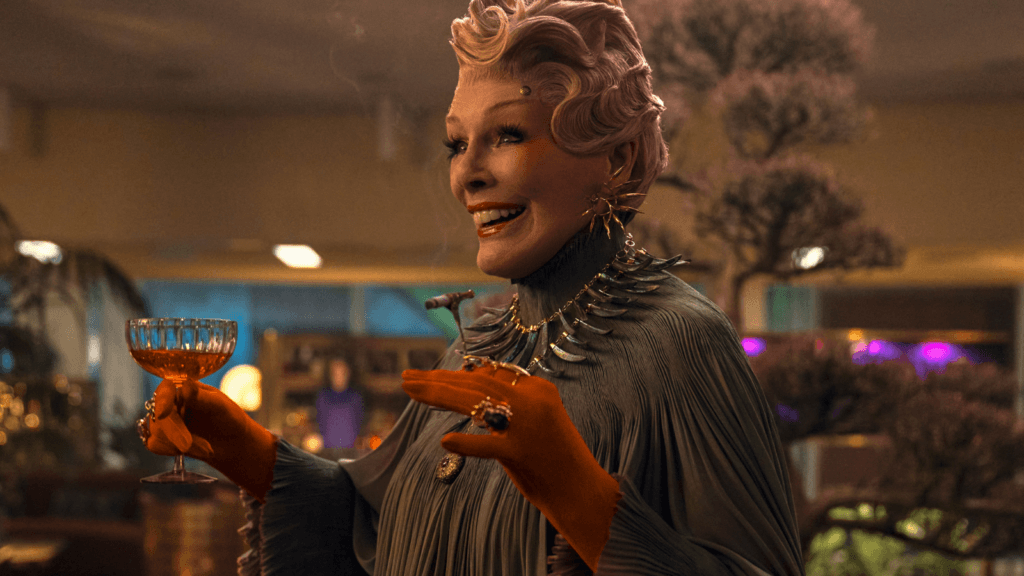
No one embodies the Capitol’s excess better than Drusilla Sickle, the District 12 announcer played by an unhinged Glenn Close behind a mask of prosthetics and CGI polish. She’s a disturbing, plastic-looking monstrosity who looks like what would happen if Close’s Cruella de Vil from 101 Dalmatians (1996) had the same procedure as the stretch-faced mother from Brazil (1985), then visited the Surgeon General of Beverly Hills from Escape from L.A. (1996) too many times. Adapted by series regulars Billy Ray and Michael Leslie, Sunrise has a mean streak that pours acid on this already brutal world. Drusilla furiously slings insults at the crowd during the District 12 reaping, the ceremony where tributes are drawn at random to participate in the Hunger Games. When one of the tributes, Maysilee Donner (Mckenna Grace), insults her appearance, Drusilla furiously whips her. As played by Culkin, Flickerman, too, is a nasty piece of work, taunting the tributes and mocking their eventual deaths, claiming that Panem’s overprivileged audiences “need this respite” of watching children die to unwind.
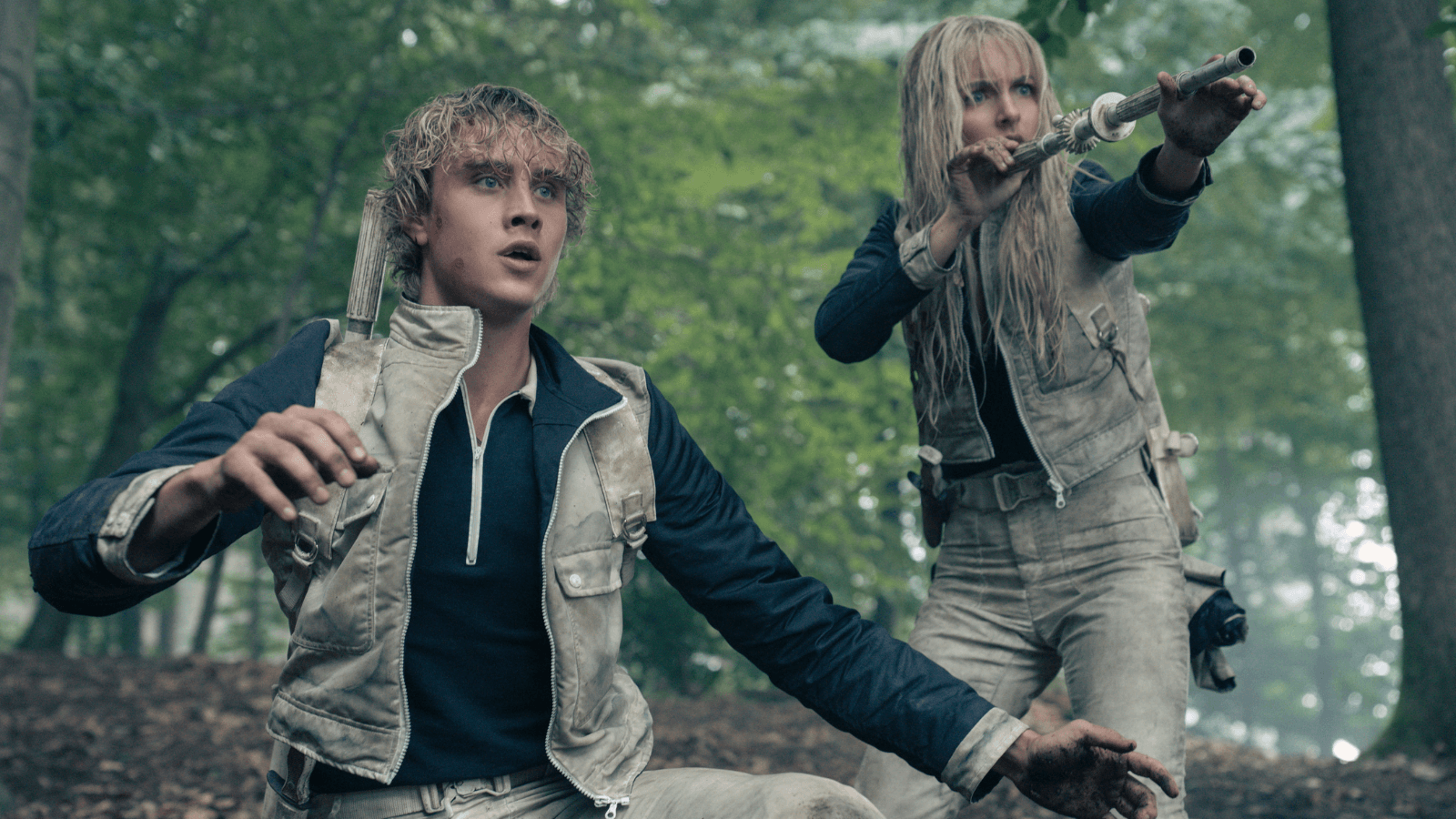
To commemorate its fiftieth anniversary with a double-size event, the Capitol selects four tributes from each district to participate: two boys, two girls. Haymitch, played by Joseph Zada (who captures Harrelson’s distinctive rusty vocals and Southern brogue), celebrates his sixteenth birthday on the same day as the reaping. Drusilla doesn’t draw his name, but much like Katniss will do, he intercedes to protect his sweetheart, Lenore Dove (Whitney Peak)—a Covey girl, a nomadic bohemian people of Panem who openly defy the Capitol—and finds himself enlisted in the deadly elimination tournament. Haymitch and three other tributes become the focus of Plutarch Heavensbee (Jesse Plemons, in the role originated by Philip Seymour Hoffman), the District 12 propagandist who’s a master at storytelling and controlling narratives, though he works from within the Capitol to dismantle it. “The Capitol has all the power and always has,” says Haymitch resignedly. But as several others tell him in the movie: “Nothing is inevitable.”
Then again, it’s pretty much unavoidable that Haymitch is targeted after publicly slow clapping in defiance of President Snow (Ralph Fiennes, chilling in the role originated by Donald Sutherland), following a disastrous chariot crash at the opening ceremony. Although Haymitch forms an alliance with other tributes to protect against the deadliest combatants, he resolves to go it alone once inside, knowing that Snow will torment others to punish him. Besides Maysilee, Haymitch must consider his fellow District 12 tributes, the oddsmaker Wyatt (Ben Wang) and the much younger Louella (Molly McCann), the last of whom dies before the Games begin and is replaced by a surgically altered, mentally wiped alternate. Moreover, Haymitch is also on a secret mission to dismantle the arena’s machinery, trained by several former victors, each with familiar names but younger faces: Maya Hawke as Wiress (previously played by Amanda Plummer), Kelvin Harrison Jr. as Beetee (originally Jeffrey Wright), and Lili Taylor as Mags (originally Lynn Cohen). It’s a little odd at first, watching so many talented actors occupy roles memorably played by other talented actors. But the new cast embodies them flawlessly, especially the bright Elle Fanning as Effie Trinket (originally Elizabeth Banks).

Director Francis Lawrence returns, having skillfully helmed every installment since 2013’s Catching Fire, the first sequel and best entry in the series. He oversees a spare-no-expense production, with a visually gorgeous yet horrifying arena that looks like a picturesque, isolated valley nestled amid mountains, populated by birds, butterflies, and bunnies. Except those birds will peck your eyes out, the butterflies will electro-shock you, and the rabbits suffer so Haymitch can learn that the water is poison—Snow’s preferred method of murder. Don’t even ask about the squirrels. Lawrence teams once again with Belgian cinematographer Jo Willems, shooting digitally for IMAX, which is the ideal way to see this. When so many studio productions lately seem to skimp on quality CGI, it’s a relief to see this stunning presentation, with several wowing sequences. Among them, there’s an impressive volcano eruption and several horrifying encounters with deadly animal-bots. And despite a lengthy runtime of 158 minutes, Sunrise is briskly paced and never overstays its welcome.
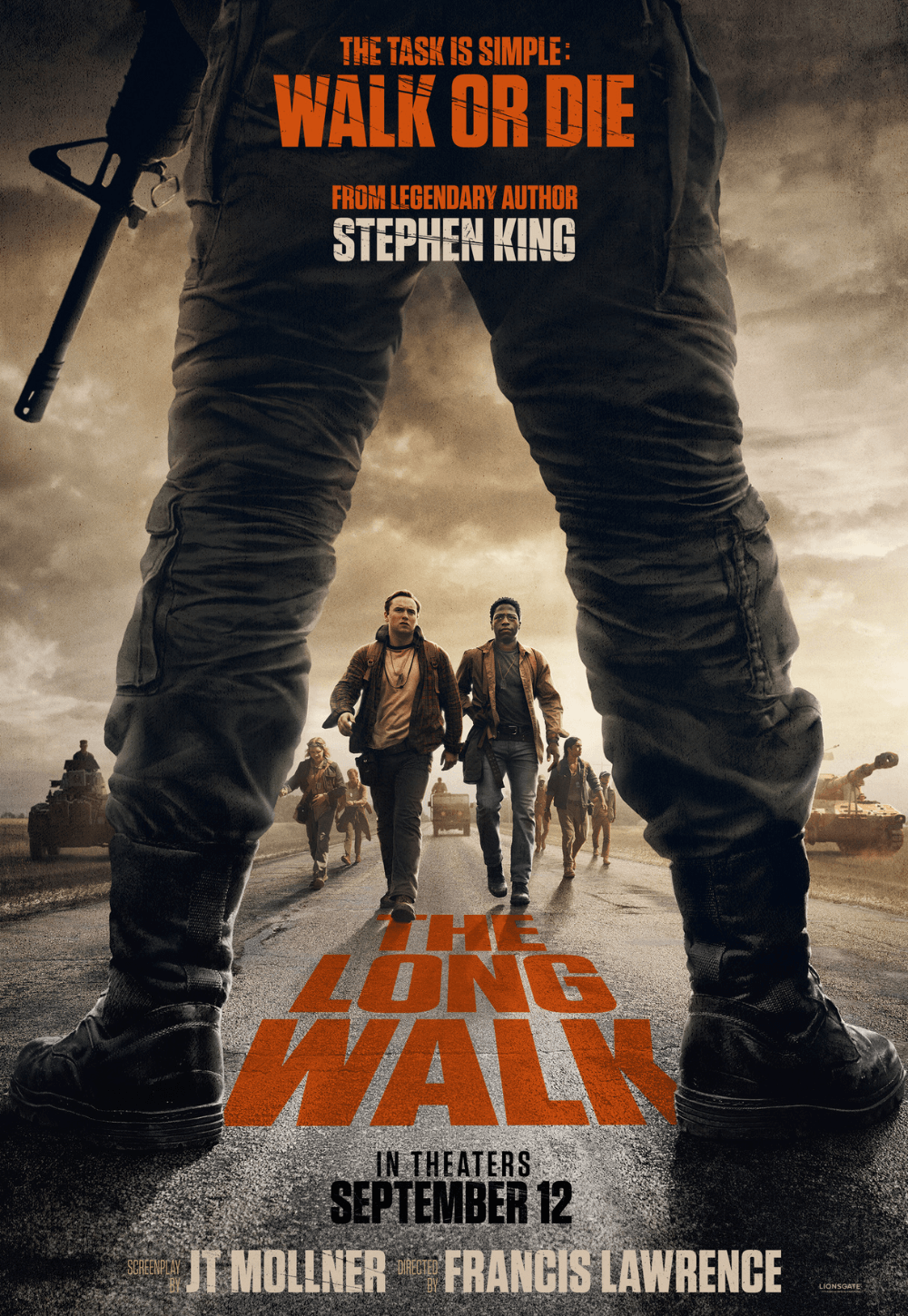
The film even improves on the book in some ways, ditching Collins’ tedious, indulgent, verse-laden ending that links the material’s persistent theme to Haymitch’s grief, his lost Lenore, and Edgar Allan Poe’s The Raven. If there’s a single misstep, this series tends to soften the harshest aspects of Collins’ dystopia, such as downplaying the psychological scarring on Katniss Everdeen at the end of the original movies. The story ends with Haymitch shattered, but rather than leave us with his trauma, Sunrise softens the blow with a coda set after the rebellion, featuring Katniss and Peeta (Josh Hutcherson), reminding us that Haymitch has a happy ending, sort of, eventually. For a starker, more unrelenting take on entertainment-as-control, check out Lawrence’s brilliant The Long Walk (2025). Its hard-R rating means the director doesn’t shy away from showing grim physical details and psychological consequences. Even so, Sunrise on the Reaping is a satisfying, inspired entry in the Hunger Games saga, crafting an urgent allegory that exposes how authoritarians operate, why the masses don’t need to submit to them, and how they can be defied.

Like DFR? Support us.
This site exists because readers like you care about film. If DFR has enriched your experience with movies, I’d be grateful for your support. You have a few options:
• Join DFR’s Patreon community
• Make a one-time donation on PayPal
• Buy me a coffee
Whatever option you choose, it helps keep my work independent. And it means a lot to me.
Thank you for reading, and for making this work possible.
Brian Eggert | Critic, Founder
Deep Focus Review