Ray Gunn
By Brian Eggert |
Brad Bird has been developing his retrofuturist Ray Gunn since the 1990s. So, it’s with some regret that I report my disappointment with the long-gestating film. Bird is among the finest writer-directors working in animation, having helmed The Iron Giant (1999) and Pixar’s Ratatouille (2007). Similar to his two Incredibles features, this passion project, produced by Skydance and distributed by Netflix, blends heaps of nostalgia with an affinity for high-tech spectacle. With its story about a 1940s-style private detective in a space-age metropolis, Ray Gunn is a pastiche that contains multitudes: film noir, science fiction, corporate conspiracy, and even romance—a genre mashup recalling Blade Runner (1982). It also explores timely concerns, such as the use of artists’ likenesses in AI-generated entertainment, the ethics of consumer surveillance for marketing, and xenophobic prejudice. The animation is quite good, too, surpassing the computer-generated efforts of DreamWorks and Illumination. All the elements are in place for a superior animated movie here, particularly one suited to my interests and tastes, but much to my surprise, Ray Gunn never really clicked for me.
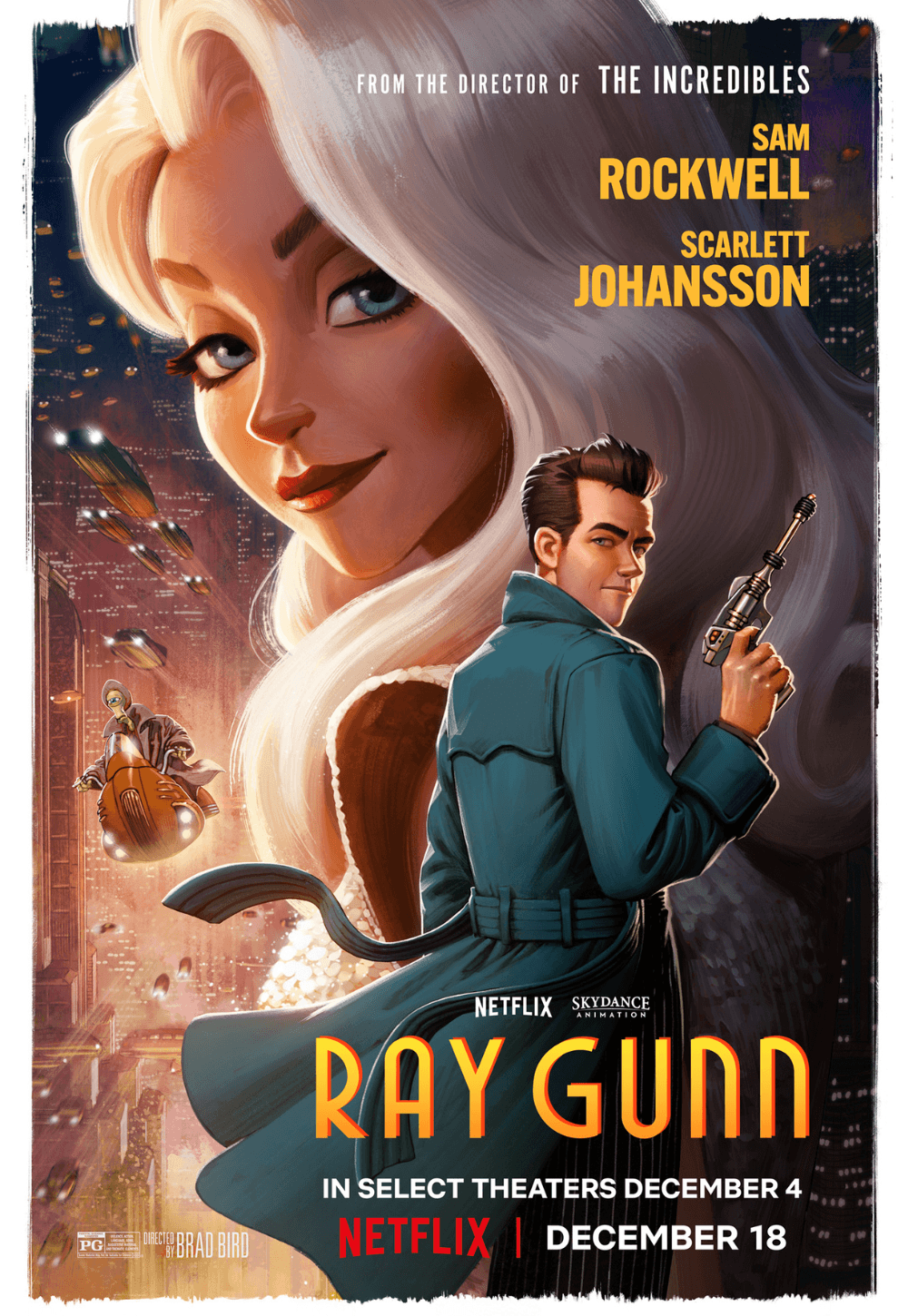
The story takes place in an alternate world where humanity has made contact with countless alien species, and they live among us as second-class citizens. In the first scene, the titular gumshoe, unmistakably voiced by Sam Rockwell, sneaks into an office with his partner Eye-ra (Tom Waits). Immediately, I was struck by how generic the character designs looked. Eye-ra—a one-eyed, green-skinned alien who looks like Mike Wazowski’s thin brother—and the other aliens seem like knock-offs of Monsters, Inc. (2001) and Monsters vs. Aliens (2009) designs. Gunn has low-set eyebrows, an upturned nose, and a large forehead, looking a bit like Kevin Bacon. Metropia, the city around them, fares better, blending Art Deco, newspapers, and black-and-white televisions with jetpacks and flying cars. The city bears a passing resemblance to those in Metropolis (1927) and The Fifth Element (1997). But the film doesn’t explain this world’s backstory, which is both refreshing in its refusal to pander and irritating in its lack of detail. (When did humanity make first contact? How many alien species live on Earth? I want to know.)
Accompanied by Michael Giacchino’s jazzy score, the overplotted film follows the financially struggling Gunn and Eye-ra as they become embroiled in a multilayered case involving Venus Nova (Scarlett Johansson), a famous pop star with a reputation for volatile behavior. The story closely adheres to the template of film noir from Hollywood’s Golden Age. There’s a scheming husband, a corporate cover-up, a series of murders, and other familiar turns. Even the character designs evoke classic cinema. A rotund alien named Slugsy, voiced by Matt Berry and dressed like Sydney Greenstreet from Casablanca (1942), comes with a Peter Lorre-esque henchman. As appealing as the homage may be, I found the plot to be predictable. I always felt about ten minutes ahead of where the story was taking me. It doesn’t help that the casting unintentionally gives away some of the twists.
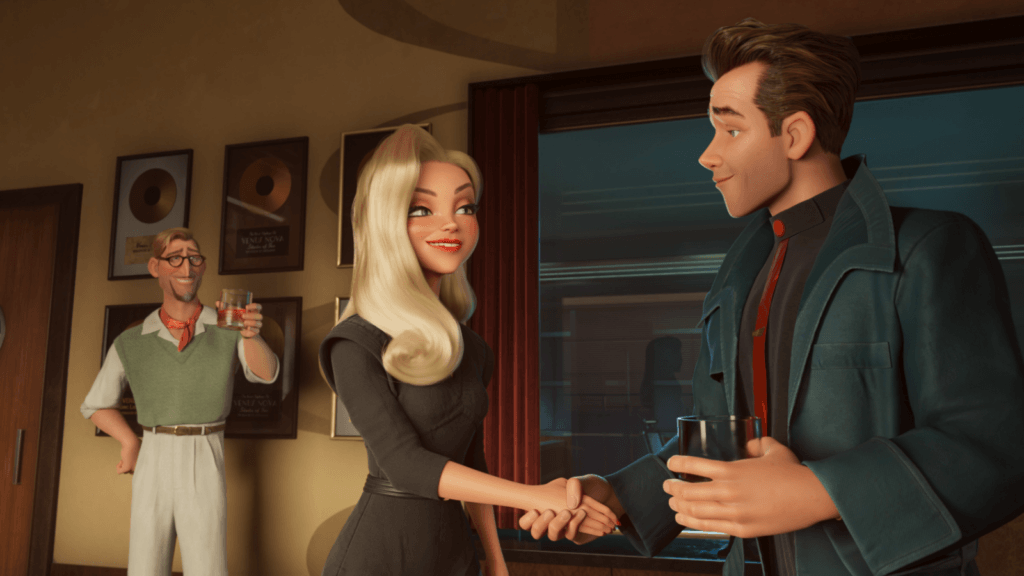
To be sure, one of Ray Gunn’s biggest missteps is that the main cast sounds recognizable. I struggled to hear the character over the actor. Viewers unversed in Waits’ somewhat obscure music and acting roles may not immediately think of him whenever Eye-ra speaks, as I did. But Rockwell’s voice is so distinctive that his character never became a singular entity for me. Worse, Johansson’s delicate, raspy sound spoils one reveal. She sings and speaks as Nova, but when she’s heard voicing another character, it becomes obvious someone’s in disguise—or that she has a sister, clone, or robotic double. For whatever reason, animation houses think they need big-name celebrities as characters. But if the material proves weak or the actors speak in their usual voices, it can become distracting, as it does here. Given this, and given that Bird’s screenplay doesn’t deviate from the noir schematic, Ray Gunn has no surprises in store for a film-savvy viewer.
Thematically, the film has its heart in the right place, but ironically so. Here’s a movie that villainizes corporations that refuse to deal with the lives (or deaths) of celebrity artists and instead attempt to manufacture computer-generated avatars of them. Netflix has been using AI to explore voice replicators and digital twins of actors for its “content,” and so Bird seems to be slapping its wrist with Ray Gunn. It also portrays a world where no one cares about truth, and where the super-rich will sacrifice their principles to make more money. If backing intolerant policies lands them a bigger payday, then so be it. (Watching this on the same day Elon Musk, that Nazi-saluting poster child for “Dark MAGA,” claimed he’s a moderate in a pathetic attempt to warm up to the future Democratic-led Congress, felt appropriate somehow.) By contrast, Gunn and Nova share a stronger sense of decency and honesty. Each of them explains why they won’t betray their morals: “I have to live with myself.” The movie also considers the aliens’ perspective in a discriminatory society, where human hospitals reject incoming alien patients, who sometimes feel the need to hide from humans to avoid prejudicial treatment.
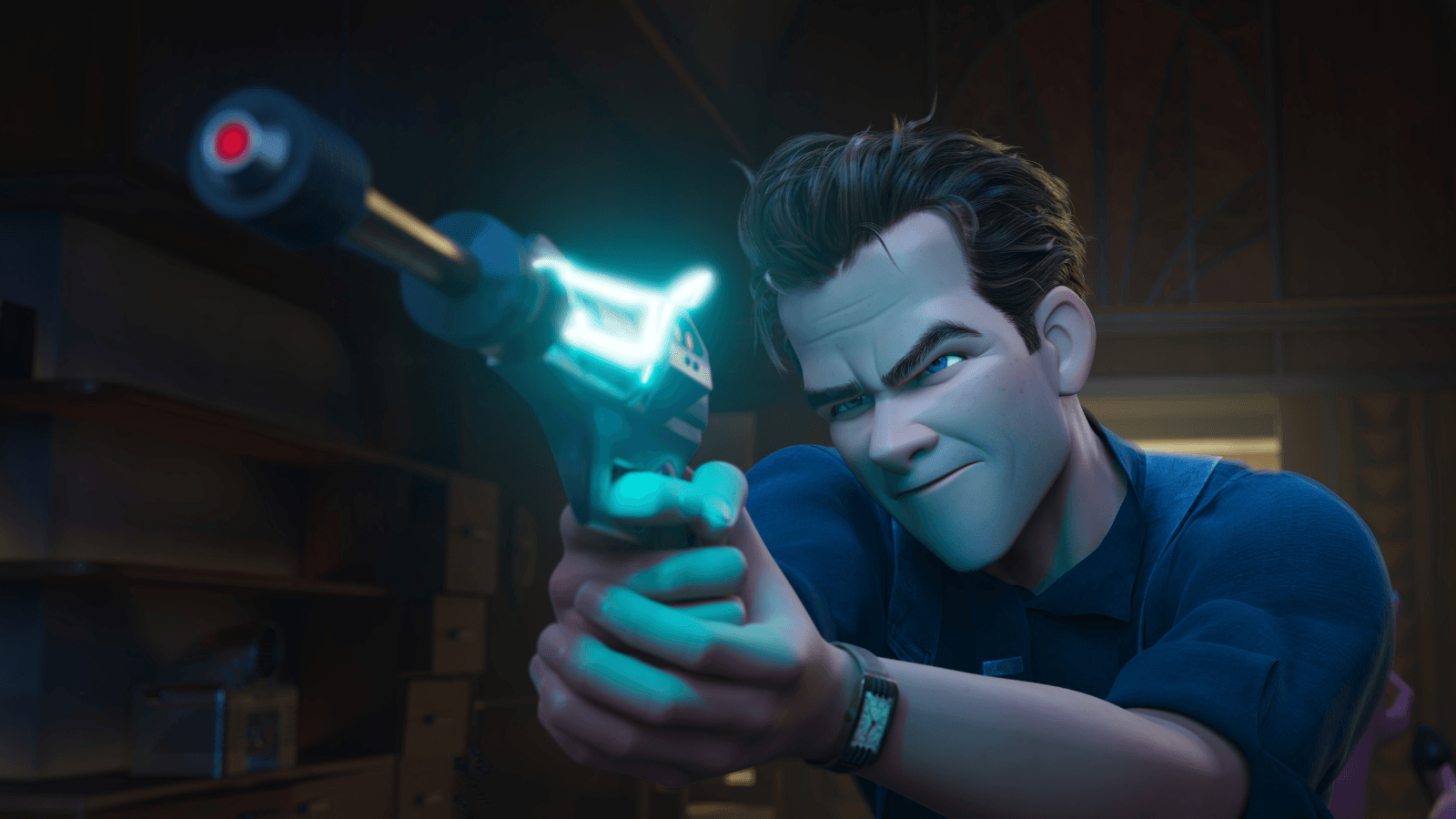
Throughout Ray Gunn, I found myself more compelled by these ideas than the frantic, monotonous action scenes or cartoony aliens in a future-noir world—a reaction that doesn’t speak well of its escapist entertainment value or lack thereof. The film also marks a reunion between Bird and John Lasseter, the Pixar co-founder ousted after #MeToo complaints and now teaming with David Ellison’s Skydance Animation on several Netflix productions. (The yuck quotient in that sentence is considerable.) It’s not that the movie is actively bad. The concept is sound, and certain aspects of the execution are impressive-looking or delightfully weird. Note a bizarrely funny sequence where Gunn and two goons are zapped into a mass that recalls the human tumbleweed in this year’s Resident Evil. What’s so frustrating about Ray Gunn is that the potential for something special is clear, yet it’s an unremarkable experience that left me bored and underwhelmed.
Like DFR? Support us.
This site exists because readers like you care about film. If DFR has enriched your experience with movies, I’d be grateful for your support. You have a few options:
• Join DFR’s Patreon community
• Make a one-time donation on PayPal
• Buy me a coffee
Whatever option you choose, it helps keep my work independent. And it means a lot to me.
Thank you for reading, and for making this work possible.
Brian Eggert | Critic, Founder
Deep Focus Review