Pressure
By Brian Eggert |
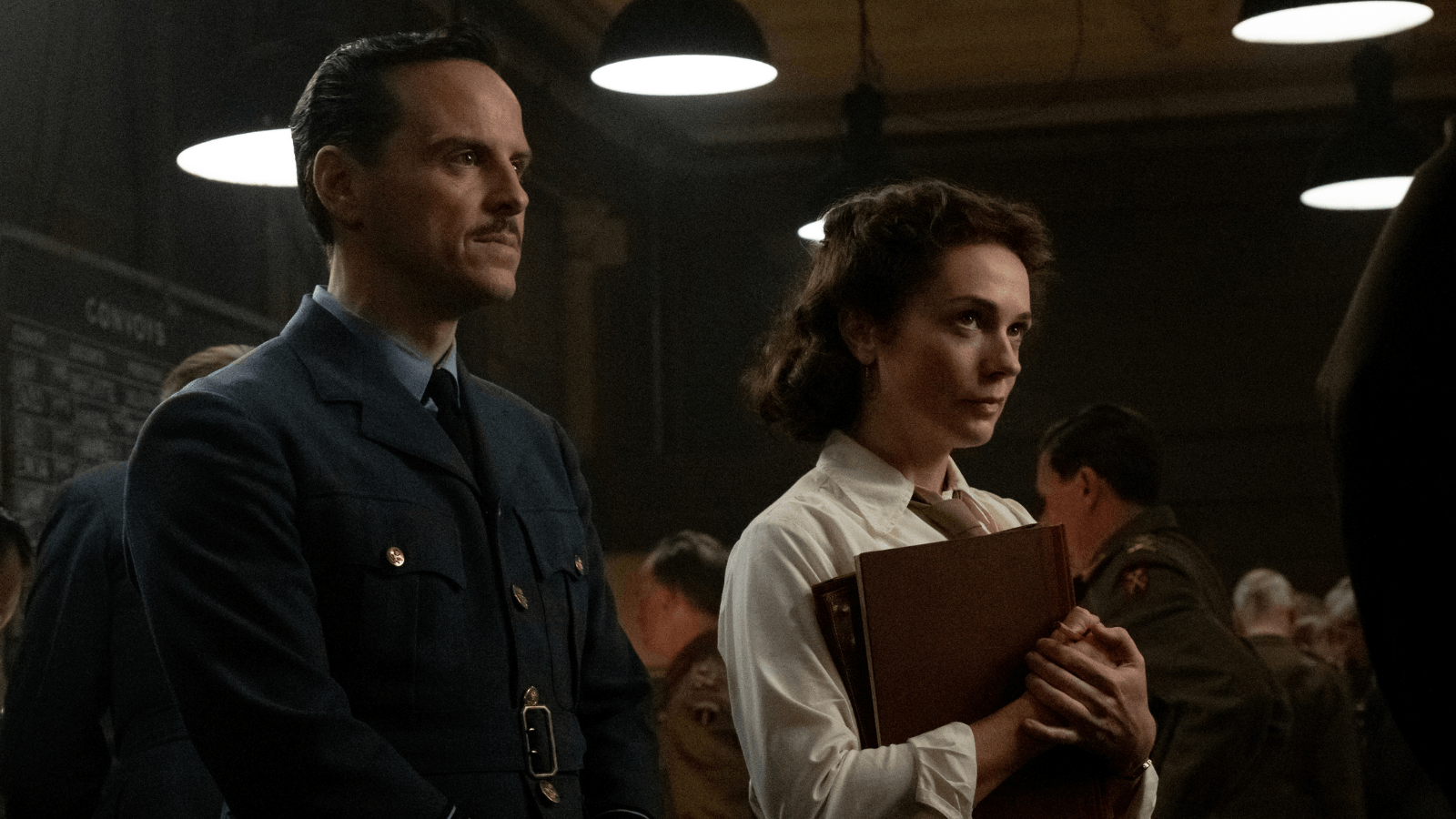
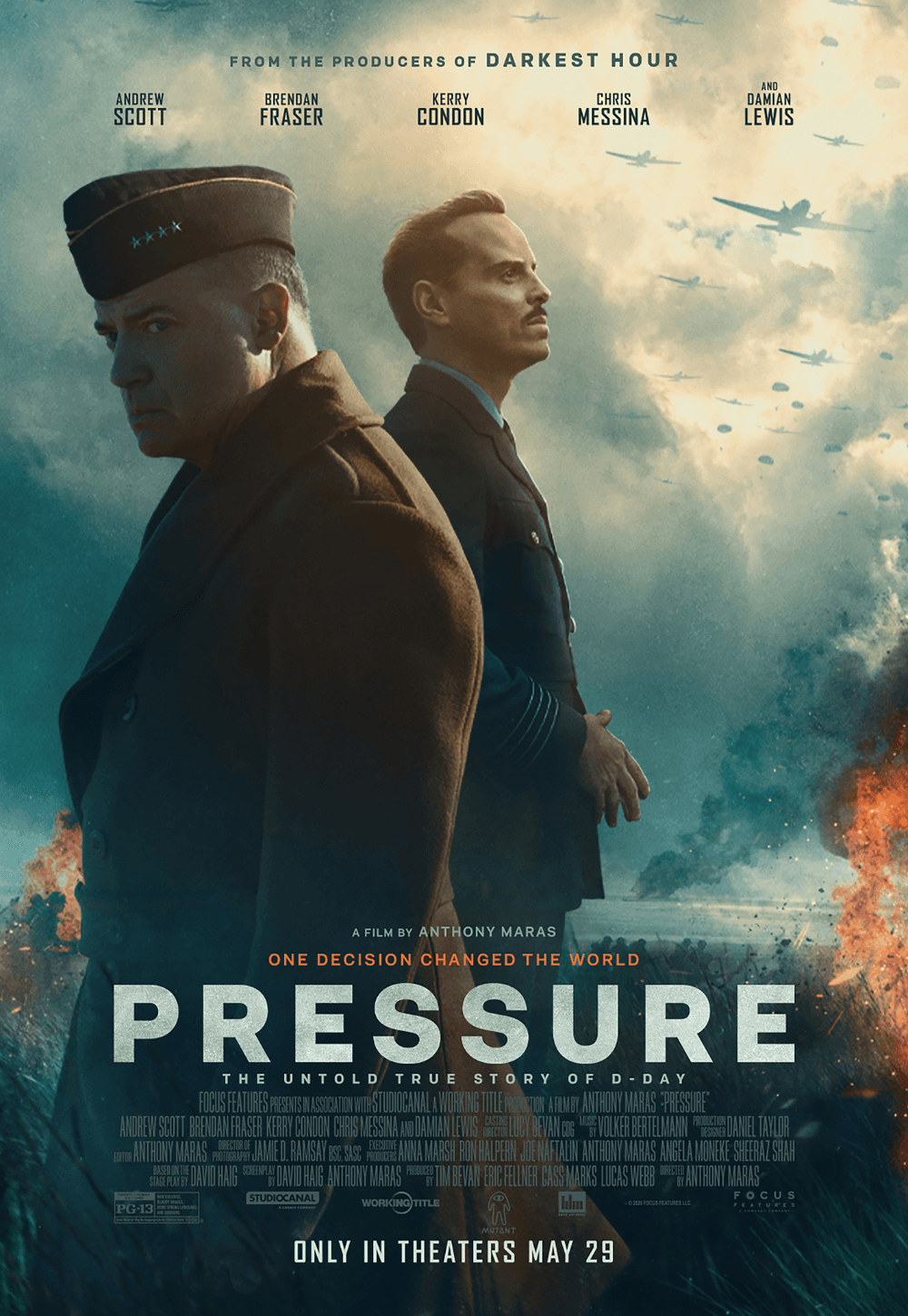
Few topics of casual conversation are less interesting than the weather. Only talk of gas prices and that something’s “going around” (usually the common cold) is more banal. But somehow, Pressure makes weather palatable, even enthralling, by demonstrating, through an intriguing episode of twentieth-century world history, how meteorology had a formative impact on the outcome of World War II. The film tells the story of Group Captain James Martin Stagg, played here by Andrew Scott in a steely performance. Stagg was the Scottish scientist who advised Eisenhower on the best day to launch the D-Day armada, the largest seaborne invasion force in history, against Nazi Germany. Those with a firm grasp of the significant dates in that war won’t be surprised by the outcome. However, the material, based on David Haig’s 2014 play of the same name, also offers a welcome argument, much needed in these anti-science times, of how, as one character puts it, “Data—that’s what counts.”
Indeed, the message is galvanizing. When the end credits started to roll at the press screening I attended, a woman in the audience shouted, “Science works!” At the center of Pressure is a story about how Allied forces arrived at the decision to land on the beaches of Normandy on June 6, 1944. The screenplay, adapted for the screen by Haig and director Anthony Maras, doubles as a demonstration of how we can use data to confirm our own biases. But the true scientific method, when strictly followed, eliminates biases and leaves only cold, hard facts. Not what philosophers call truth. Not what the faithful call belief. But facts. For this, Pressure is unlike any other in the war movie genre, which too often relies on jingoism, sentimentality, action, intrigue, and, on rare occasion, a condemnation of humanity’s capacity for senseless violence.
Stagg must leave his nine-months-pregnant wife for a post at Southwick House, the secret headquarters of the Allied military command. When the resolute scientist arrives, he’s less interested in military protocol or making friends with others in his meteorology department than in doing things his way—by making informed decisions based on data. There, he meets Dwight D. Eisenhower (Brendan Fraser), the Supreme Commander of the Allied Expeditionary Force, who wants certainty, not guesses, about the weather forecast for the D-Day invasion, originally planned for Monday, June 5. Although Churchill swears by Stagg’s abilities, Eisenhower has more faith in his American counterpart, the cocky US Air Force meteorologist Irving P. Krick (Chris Messina), an insufferable blowhard.
The drama stems from Stagg and Krick’s opposing forecasts for the invasion on Monday, leaving the two men with a tense few days of power struggles and arguments before they make their final recommendation to Eisenhower. Krick makes predictions based on similar weather patterns observed throughout history, going back to the early 1900s. Stagg recognizes that the weather isn’t predictable based on historical reports and relies on up-to-the-minute reports from weather stations around the world. Krick predicts sunny skies on the day in question. Stagg suggests the conditions couldn’t be worse, with two storms creating high winds and waves that will thwart the Allied Air Force and Navy. The military high command views Stagg as a pessimist and shoots him disapproving looks. General Bernard Montgomery (Damian Lewis), the dogged and experienced war vet who grows tired of the science talk and wants to rush into battle regardless of the weather conditions, declares, “Battles are lost when doubt enters the mind.” But Stagg isn’t a pessimist or doubter. He’s a realist who relies on facts, not (misguided) intuition, (false) hope, or (blind) confidence.
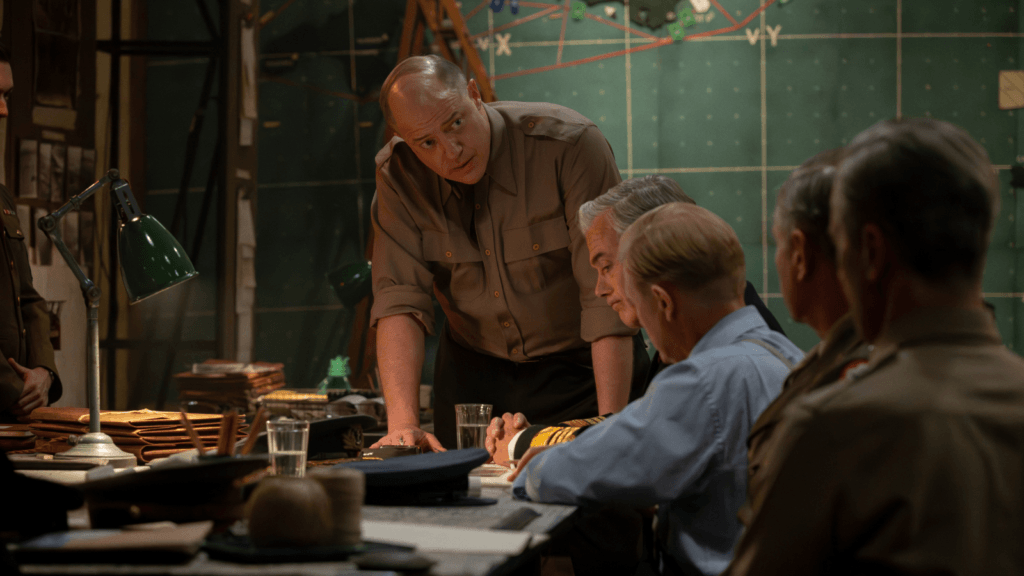
Fortunately, most of the actors fit convincingly into their roles, with Scott, Messina, and Lewis each leaving quite an impression. However, Fraser, ever the ham, does not have the gravitas to play Eisenhower. The Oscar-winner and former Encino Man, with his cracking voice and kind eyes, never quite disappears into the role. Out-acted by his costars, Fraser is performing. All the other actors are inhabiting. Also in the cast is Kerry Condon as Kay Summersby, Eisenhower’s assistant. The screenplay leaves little for the talented Condon to do in this role, other than to provide Stagg with empathy when there’s a scare involving his wife. It feels as though Haig added the part only to catch the woman’s perspective, but he couldn’t think of anything vital for her to do besides support the drama’s men. Regardless, most of our attention is reserved for Scott, whose moving portrait finds him touching his wedding ring as he gives a bad forecast to his commander, all while thinking of his wife and child. Few actors working today handle emotional devastation as well as Scott (see All of Us Strangers, 2023).
Pressure has the feeling of a mid-budget production that’s trying to pass as a blockbuster. Maras and his cinematographer, Jamie D. Ramsay, employ a shimmering, soft-filtered aesthetic, reminiscent of many glossy war movies. However, Maras relies on frequent filler montages of waiting soldiers, weather balloons, and inconsistent use of vintage wartime footage from the era. Such in-between passages tend to connect the play’s primary dramatic scenes, occupying the space where the stage lights would normally dim as a scene transitions into another. Most of these moments feel either superfluous or visually inconsistent with the film’s narrative thrust. Montages also facilitate scenes where Stagg and his team gather data, but they never attempt to explain the science. Instead, they merely show nonspecific science happening. Elsewhere, Maras, serving as editor, creates confusion. At one point, Condon’s character peels an orange for Eisenhower. She even notes how rare oranges are in this part of England at the time. A moment later, the orange has conspicuously disappeared from the scene, leaving us to wonder why the filmmakers brought it up in the first place.
Despite occasional inept technical choices, Pressure is a stirring drama thanks to Scott and its effective countdown structure. It’s a curiously small-scale and talky play-to-film adaptation, with a half-hearted D-Day sequence at the end that plays like a trailer for Saving Private Ryan (1998). That aside, it’s a refreshing change of pace from the usual offerings during the summer moviegoing season. And it’s particularly resonant in its condemnation of what Stagg calls the “confident moron”—a person suffering from the Dunning-Kruger effect. In this age of selective data and alternative facts, no one likes the dour guy with bad news that happens to be accurate. Fortunately, Stagg was living in a saner time than we do, when the people in charge responded to factual authority. In that sense, Pressure feels not only inspirational but almost bittersweet in the end, leaving the viewer nostalgic for somewhat more rational times.
Thank You for Supporting Independent Film Criticism
If the work on DFR has added something meaningful to your love of movies, please consider supporting it.
Here are a few ways to show your support: make a one-time donation, join DFR’s Patreon for access to exclusive writing, or show your support in other ways.
Your contribution helps keep this site running independently. However you choose to support the site, please know that it’s appreciated.
Thank you for reading, and for making this work possible.
Brian Eggert | Critic, Founder
Deep Focus Review