Hoppers
By Brian Eggert |
Stop. Set down your phone. Find a quiet place near a glade or a meadow. And just observe. After a few minutes of silence, you will notice an ecosystem at work. That’s the lesson imparted by Grandma Tanaka to Mabel, the hero of Pixar’s latest gem, Hoppers. A high-concept adventure involving the secret hierarchies of the animal kingdom, technology that places a human mind into a robot body, and a race to stop an invasive construction project, the film ranks among the animation studio’s most entertaining recent efforts, complete with a title sequence reminiscent of Mission: Impossible’s light-the-fuse opening. Although one could trace the various plot points to other material, ranging from Avatar (2009) to Furry Vengeance (2010), the film transcends its more familiar aspects with breakneck energy and humor, along with the best-looking computer animation from any of today’s animation houses. Like Pixar’s most memorable films, Hoppers combines silliness and sophistication in a way that feels like magic.
Hoppers was written by Jesse Andrews, the author of Me and Earl and the Dying Girl (2012), who has since collaborated on two Pixar features—the other being Luca (2021). He conceived the idea alongside Daniel Chong, who makes his directorial debut at Pixar. However, anyone familiar with Pixar’s process knows that developing the story is a collaborative effort. Whereas most movies suffer from too many writers and voices contributing to the narrative, Pixar remains unique. They’ve figured out how to set aside egos and tell the best possible story, backed by their senior creative team (Andrew Stanton, Domee Shi, Peter Sohn, Dan Scanlon, and many others). With much of Pixar’s output focused on sequels as of late, features such as Hoppers and last year’s underseen and underrated Elio have a refreshing originality that reminds us what makes Pixar great.
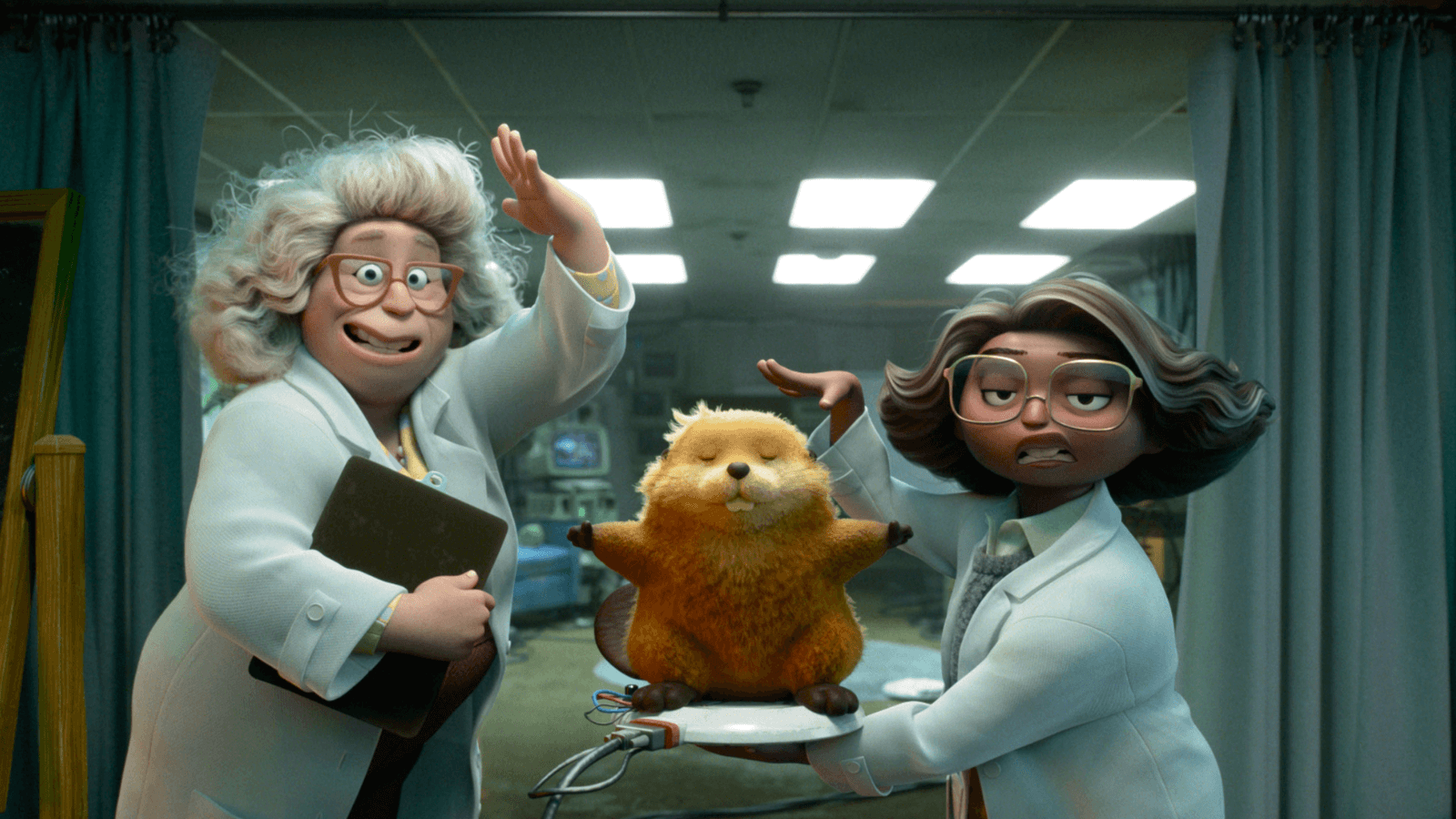
The film follows Mabel, who, as a child, earned a reputation for animal activism by liberating her school’s classroom pets from their containers. At 19, Mabel (voiced by Piper Curda), a student at her hometown university in Beaverton, is on a mission to save the idyllic glade where her late Grandma Tanaka (Karen Huie) taught her about appreciating Nature. But Beaverton’s smarmy Mayor Jerry Generazzo (John Hamm) has plans to build a new beltway over the glade, which all the local fauna have conveniently, and suspiciously, abandoned. Her biology professor, Dr. Sam Fairfax (Kathy Najimy), and her two researchers (Aparna Nancherla, Sam Richardson), explain that if a beaver could be enticed to return to the spot, the presence of a beaver dam would attract other critters as well. And then Mabel discovers that her instructor has invented a technology called the “Hoppers” project that could help: They can temporarily transfer a person’s consciousness into a robot-animal body to observe habitats in the wild. Seeing that they have a beaver-bot, Mabel puts her mind inside, much to Dr. Fairfax’s alarm.
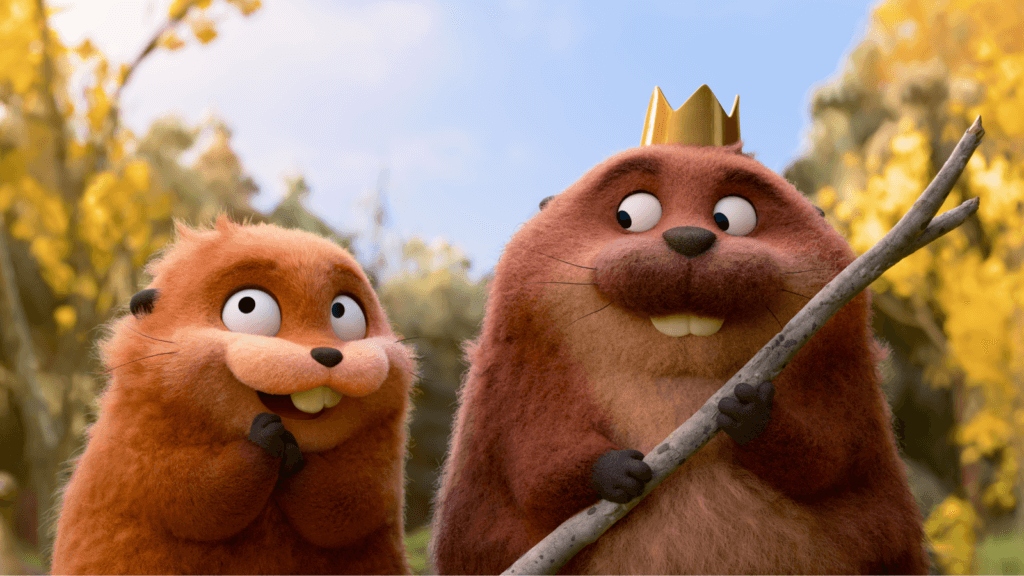
Almost instantly, Pixar’s knack for inspired visual jokes becomes apparent. From a human’s perspective, the robot beaver looks and sounds like the real thing, with little brown eyes and adorable, if unintelligible squeaks. From Mabel’s perspective inside the bot, other animals have cartoonish eyes and speak in English. The dynamic between the animal and human worlds and the wonderfully timed alternations between them remain a persistent source of laughs. On her undercover mission, Mabel meets the mammal leader, King George (Bobby Moynihan), who has a little crown and upholds “Pond Rules,” which encourage a community vibe but also allow for the circle of life—such as the grizzly bear named Ellen (Melissa Villaseñor), who occasionally eats someone in her community (a refreshing detail that acknowledges how, in Nature, but not in most talking animal movies, predators eat prey). Mabel tries to convince King George to build a dam in the glade, which will prevent the Mayor from building the highway over it. Except that the Mayor has taken steps to discourage local wildlife from returning.
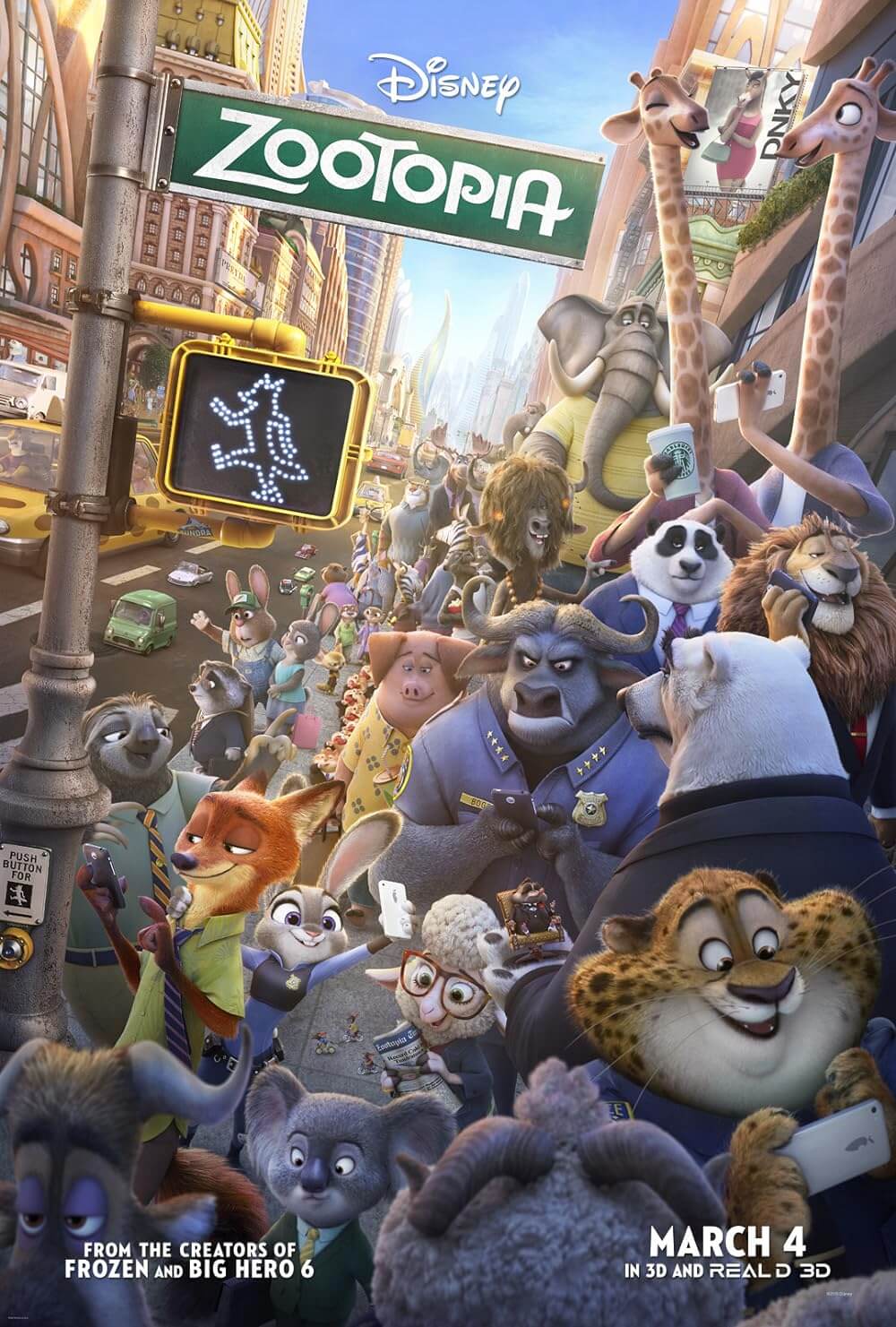
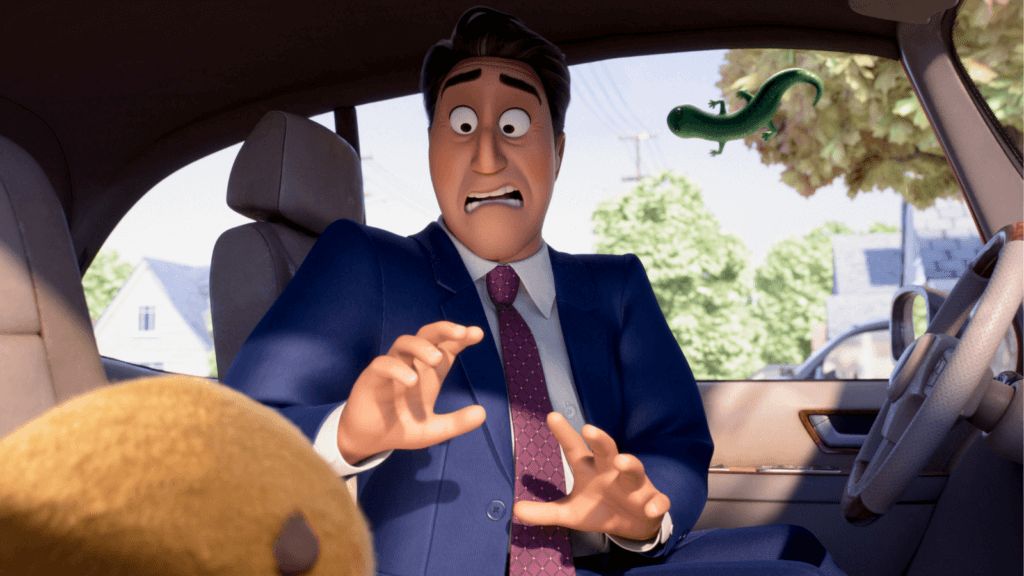
As the story progresses and introduces various other animal realms, Hoppers feels like what would happen if the world of Zootopia (2016) and its sequel collided with humanity. There are amphibian, avian, and piscine kingdoms, each overseen by the insect queen (Meryl Streep), a butterfly whose caterpillar son becomes the film’s unlikely villain in the second half. Mabel hopes to organize them against the Mayor to stop the beltway, and the situation quickly gets out of hand when they announce plans to “squish” the Mayor (from an insect’s perspective, “squish” is tantamount to “kill”). In usual Pixar fashion, much of the final stretch consists of fast-paced action and elaborate sequences, with Devo’s Mark Mothersbaugh providing a lively score to maintain the film’s energy. The animation, of course, is incredible throughout. Pixar’s animators have outdone themselves with their rendering of matted and clumpy fur, the variety of styles between realism and cartooniness, and their willingness to get downright scary when a maniacal insect places its mind in a robotic human body. Hoppers also bears the studio’s delightful self-referentiality to other Pixar features, with hidden jokes and references to Finding Nemo (2003), Up (2009), and many others.
The film might send mixed messages, given how it combines themes of the therapeutic aspects of Nature with the persistent presence of smartphones and emojis. A running gag that extends into the playful end credits involves animals pressing emojis on a text-to-speech app—King George, for instance, repeatedly presses the beaver and log symbols. It’s an amusing bit, watching a cuddly beaver press the same button over and over, accompanied by the app’s flat reading. While the film sends youngsters off with a message about the majesty and fragility of the natural world and humanity’s role in that world not as custodians but as members, it also implants an unfortunate desire to pick up a device. Of course, the filmmakers hope for a balance between the two ideas, just as the themes yearn for a harmony between humans and their environment. However, I worry that, on the ride home, the lesson might be forgotten as children tap away on their tablets in the back seat.
Nevertheless, I thoroughly enjoyed Hoppers. It contains a relatable theme about the stress of caring deeply for a cause that everyone around you seems to ignore. I also appreciate how it situates human beings within the larger biosphere, offering an environmental commentary that reframes us not as Nature’s overseers but as part of a global network of ecosystems. Seeing other species as a community, and further, a community in which humans have a role, makes it more difficult to dismiss them. “Animal homes. Human homes. They’re all just one big place,” says Mabel. It’s a clever tactic to encourage environmental responsibility. On a more basic level, Hoppers is simply a lot of fun, racing by with a brisk momentum. It’s the latest in a long line of Pixar’s hilarious and visually inspired features. The filmmakers take an intricate yet effortless plot, imbue the material with a full spectrum of emotion, and leave the viewer feeling as if they’re witnessing something both elementary and enlightened.
Thank You for Supporting Independent Film Criticism
If the work on DFR has added something meaningful to your love of movies, please consider supporting it.
Here are a few ways to show your support: make a one-time donation, join DFR’s Patreon for access to exclusive writing, or show your support in other ways.
Your contribution helps keep this site running independently. However you choose to support the site, please know that it’s appreciated.
Thank you for reading, and for making this work possible.
Brian Eggert | Critic, Founder
Deep Focus Review