Hope
By Brian Eggert |
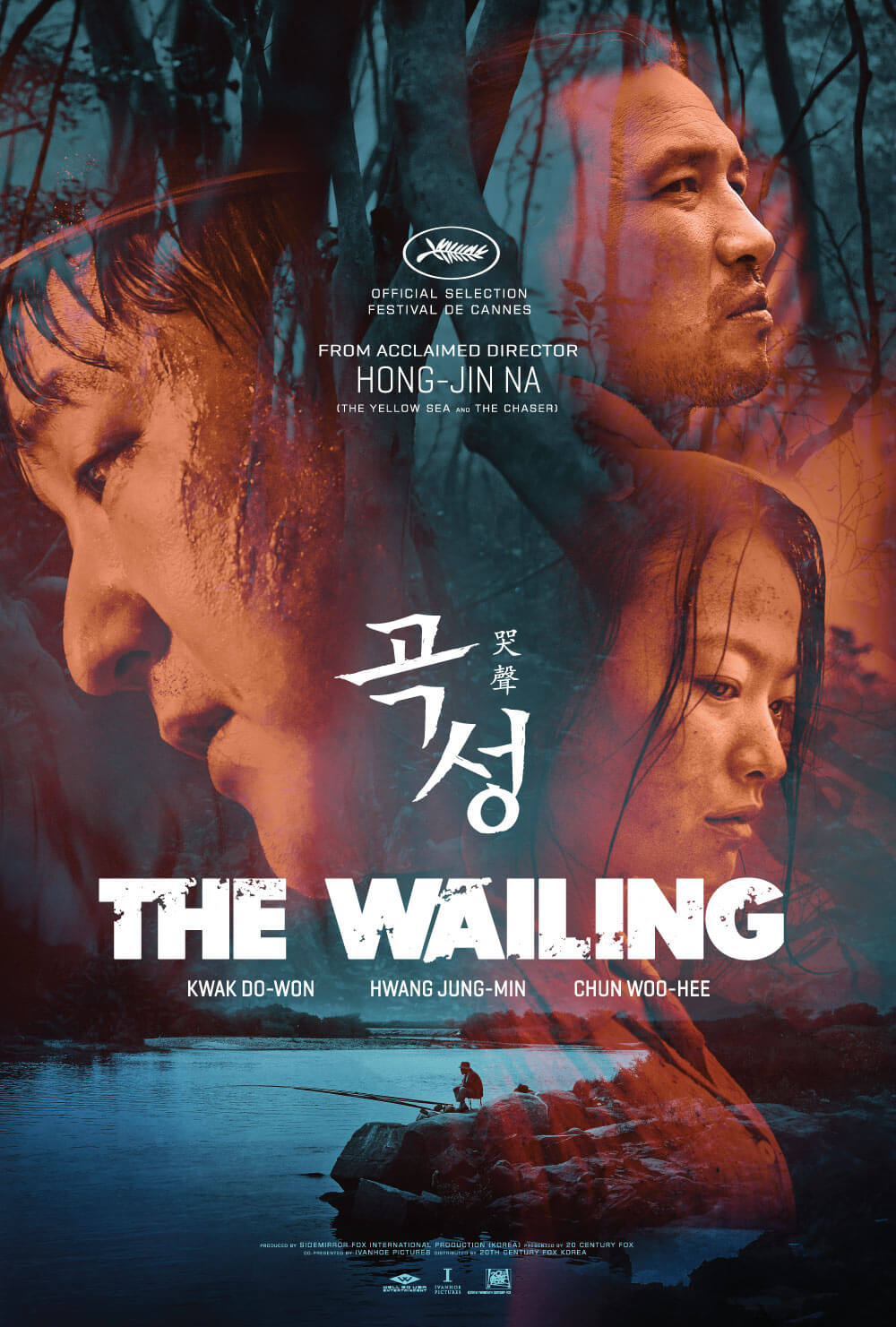
Hope has one of the most dramatic downturns from a great movie to a disappointing one that I’ve ever experienced. For two hours, South Korean writer-director Na Hong-jin, who returns with his first film since The Wailing in 2016, sustains a relentless procession of genre-heavy pandemonium. Despite the innocuous title, what begins as an engrossing, edge-of-your-seat monster movie gives way to human-alien conflict doused in blood and dusted with gunpowder. It’s not hyperbole when I say the production features some of the best stunt driving I’ve ever seen. Na and cinematographer Hong Kyung-pyo, who shot Burning (2018) for Lee Chang-dong and the Oscar-winning Parasite (2019) for Bong Joon-ho, orchestrate some incredible shootouts and high-speed chases that made my jaw drop. If only every aspect of the production had the same polish. In the last half-hour of this 156-minute epic of mayhem, some laughably awful-looking CGI characters appear, spout cryptic dialogue, and drag the film down to a nadir that’s practically subterranean.
Granted, the silly visual effects amount to a negligible percentage of screen time in the grand design of Hope, which, in every other technical department, excels. I now face a decision about how to review the film. If four-fifths of a movie achieve greatness, and one-fifth is bafflingly uneven, particularly the final fifth, does that negate the entire experience? When Hope’s confounding last 30 minutes threaten to derail the preceding two-hour ride, how do I reconcile this review’s star-rating arithmetic? After all, the first two hours deliver some of the best moviegoing I’ve had all summer. Sitting in a Dolby Cinema at my local AMC, I felt like Nicole Kidman, with an expression of rapturous wonder on her face. But later, I understood what she meant in her pre-show ad (one of many AMC has for its own theater chain), when she says, “Somehow, heartbreak feels good in a place like this.” Hope is a work of heartbreaking dissatisfaction for me, even as it supplies an exhilarating watch for much of its runtime.
What’s more, Hope might also be only half the story. The film ends rather abruptly, unresolved. Na announced after its Cannes debut that he’s written a script for the sequel. The question is: Will I care to see another entry after my staggering disappointment in the original? There’s undoubtedly a larger story to tell. But it starts rather small, with a dead bull on a dirt road, slashed to shreds by something. The setting is the fictional fishing village of Hope Harbor, situated alongside the Demilitarized Zone separating South Korea from the North. DMZ signs advise citizens to “Report Spies” and warn of mines beyond a perimeter fence. A loose animal is a new kind of threat. The local police chief, Bum-seok (Hwang Jung-min), worries about a predator on the loose, like a tiger down from Siberia. “We’re in deep shit,” he remarks, knowing most of the town’s officials have gone to the mountains to fight wildfires. He asks the group of hunters who found the bull, led by Sung-ki (Zo In-sung), to search the forest for signs. At the same time, Bum-seok heads into town, where he discovers what one eyewitness calls “a fucking huge monster” running amok.
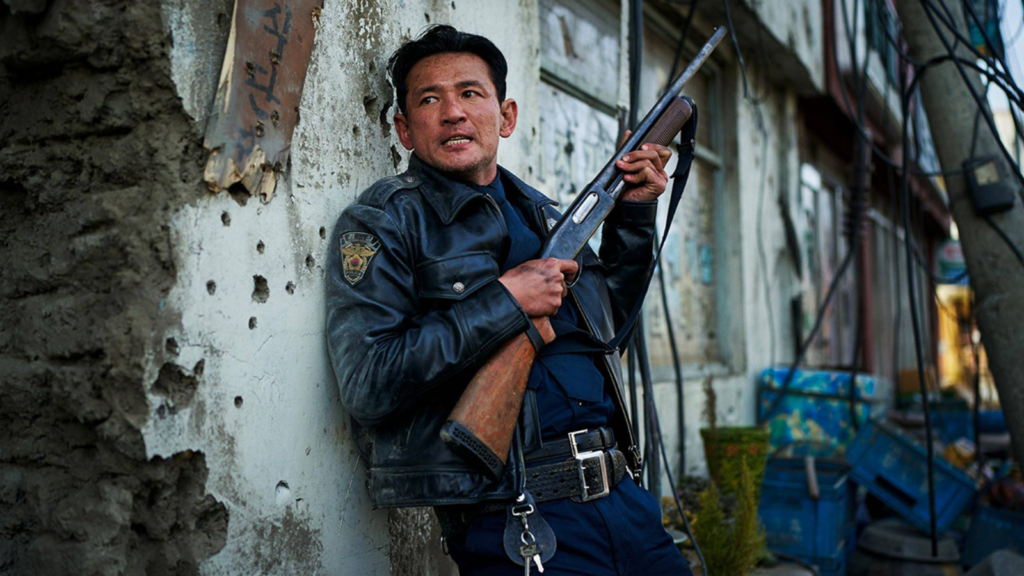
Na’s patient setup deserves praise. He builds dread by concealing his monster, leaving Lee Hwok-young’s scattered production design to implant fright by showing the aftermath of its rampage. It’s a note borrowed from Steven Spielberg’s Jaws (1975), where Chief Brody knows there’s something dangerous in the water, but neither he nor the audience sees the shark until much later. And like Chief Brody, Bum-seok proceeds with a shaky, almost comical devotion to his duties, despite being terrified of what’s to come. Shotgun in hand, he explores Hope Harbor’s torn-apart façades, which look as if a tornado went through town. Buildings appear in shambles, and people lie gutted amid the debris. It’s a small harbor, so the chief recognizes almost every victim, adding a layer of personal involvement. Then, he finds a bloody footprint that resembles a giant reptile’s, and something roars in the distance. After about an hour, Na reveals the thing: a lanky ten-foot-tall figure with green skin and clumpy black hair, calling to mind the underdweller from Barbarian (2022). It runs from zero to sixty in about five seconds, and it doesn’t think twice before smashing people and property to bits.
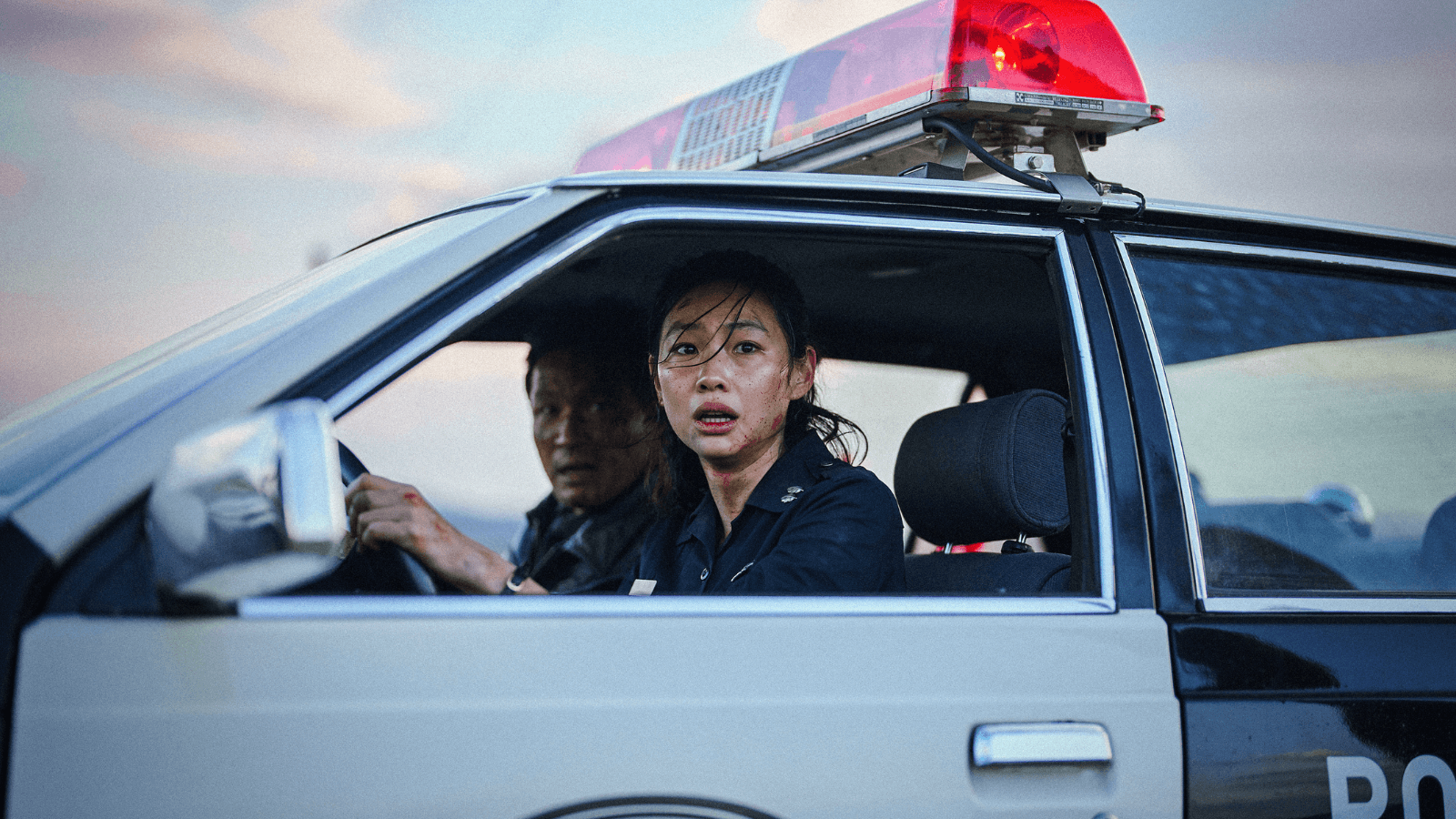
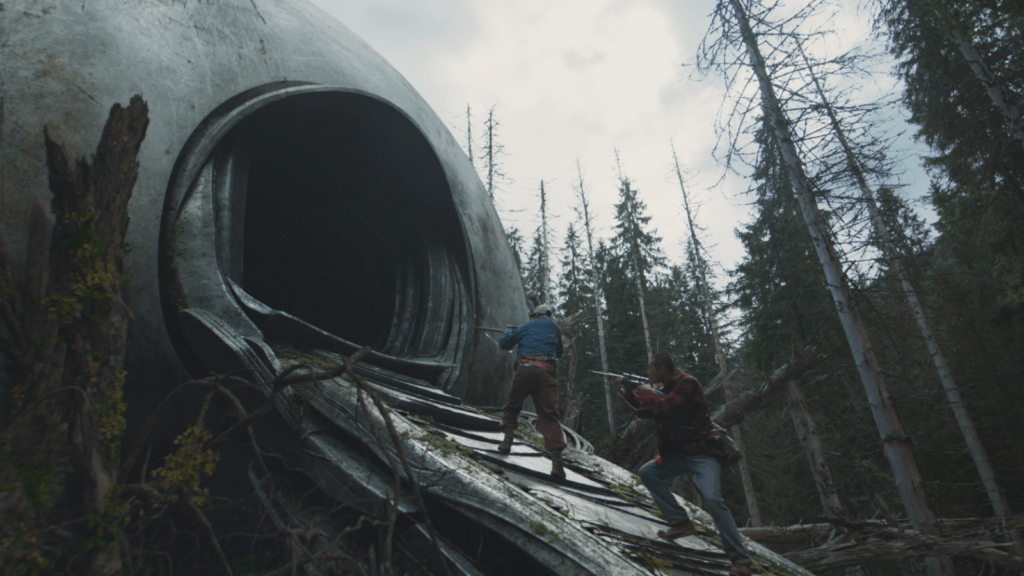
Perhaps the sequel will better establish some of Hope’s details, such as why the Harbor’s mostly elderly citizens have a secret inventory of high-capacity machine guns and other weaponry. Driving around town in a cop car with a small arsenal, Bum-seok is joined by a foul-mouthed deputy, Sung-ae (Hoyeon)—who calls the monster everything from a “fucking bastard” to a “stinky butthole”—and they form a makeshift posse with two other survivors. No matter how many bullets or grenades hit their target, the thing won’t die. Na and editor Kim Sun-min cut between Bum-seok’s battle in town and Sung-ki’s search in the woods with his fellow hunters. They find more animals and people ripped apart before stumbling on an egg-shaped spaceship, with a fleshy metal design worthy of H.R. Giger and a ramp out of a 1950s UFO movie. Even as Na prolongs the action with lavish sequences of driving and running (and horseback), shot by Hong in steady, wide-angle imagery that feels as immersive as an IMAX presentation, he also makes time for absurdist humor. Sung-ae treats the wounds of a trustworthy septuagenarian hunter (Im Hyun-sik), who wraps his revelation that there are multiple monsters in a detailed story about his diarrhea. It’s also amusing that the village idiot (Eum Moon-suk) may have inadvertently started the conflict.
Na’s blend of gnarly action and physical comedy, including an alien autopsy performed with a chainsaw, is counterbalanced by his sobering treatment of the aliens. A sign near town warning people to “Protect the Nation from Infiltration” establishes the threat of real-world outsiders. But once Na starts exploring the invasion from the aliens’ perspective (revealing a vague hierarchy and various species among their ranks), they seem less like invaders and more like severely misunderstood visitors. Na doesn’t share enough information to clarify their backstory, nor does he give his human characters much dimension, which only raises questions about his intent. Is this a commentary on perspectives that dehumanize immigrants? If so, it’s fitting that several Western performers (Alicia Vikander, Michael Fassbender, Taylor Russell, Cameron Britton) play the aliens in motion-capture performances—but you’d never know it. Their digital skins recall D-grade versions of the aliens from A Quiet Place (2018) and move with the computery judder of a bad video game cutscene. The biggest offender is Ma’veyyo, who looks like a cheap version of Abomination from The Incredible Hulk (2008), albeit animated with an unconvincing herky-jerky quality. When Ma’veyyo shifts his appearance from a relatively human, bipedal form to something that recalls the doglike licker from Resident Evil, the transformation doesn’t quite resolve in the viewer’s brain. Unlike in Jaws, where the rubber fish does enough to suspend our disbelief, the aliens in Hope have the opposite effect.
For a film with so many real village and forest locations, gooey practical effects for dead bodies and gore, and impressive driving scenes that rival those in The French Connection (1972) and To Live and Die in L.A. (1985), Hope’s CGI is embarrassing. The aliens’ vague dialogue only makes matters worse, alluding to a mysterious intergalactic conflict. By the final frames, we don’t understand what’s going on with the aliens, and the humans onscreen seem secondary. It’s unclear what Hope has to say about aliens, with its motifs of xenophobia and invasion from outside of South Korea’s borders. Is the film a commentary on America’s capitalistic colonization of Na’s country, which forces them into conflicts that otherwise wouldn’t concern them? Probably not, since the aliens are shown to be sympathetic. Bum-seok figures that one of them was likely trying to protect her child, yet that doesn’t inspire him or anyone else to attempt peaceful communication. Basically, Hope is about a big misunderstanding—a violent clash between two parties that seem to know little about one another, and by the end, haven’t resolved anything. The humans continue firing away at intelligent life, and the tough aliens keep chasing and thwacking them in return, sending them flying into trees.
Even without giving his characters (human or otherwise) personal histories or much shading, a lot happens in Hope. Na’s attention sometimes wavers nonetheless. For instance, he introduces a hunting Beagle named Monkey who disappears from the film without mention. What happened to the RPG rockets that were in the backseat of the cop car? And why does no one call the country’s equivalent to the National Guard, the Homeland Reserve Force, to assist with the threat? These questions arise afterward, whereas Na seizes our attention for most of the runtime. His concoction tries to replicate the James Cameron formula, mixing the car chases and gunplay of the Terminator series with a smaller dose of Avatar’s motion-capture aliens. Unfortunately, Hope only occasionally matches Cameron’s bravado—a stunt leap from a horse to a car stands out—but Na’s script lacks Cameron’s penchant for narrative clarity. To work, Na’s film needed either more or less screen time for his aliens, and given their appearance, less would have been preferable. Still, action junkies and South Korean cinema fans will probably be able to look beyond the poor CGI better than I can, making it worth seeing, even admiring Hope, with caveats abounding.
Like DFR? Support us.
This site exists because readers like you care about film. If DFR has enriched your experience with movies, I’d be grateful for your support. You have a few options:
• Join DFR’s Patreon community
• Make a one-time donation on PayPal
• Buy me a coffee
Whatever option you choose, it helps keep my work independent. And it means a lot to me.
Thank you for reading, and for making this work possible.
Brian Eggert | Critic, Founder
Deep Focus Review