Colony
By Brian Eggert |
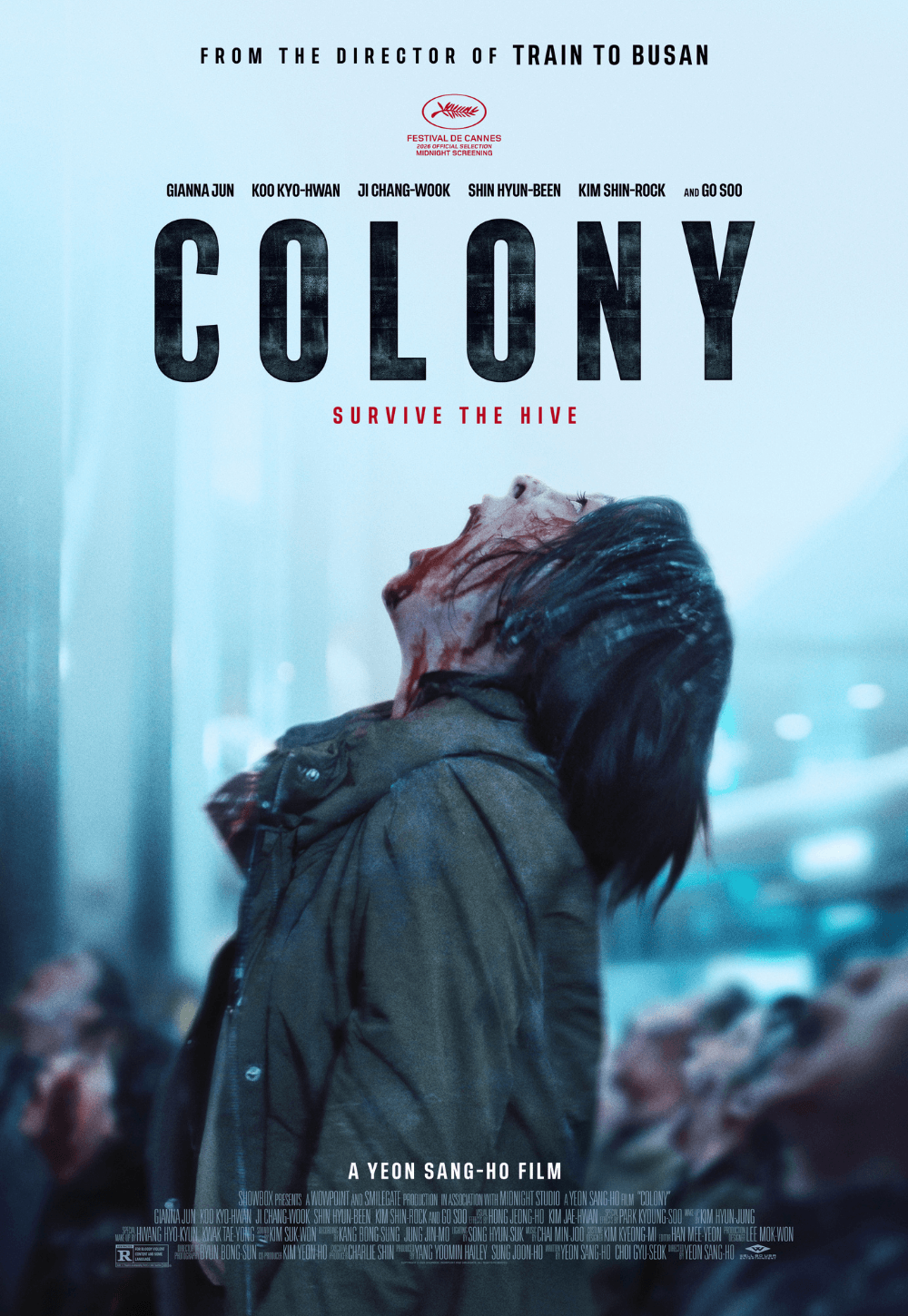
South Korean animator and director Yeon Sang-ho crafted an international hit with his first live-action film, Train to Busan (2016), a fast-moving zombie outbreak flick celebrated for its high-energy chaos and liberal dose of earned sentimentality. Since then, the filmmaker has dabbled in other genres, including superheroes, science fiction, and murder mysteries. None of Yeon’s other efforts became the phenomenon Train to Busan was, but he’s had a few modest successes in the interim, including the actionized sequel, Peninsula (2020). He returns to something resembling the undead subgenre with his latest release, Colony, which shares DNA with zombie-adjacent material from 28 Days Later (2002) to The Crazies (2010). Yeon’s latest is about a bioterror weapon that turns people into a rabid, groupthink horde bent on converting others into their collective. One can extract all manner of subtextual meaning from this story about hive minds today, but Yeon doesn’t draw parallels to today’s cultists and political fanaticism—he leaves that to us. Mostly, Colony is a chunk of solid genre entertainment.
Technically, Colony isn’t about zombies. It’s about a fungus that infects its hosts, turning them into mindless drones controlled by a smarter-than-average overseer—like an ant colony run by a queen. The concept isn’t new to the genre. The recent 28 Years Later movies introduced an Alpha-level infected, and Zack Snyder’s Army of the Dead (2021) featured a queen. However, fungi have been turning people into zombie-like creatures since the nasty, underseen Splinter (2008), followed by The Girl with All the Gifts (2017) and The Last of Us game and HBO series. What Yeon’s premise lacks in originality, it makes up for in sheer thrills. The action starts almost immediately after some cursory introductions. At a scientific conference held by the corporation Chains Bio, inside Seoul’s (fictional) Doongwoori Building, Professor Kwon Se-jeong (Shin Hyun-been) and her colleague Han Kyo-seong (Go Soo) respond to an invitation from the company’s CEO, Kang (Kim Jong-tae). Before they figure out why Kang knows nothing about the invitation, the executive is called away, only to face Dr. Suh Young-chul (Koo Kyo-hwan), a disgruntled scientist who injects himself with a vaccine before infecting Kang with his engineered bio-weapon.
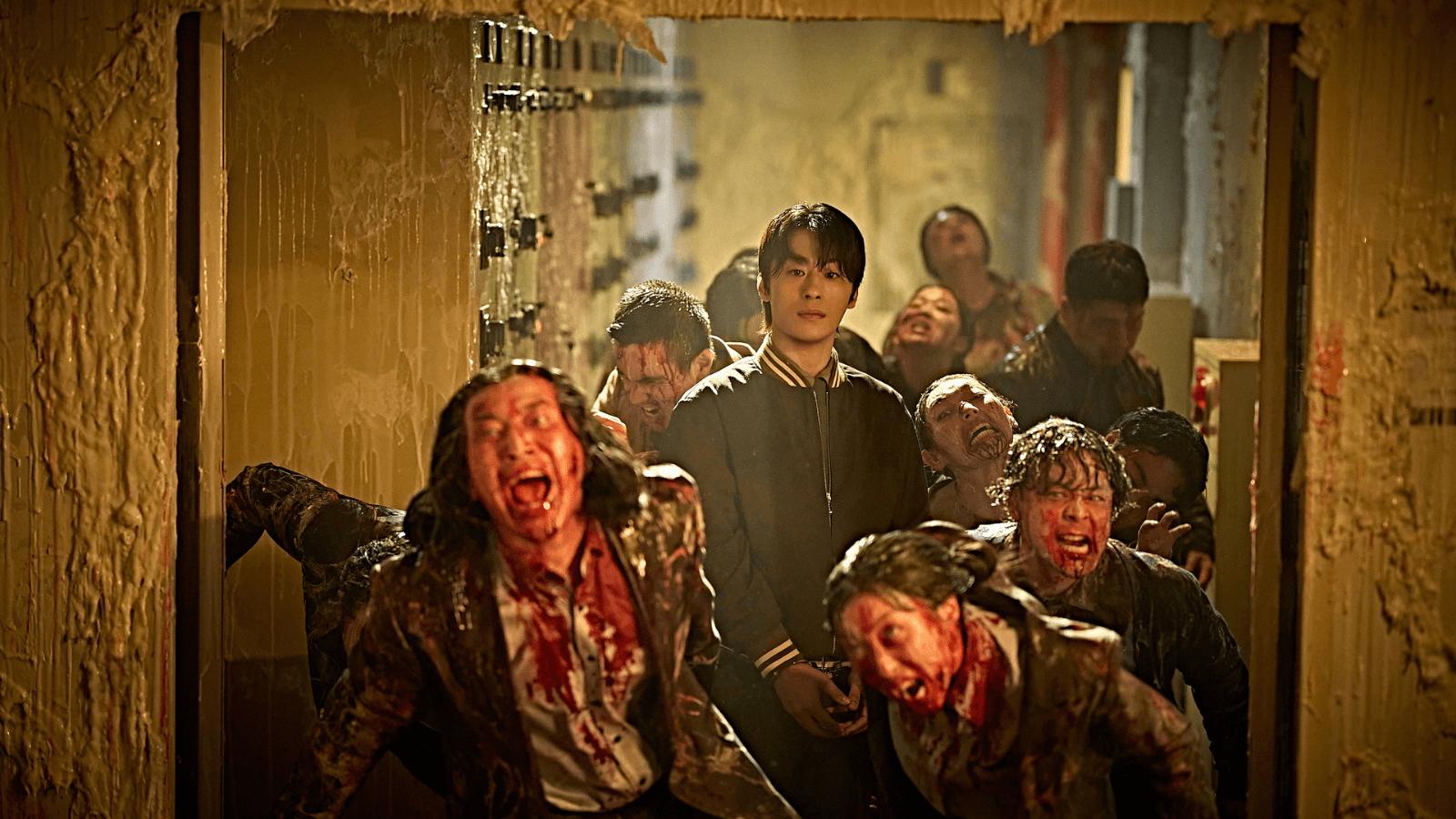
Colony wastes no time before the infection spreads throughout the 33-story building’s random mall-like storefronts and office spaces. Inside, the survivors desperately try to avoid detection, while outside, a government quarantine prevents anyone from leaving. It turns out, Chains Bio was researching genetic engineering to improve communication, and Suh came up with a solution: a swarm of humans who can read each other’s thoughts and grow their collective intelligence through slimy white mycelium. Sour over Kang stealing his research on organic superconductors, Suh has resolved to take “humanity to the next level” and bring about “the birth of a new humanity.” The mindless victims start off like snarling animals, moving on all fours and biting at cardboard cutouts and mannequins. Gradually, they learn from each new encounter and communicate each lesson by upgrading their group intelligence during screaming telepathic fits. Despite Yeon’s innovative take on the undead, their herky-jerky movements resemble the twitchy physicality of your typical twenty-first century zombie.
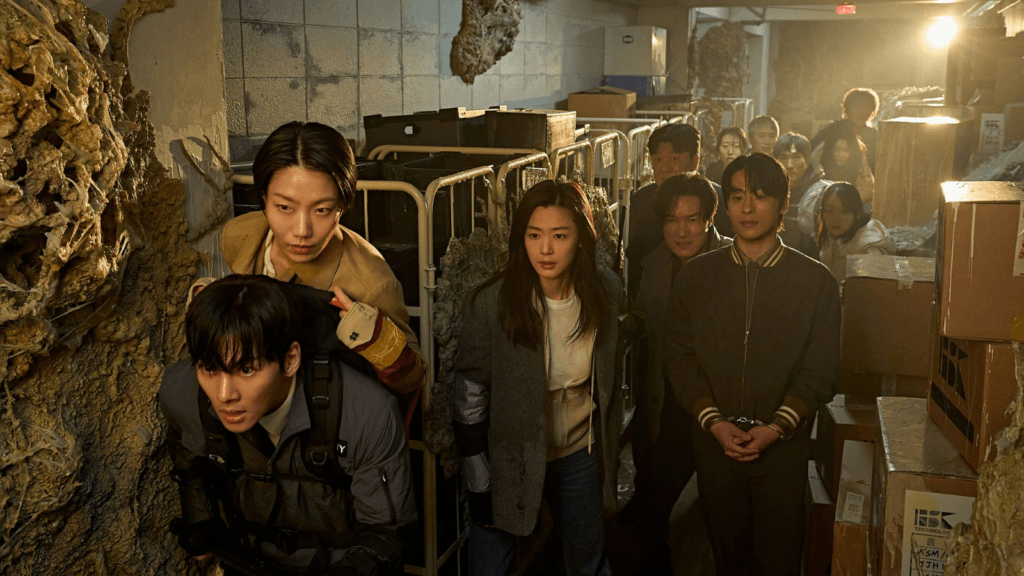
Yeon and Choi Gyu-seok’s screenplay occasionally features maddening, yell-at-the-screen stupidity from the survivors, particularly some youths in a bullying subplot. The security guard Seo Yeon-cheol (Koo Kyo-hwan) and his wheelchair-bound sister (Kim Shin-rok) fare better than most of their panicky counterparts, coming up with a nifty solution to the physically incapacitated sibling—which the infected imitate in a creepy development. Led by Kwon, the people inside discover that the infected can learn. Still, they reveal escape plans in the infected’s presence, self-sabotaging any hope of escape. Fortunately, these zombies are a clumsy bunch, bordering on drunken boxing slapstick. They slip on the slimy and bloody floors, drift around wide corners, and stumble over each other. When they attack, the infected climb on victims like they’re eating them in a typical zombie horde, but they’re not; they’re just spreading the infection. You would think that, since one bite does the trick, a whole swarm wouldn’t be necessary. Apparently they haven’t learned that lesson yet.
Unlike Train to Busan, Yeon offers little character depth and even fewer emotional stakes beyond the obvious desire to see the humans survive. For all of its remarks about groupthink and human evolution, Colony doesn’t reinvent the zombie genre, but it’s suitably thrilling and propelled by frenzied action sequences, some inspired by Aliens (1985). Armed soldiers from outside invade the building, vowing not to shoot the infected and locate Suh, who’s a living vaccine. In addition to the genre’s usual jolts of monsters popping out from nowhere, there’s plenty of gunfire and body-cam footage to amplify the tension. Occasional Shaky-cam aside, cinematographer Byun Bong-sun and editor Han Mee-yeon keep things visually comprehensible and coherent, showcasing impressive indoor sets that stand in for the Doongwoori Building. The CGI and practical makeup effects, too, are top-notch and never strain credibility. Halfway through its two hours, the film begins to drag after a series of false solutions and dead ends. But the climax is worth enduring the mid-film grind.
Yeon doesn’t seem that interested in making an outright commentary with Colony; he prefers to focus on his brand of high-energy zombie mayhem. And that’s just fine. However, as Suh tries to create a hive mind to share knowledge and information, which he believes will level the social playing field and allow people to experience greater empathy from and about others, there’s little discussion about the loss of individuality, as in Philip Kaufman’s Invasion of the Body Snatchers (1978). Suh’s logic mirrors that of self-serving politicians and AI advocates who argue for uploading information into databases, supposedly to make that knowledge accessible to everyone. But much like the film’s raging horde, the decision is backed by someone who benefits and remains in control—usually someone who wants to be in charge and therefore shouldn’t be. Whether it’s a mad scientist or tech-bro oligarchs, the loss of individuality (the thing that makes us human) is tantamount to becoming a zombie. If Yeon’s film doesn’t directly remark on these parallels, it at least inspires thought after its large-scale genre fun.
Thank You for Supporting Independent Film Criticism
If the work on DFR has added something meaningful to your love of movies, please consider supporting it.
Here are a few ways to show your support: make a one-time donation, join DFR’s Patreon for access to exclusive writing, or show your support in other ways.
Your contribution helps keep this site running independently. However you choose to support the site, please know that it’s appreciated.
Thank you for reading, and for making this work possible.
Brian Eggert | Critic, Founder
Deep Focus Review