Backrooms
By Brian Eggert |
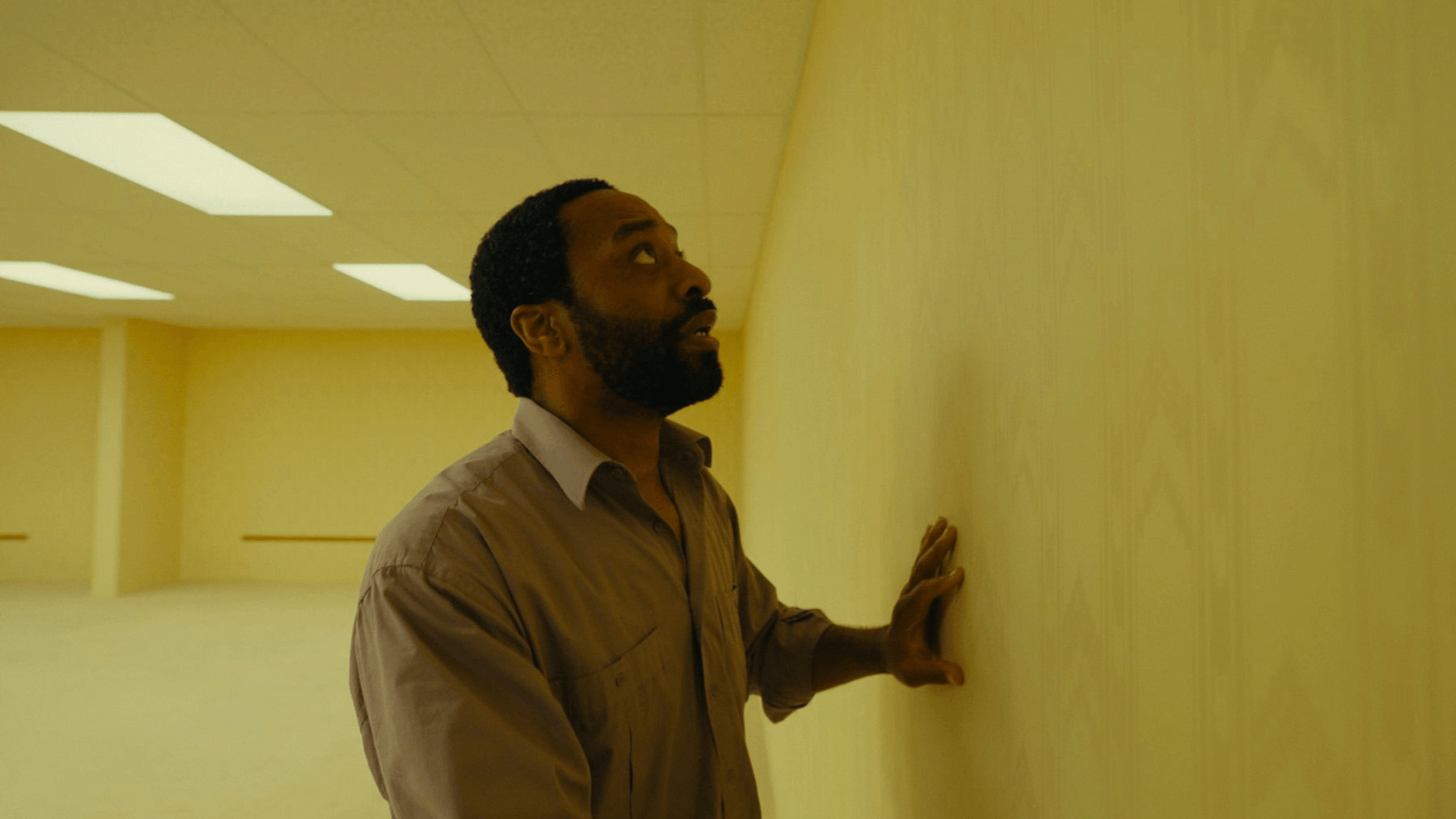
Kane Parsons delivers a remarkably assured debut feature with Backrooms, a liminal horror film distributed by A24. The title’s nightmarish setting initially resembles an abandoned, decades-old waiting room with putrid yellow wallpaper and carpet, a tiled drop ceiling, and humming fluorescent lights. The windowless place looks dismal and shabby, yet also unnerving, even claustrophobic in its emptiness. But as the film’s characters explore the endless maze of rooms, full of dead ends and objects that half-disappear into walls, the nonsensical layout becomes a physical manifestation of the work of M. C. Escher and Salvador Dalí. The surreal environments seem to suggest that multiple realities have merged into one, and the same can be said of the disturbing inhabitants, who look like defective models discarded by their maker. Parsons, who drew in millions of viewers with his YouTube shorts set in this space, started making videos at age 16. Now 20, he has a bright future, and his command of the medium is evident throughout this chilling experience.
Backrooms is also proof that the internet isn’t always a cesspool. The original idea for the film started in 2019 with a post on a 4chan message board. An anonymous user shared a photo of a dingy yellow room, along with a paragraph about the possibility of passing through its walls and becoming lost. Much like the Slenderman phenomenon, an online community latched onto this creepypasta concept and expanded upon it, creating indie games, videos, and social posts about the backrooms. Those unfamiliar with the online community may have seen a 2024 episode of the American Horror Stories anthology series featuring Michael Imperioli as a man lost inside. In 2022, Parsons, under the name Kane Pixels, started a 24-episode web series called The Backrooms: Found Footage that builds an elaborate, vague mythology around the space and the scientists at Async Research Institute who try to understand it. The series proved wildly popular, and Parsons was approached about directing a feature with a $10 million budget.
With a screenplay credited to Will Soodik, whose credits include HBO’s Westworld and the Ash vs. the Evil Dead series, Parsons begins his Backrooms feature like one of his videos. It’s 1990, and a lone explorer traverses the never-ending rooms with a VHS camcorder, resulting in the shaky, fuzzy aesthetic seen in the V/H/S anthology movies. It doesn’t end well for him. After instilling ample dread, Parsons introduces us to Clark (Chiwetel Ejiofor), the owner of Capt’n Clark’s Ottoman Empire furniture store in a rundown strip mall. Separated from his never-seen wife and sleeping in the store, the embittered Clark works through his resentment and solitude with his therapist, Dr. Mary Kline (Renate Reinsve). But Mary, who has authored a series of self-help tapes, has her own problems related to her schizophrenic mother and disturbing childhood memories.
When an electrical issue in Clark’s store leads to his discovery of what he calls “a place,” he begins to explore and gathers only an obscure understanding of how it operates. He tries to explain the area to Mary, but she sees his unhinged ravings as a symptom of his mental state—his fragile male ego has spiraled out of control since separating from his wife. He feels alone, and the backrooms somehow make him feel differently. Clark soon asks his sole employee (Lukita Maxwell) and her videographer boyfriend (Finn Bennett) to enter the zone and capture evidence on tape, a trek that goes horribly wrong. Something’s in the backrooms, relentlessly stomping along and killing anyone in its path, like one of the towering creatures from Silent Hill. When Clark never returns to Mary’s office, she goes searching for him by leaping down the same rabbit hole (there’s even a tiny door reminiscent of Alice in Wonderland).
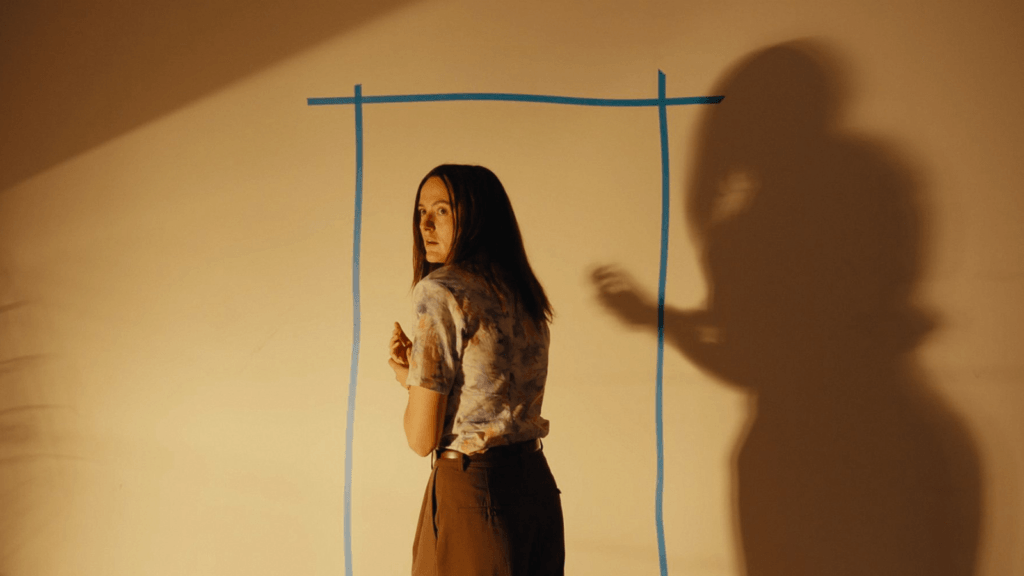
Soodik’s script offers some Psychology 101 explanations about how Clark and Mary have been stuck in life’s circular patterns. “We all have our loops,” Mary explains, with most instilled during childhood. All one must do to escape their “neural pathway of least resistance” and create positive change is to “open the window” and step through. But Clark finds comfort in those loops. Mary tries to break free but cannot. Beyond this dramatic arc for each character, there’s not much driving the emotional thrust of Backrooms aside from its inherent mystery. In that sense, the film recalls ABC’s Lost in its structure, complete with a mysterious agency, metaphysical reality, and a mythology that always feels on the cusp of a new revelation. But any real understanding remains elusive, evidenced when Mark Duplass shows up as a baffled Async scientist. Not knowing is part of what makes Backrooms work so well, and it can be included in a new subgenre dubbed liminal horror. Examples such as Skinamarink (2023) and this year’s Exit 8 explore in-between spaces of unknown origin, wherein the emptiness and silence amplify the eventual arrival of eerie, dangerous figures.
Apart from directing, Parsons also contributed to the haunting music (with Edo Van Breemen) and special effects in Backrooms. Although many of the sets in the film are practical, Parsons used the open-source effects software Blender to create some of the more out-there visuals. Most impressive is how he and his cinematographer, Jeremy Cox, a regular collaborator with Osgood Perkins, guide the viewer through the rooms with unsettling wide-angle lenses and camerawork that closely follows each character, drawing us into their experience as they navigate the rooms. Production designer Danny Vermette creates a labyrinth that varies: the jaundiced areas first explored, the white-tiled rooms with pools of water, and a hub out of Escher’s Relativity (1953). Eventually, Mary finds Clark, who introduces her to some of the other people inhabiting the backrooms, including a towering monstrosity played by the seven-and-a-half-foot Romanian actor Robert Bobroczkyi. Their designs are downright frightening.
Both Clark and Mary use the analogy that the backrooms are “like describing a dog to someone who’s never seen a dog, and then asking them to draw it.” Parsons gives his audience just enough information to feel like we have some grasp of what the backrooms are and how they work, though we may struggle to articulate it. Alex Garland’s Annihilation (2018) came to mind, in the way the alien-infected Area X at once absorbs, incorporates, and reflects those who enter. Something similar happens in Backrooms. But grasping the mystery isn’t the point. Parsons understands this and maintains its ambiguities. The experience is further enhanced by terrific performances from the cast, particularly Reinsve, who commits to Mary’s inner complexity and terrified reactions, selling the narrative as one about whether we will repeat our patterned behaviors or accept our choices and move on. While its emotional breakthroughs and backstories flesh out the characters and setting just enough to make them feel substantive, Backrooms is better seen as a well-crafted, horrifying, experiential funhouse ride from a talented first-time filmmaker.

Thank You for Supporting Independent Film Criticism
If the work on DFR has added something meaningful to your love of movies, please consider supporting it.
Here are a few ways to show your support: make a one-time donation, join DFR’s Patreon for access to exclusive writing, or show your support in other ways.
Your contribution helps keep this site running independently. However you choose to support the site, please know that it’s appreciated.
Thank you for reading, and for making this work possible.
Brian Eggert | Critic, Founder
Deep Focus Review