The Further Mis-Adventures of Cliff Booth
By Brian Eggert |
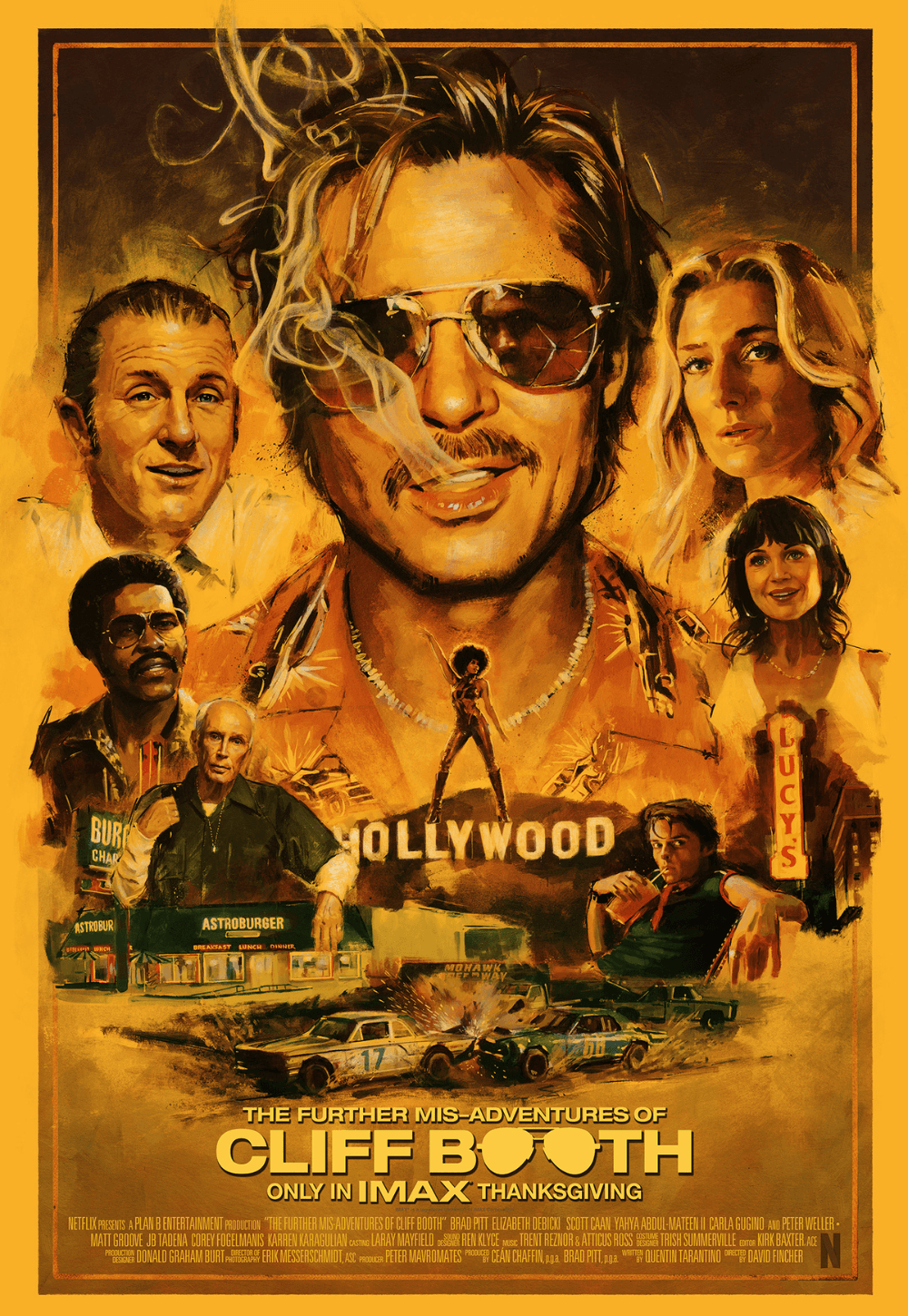
Netflix will release The Further Mis-Adventures of Cliff Booth in theaters on November 25. It will arrive on the streamer on December 23.
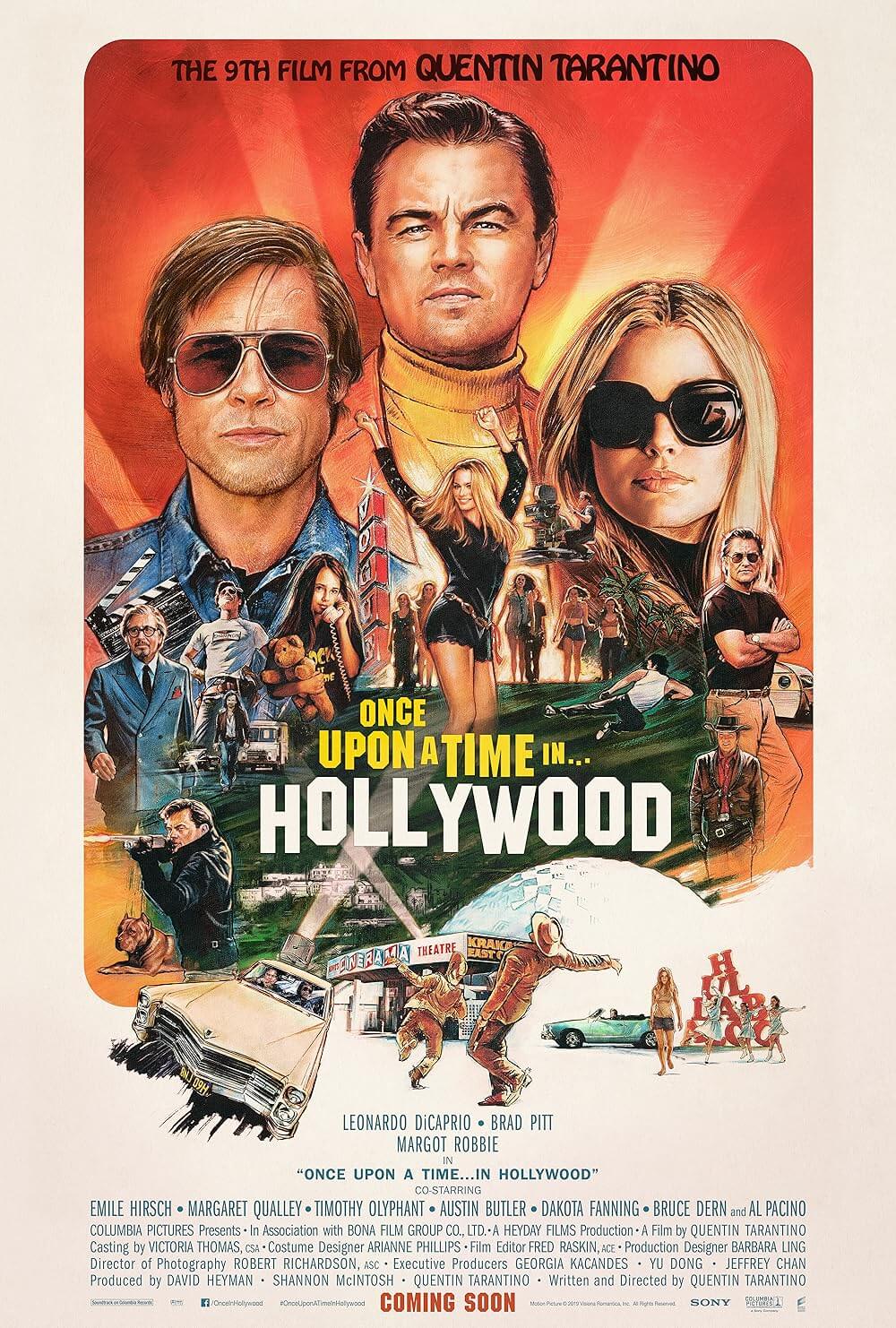
Continuing the infectious, effortlessly enjoyable hangout vibe of Quentin Tarantino’s Once Upon a Time in Hollywood (2019), The Further Mis-Adventures of Cliff Booth has one glaring flaw. It ends too soon. David Fincher directs the leisurely paced sequel, written by Quentin Tarantino, marking an unlikely collaboration between two singular filmmakers whose aesthetic and thematic concerns seem worlds apart. But it’s a happy union of sensibilities, even if the result feels neither entirely like a Fincher film nor a Tarantino film. Brad Pitt returns to the part that deservedly earned him an Oscar, looking a few years older but no less charismatic. The cast is a little less star-studded, and the story less sensational without the cloud of the Manson Family and Sharon Tate’s murder looming over the setting. Still, the entire film feels like one of the writer’s extended scenes, where winding conversations gradually build tension and climax with a burst of violence. It’s almost tantric in the way the film builds toward the explosive finale over two hours and twenty minutes, even with Tarantino’s usual tangents. Produced by Netflix, the follow-up is an oddity, to be sure, but a welcome one.
Tarantino has long said he intends to direct only ten movies, and after Once Upon a Time in Hollywood, he’s got just one left. Perhaps he’s saving the best for last, and that’s why he handed this trifle over to Fincher. A few years ago, Tarantino announced his career-closing film would be called The Movie Critic, but that project was canceled, leaving his final directorial effort in question. But the idea that he keeps writing pulpy scripts for other filmmakers to direct is appealing, especially when the results are this satisfying. Fincher’s outwardly serious oeuvre may seem too dark and moody for the postmodern pop-referentiality of Tarantino’s voice, but he’s shown his morbid sense of humor before. See Fight Club (1999), Gone Girl (2014), and The Killer (2023). The visuals aren’t as bright, colorful, or full of dynamic contrast without Tarantino’s usual cinematographer, Robert Richardson, behind the camera; however, Fincher’s recent collaborator, Erik Messerschmidt, adjusts the director’s signature precision and brown-soup palette to meet Tarantino’s playful throwback flair halfway.
Cliff Booth takes place in 1977, eight years after the original, and doubles as a travelogue of Los Angeles landmarks. It opens with a fake-out sequence (not the last) that reveals itself as a nested film, a Blaxploitation picture called Soul Brothers Die Hard!, screening at the historic New Beverly Cinema (which Tarantino purchased in 2007). The titular war hero and former Hollywood stuntman runs the projector and delights in watching the film for the umpteenth time, mouthing along with the dialogue in its fiery finale: “This don’t mean shit to me,” says the Dolemite-esque character onscreen, played by Yahya Abdul-Mateen II. This seemingly throwaway sequence, with Cliff changing reels and swapping kegs at the theater, initially feels indulgent but becomes vital upon reflection. For the time being, however, Cliff has stepped away from the entertainment industry to work part-time gigs as a projectionist, a bartender specializing in elaborate rum cocktails, and other, less legal work we learn about later: helping out friends when they get into trouble. Cliff doesn’t have high ambitions for his future. “I’m not that deep,” he admits later.
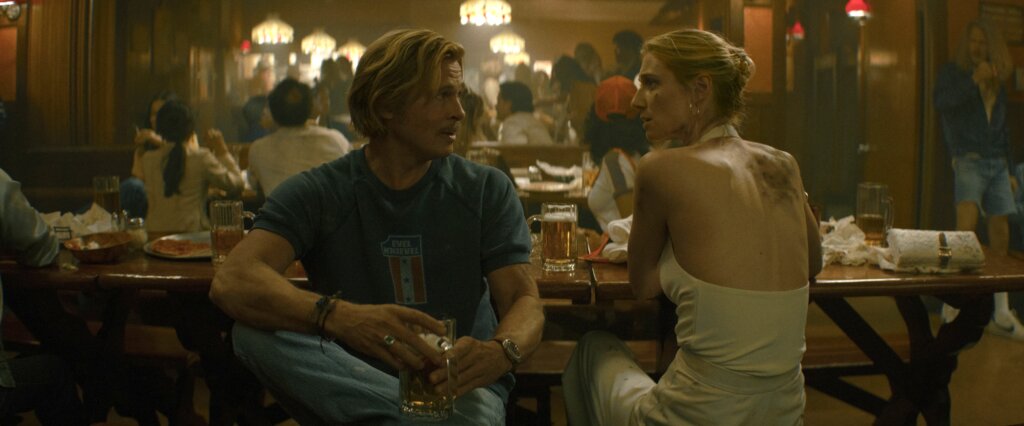
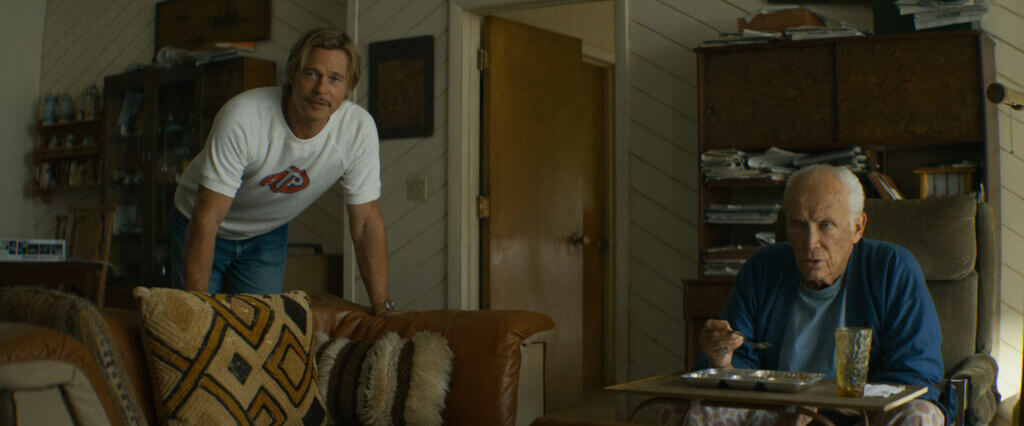
Much like its predecessor, the film follows Cliff to various neighborhoods around L.A. (Beverly Hills, Carson, Compton, Malibu, etc.), where he has brief, seemingly inconsequential encounters before heading to his next stop. Each night, he returns to the Marina del Rey apartment he shares with his set-in-his-ways father, Gus (Peter Weller). When he’s not running his pawn shop, Gus sits in his recliner, fusses over his fussy cat, paints models with his son, or watches movies and shows on his color TV. Cliff joins him, giving us a glimpse of their loving relationship, peppered with an inhabited shorthand that’s charmingly specific. The thrust of the narrative involves a decidedly short actor, Charlie Peters (Scott Caan), known for doing his own stunts and walking on planks to make him look taller (cue inevitable Tom Cruise comparisons). Charlie’s agent, Karen Crosby (Elizabeth Debicki), arranges a meeting with Cliff for reasons that remain unclear until the last third—but they almost certainly involve the Verdusco brothers (Matt Groove, JB Tadena), two ruthless killers from the Philippines. Regardless, Cliff’s immediate concern isn’t Charlie; it’s Karen, for whom he has a little crush that leads to a tentative coupling, smacking of BDSM.
Like most of Tarantino’s work, Cliff Booth is a pleasure on the ears—for the throwback score (by Trent Reznor and Atticus Ross) and the excellent soundtrack, sure, but more so for the exceptionally written dialogue, filled with elaborate pop-culture digressions and winding logic. Moreover, the film-savvy writer often references the cinema that inspired him, giving his audience the context needed to understand what he’s trying to accomplish and how to think about his film. For instance, the final line in Inglourious Basterds (2009) framed his film for critics: “I think this just might be my masterpiece.” Cliff Booth features such a conversation at a tennis club, where Karen, a former critic, shares her views on movies. The gist: Karen argues that movies aren’t art; she compares them to cheeseburgers—delicious, but hardly high cuisine. Film critics, she says, call movies art, whereas the average moviegoer wants to be entertained. Critics will undoubtedly latch onto the exchange and describe Cliff Booth as a juicy meal (to quote Jules from Pulp Fiction, “That is a tasty burger”) rather than a meaningful work of art with something to say. Movies are “artistic,” she says, but not art. But Karen’s line of reasoning negates the spectrum of so-called high art and low art. And as a critic, I feel compelled to point out how Marcel Duchamp defined art: “It’s art if I say so.”
In any case, Tarantino’s dialogue features hilarious detours and such entrenched particularity that it can be all-consuming, lending the sequel the easygoing quality of Once Upon a Time in Hollywood. That film didn’t really have a plot until everything came together in the end. Cliff Booth recaptures that laid-back movie feel. There’s also plenty of world-building within Tarantino’s alternate history, where Sharon Tate (Margot Robbie, seen briefly) is alive and appears in cigarette commercials, and where Rick Dalton (Leonardo DiCaprio, absent) has a hit show in Australia. Amusingly, a joke about Rick putting on so much weight that Cliff can no longer be his stunt double follows a discussion of actor Ralph Meeker, whom both Cliff and Gus admit looked good whether he was in shape or not. The same thing could be said about Rick (it might even be some chummy ribbing directed at DiCaprio). Elsewhere, this version of Los Angeles features a Big Kahuna Burger joint and whispers about Cliff’s takedown of Bruce Lee in the previous film, yet few seem concerned (as Zoë Bell and Kurt Russell were) that Cliff supposedly killed his wife. Instead, the mythmaking around Cliff centers on his World War II experience and a recurring gag about where people might recognize him from.
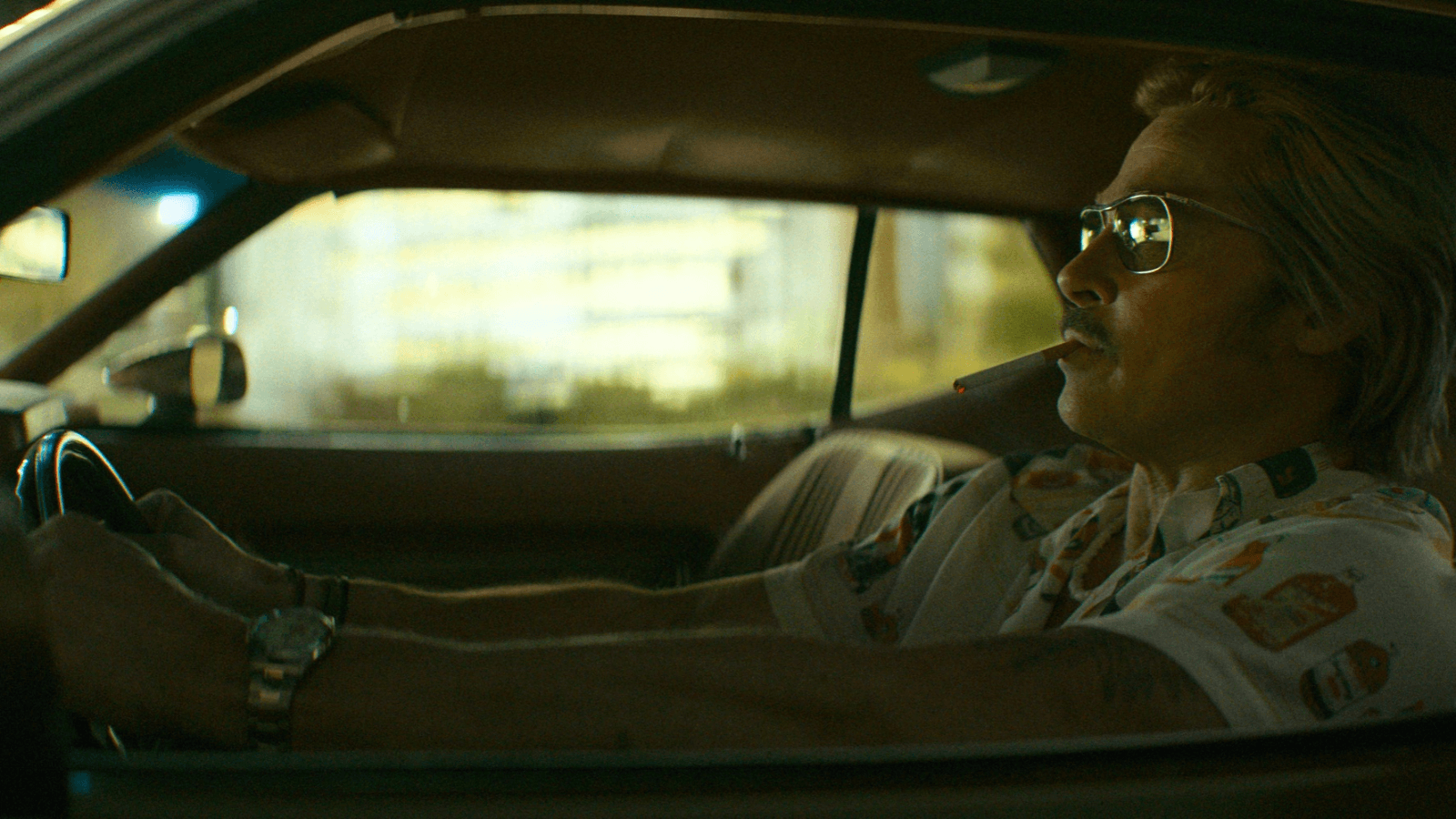
Fincher surrenders some degree of his usual meticulous control here in service of the material. The notoriously exacting filmmaker’s production nevertheless has an incredible level of detail in the 1970s milieu, from the billboard for the Richard Pryor comedy Which Way Is Up? (1977) spied in the blurry backdrop during one of the many driving scenes to the precise costuming by Trish Summerville. The production is not without some questionable choices, however. Pitt, who effortlessly embodies Cliff’s cool-as-a-cucumber presence, had his head shaved for Heart of the Beast before shooting began. As a result, he wears a wig that, frankly, looks like a wig and seldom moves. Along with some obvious digital touch-ups on Pitt’s face, Cliff occasionally has a plastic-looking quality that only the actor’s performance and our immersion in a given scene can overcome. Even so, by the finale, both Fincher and Pitt come alive for an encounter as uneasy as anything in either the director’s or screenwriter’s body of work, and the relaxed tone suddenly turns into breathless chaos. Even though its mid-credits scene gives us a winking full-circle moment that establishes Cliff as an all-time badass, an additional scene or two might have provided some better closure for the much-loved character.
I wanted more from The Further Mis-Adventures of Cliff Booth, but in the best way. It could have gone on for another hour or more without complaint, orbiting Pitt’s ceaselessly cool character and performance. Fincher reportedly ditched twenty pages from Tarantino’s script, needlessly worrying about the film’s pace. But the chill tone proved transfixing, with rich characters telling stories about movie productions and the criminal goings-on in Los Angeles, or Cliff’s confidence when downplaying his war experience and offering advice to learn what it feels like to kill someone. Tarantino’s voice even pops in as a narrator, providing backstory to Charlie Peters (reminding us why Russell, Samuel L. Jackson, or Uma Thurman have been better narrators in Tarantino’s films). However apt Karen’s description of movies like this as comfort food may be, no rule says cinema this gratifying can’t also be art. Cliff Booth sits somewhere between high and low art, but leans more toward being a Tarantino film than a Fincher film. Auteur theory be damned. Whatever labels it invites, it’s one entertaining flick.
Like DFR? Support us.
This site exists because readers like you care about film. If DFR has enriched your experience with movies, I’d be grateful for your support. You have a few options:
• Join DFR’s Patreon community
• Make a one-time donation on PayPal
• Buy me a coffee
Whatever option you choose, it helps keep my work independent. And it means a lot to me.
Thank you for reading, and for making this work possible.
Brian Eggert | Critic, Founder
Deep Focus Review