How to Rob a Bank
By Brian Eggert |
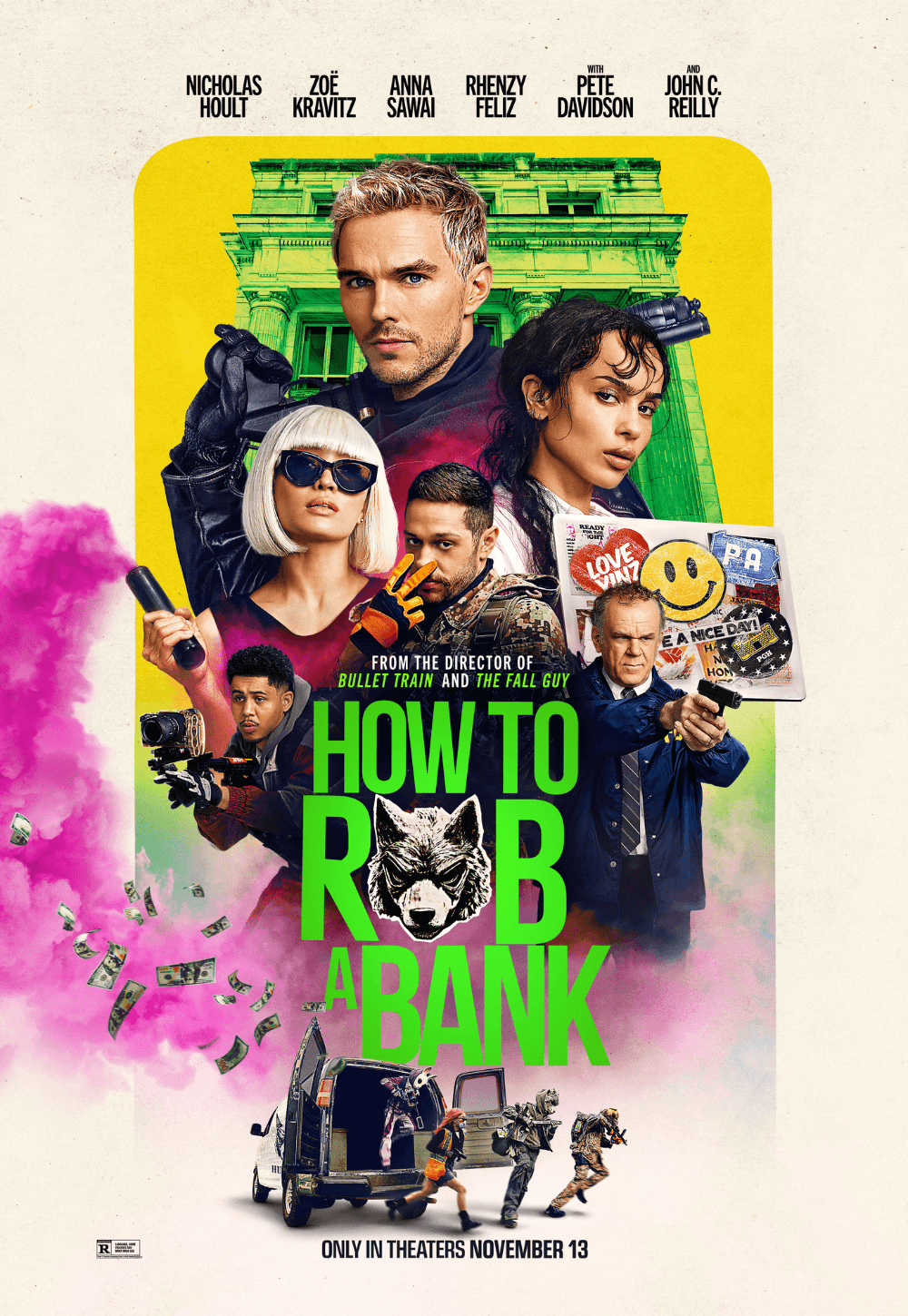
David Leitch’s How to Rob a Bank opens with a borderline nonsensical array of maxims spouted on YouTube by Ryan, Nicholas Hoult’s anonymous, wolf-masked leader of a bank-robbing crew. Ryan tells us content is king, authenticity comes with nothing left to lose, and true power is having an audience. Captured with mounted mini-cams and drones, the footage delivers a message with zippy editing and splashy animations, as Ryan’s animal-masked cohorts leap around like well-armed amateur parkourists. To be sure, here’s a movie that wants to turn social media aesthetics into cinema. And when Ryan announces to his team early in the movie, “Let’s make some content,” it sounds like he’s making the opposite of art. Within the story’s context, that’s quite true. Ryan and company have social and financial goals they have planned tirelessly to achieve, not creative ambitions. How to Rob a Bank has no such cinematic aspirations, either; it’s shot like an energy drink commercial engineered to go viral, with as much originality as a regurgitated AI prompt response. Worse, the crew’s “fuck capitalism” message couldn’t feel any more disingenuous coming from an Amazon MGM Studios production.
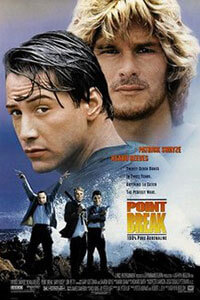
Leitch (co)directed one of this century’s most iconic action movies with John Wick (2014). Since then, he’s made a series of forgettable, hyperactive shoot-em-ups, none of which I’ve thought much about since reviewing. See, or don’t, Atomic Blonde (2017), Bullet Train (2022), and The Fall Guy (2024). Much like his latest, his previous disappointments all had potential, with neat concepts and talented casts. But Leitch can’t make these projects stick in my memory beyond the time it takes to write about them. With How to Rob a Bank, the director and his screenwriter, Mark Bianculli, race through familiar territory, navigating a modern-day equivalent to Point Break (1991). Their characters even talk about how much they love the Kathryn Bigelow classic. After all, both feature masked, armed robbers who rationalize their crimes with thin moral, even philosophical, justifications; both feature FBI agents on the robbers’ trail; and both tap into contemporary trends in youth culture: extreme sports in the former, online clout in the latter.
After briefly introducing the “How to Rob a Bank” YouTube channel’s team, the movie turns to the FBI’s dry-humored Agent West (John C. Reilly), who’s tasked with capturing them. Just ignore, as the movie does, that YouTube has several policies prohibiting videos that depict or encourage illegal acts, and that the FBI could work with the platform to shut them down, thus invalidating the whole premise. Instead, West enlists the help of a programmer named Reagan (Zoë Kravitz), who invented code that can locate people from their online activity. Teaming up, West and Reagan have a chummy dynamic. He’s an old-school cop who still believes in The System, and she’s a hip cynic who understands why the YouTubers have racked up 900 million views after robbing fifteen banks in three months. She admires them as Robin Hood-esque figures, stealing from the rich and paying it forward by distributing their plunder to charities. Each new video gives subscribers tips on how to carry out their own robberies, and sure enough, copycats appear throughout the country, heightening the urgency of West’s mission.

The movie is determined to rabble-rouse. It’s Ryan’s stated ambition, but it’s also evident in Leitch’s presentation. The director doesn’t adopt a traditional bank robbery movie form like Point Break or the similarly themed cops-and-robbers saga Heat (1995). Rather, the movie aligns with the audience it hopes to reach: young viewers who grew up consuming social media videos. At times, the entire screen is filled with a desktop view of YouTube, which is about as banal as a big-screen presentation gets. These video sequences are intercut with the robberies themselves, which doesn’t really make sense, since one would have to record and edit the footage before uploading it. Only their final mission is live-streamed. But don’t let that distract you, I guess. Leitch’s usual cinematographer, Jonathan Sela, tries a hodgepodge of styles, which editor Elísabet Ronaldsdóttir stitches together with as much cohesion as she can muster, given the movie’s scene-to-scene personality switches. Watching How to Rob a Bank might give the viewer whiplash as it fluctuates from one tone to another. And while tonal disparity is a common tool among certain filmmakers (Bong Joon-ho, Terry Gilliam, the Coen Brothers, etc.), neither Leitch nor the screenplay has enough control over the material to pull off the random shifts throughout.
For instance, at the halfway point, a plot development slows down the ADHD-level energy to fill in the cloyingly melodramatic backstories of Ryan’s crew—characters who, until this point, have been little more than passing faces onscreen. Ryan and his partner (Anna Sawai) lost their child to cancer and blame a bank, though the specifics remain unclear. Pete Davidson’s character, a former soldier who now has terminal lung cancer, wants to build a nest egg for his wife and child before he dies. The group’s tech whiz (Rhenzy Feliz) hopes to support his family, whose immigrant status is questioned. Hard as Leitch might try, none of these subplots amount to much feeling. More impassioned and effective is their revenge plot against a banking executive (Christian Slater) who concocted a nasty “unpayable debt” scheme to exploit customers. Ryan’s crew intends to weaponize their millions of followers in an Occupy Wall Street-style movement, which will provide a necessary distraction in the finale and, hopefully, lead to widespread accountability for predatory lenders.
Alas, How to Rob a Bank isn’t clever enough to parody or even remark on TikTok or YouTube virality, preferring an algorithmic approach that keeps younger viewers entertained by replicating proven influencer tactics and, to a lesser extent, successful action movies. Much of the two-hour runtime consists of the channel’s tips, with Ryan talking to the camera and seemingly giving genuine advice on how to carry out bank robberies or survive a police interrogation. And while in these moments the movie may seem to wear the mask of a revolutionary, it takes no real risks, politically or cinematically. It has nothing to say about social media, only banks’ shady schemes, which, with today’s severe economic divide between the haves and have-nots, will certainly resonate with most moviegoers. How to Rob a Bank is a movie whose message is on point but whose methods range from obvious to obnoxious (just when you think it couldn’t get any worse, Ryan breaks the fourth wall outside of a video post in a “Life moves pretty fast” Ferris Bueller homage that turned my souring impression of the movie into bitterness).
Yet I must confess that the audience at my screening seemed to enjoy the movie more than I did, so perhaps How to Rob a Bank will work like gangbusters for general audiences and less so for critics—or at least this critic. To be fair, I liked plenty about the movie, and it kept my attention. I wanted to see Ryan and his friends get away with their plan. Reilly and Kravitz, two performers I enjoy, also have a charming odd-couple quality that amused me, cliché as it is: he can’t figure out AirPlay and drives a wood-paneled ’91 Wagoneer; she eats Flamin’ Hot Cheetos, smokes pot, and lives in a roomy apartment (a messier version of Kravitz’s place in 2022’s KIMI). I also like Hoult, who makes a sympathetic leading man. But despite its many pluses, the overall effect proves restless, annoying even, leaving us with little more than a copy of a copy, another take on Point Break for the Digital Age.
Like DFR? Support us.
This site exists because readers like you care about film. If DFR has enriched your experience with movies, I’d be grateful for your support. You have a few options:
• Join DFR’s Patreon community
• Make a one-time donation on PayPal
• Buy me a coffee
Whatever option you choose, it helps keep my work independent. And it means a lot to me.
Thank you for reading, and for making this work possible.
Brian Eggert | Critic, Founder
Deep Focus Review