Whalefall
By Brian Eggert |
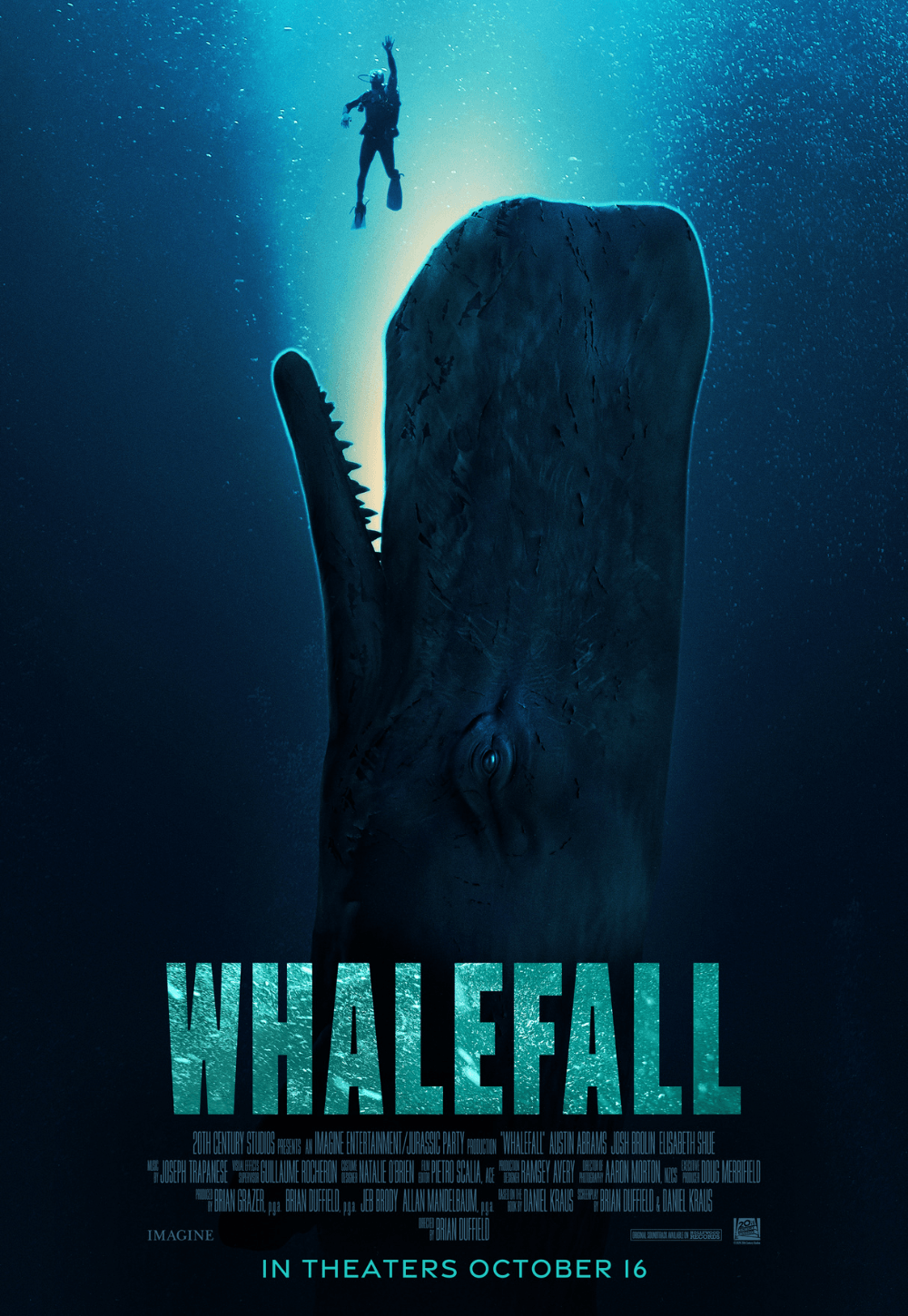
Although I haven’t read the book it’s based on, Whalefall seems like the kind of page-to-screen adaptation that cannot possibly capture the imagination as well as the source material. It’s one of those books that had a movie deal before it was published. Brian Grazer and Ron Howard’s production company Imagine Entertainment optioned the text for distribution by 20th Century Studios. Published in 2023, Daniel Kraus’ novel is about a diver who finds himself inside the belly of a whale. The story involves his desperate attempts to escape. The movie portrays the whale’s interior and exterior with mostly digital effects, so it often looks like Austin Abrams, the lead actor whose character is swallowed in the first act, is surrounded by globs of gelatinous CGI. Despite an engrossing (emphasis on gross) setup, the by-the-numbers script uses trite dramatic devices that diminish the otherwise intense story.
Screenwriters Brian Duffield and Kraus adopt a narrative structure that reminds me of Danny Boyle’s 127 Hours—the 2010 movie about Aron Ralston, who famously cut off his arm after he was pinned under a rock for five days. That was a true story. This one is not. But in both, the protagonist is trapped. He will die unless he takes some drastic action. Only by scouring his memories does he find the methods to free himself by MacGyvering random objects found in the whale’s belly. Each memory unlocks a buried lesson the hero uses to make a little more progress toward escape. A similar setup appears in Project Hail Mary, Andy Weir’s superb sci-fi novel from 2021, also adapted into a movie this year.
Abrams plays Jay Gardiner, a college student who returns home to California after his mortally ill father, Mitt (Josh Brolin), intentionally leaped to his death into the ocean. Never part of the tight-knit family unit as his mother (Elisabeth Shue) and sisters (Jane Levy, Emily Rudd), Jay struggled in a tense relationship with his late father, a locally famous diver whose tough, bullying approach to diving instruction drove a wedge between them. Nevertheless, Jay draws from those lessons to sneak away one morning and scuba dive in search of his father’s remains. While looking into an abyss-like drop-off, something looks back: Jay sees a giant squid emerge, pursued by a sperm whale. Then the squid grabs Jay. And when the whale swallows the squid, it gulps Jay down with it.
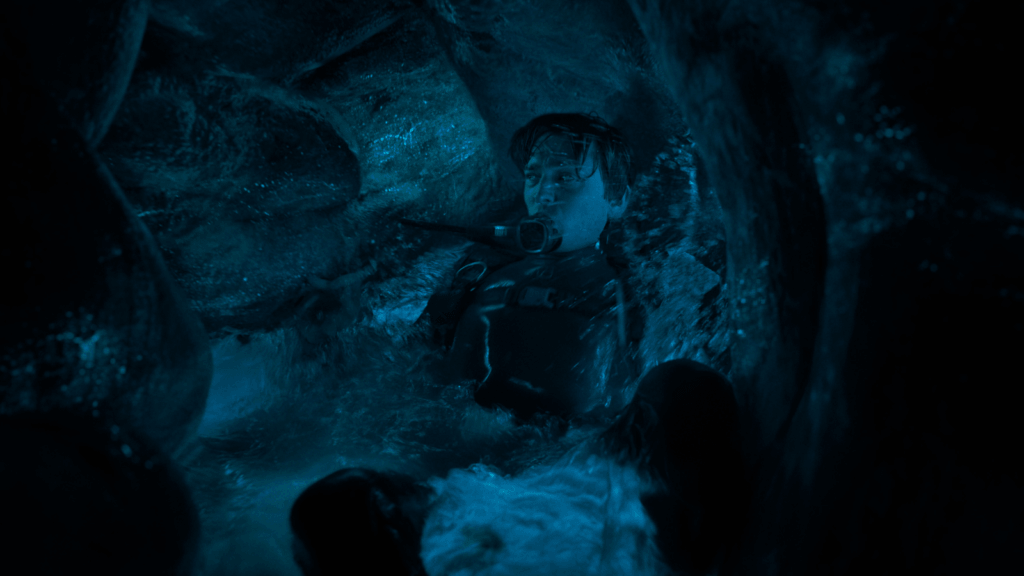
Duffield—well-versed in thrilling oceanic adventures after writing Underwater, a movie that’s grown on me since 2020—helms Whalefall with technical and dramatic competence. The director reteams with cinematographer Aaron Morton (after 2023’s No One Will Save You, a tense, mostly dialogue-free alien invasion movie), lending the proceedings a blue-gray color palette. Inside the whale’s first stomach chamber, a cave of muscles designed to crush food into swallowable portions, Jay is fortunate enough to have bioluminescent bacteria to light his way. His gooey digital surroundings never look convincing; the idea of what’s happening is often scarier than how it appears. However, Jay’s brief stay in the whale’s second stomach chamber, where acid starts to eat away at his bare hands, is a memorable body horror sequence. A month after appearing in Resident Evil, Abrams has been put through the gory wringer again.
Whalefall’s first half is situational; the second half is spiritual. With just an hour of oxygen in his tank, Jay wastes his air talking himself through the problem, if only for our expositional benefit and to spare us an internal monologue via voiceover. (He also talks to a swallowed jellyfish, the resident Wilson.) Later, Jay speaks with his father to work through his lingering daddy issues. The setup is all a big metaphor, you see, with Jay at once trapped by his father and saved by him. Jay sees his father’s unwavering commitment to ocean life as a spiritual link to the whale, as though Mitt’s soul had been transferred into the whale, giving the mammal the ability to speak (in Jay’s head). The voice helps Jay escape as he recalls every lesson his father taught him. This solves both his predicament and his anger toward his father, partly through reconciliation (again, in his head) and partly by realizing his father’s lessons had an impact. The screenplay is filled with contrivances and conveniences in this regard, with the early introductions of Chekhov’s nine-volt battery and steel wool predictably helping Jay in the climax.
The premise and performances in Whalefall have potential, but the screenplay’s manner of solving each problem with convenient flashbacks is so patterned and uninspired that it neutralizes the movie’s dramatic possibilities. That, along with the eye-rollingly corny whale-father spirit voice in the later scenes, makes for a ridiculous conclusion. This is a shame, since Abrams is a skilled performer and brings dimension to his underwritten character. Unfortunately, Brolin is typecast as another macho man, and the rest of the cast hardly registers beyond their familiar faces. In the end, it’s a story that might have been a tense, claustrophobic thriller, but instead it turns into a formulaic story that wastes much of its goodwill with the audience before the final frames.
Thank You for Supporting Independent Film Criticism
If the work on DFR has added something meaningful to your love of movies, please consider supporting it.
Here are a few ways to show your support: make a one-time donation, join DFR’s Patreon for access to exclusive writing, or show your support in other ways.
Your contribution helps keep this site running independently. However you choose to support the site, please know that it’s appreciated.
Thank you for reading, and for making this work possible.
Brian Eggert | Critic, Founder
Deep Focus Review