Buddy
By Brian Eggert |
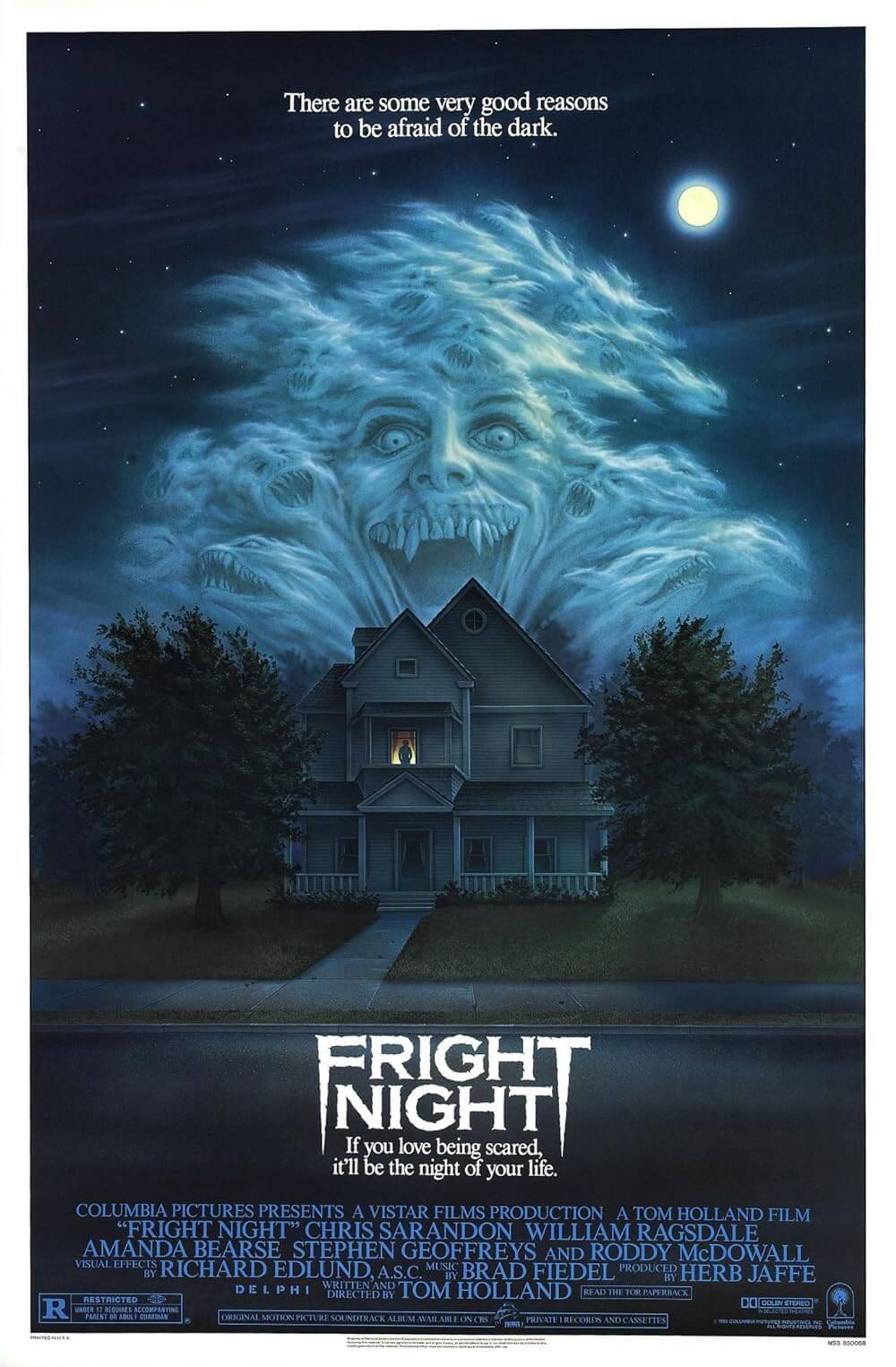
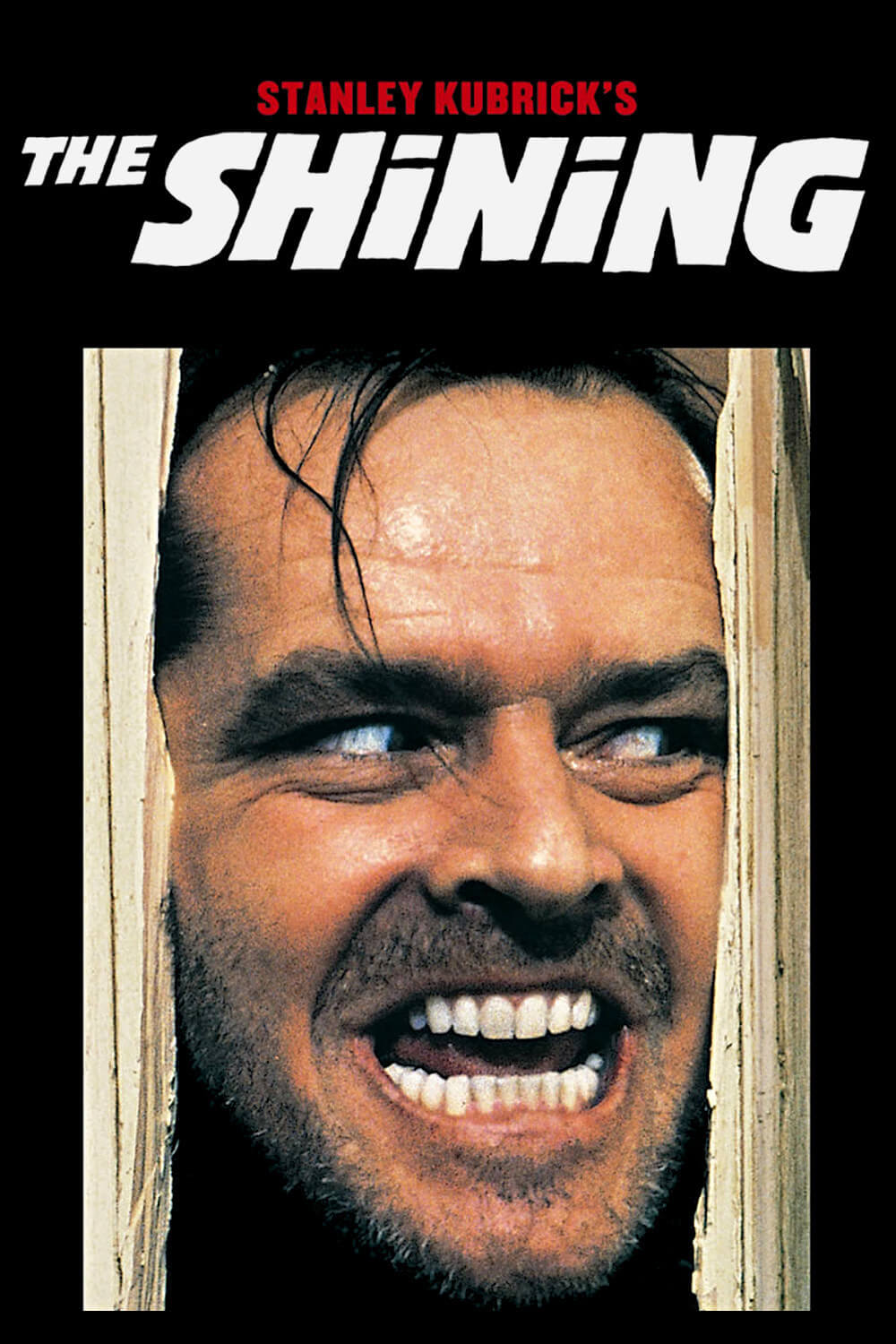
Horror movies love to betray the viewer’s trust by turning something wholesome into a source of pure evil. Nothing conjures nightmares like corrupted innocence. Stephen King has made a career out of finding terror in the unlikeliest of places: a clown, the family dog, a classic car, and even the local antique store. Other voices in horror have carried on the tradition in Child’s Play (1988), about a kid’s doll possessed with the soul of a serial killer, and Poltergeist (1982), where an idyllic house in a small suburban neighborhood becomes host to unruly spirits. Casper Kelly adopts a similar strategy in his latest mind-fuck after his “Too Many Cooks” short film for Adult Swim and a memorable segment from last year’s V/H/S/Halloween. Buddy presents the contained, televised world of a children’s mascot as a surreal prison overseen by a malignant narcissist who can reach into the real world and pull people into his show. And it’s every bit as messed up as it sounds.
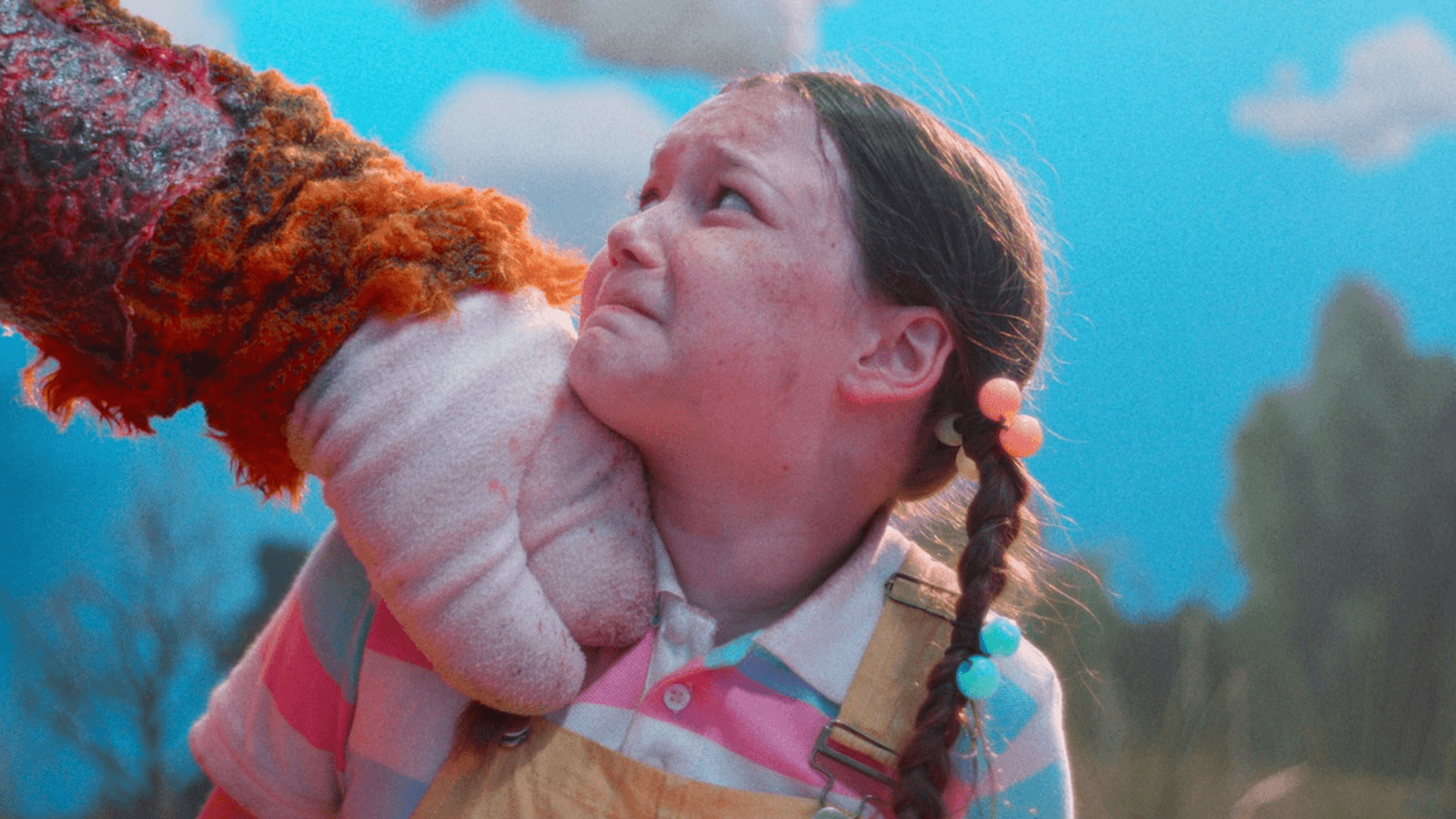
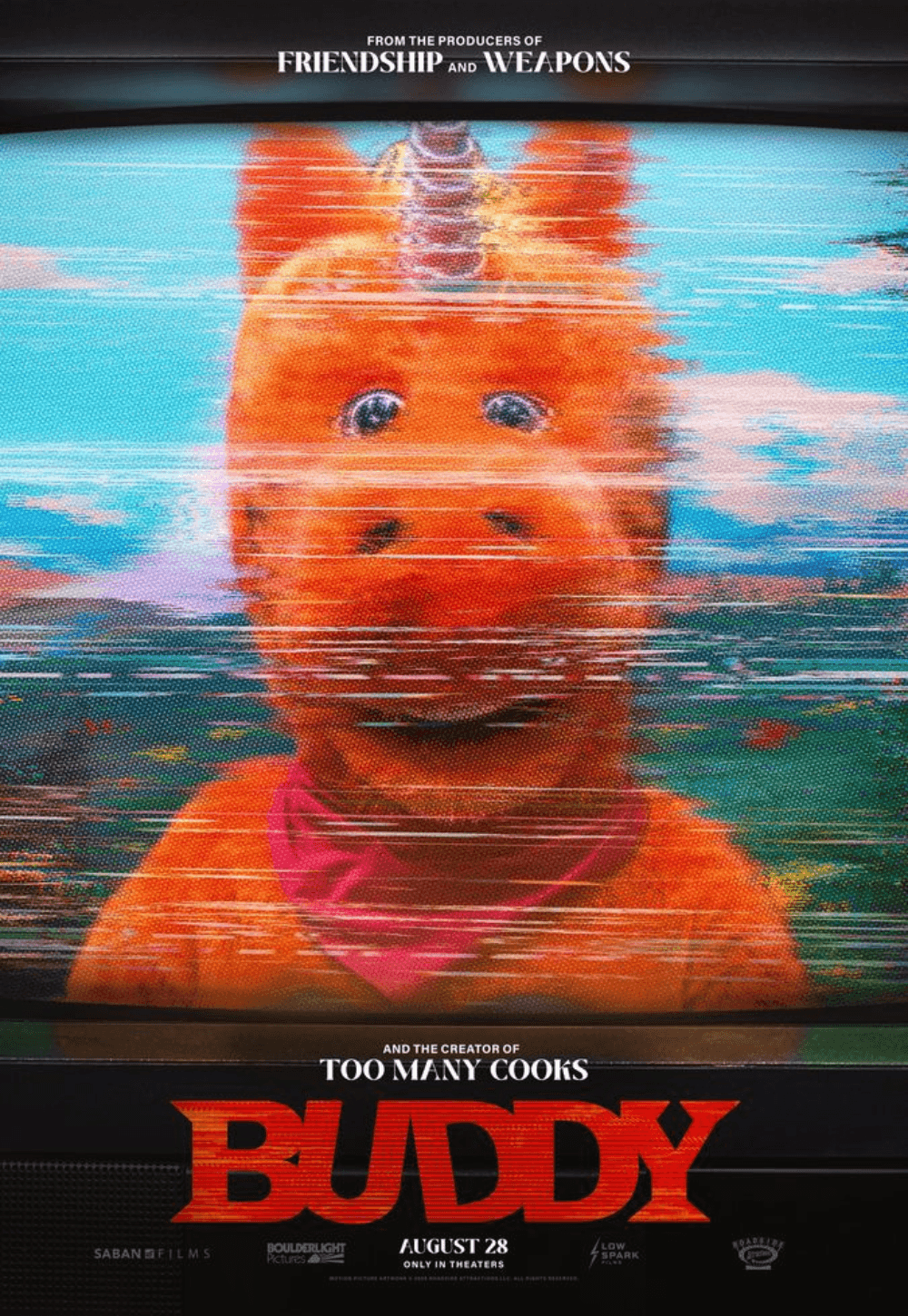
Like Barney the Dinosaur and the Teletubbies, Buddy appears to be a guy-in-a-suit character: an orange unicorn who hosts “It’s Buddy!” Like Kelly’s “Too Many Cooks,” Buddy introduces viewers to the show and establishes its patterns, and then immediately breaks and exaggerates them. Voiced by Keegan-Michael Key, Buddy looks plushy and pleasant. He lives in a plastic wonderland called the Park, reminiscent of Pee-wee’s Playhouse (1986-1990). Nestled amid a forest, Buddy’s house looks like the set of a ‘90s show, and every piece of furniture or wall adornment talks and has googly eyes. Buddy seems to live there with a few children, and together, they go on daily adventures. But that’s where the demented part comes in. Kelly wonders about the rules of such worlds, and moreover, what happens when they’re broken. Where do the kids come from? Do they have parents or ever return home? Everything’s so pleasant, but what happens when it isn’t?
The answers are mostly disturbing. Two of the children on Buddy’s show, Freddy (Delaney Quinn) and Wade (Caleb Williams), begin to suspect their plushy host when they discover their friend, Josh (Luke Speakman), is missing. Freddy finds Josh’s book stuffed in the garbage, covered with blood. And the closer the kids look, the more Buddy’s behavior resembles that of a classic abusive parent or caretaker. He controls the children with fear and intimidation, telling them they cannot leave because monsters lurk outside the park, and any critique of his behavior leads to defensiveness and harsh reprisals. Buddy needs to be the center of attention and told he’s loved, and when he’s not, he rips off Mr. Mailbox’s jaw and intimidates his fellow mascot Betty Bunny (Jimmica Collins), who complies in terror.
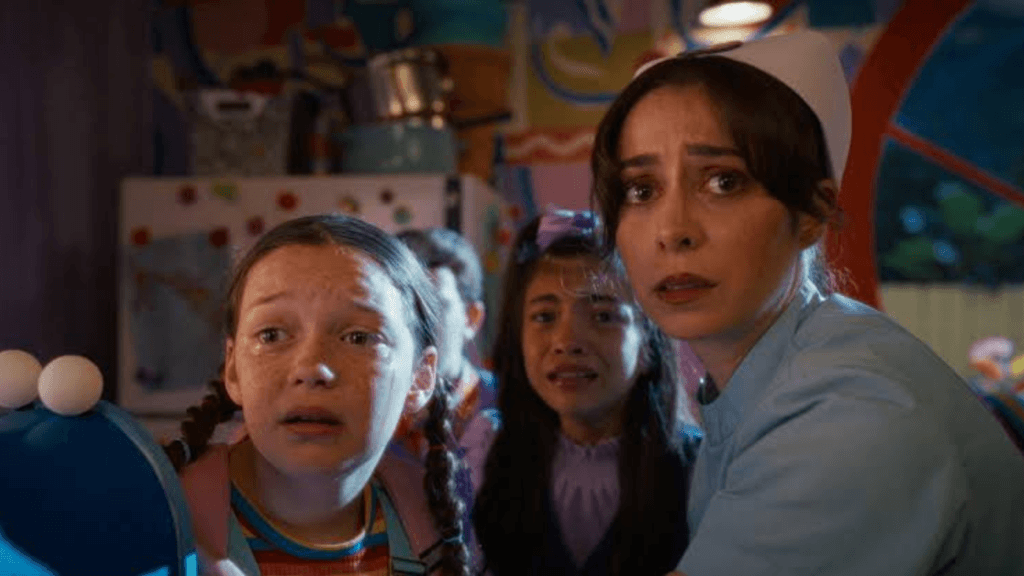
Just as the children mount an escape and disrupt Buddy’s episode cycle, Buddy shifts to the real world, outside of the show, where married couple Grace (Cristin Milioti) and Ben (Topher Grace) raise their two kids, the angsty teen Derek (Bryson JonSteele) and younger Timothy (Seamus Flynn). But Grace has a nagging sense that something’s wrong and somehow Buddy is responsible, fueled by the empty chair at the family dinner table and the fact that she cannot find any evidence of “It’s Buddy!” online. Grace tells Ben, “I feel like we have a third child”—a realization that prompts her to scream in terror and dread, frightening her children. Buddy soon notices her suspicions and makes contact from inside the television, exposing how reality and Buddy’s realm in the show-within-the-movie coexist. He’s like a Freddy Krueger type, except instead of dreams, he haunts a fictional space of his own invention.
Kelly’s rubber-reality production convincingly mimics programs of this ilk, opting for a postmodern Sarah Sherman aesthetic, where odd but well-intentioned puppet characters inhabit a late-‘80s, early- ‘90s design of bright colors and cartoon shapes. Zach Kuperstein’s cinematography captures the video glitches and tape-quality visuals in the TV show scenes, shown in Academy ratio, and crisp widescreen digital lensing for scenes outside of the show. Those familiar with Kelly’s work won’t be surprised when Buddy veers into strange and unusual places, prompting the occasional “What the hell am I watching?” remark. Take a surreal campfire visit from a Clint Howard cowboy and his Howdy Doody-style puppet, Willie (Michael Shannon), who introduces the kids to psychedelics. The imagery extends beyond its Grimm version of children’s shows from yesteryear; Kelly also evokes cinematic influences. One shot reminded me of The Night of the Hunter (1955), with a silhouette of Buddy searching for the children on a faraway horizon road. This might all seem innocent enough, until Kelly’s capacity for blood and gore surfaces with dismemberments and Buddy’s eventual resemblance to Two-Face from The Dark Knight (2008) after surviving a fire.
Kelly’s ideas aren’t original. The Five Nights at Freddy’s video game and movie series took beloved animatronics and turned them into slaughterbots; something similar happened in The Banana Splits Movie (2019) and Willy’s Wonderland (2021). My favorite in this subgenre is Nacho Vigalondo’s Pooka! (2018), about a toy with an uncanny effect on Christmas (and a catchy jingle). For Buddy and his mysterious show, there’s no grand mythology or explanation to clarify all of this weirdness. And it’s scarier that way. When humans succumb to the big orange creature, they disappear, only to be replaced by new “cast members” on a self-perpetuating show. If Buddy struggles to sustain its novelty over 90 minutes, leaving things to get overly serious and plot-driven in the final act, it’s also a delightfully morbid watch that will linger in your unconscious long afterward.
Thank You for Supporting Independent Film Criticism
If the work on DFR has added something meaningful to your love of movies, please consider supporting it.
Here are a few ways to show your support: make a one-time donation, join DFR’s Patreon for access to exclusive writing, or show your support in other ways.
Your contribution helps keep this site running independently. However you choose to support the site, please know that it’s appreciated.
Thank you for reading, and for making this work possible.
Brian Eggert | Critic, Founder
Deep Focus Review