In the Grey
By Brian Eggert |
Guy Ritchie’s aptly named In the Grey is neither good nor particularly bad. It’s one of those movies that exists in the obscure middle ground, where you can see the possibilities for something better, but it never quite achieves its potential. Fittingly, that’s how Eiza González’s character, named Rachel Wild, explains her elite unit of special-ops debt collectors. Her team employs a mix of legal and illegal channels to recover massive financial obligations from unsavory types, leading her to use the titular line to describe the sketchy moral territory in which her business thrives. But Ritchie is so preoccupied with concocting ostentatious planning montages for the inevitable mission that he forgets to invest his audience in his characters or the reasons for the assignment. In the Grey proves diverting only because it’s consistently flashy and stars two charismatic leads: Jake Gyllenhaal and Henry Cavill.
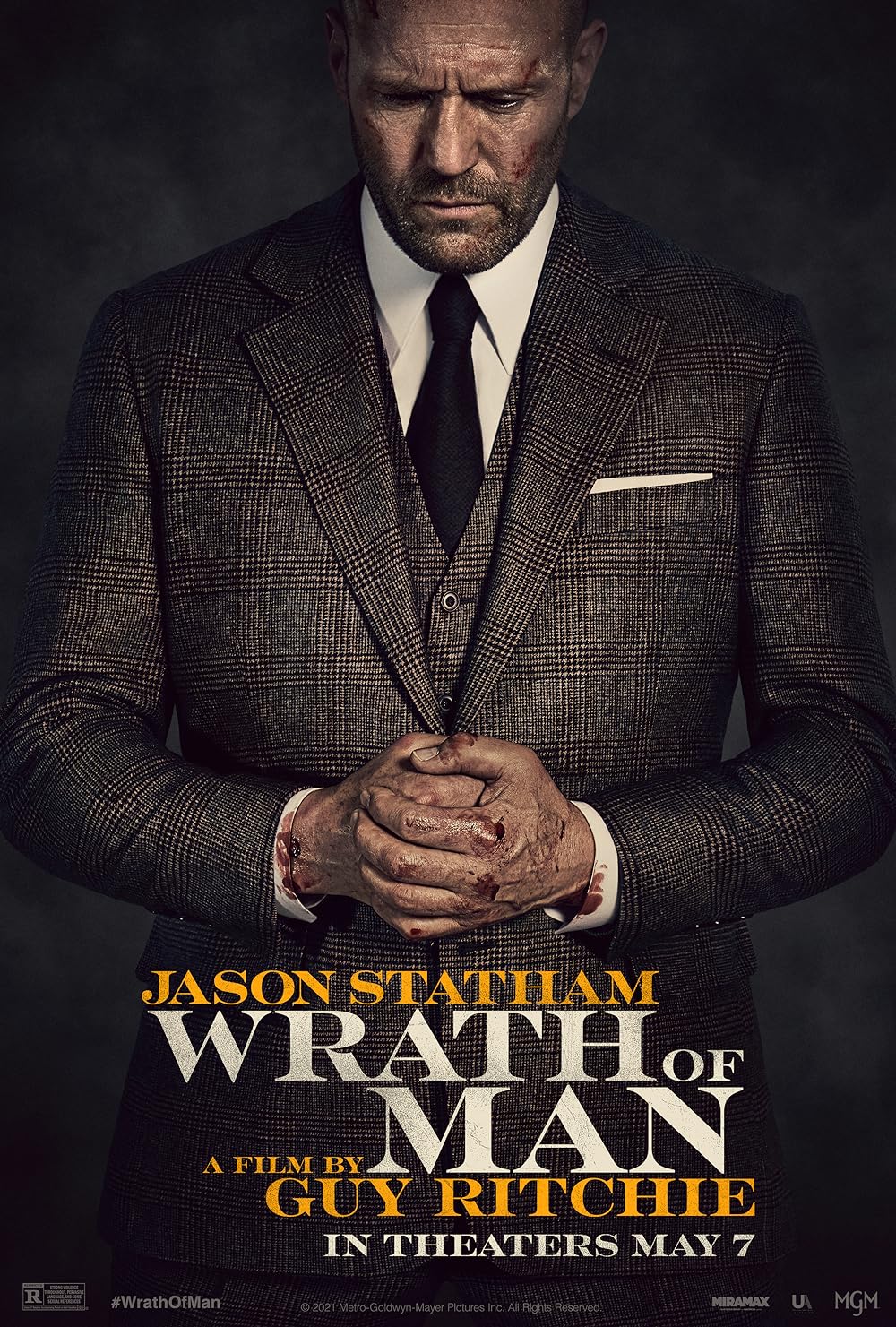
Ritchie’s recent spate of action and adventure yarns has seen him shed the skin of the pulpy, Tarantino-esque crime fiction in which he started. The days of his cool criminals from Lock, Stock and Two Smoking Barrels (1998) and Snatch (2000), who speak his signature brand of chummy dialogue rooted in Cockney slang, have given way to mostly indistinct shoot-em-ups and studio blockbusters. These range from passable efforts such as Operation Fortune: Ruse de Guerre (2023) to last year’s abysmal Fountain of Youth. Only Wrath of Man (2021) stands out among the director’s recent one-title-per-year output. Indeed, Ritchie seems to be thriving in this mid-budget arena, where his productions cost around $50-$60 million and studios can easily justify the cost, especially when he attaches bankable stars. One of the only reasons I chose to see In the Grey—which its distributor, Black Bear Pictures, chose not to screen for critics (never a good sign)—was my affinity for its main cast.
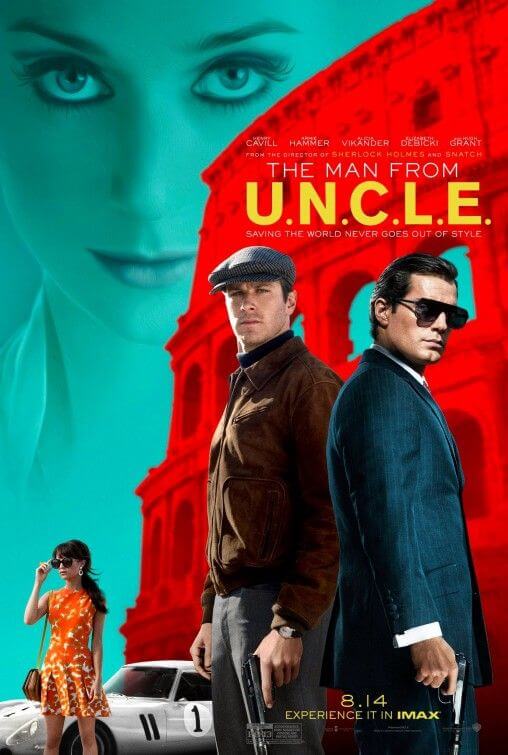
Ritchie seems to be one of the only filmmakers who knows what to do with Henry Cavill, who never quite popped as the Snyderverse’s Superman. Ritchie tapped into the muscular actor’s appeal in his underrated The Man from U.N.C.L.E. (2015) and The Ministry of Ungentlemanly Warfare (2024). Cavill is solid here, too. And though Gyllenhaal might be one of today’s finest performers, evidenced by Zodiac (2007) and Nightcrawler (2015), he has resolved to headline a series of underwhelming action movies in recent years, only testing his range with inspired oddities such as Okja (2017) and The Sisters Brothers (2018). Neither actor stretches his talent for In the Grey, since Ritchie’s interest in his characters is purely superficial. They’re both saddled with unfunny quips and playful ribbing, with hints of ironic flirtation embedded in their juvenile exchanges—all of which registers less as homoerotic banter than mild homophobia. Still, their sheer star power accounts for much of the movie’s fun, even if they seem like they’re on autopilot.
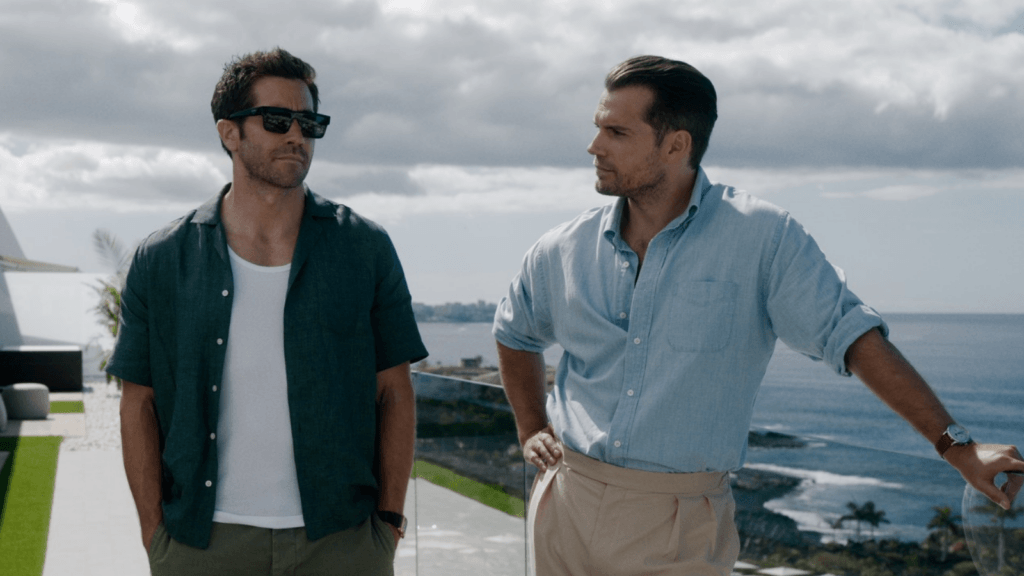
Ritchie’s convoluted story opens with Rachel Wild’s voiceover, explaining her unique business of debt collecting for powerful asset managers. Her devoted team, all of whom call her “mom” (or “mum”), consists of lawyers, digital security experts, and highly trained mercenaries, such as Sid (Cavill) and Bronco (Gyllenhaal, who affects an uneven Bostonian accent). Their latest assignment: reclaim $1 billion from the crimelord Salazar (Carlos Bardem), who borrowed from a New York-based firm called Spencer Goldstein. Rachel’s team is hired by a shady executive, Bobby Sheen (Rosamund Pike), who unwisely lent the funds to an international criminal. Bobby has already sent someone else to collect, and he ended up dead. Salazar has an entire island, complete with a private army and corrupt police force, to shield him from any strong-arming. However, Rachel’s approach will be more strategic.
In the Grey is structured like an actionized version of an Ocean’s movie, with much of the runtime devoted to elaborate planning and coordination. Rachel’s team targets Salazar’s private transportation and construction projects, bugs his offices, and applies pressure on his attorney (Fisher Stevens) through the international courts. Meanwhile, her team of loyal operatives installs tactical booby traps on Salazar’s island for an inevitable showdown, testing various escape routes involving dirt bikes, gyrocopters, and an ambulance. Ritchie punctuates the setup with a barrage of yellow expository titles and editor Martin Walsh’s snappy cutting. Just when you begin to wonder whether these elements will ever pay off, the final act turns into an extended chase involving endless gunfire and explosions. All the while, Rachel’s team makes jocular remarks that seldom generate laughs. Worse, Ritchie never develops his characters enough for the viewer to care when members of Rachel’s team perish.
At 97 minutes, In the Grey begins to feel overlong, both in its planning and execution sections. The zippy preparation montages are tedious after 20-odd minutes, and the relentless gunfire in the finale becomes monotonous. Cavill and Gyllenhaal are serviceably buddy-buddy, while González, who also starred in Ritchie’s last two features, has little to do but act in control of most situations. There’s never more than a single dimension to anything happening onscreen, and Ritchie’s characters seem to have no internal lives or backstories. It’s mindlessly entertaining, I suppose, and not as actively bad as Fountain of Youth was. But it’s also sure to vanish from one’s memory as soon as the credits roll. If there’s any message whatsoever here—and that’s a big “if”—it’s that the predatory lenders are just as shady and duplicitous as those who borrow with no intent to pay back. I guess that’s something.
Thank You for Supporting Independent Film Criticism
If the work on DFR has added something meaningful to your love of movies, please consider supporting it.
Here are a few ways to show your support: make a one-time donation, join DFR’s Patreon for access to exclusive writing, or show your support in other ways.
Your contribution helps keep this site running independently. However you choose to support the site, please know that it’s appreciated.
Thank you for reading, and for making this work possible.
Brian Eggert | Critic, Founder
Deep Focus Review