The Christophers
By Brian Eggert |
Note: Steven Soderbergh’s The Christophers was screened as part of the 45th Minneapolis St. Paul International Film Festival. For the full lineup of films available between April 8-19, check out the schedule here. The film arrives in theaters on April 17, 2026.
Just when you think you have a handle on where The Christophers is going, it pivots in another, altogether surprising direction that undermines our expectations. That’s true of its filmmaker as well. Steven Soderbergh has been one of the most prolific and unpredictable filmmakers over the last thirty years, to the point that some have questioned his status as an auteur. You think you have him characterized, that he can’t possibly surprise you or reinvent himself yet again, but then comes a film like this. It’s at once a Soderbergh production through and through, yet dissimilar from anything else in his filmography. That’s true of so many of his thirty-plus directorial efforts. Last year, he released his first supernatural horror film, Presence, told from the ghost’s point of view. That was the first of two films he made with writer David Koepp in 2025. The second was the dialogue-driven spy thriller Black Bag, a cat-and-mouse game set in the intelligence community. The Christophers isn’t so easy to summarize. It contains some familiar thematic elements for Soderbergh; however, it’s new territory stylistically and thematically, in a way that feels essential to his perspective as an artist.
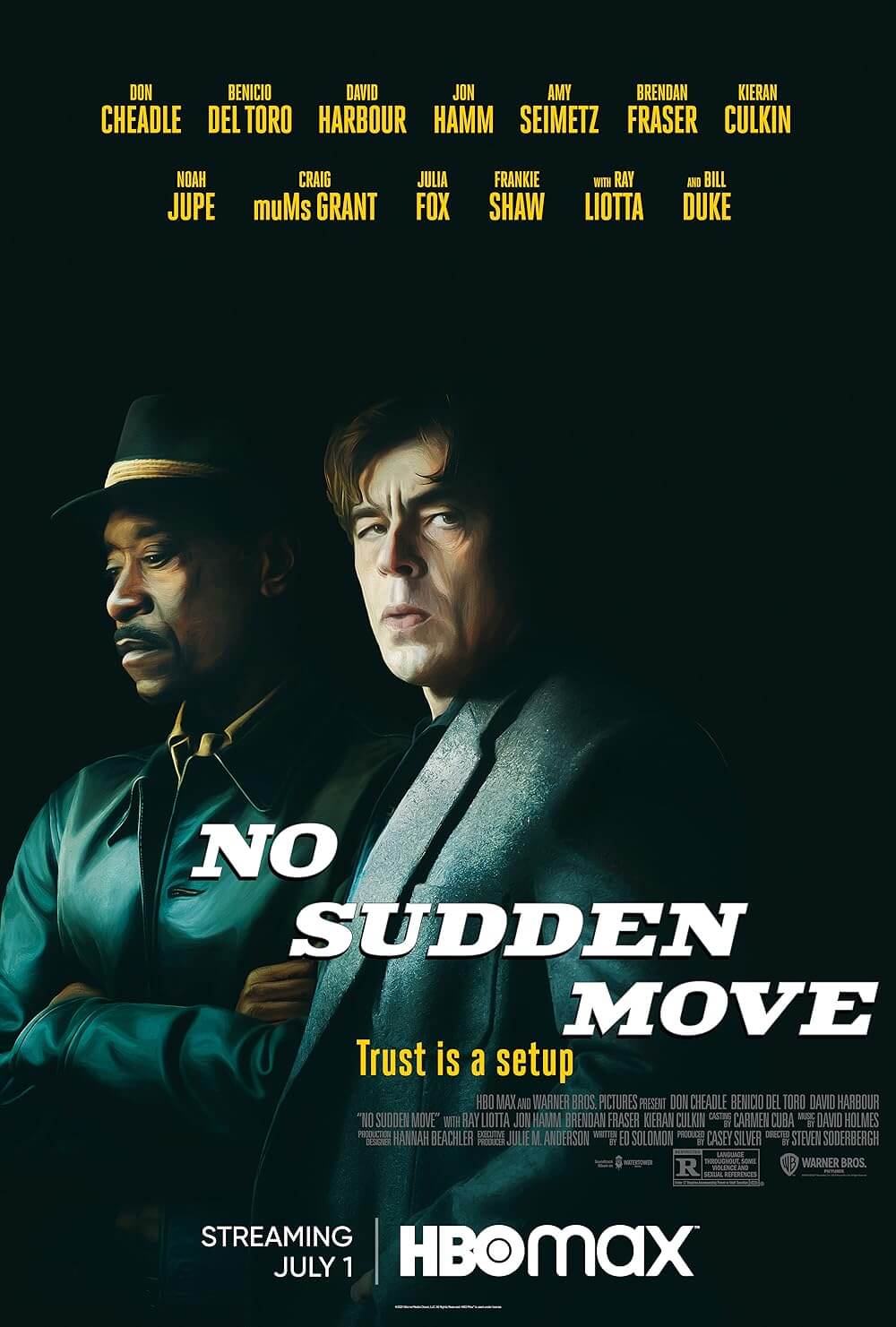
It would be too easy to mistake The Christophers for another Soderbergh caper in the vein of Out of Sight (1998) or the Ocean’s trilogy. It was written by Ed Solomon, who penned the director’s underrated crime story No Sudden Move (2021). Like that film, The Christophers begins with an elaborate scheme but gradually unfolds into an intricate narrative about more than merely a theft. No Sudden Move began with a trio of low-level gunmen hired in 1957 to steal a document, before veering into a subversive message about the automotive industry’s unscrupulous greed. Soderbergh has employed this strategy before, and, more than any visual technique or thematic concern, his approach of infiltrating popular entertainment with a commentary on corrupt systems remains one of the few constants in his career. This has been true from Erin Brockovich (2000) to The Informant! (2009) to KIMI (2022), among many others.
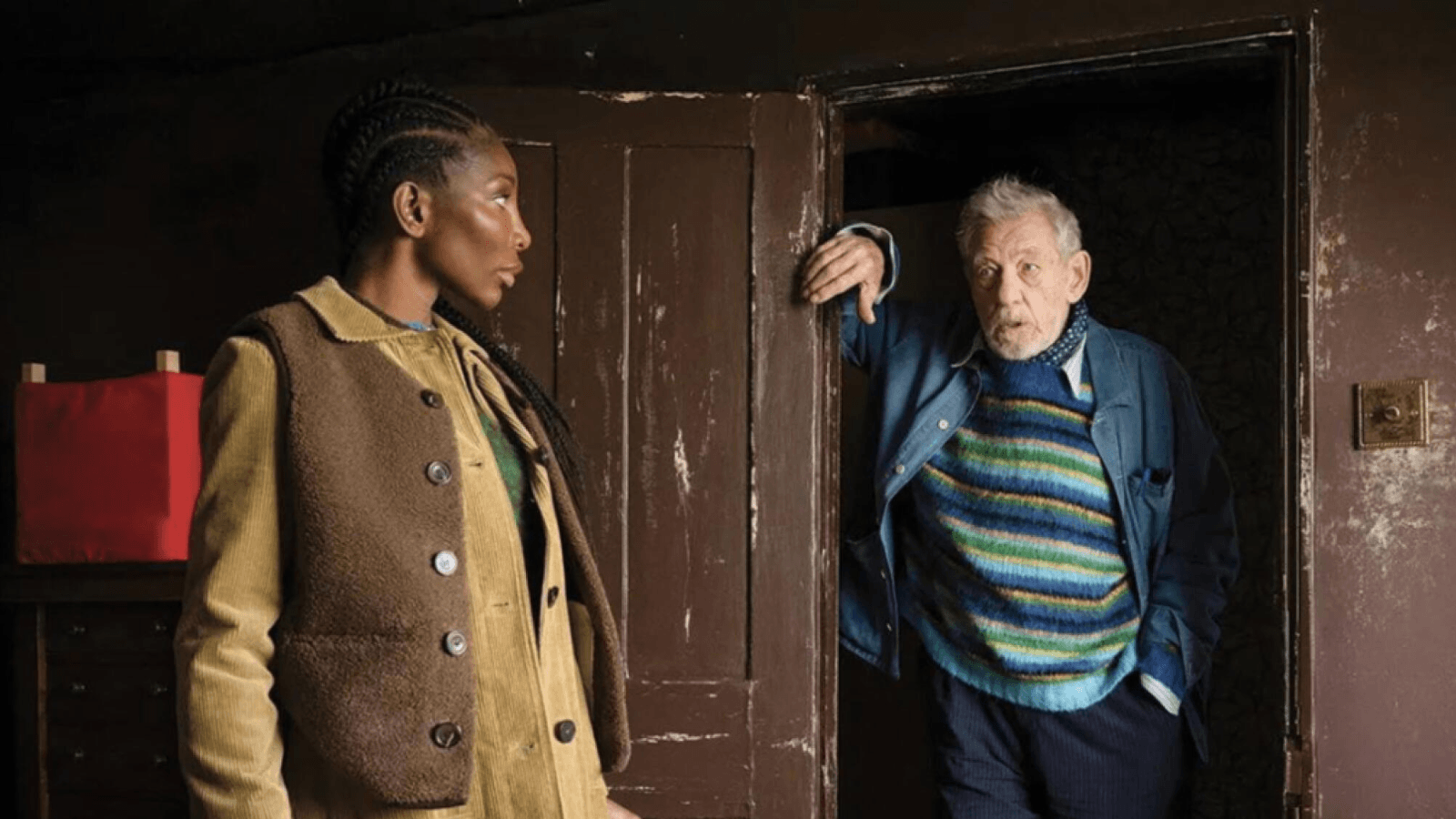
Similarly, The Christophers begins as one thing and ends as another. The narrative gamesmanship isn’t about putting one over on the audience, however. The film is structured to reveal dimensions to its characters that aren’t immediately apparent. It’s fitting, then, that Michaela Coel plays the film’s protagonist, Lori Butler, with an inward, sometimes inscrutable expression. Lori is a painter and has a struggling art restoration business. But some know her for her forgeries, which have been displayed in museums and sold at auctions as the originals. Among those in the know are Barnaby (James Corden) and Sallie (Jessica Gunning), the money-grubbing children of Julian Sklar (Ian McKellen), a famous painter who admits he hasn’t been good in thirty years and hasn’t produced any new canvases in twenty. Instead, he has paid the bills by appearing on a defunct television show called Art Fight, on which he served as a cruel judge of amateur painters hoping to have their work evaluated by a major artist, often eviscerating them for the camera. Now dying, he lives in his bohemian London townhouse and earns a living with cheeky Cameo videos for fans.
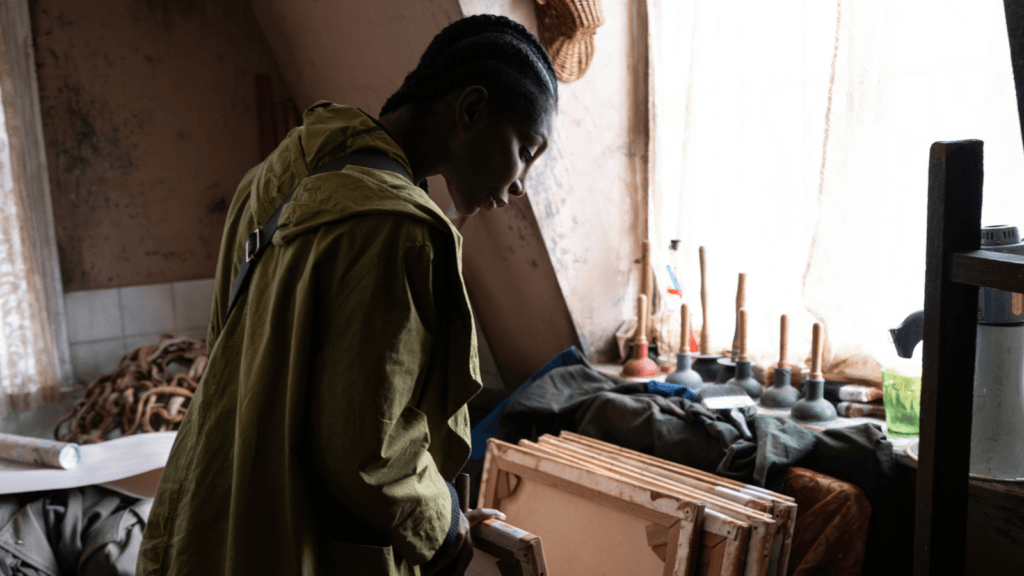
Julian’s children expect their father to pass away soon, and they’re less concerned about his death than about how they can profit from it. Corden and Gunning portray the siblings as talentless, vile opportunists who have done nothing with their lives except thrive on their father’s legacy and try to find an angle to exploit the art world. Sallie, for instance, tried painting briefly, and the results were comical. Her painting was a shameful attempt to forge a work in her father’s style—mimicking Julian’s most famous series of portraits of his former lover, known as The Christophers. He painted two cycles in this series, the first at the beginning of their relationship, the second near the end. Julian never completed a third, and the unfinished canvases remain in his attic. Barnaby and Sallie want Lori to pose as Julian’s assistant, find the paintings, and complete them in Julian’s style so they can sell them for millions after Julian’s death. Seemingly anticipating a huge payday, Lori agrees. But she agrees to the job for reasons that go beyond money.
When she first arrives at his home, she’s professional and businesslike; he’s self-absorbed and rude, if also inappropriate. They clash, with Lori feeling that she has nothing to learn from his outdated worldviews, and Julian’s behavior suggests he has abandoned painting. Lori’s scam soon becomes complicated as Julian wants her to destroy the unfinished Christophers upstairs, correctly suspecting that his tactless children want them, and she’s somehow involved. Plus, he has good reason not to trust her, besides the obvious. A quick online search brings up an article Lori wrote years earlier, condemning Julian’s later paintings in scathing terms. Julian wonders why someone with her views on his art would want to be his assistant, and he quickly sniffs out the forgery scheme. As Julian learns, she agreed to the job as a chance for revenge. Lori appeared on Art Fight when she was a teenager, and Julian could hardly be bothered to give her painting an adequate assessment. Instead, he insulted her skill and derailed her plans to become an exhibiting artist—all for the sake of good television.
Soderbergh offers a two-hander chamber drama with The Christophers, as most of the action takes place in Julian’s townhouse. Whereas the director’s technique is always quite specific in its stylization, as in the black-and-white 1940s aesthetic of The Good German (2006) or the fisheye paranoia of Unsane (2018), his visuals are recessive here. Soderbergh’s editing is invisible and unselfconscious; his colors look earthy and pale; and his camera follows the characters in long, immersive takes where the shot length never distracts from the outstanding performances. Moreover, this must be McKellen’s best role since Gandalf or his Oscar-nominated turn as James Whale in Gods and Monsters (1998). The 86-year-old actor’s charm never ceases here, from the playful early scenes to the rather aching later sequences where Julian and Lori resolve to collaborate after some honest conversations. Coel is terrific as well, her steely expression giving way to strength and tenderness underneath—an idea underscored by David Holmes’ mysterious, almost mischievous music. Solomon has written fascinating characters and intricate, layered dialogue, and watching these actors perform their roles is bliss.

Julian is a fascinating case. The reasons for his cruelty on the show stemmed from his mounting disdain for the art world, which led to him being “justifiably canceled,” according to Lori. Not long after the show, he insulted the art community with a “Sidewalk Salon” just outside his home, where, in a “$3.5 million or best offer” campaign, he sold many of his works (which could have fetched millions at auction) for a few hundred pounds. Only Lori can guess the reasons Julian imploded the way he did, and that’s only because she understands how the artist works. In a key scene, she interprets his brushstrokes and use of color in biographical terms, which floors Julian in a way he never expected, exposing feelings he’d been trying to bury for decades. When they resolve to work together, it’s not for money or fame, but for the joy and passion of expressing oneself through art. Throughout the film, Soderbergh and Solomon manipulate their audience by constantly shifting the nature of the con. But it’s not so much about one party deceiving another as it is about artists realizing why they need to create. For Julian, art gives his life meaning. Though he claims art is a relationship between the artist and his canvas, Lori helps him recognize that his art means he will endure in the minds of his audience long after his death. Like any artist, once he puts an artwork into the world, he loses all control over what it means to others.
Indeed, The Christophers is about artistic reinvention, about the ebbs and flows of inspiration. Few filmmakers know more about these subjects than Soderbergh, who continually redefines his limitations and explores technological boundaries (he was among the first to embrace digital cameras, shooting on iPhones, and has incorporated artificial intelligence into his new documentary about John Lennon and Yoko Ono). His career has had ups and downs as well. After his Palme d’Or-winning debut sex, lies and videotape (1989), he floundered with a series of arthouse flops. Rather than give up, he resolved to embrace Hollywood, starting with Out of Sight, and use commercial platforms to experiment with style. Over the years, he has announced plans to retire and become a painter. In 2011, he told The New York Times that he planned to leave filmmaking because he was “interested in exploring another art form while I have the time and ability to do so.” Of course, Soderbergh’s four-year hiatus after his HBO drama Behind the Candelabra (2013) didn’t last or result in a painting career. Instead, he oversaw The Knick (2014-2015) for Cinemax and worked on various theater and editing experiments.
Still, given his interest in painting and the evolution of artists, The Christophers feels like his most personal film in years. It’s about “the art of being someone else,” which describes both Lori and Julian. The topic also describes Soderbergh’s ever-evolving body of work, right down to his regular use of pseudonyms: Peter Andrews as cinematographer, Mary Ann Bernard as editor. Soderbergh refuses to be pigeonholed into a specific kind of film, just as Julian sees himself as an iconoclast—perhaps only because of his personal history. However, Lori sees Julian’s career throughline better than he can. She can identify his most passionate works, right down to his childhood output, and she puts that understanding into her art. In the end, Julian recognizes her insight into his work. The result is a touching, perfect ending. To be sure, Soderbergh’s latest is a deeply moving look at creatives who either manage the demands of their audience and their industry or pursue their passion. With The Christophers, Soderbergh seems to do the latter.
Thank You for Supporting Independent Film Criticism
If the work on DFR has added something meaningful to your love of movies, please consider supporting it.
Here are a few ways to show your support: make a one-time donation, join DFR’s Patreon for access to exclusive writing, or show your support in other ways.
Your contribution helps keep this site running independently. However you choose to support the site, please know that it’s appreciated.
Thank you for reading, and for making this work possible.
Brian Eggert | Critic, Founder
Deep Focus Review