Twin Cities Film Fest 2026 – Dispatch
By Brian Eggert | October 23, 2026
The 2025 Twin Cities Film Festival runs from October 15 to October 24. Check out the full lineup here. In addition to the capsule reviews below, read my coverage of the Opening Night film, Wild Horse Nine.
Give Me the Ball!
Directors Liz Garbus and Elizabeth Wolff deliver a pretty standard documentary feature with their portrait of Billie Jean King, the tennis pro who made headlines by standing up to gender discrimination. Still an unstoppable, energetic force in the typical talking-head interviews for the doc, King shares stories about her tomboyish upbringing and her affinity for what are often considered boys’ sports. In many ways, King tried to conform early in her career, but she couldn’t resist fighting against the increasingly absurd standards for women in tennis, such as the requirement that they wear a tennis dress, not shorts, and accept less pay and prize money. King became a figurehead in the feminist movement of the 1960s and 1970s, selflessly juggling efforts to secure sponsorship deals for the women’s league (Virginia Slims), make political appearances, and maintain a media profile.
ESPN produced the film as a 30 for 30 project, and it debuts on November 22. Even so, it’s also less focused on her tennis career than her unconventional role in the culture. Of course, there’s a lengthy chapter about the famed “Battle of the Sexes” against chauvinist Bobby Riggs (dramatized in a rather lame 2017 movie). However, the most fascinating aspects involve her unhealthy relationship with food and crumbling marriage in the media spotlight. King’s abortion, divorce, and bisexuality—all taboo-breaking at the time—became national news. King felt a deep personal responsibility, as a woman with a platform, to push through it all and fight for fellow women athletes who remain underpaid and sidelined. Still, the personal toll was great. King relays her story in a manner that aligns with the format of so many biographical docs that it risks feeling banal, except she’s such a fascinating and engaging presence onscreen that you can’t look away. She made strides for women, but as she admits, there’s still so much work to be done. 3/4 Stars.

One Plant
One plant to rule them all; one plant to clothe them, one plant to feed them, one plant to high them, and when used as rope, bind them.
If the filmmakers of this documentary are to be believed, hemp is the solution to many of the world’s problems: the climate crisis, food shortages, healthcare, and livestock feed. The list could go on. Director Jordan Berger clumsily ties the death of his mother from opioid addiction into a 90-minute advertisement for hemp. It’s difficult to argue with Berger’s message—that hemp was once one of America’s most thriving resources, used for clothes, ropes, paper, and countless other applications. Today, say “hemp,” and most people think of pot and its recreational use. The reason for that is a century-old campaign against hemp, rooted in the nation’s racist history (look up the origins and intentions of the word “marijuana” sometime).
It’s not that I disagree or take issue with any of the information presented in One Plant; it’s the generic and agenda-driven format the movie takes. Laden with drone shots and testimonial-style interviews that look less filmic than like advertising, the movie features self-interested experts, farmers, activists, and business owners, all of whom sing the praises of hemp because it benefits them. It feels less like a documentary than an infomercial—albeit an interesting one that will keep you watching. When Berger inelegantly tries to make what is clearly a sales pitch into a personal project, it doesn’t quite fit. But for those who know nothing about hemp and want to learn, there are worse ways to spend 90 minutes. 2.5/4 Stars.

Morelife
Writer-director C.J. Renner’s second feature is a pseudo-It’s a Wonderful Life tale, except instead of seeing a world without him to find a reason to keep living, the protagonist and his guardian angel go searching for morel mushrooms. Get it? Morel. More life. Obnoxious attempts at cleverness aside, this self-consciously quirky Minnesota production has the energy of an American independent movie from the 1990s, except it looks too good to be considered admirably scrappy. That might be a good thing under different circumstances, but the result comes off as pretentious.
Someone once asked me what it means to call a movie “pretentious.” I didn’t have a great answer at the time. But I don’t think it means highbrow, which is quite its own thing and not necessarily pejorative. Something effectively highbrow isn’t innately pretentious; it’s sophisticated, arty, or serious. A film becomes pretentious when a filmmaker attempts something highbrow and doesn’t pull it off. That’s Morelife, an insufferably talky and aimless drama about a young man (Jackson Whitman) who’s stopped from jumping off a bridge by his (imaginary?) friend, Kermit (Clayne Crawford), who spends the entire movie in an inexplicable fish mask. Based on the film’s IMDb.com description, this isn’t merely a mask. He’s literally “a half-man half-fish.” Looked like a mask to me.
Whatever profound message Renner sought to convey gets lost in the movie’s tedious road-movie structure, reminiscent of other independent productions, except nothing sets Morelife apart—not even a fish-man. On a formal level, it doesn’t look cheap. Cinematographer Ben Enke’s digital lensing is professional, if characteristic of our Instagram world. But Renner and editor Sarah Mevissen deploy prolonged slow-motion sequences (in a roller rink, a hotel room, a pool) that register as padding for a feature that only hits 90 minutes with the credits, most of it set to an innocuous score of electronic tones. There’s little substance to cling to, only shots of silence interrupted by inane dialogue that seems desperate to capture the meaning of life. 1/4 Stars.
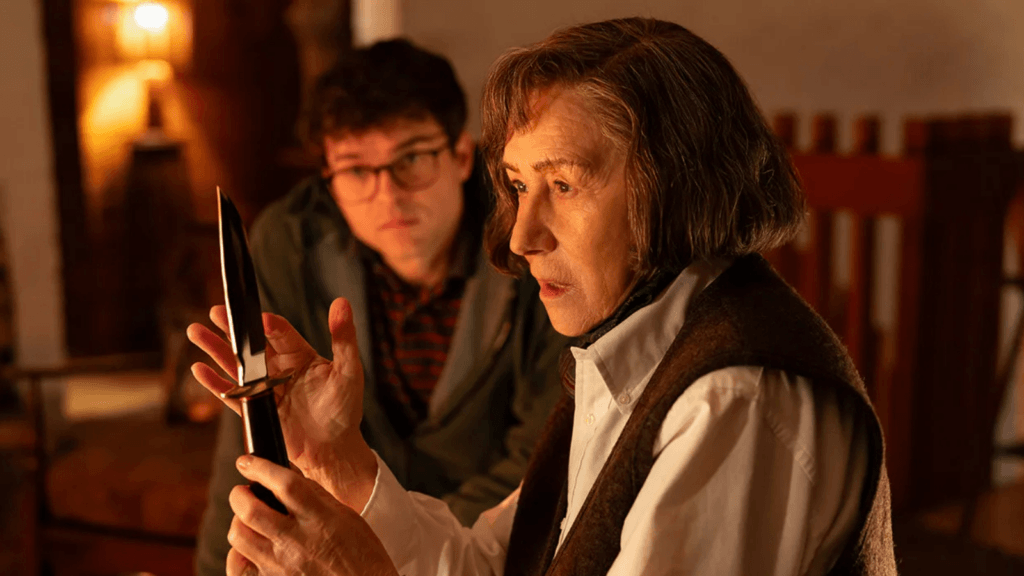
A Talent for Murder
The film world has a dearth of original ideas. Everyone’s trying to sell you the same thing, over and over again. That’s why legacy sequels, franchise reboots, and spinoffs often start at a disadvantage for me. But no category is less compelling to me than fan fiction—a whole genre that proves some creatives, despite having untold worlds at the tip of their imagination, can’t be bothered to come up with characters or universes of their own. A Talent for Murder isn’t quite that, but it’s close. An adaptation of Joanna Murray-Smith’s play Switzerland, the film imagines an alternate ending to the life of thriller writer Patricia Highsmith, who was famous for inventing Tom Ripley, one of the most fascinating characters of literary (and cinematic) history.
Helen Mirren plays Highsmith in the film, set in the mid-1990s, just before the author’s death. The reclusive scribe (“She doesn’t like people,” one character understates) lives in a picturesque house amid the Swiss Alps, where she has all but stopped writing. Alden Ehrenreich plays Edward Ridgeway, who works for her New York publisher and journeys to her house to convince her to write a final Ripley book, which would make it the sixth. Their relationship instantly becomes a cat-and-mouse affair, with the author sizing up her young visitor and delighting in scaring him with her collection of weapons and poisons. He’s nervous because his predecessor from the publisher went missing, and there’s some question as to whether Highsmith was responsible.
Elegantly directed by Anton Corbijn, who samples a few shots from Anthony Minghella’s The Talented Mr. Ripley (1999), the film unfolds against lavish interiors and extraordinary European backdrops. Cinematographer Robbie Ryan, a regular collaborator with Yorgos Lanthimos, lights these spaces with a classical, textured composure that made me want to don a shawl cardigan and warm some cognac in a snifter. The setup recalls Sidney Lumet’s Deathtrap (1982), where an older writer must contend with a younger writer’s ideas. You see, Highsmith can no longer write. She’s ailing from various medical conditions and has trouble coming up with ideas. So she reluctantly enlists Edward to come up with “something Highsmith,” using her own surname as an adjective.
Cleverly, the scenario weaves aspects of Edward’s journey and chance meeting with a wealthy heiress, Clementine (Olivia Cooke), into the mix. Edward uses details from his interaction to enhance his ideas for the new book about Ripley, whom Highsmith calls “the ultimate opportunist.” So is Edward, or at least he learns to be by studying Ripley. However, he doesn’t appreciate the implication when Highsmith draws parallels between him and Ripley, given that she compares her character to a hermaphroditic snail, able to have sex with either gender when the situation calls for it. Edward claims he’s heterosexual with a kind of embarrassing certainty that exposes his uncertainty. But he’s determined to have the last laugh.
As they conceive the next Ripley book, we see their story playing out, with Edward standing in for Ripley and Clementine as his mark. Real life also imitates their fiction, with Edward applying what he’s learned from Ripley in his interactions with Clementine and her sickeningly wealthy family. Some of them fall for his lies; one of them, who calls herself an “ally,” sees through his ruse and gives him some pointers for passing in their class. It’s the film’s most intriguing moment, even amid the more genre-centric scenes.
One would hope that the film’s setup would lead to a Ripley-level imitation, following its rather meta conceit of Edward imitating Ripley, just as Murray-Smith, and by extension Corbijn, imitates Highsmith. The film captures the spirit of Highsmith, to be sure, but it never quite pulls off more than a knowing imitation. But A Talent for Murder isn’t an extension of Highsmith as, say, Brian De Palma carried on themes and visual currents zapped into being by Alfred Hitchcock. 2.5/4 Stars.

Not Dead Yet
Eric and Nick Weber direct Not Dead Yet, the closing-night feature of TCFF that has a quaint, charming quality I enjoyed. Written by the former, it’s a modest story that thrives largely on the talented cast, despite a few amateurish performances by the younger actors. Playing against the ridiculous and silly persona he’s lately been assigned, Richard Kind stars as Elliot, a longtime advertising whiz who gets let go after decades on the job, seemingly because he’s aged out of his business. Never mind that Elliot lives in the Hamptons and has led successful campaigns for companies such as Dr. Pepper, yet he somehow hasn’t saved enough to retire. Maybe he has savings and just likes to work. The movie doesn’t get into his finances, but his charmingly pampered wife (Polly Draper) seems unconcerned by their situation.
Anyway, Elliot belongs to a group of septuagenarians who meet most mornings at a local coffee spot, where the employees worry because “old people are not good for the brand.” Elliot’s circle is populated by an ensemble of talented and familiar faces: Tovah Feldshuh plays a once-famous performer whose constant vaping shows she’s trying to keep a youthful appearance; Ed German is the local disc jockey whose affinity for obscure jazz isn’t to everyone’s taste; Paul Raci plays a proud starving artist who surfs most days; Bill Smitrovich is the one who coughs into a handkerchief and doesn’t like what he sees; and Claudja Bicalho runs a clothing boutique. Together, they have an easygoing dynamic, toasting to “medically engineered hard-ons” and later opening a blueberry pancake spot.
Ageism and generationalism remain at the center of Not Dead Yet, which depicts most younger people as smarmy morons who dismiss Boomers—particularly those in Elliot’s line of work. Kelen Coleman and Dan Rosen appear as fresher, hipper reps from a small marketing agency that put Elliot out of work. Predictably, they eventually need him to come up with a genuine idea to sell a campaign, not something regurgitated from AI or stolen from someone else. “There will never be a substitute for a real idea,” Elliot tells them. And he’s right. Watching Elliot and his crew defy the expectations Gen-Xers and Millennials set for them reminds us that not everyone within a generation adheres to those stereotypes. Obvious lessons aside, Kind and company supply a lighthearted, unfussy, somewhat formally cheap and generic, yet entirely pleasant movie. 3/4 Stars.
Like DFR? Support us.
This site exists because readers like you care about film. If DFR has enriched your experience with movies, I’d be grateful for your support. You have a few options:
• Join DFR’s Patreon community
• Make a one-time donation on PayPal
• Buy me a coffee
Whatever option you choose, it helps keep my work independent. And it means a lot to me.
Thank you for reading, and for making this work possible.
Brian Eggert | Critic, Founder
Deep Focus Review