Wild Horse Nine
By Brian Eggert |
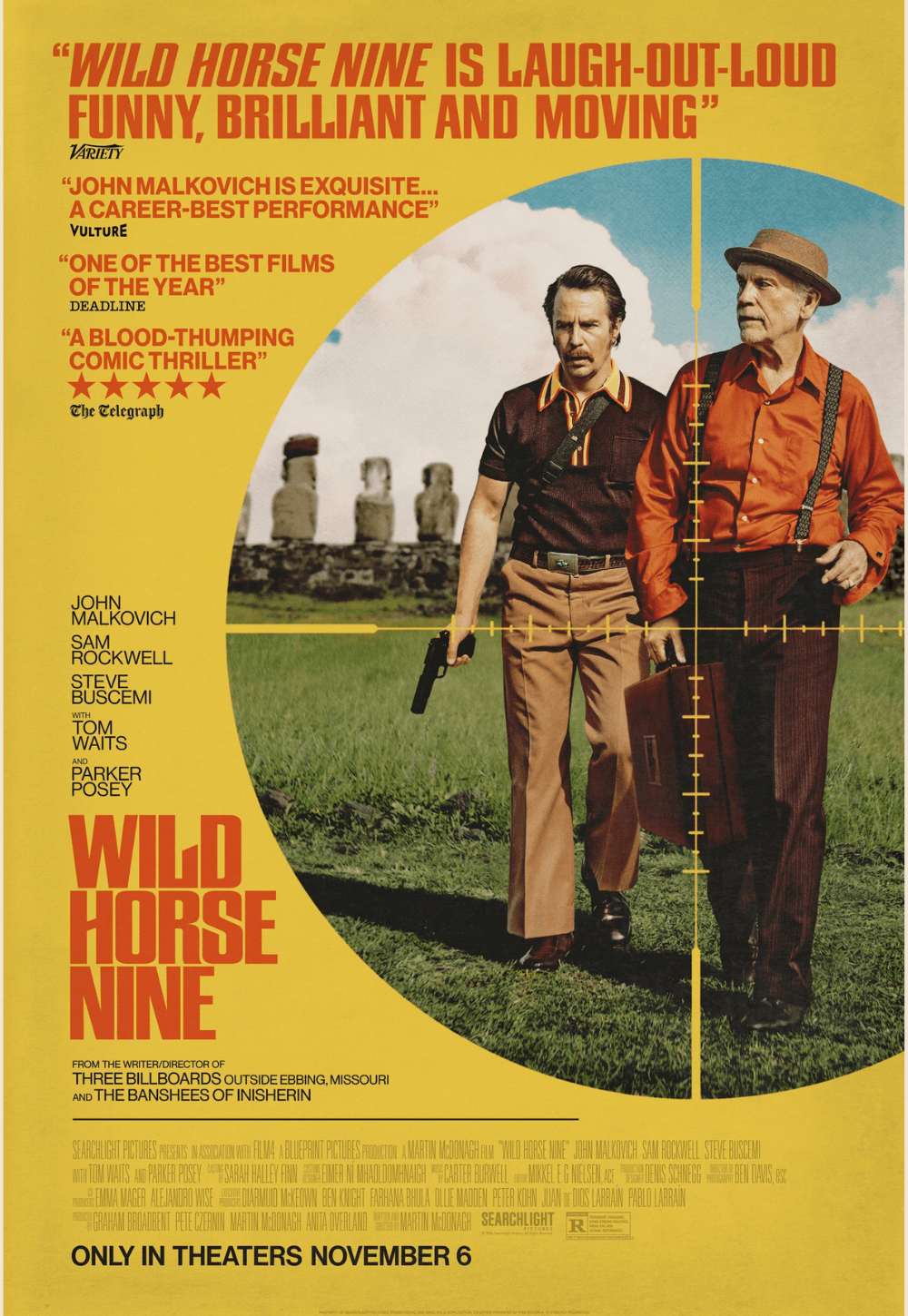
Martin McDonagh’s Wild Horse Nine is the Opening Night film of the Twin Cities Film Fest (October 15-24). It opens theatrically on November 6, 2026.
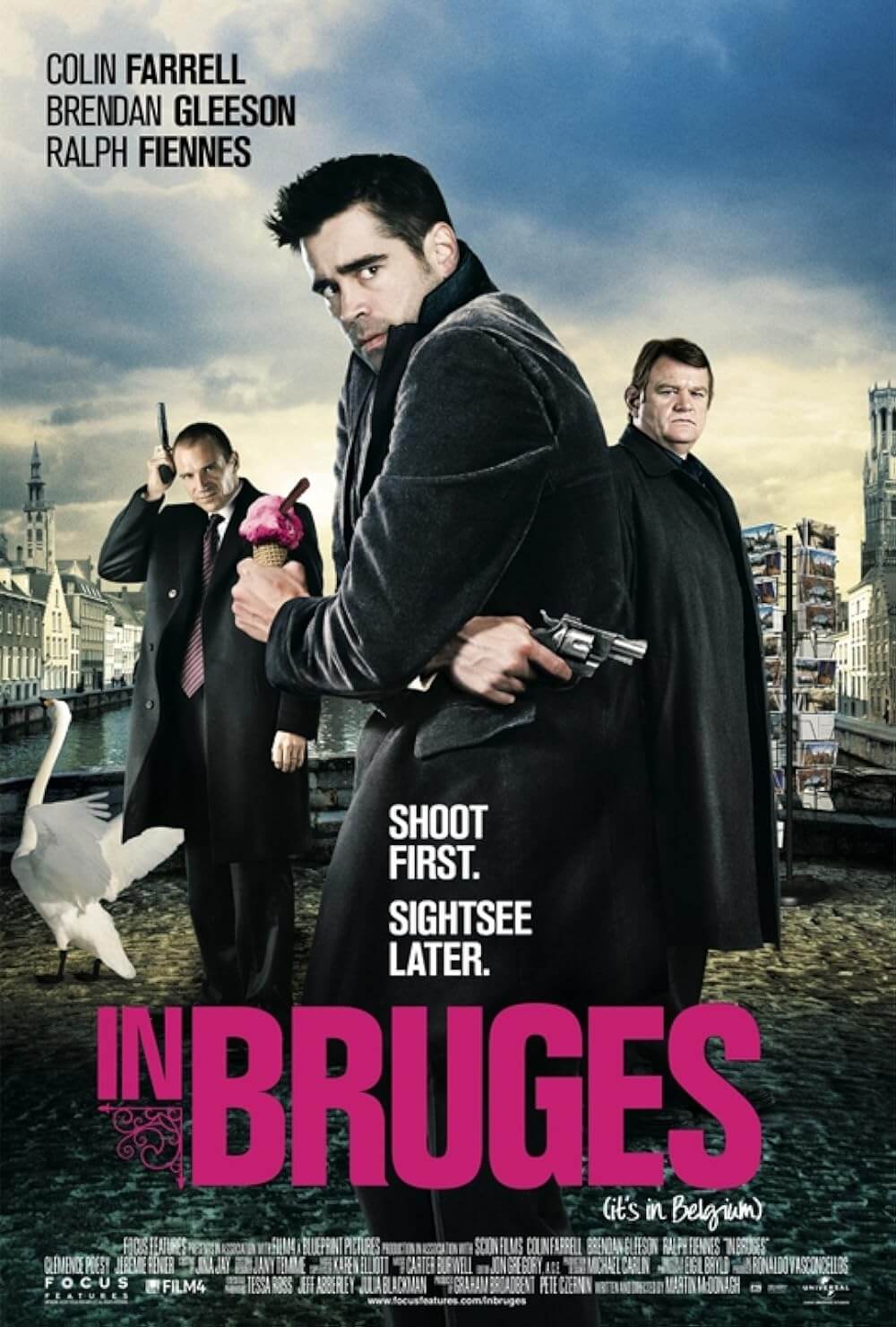
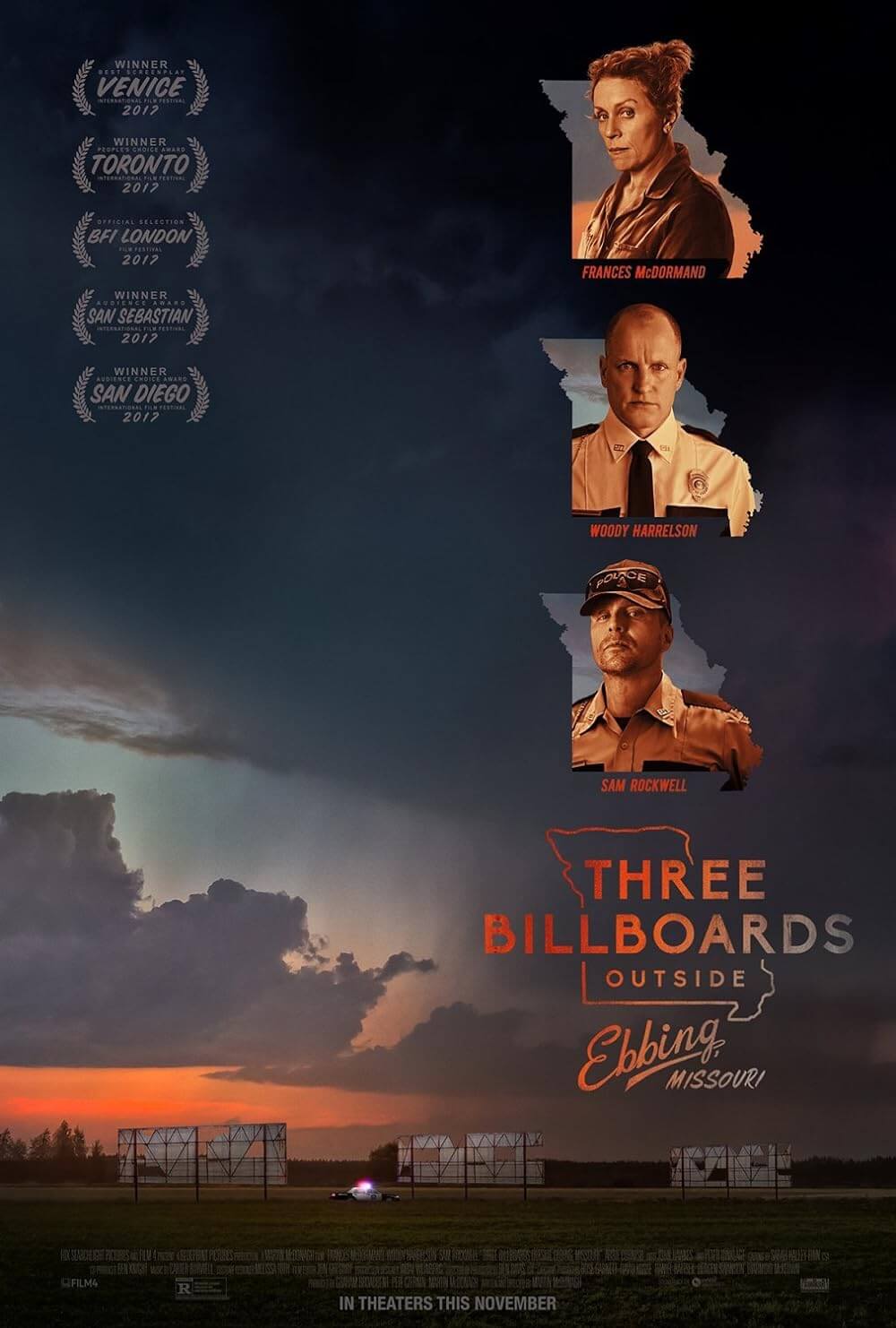
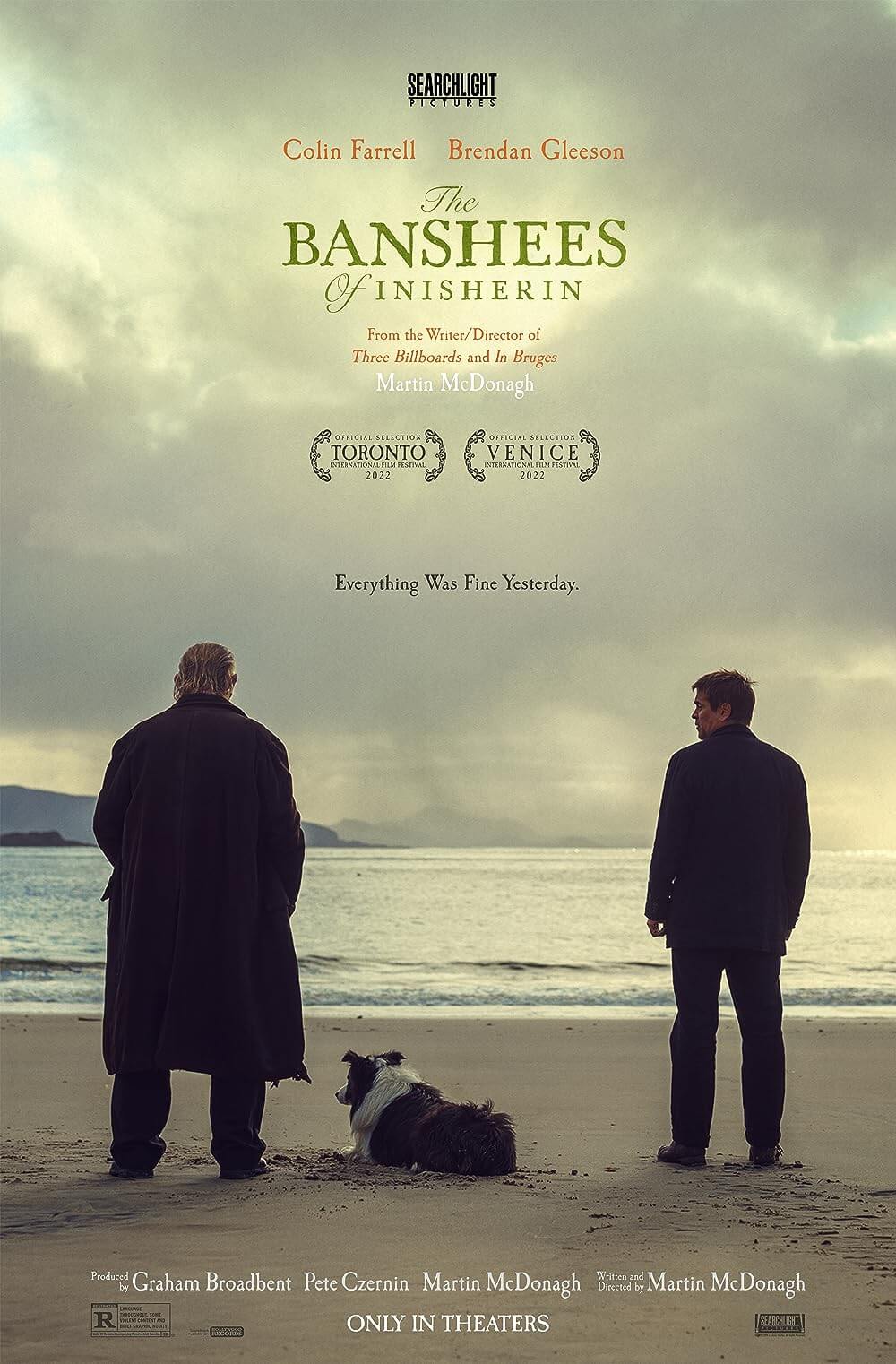
Wild Horse Nine is a variation on themes present in many of Irish writer-director Martin McDonagh’s previous features. The witty and acerbic humor shared between two hitman pals, one of whom is doomed yet ultimately protected by his partner, is straight out of McDonagh’s feature debut, In Bruges (2007). Its rather disagreeable-on-paper characters, whom McDonagh somehow makes sympathetic, recall those in Three Billboards Outside Ebbing, Missouri (2017). And its historically and politically charged landscape, which reflects the discontent of its protagonists, brings to mind The Banshees of Inisherin (2022). Consider these similarities not a sign of a tiresome, repetitive filmmaker, but of an artist whose preoccupations remain consistent through his body of work—just as Stephen King explores the same few ideas over and over in his books, or Wes Anderson’s films are dependably particular with a moving undercurrent. McDonagh’s authorial signatures may be constant, but more than his other work, his latest exploration of hitmen and history feels chillingly pertinent to present-day America.
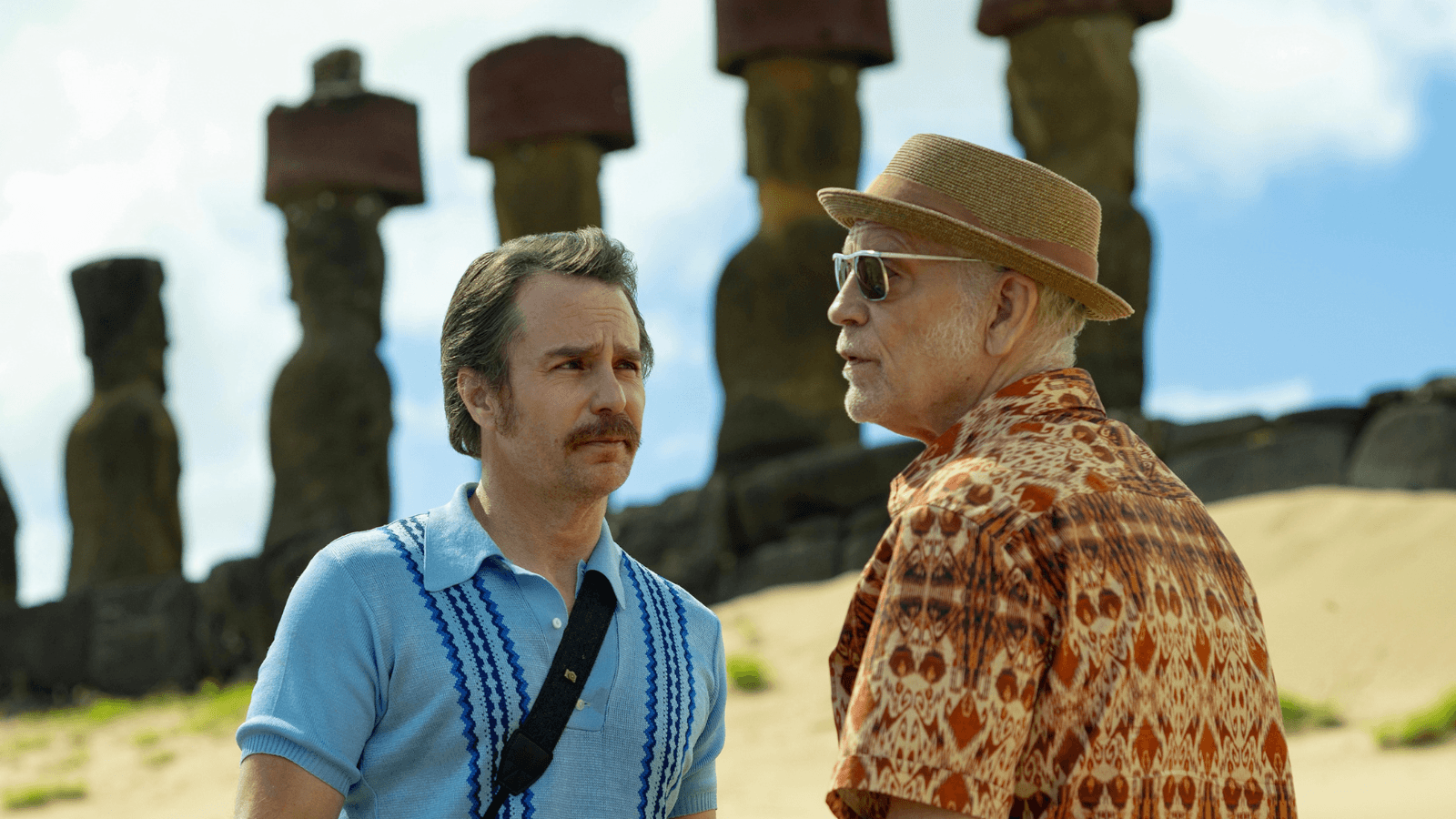
At first glance, that may seem unlikely, given that the setting is Santiago in early 1973, just months before the coup d’état that left the democratically elected socialist President Salvador Allende dead and gave rise to the military dictatorship of General Augusto Pinochet. But there’s a heavy CIA presence in Chile’s capital city, with agents Chris (John Malkovich) and Lee (Sam Rockwell) casually concealing their role in orchestrating the military junta. With time to kill before the coup, slated for September, they travel to Easter Island for what eventually becomes clear is a farewell for Chris, who’s got only a week or so to live after a grim cancer diagnosis. Chris wants to see the famous stone heads before he dies, though he couldn’t care less about their indigenous name (Moai) or the island’s (Rapa Nui). His dismissal of the Moai may be end-of-life cynicism; it may also be that he recognizes them as deified renderings of indigenous leaders and, given his experiences, he sees through the worship of leaders and history’s cover stories. Indeed, Chris is something of a legend in his field, having played a role in most CIA-led political actions and killings throughout the 1950s and 1960s.
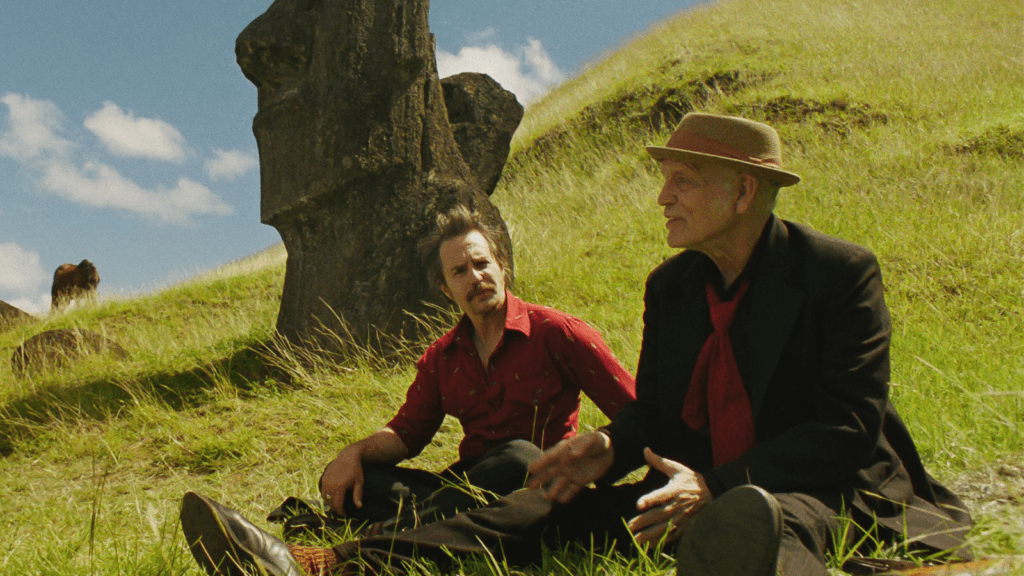
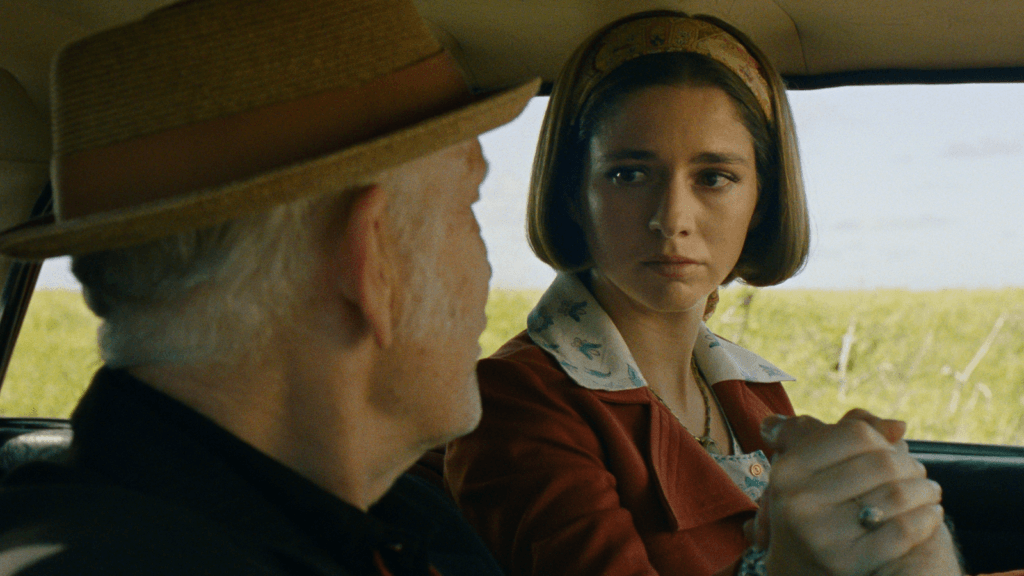
However, his mind is going. He’s becoming forgetful and loose-lipped about his past, prompting their prickly superior, MJ (Steve Buscemi), to order his death during their trip and collect any proof of Chris’ role in the Kennedy assassination. Chris’ worsening condition has eroded his discretionary filter, leaving him to speak loudly in public about being in the CIA and allude to the upcoming coup to two Chilean students. With a bemused tone that could be cruelty or just black honesty, he tells Monica (Mariana Di Girólamo) and Alicia (Ailín Salas) to enjoy their left-wing president while they can. And no matter how many times Lee tells him to “Shut the fuck up,” Chris’ soon-to-be-over life has left him self-reflective and uncaring about secrecy. Despite his callous exterior and troubling history, Chris grows on you as he begins to regret his choices. He has an affinity for and gentleness toward moths and horses, including a herd of wild horses on the island, and really anything that dies—even cancer cells. He has a strange, absurdist sense of humor and imagination, shown as he tape-records his memoir, which begins by asking whether dinosaurs had souls and how surprising it would be to arrive in heaven and see prehistoric creatures there. That memoir, containing all manner of state secrets, is what concerns MJ.
McDonagh reminds his audience of the United States’ role in destabilizing democracy in other countries during the mid-twentieth century, drawing on both recorded history and conspiracy theories. Concerning Chile, there’s documented proof from a Senate investigatory report of the CIA’s covert actions that put Pinochet in power. Over Pinochet’s 17-year rule from 1973 to 1990, thousands of left-leaning students, protesters, and journalists were killed or went missing and were presumed dead. Chris mentions that he also helped destabilize the democratic governments of Guatemala, Congo, Indonesia, and, of course, the US. Although McDonagh blends fact with speculation, he holds a mirror up to America, revealing a history of post-World War II fascism that echoes the contemporary political environment. He told The Guardian, “The difference is that with old-timey fascism, you at least had to keep it secret. These days you don’t have to hide it any more. Is that more fucked? Or is it more honest?” Either way, history repeats itself, and students of history can see that something doesn’t align between reality and America’s hollow pronouncements and branding about freedom and bringing democracy to the world.
But these themes never become oppressive; they’re left for the viewer to discover in (or project upon) the film. More foregrounded is the acting. Rockwell is no stranger to McDonagh’s pulpy dialogue, laden with intentionally offensive language (a conversation about how “gay” European countries produce cheese) and a philosophical undercurrent. Rockwell proved his aptitude with such material in Seven Psychopaths (2012) and Three Billboards, the latter of which earned him an Oscar for Best Supporting Actor. And before those on-screen collaborations, Rockwell starred in McDonagh’s play A Behanding in Spokane on Broadway, so he’s mastered McDonagh’s rhythms and verbal punctuation. The bigger surprise is that Malkovich gives arguably his best performance to date as Chris, who begins as an almost buffoonish wild card with monologues (such as one about Hank Williams and a bird shooting heroin together), then reveals layer after layer as the story unfolds, until he finally becomes a tragic antihero. Just when you think his character couldn’t be more thankless, he finds moments of genuine emotion and connection with Monica. Di Girólamo, from 2020’s Ema, is also excellent. On the margins, Buscemi and Tom Waits (in a single scene) inhabit smaller but no less impactful, thoughtfully written roles. Parker Posey is charmingly ridiculous as Lee’s unfaithful, alcoholic wife.
McDonagh isn’t a filmmaker who has a distinct visual style. However, his collaborations with cinematographer Ben Davis show consistent restraint that serves the written material and actors first, while showcasing their distinct locations. There’s some gorgeous footage of Rapa Nui and its dramatic skies here. Doubtless, McDonagh’s origins as a playwright with a penchant for acidic, hilarious, yet smart dialogue explain his relative visual restraint. Even so, a subtle application of color and costume does much to transport the viewer to the 1970s. Lee’s occasional use of a Super 8 camera to record their trip—an odd choice for a secret agent, hinting at a suppressed sentimentality between these colleagues—also lends a throwback vibe. But McDonagh’s secret weapon is Joel and Ethan Coen’s regular composer, Carter Burwell, who lends this film (and each of the director’s works thus far) a beautifully melancholy tone. Burwell is high on my list of favorite composers working today because his music often draws out the story’s complexity, sadness, and humanity.
Wild Horse Nine is the kind of film that almost seems lighthearted and airy, until it isn’t. Suddenly, it’s about the elemental forces of mortality and friendship. But it’s just as much about Chris and Lee finding some meaning in their lives as it is about the CIA’s history of political intervention. That said, one cannot help but notice the rise of films about South American dictatorships supported by the US: Pablo Larraín’s El Conde (2023), which suggests that Pinochet (along with other right-wing leaders) was a vampire, and recent dramas about a similar authoritarian rule in Brazil, including I’m Still Here (2023) and last year’s The Secret Agent. Perhaps it’s self-obsessive to think these non-American filmmakers are trying to warn US moviegoers with a cautionary tale, rather than unpacking their own history. It certainly feels that way. In any case, McDonagh has made another disarmingly funny and sneakily profound film, adding to a career of features that earn our investment with laughs and fine acting from talented performers, and then disquiet us with a sobering dose of emotional reality.
Thank You for Supporting Independent Film Criticism
If the work on DFR has added something meaningful to your love of movies, please consider supporting it.
Here are a few ways to show your support: make a one-time donation, join DFR’s Patreon for access to exclusive writing, or show your support in other ways.
Your contribution helps keep this site running independently. However you choose to support the site, please know that it’s appreciated.
Thank you for reading, and for making this work possible.
Brian Eggert | Critic, Founder
Deep Focus Review