NAZA
By David Hill |
Since its world premiere at the Venice Film Festival, the documentary NAZA has already been the subject of much debate, and it has received strong pushback from Israeli government officials. Prime Minister Benjamin Netanyahu even announced that he intends to seek legislative changes to revoke the citizenship of the film’s directors, Yuval Abraham and Rachel Szor—two Israeli investigative journalists and filmmakers who co-directed the excellent, Oscar-winning documentary No Other Land (2024) with their Palestinian colleagues Basel Adra and Hamdan Ballal.
NAZA builds on investigative journalism about Israel’s systematic mass killing of Palestinians that has been published in The Guardian, +972 Magazine, and Local Call since December 2023. The film mainly consists of filmed interviews with 24 Israeli intelligence officers and soldiers, whose appearances and voices were digitally altered to ensure they remain anonymous. What these interviewees talk about in the film is shocking—a staggering extent of mass surveillance of Palestinians, an AI system that identifies targets for strikes despite being prone to errors, and snipers killing innocent civilians stepping out of queues at food-distribution sites, to name just a few examples.
What comes across most strongly in NAZA is the complete, systematic dehumanization of Palestinians by the Israel Defense Forces (IDF), as well as the dehumanizing nature of modern warfare more generally. One interviewee even likens carrying out deadly strikes in Gaza remotely from his office in Israel to playing a video game. The film’s title also alludes to this dehumanization: NAZA is a military acronym derived from the Hebrew term Nezek Agavi, which means collateral damage—i.e., innocent civilians killed by an Israeli strike. According to the interviews shown in the film, 20 NAZA are generally considered acceptable by the IDF to hit their target, although one interviewee mentions that a strike with 500 NAZA was once approved to kill a single target.
As Israel’s genocide of Palestinians—a term used by one of the interviewees and also applied by an independent UN Commission of Inquiry—continues, having already resulted in more than 73,000 people being killed since the deadly Hamas attacks on October 7, 2023, NAZA is a vital and important documentary. That said, the film’s impact does not only derive from what it is about, but also from how well it is made—like No Other Land (which depicted the destruction of Masafer Yatta, a Palestinian community in the occupied West Bank, by Israeli forces), NAZA is a great piece of documentary filmmaking regardless of its content.

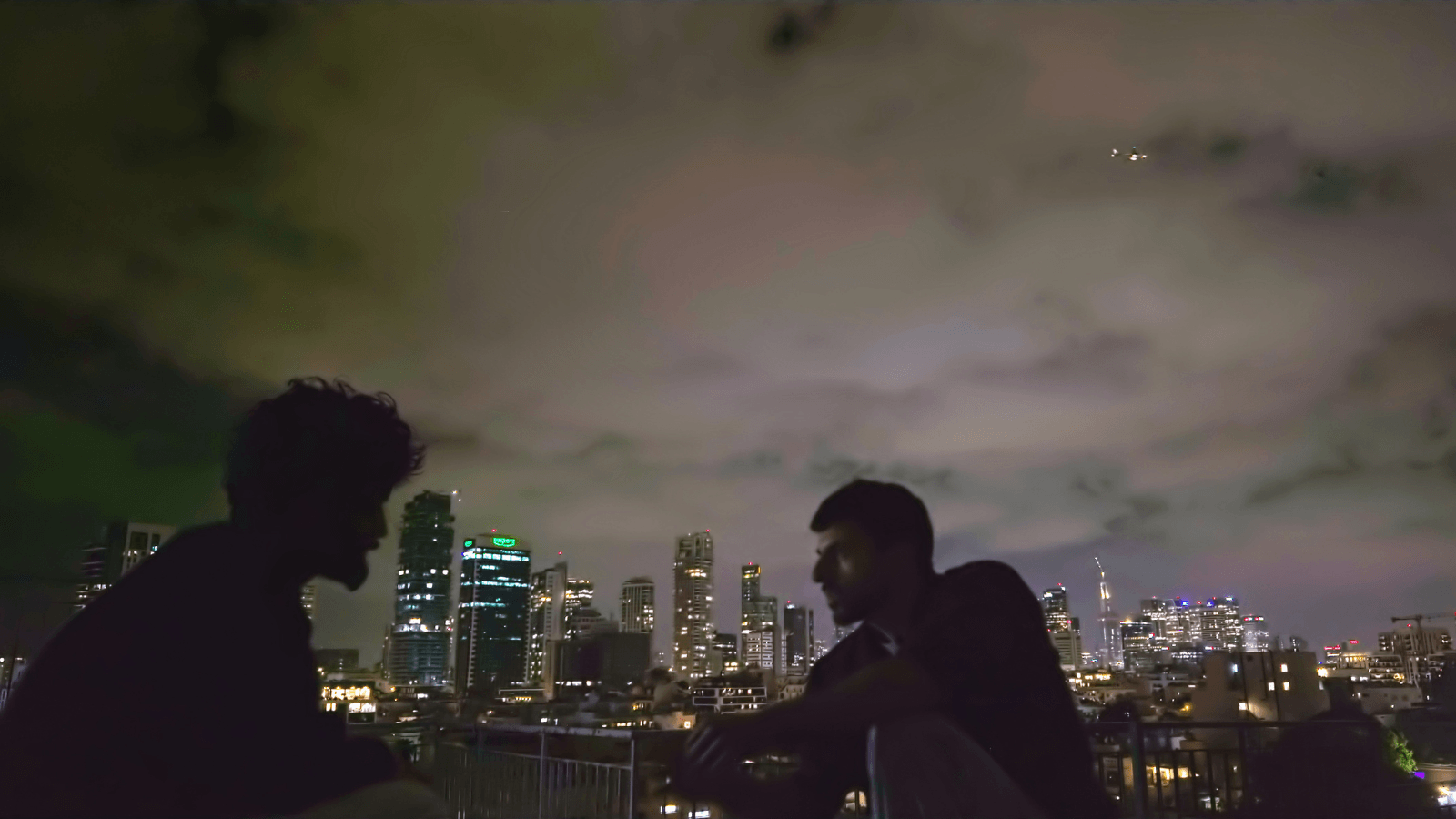
A film mainly consisting of interviews could easily feel dry or uncinematic, but Abraham and Szor’s approach ensures that this is never the case. The interviews were filmed on rooftops in Tel Aviv at night, and between interviews, there are eerie shots of the city in the dark, with the camera gliding over its skyline and peering into the lit apartments of its inhabitants. These shots not only offer the viewer a moment of respite but also open up a range of possible associations, with the city of Tel Aviv itself becoming a character. The voyeuristic shots through people’s apartment windows echo the mass surveillance of Palestinians described by the interviewees. Simultaneously, the glimpses into the everyday life of residents of Tel Aviv underscore the stark contrast to the destruction of Gaza described by the interviewees, which is happening only around 40 miles away along the same coast.
The audience also sees some of the residents of Tel Aviv watching the evening news, which creates another contrast—between what the Israeli mainstream media is reporting and what we hear from the interviews in the film. Additionally, due to the interviewees remaining anonymous, we only see them as dark silhouettes. While their reactions to what they reveal vary (some show remorse, while others compartmentalize or even boast about their actions), this means we cannot connect with them as individuals in the way we might if the interviews had been conventionally filmed. This was primarily done to protect the interviewees’ anonymity, but it also underscores the systematic nature of Israel’s mass killing, while simultaneously echoing the dehumanization of Palestinians.
Unlike the film’s detractors, Abraham and Szor choose a careful and restrained approach that avoids cheap polemics. They mostly let the sobering testimonies of their interviewees speak for themselves, although—in addition to the above-mentioned shots of Tel Aviv at night—there are a few brief instances where vital context is given through inserts. Among other things, there is archival footage that touches upon the history of Tel Aviv and the origins of the mass surveillance of Palestinians. There is also an excerpt of a TV interview in which a younger Netanyahu discusses his 1986 book Terrorism: How the West Can Win and gives a definition of terrorism that fits Israel’s current actions like a glove. Notably, NAZA does not include any footage of Gaza until the very end, which makes the effect of this footage all the more powerful and shattering.
NAZA is executive produced by Jonathan Glazer (whose 2023 film The Zone of Interest shares some thematic similarities with it) and deservedly won the Special Jury Prize at the Venice Film Festival. Following its current limited theatrical release, it will be made available to stream for free on the website of The Guardian in late November. It is by no means an easy watch, but it deserves to be seen by a wide audience—not only for offering vital and harrowing insight into Israel’s system of mass killing of Palestinians, but also for the exceptional filmmaking by Abraham and Szor. As far as I am concerned, NAZA is the best and most essential documentary of the year so far, and I doubt that it will be surpassed.

David Hill is a lawyer from Switzerland. He has long had a passion for cinema, and he devotes most of his spare time to watching and researching films. His primary interest focuses on arthouse films, and he occasionally contributes to Deep Focus Review as a guest writer. Follow him on Letterboxd.
Thank You for Supporting Independent Film Criticism
If the work on DFR has added something meaningful to your love of movies, please consider supporting it.
Here are a few ways to show your support: make a one-time donation, join DFR’s Patreon for access to exclusive writing, or show your support in other ways.
Your contribution helps keep this site running independently. However you choose to support the site, please know that it’s appreciated.
Thank you for reading, and for making this work possible.
Brian Eggert | Critic, Founder
Deep Focus Review