Late Fame
By Brian Eggert |
Note: Below is an expansion of my original review, covered at the 45th Minneapolis St. Paul International Film Festival. The film arrives in a limited theatrical release on August 7, 2026, and will expand throughout August.
Late Fame never mentions generative AI or how it’s become increasingly common for artists, filmmakers among them, to cut corners using this technology. But the film seems to comment on these trends indirectly. Critic-turned-director Kent Jones’ second feature is about a former poet, played by Willem Dafoe, who wrote at a time when people created out of passion. “Everyone was an artist. Everyone was poor. Everyone was young, until they weren’t,” he reflects. His character hasn’t written anything in decades; he hasn’t felt the need. And he’s been spared from seeing how social media has changed some art into a performative endeavor. He hasn’t seen how creatives care less about the process and emotional catharsis of their effort than the final result, the attention it brings, the likes it accumulates, and the money it makes. Although renown has always come from good art, the introduction of AI means a faster pathway to a completed project. Those more interested in getting noticed and being celebrated now have a tool to satiate their desire for attention with just a few prompts. It seems to me that these unspoken concerns lie at the center of Late Fame, one of the year’s most essential films as we continue to process how artificial intelligence distorts and corrupts what it means to be an artist.
Jones’ film is based on a short story by Austrian author Arthur Schnitzler, who wrote the novella on which Eyes Wide Shut (1999) was based. Screenwriter Samy Burch (May December, 2024) adapted the 1895 book and resituates the story in the fringe world of New York City counterculture artist collectives. Although at risk of anachronisms in adapting a story written in nineteenth-century Vienna, Jones and Burch focus on the timeless relationship between art and fame. The film considers how today’s artists romanticize their past counterparts and aspire to replicate their legacy, but they take shortcuts to do so. Once a vital space to pool resources for radical resistance and intellectualism, this brand of artist collective has been deprioritized and replaced today by online influencers and “content” creators. More common are online communities and siloed individuals trying to get enough engagement to monetize their YouTube channel, build their follower base, or gain enough subscribers on their Substack to quit their day job. Whatever creative energy they have left, much of it is spent managing their profiles rather than actually creating.
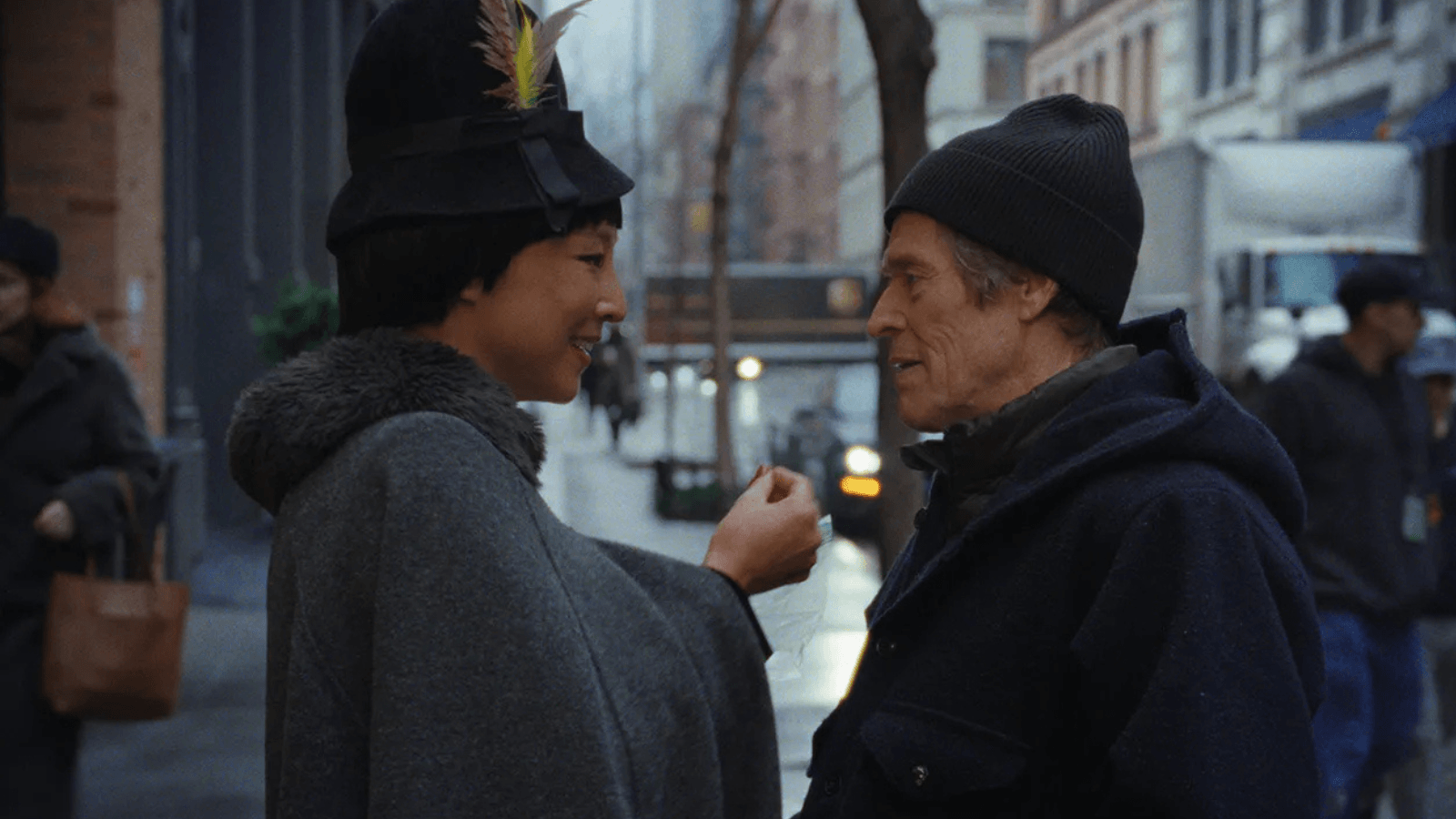
Late Fame centers on Ed Saxberger, played by Dafoe in a rare everyman performance that he slips into effortlessly. Before he started his 37-year career at the US Postal Service, Ed wrote a book of poetry in 1979 called Way Past Go that no one much remembers. His quiet routine of working, returning home for a homemade tuna fish sandwich, and playing pool with his buddies at a local bar is soon interrupted by Meyers (Edmund Donovan), a fan who wants to recreate the underground art scene of yesteryear. Meyers and several would-be creatives—mostly white male twentysomethings—have formed a throwback group of self-declared intellectuals, writers, essayists, playwrights, and poets, which they have labored to name the “Enthusiasm Society.” One of them wears a cape in all seriousness. Another dresses like a Bolshevik with a shaggy beard, suspenders, and a wrinkled linen shirt, despite living in a penthouse apartment. They welcome Ed into their fold, seemingly for the pleasure of saying his last name aloud (they refer to each other by last names only), hoping his presence will lend credibility to their half-baked movement. “Reverence for art is what binds us together,” Meyers says. “We’re radical.” One wonders if he knows the meaning of the word.

Some part of Ed enjoys the attention. They want to hear stories about the glory days of Bukowski and Ginsberg, though it’s unclear if they’ve ever read their poems, much less his. Ed doesn’t romanticize his experiences, yet he cannot help but get caught up in an energy he hasn’t tapped into for forty years. He puts everything else in his life second, including calls from his sister about his estranged brother who’s dying in the hospital. One ugly scene finds Ed giving his friend Arnold (Clark Johnson) a birthday gift of Way Past Go, which is egocentric enough. Ed’s buddies never knew he was a poet, and when he shows up to their local spot with a flashy scarf, they bust his chops. They see through his pretensions and call him a “pretty boy.” He responds in the worst possible way: “You have no idea who you’re talking to.” It’s a momentary lapse of self on Ed’s part, his ego inflated by the Society’s hero worship.
What’s worse is that Ed doesn’t see the group’s hypocrisy, at least at first. Although they pronounce themselves to be purists who reject technology and “sociopath media,” there’s a stink of poserism about them that Ed fails to notice right away. For us, the pretense is unmistakable. Meyers appears in a cream turtleneck sweater, black peacoat, fur hat, and diamond-shaped sunglasses. He speaks with a faux articulation, which he claims opposes the casual mannerisms of modern culture. His outward composure aside, Meyers is deeply insecure. At one point he asks Ed, “Do you think we seem… impressive?” This is where Meyers’ priorities lie. But there’s little for Ed to remark on besides their stated ambitions. The Society’s members don’t seem to be working on any creative projects, and if they are, Jones spares us from having to sit through them. Gradually, Ed realizes that nobody in this collective of poets and performers has put in the effort, not as he understands it. They’re trying to capture a nostalgic, possibly nonexistent past they didn’t experience and capitalize on what others have done in some vague attempt to pass as artists.
On the periphery of Meyers’ group is a fascinating, tragic character named Gloria, the one member not addressed by her surname, played by a marvelous Greta Lee in a charmingly flamboyant turn. A shameless flirt, she takes to Ed, whose lack of pretense attracts her, even though she’s wearing layers of performative makeup and clothing. Like Ed, she doesn’t have a trust fund or come from an ultra-wealthy family, whereas the others in this aspirational movement have posh apartments paid for by their parents. Ed is naturally drawn to her; perhaps he recognizes that there’s some genuine pain behind her ostentatious surface. He attends her one-woman show in a small bar, where she performs a Weimar-era cabaret song, “Surabaya Johnny,” in a burlesque getup, evoking Sally Bowles. As he pursues her, he discovers that Gloria herself is a performance—the role of both ingénue and diva, who orders an untouched absinthe because of its bohemian associations. Even if her personality isn’t genuine, she’s the one true artist in the collective, putting her pain into her acting. “I belong to no one,” she declares. “Just my art.”
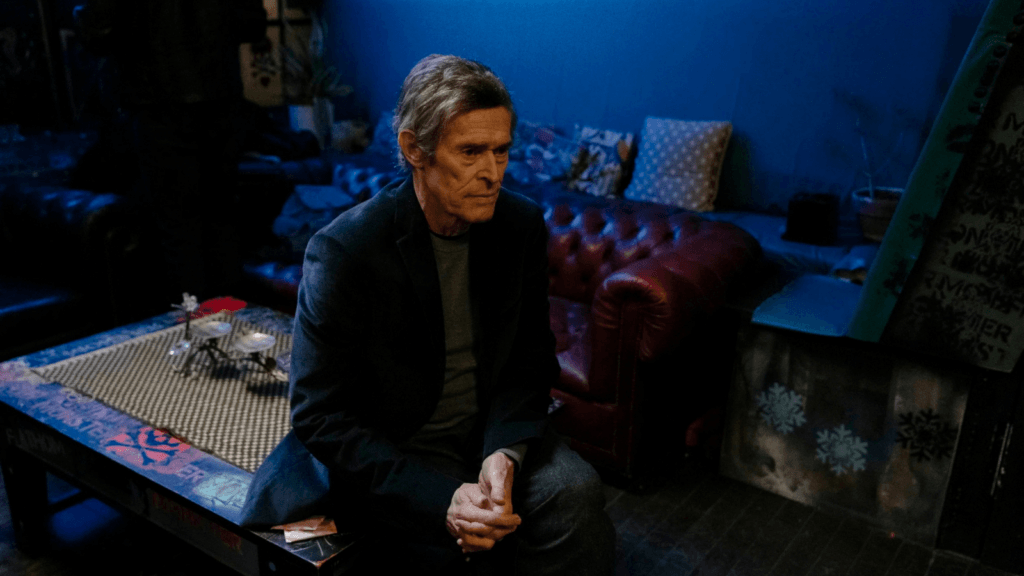
Ed doesn’t spend his time with the Society appreciating their art (if it even exists) or having personal conversations about their process. Instead, Meyers and the rest are consumed by the logistics of an upcoming show, which they hope will announce their collective to the world. They’re more concerned with labels and appearances than a desperate need to express themselves through their art. Ed, for instance, is labeled as a precious “rediscovery,” which he learns during a meeting arranged by Meyers with a vapid literary agent (Jake Lacy) who wants Ed to write his memoir—Meyers’ idea. Having withdrawn from such circles, Ed remains ignorant of how the digital age has only fueled people’s desperate need to become someone else, and how those dual lives, so prevalent online, have spilled into reality to such an extent that authenticity today is rare. For Meyers and his friends, they claim to despise social media while quietly hiding their phones and urgently searching for reviews of their show. Their hypocrisy is staggering.
More authentic is Ed, played in an extraordinary performance by Dafoe. Ed is a guy who set aside his creative outlet long ago. Dafoe’s prolific career has resulted in countless roles as memorable, offbeat characters, but few leading roles, and even fewer as a normal guy. It’s a testament to his skill as a performer that he can disappear into Ed Saxberger as easily as one of his eccentric turns in a Wes Anderson or Robert Eggers picture. Dafoe captures Ed’s inner conflict and desire to please his new friends when Meyers asks him to write a new poem for their upcoming show. He initially declines, but the gang pressures him into it. He tries to put something together, walking around his neighborhood for inspiration, repeating the phrase “seasons collide.” Jones and editor Mike Selemon craft impressionistic montages of Ed searching for inspiration, struggling to access his dormant creative spark. Great art comes from passion, not from the desire to appear great. “I had my moment,” Ed says. “It ended.”
Late Fame is a superb meditation on the relationship between art and fame, and the tendency among aspirational creatives to idealize and attempt to replicate the past—because they have no original ideas or they just want the associated attention, or both. It’s a relationship captured in cinematographer Wyatt Garfield’s grainy, earthy footage, with its almost vintage look. And besides the terrific performances by Dafoe and Lee, it’s a film populated with well-drawn characters who become instantly knowable. It shows how, as an artist, you might let fame go to your head, but when all you think about is fame, your output becomes shallow. Ultimately, Late Fame is about having the energy to put in the work and recognizing that great art comes from having something to say. There’s no shame in not having a perspective. However, recognizing the difference between inspired art and manufactured content is increasingly rare these days. So are artists who create because they must, and not for the attention the work brings them.
Thank You for Supporting Independent Film Criticism
If the work on DFR has added something meaningful to your love of movies, please consider supporting it.
Here are a few ways to show your support: make a one-time donation, join DFR’s Patreon for access to exclusive writing, or show your support in other ways.
Your contribution helps keep this site running independently. However you choose to support the site, please know that it’s appreciated.
Thank you for reading, and for making this work possible.
Brian Eggert | Critic, Founder
Deep Focus Review