MSPIFF 2026 – Dispatch 2
By Brian Eggert | April 15, 2026
The films below were screened at the 45th Minneapolis St. Paul International Film Festival (MSPIFF45), which runs from April 8-19. Check here for the full lineup and check back for additional dispatches and full-length reviews of MSPIFF releases.
Two Prosecutors
Although it concerns the nightmarish corruption of Joseph Stalin’s Great Purge, in which he removed (and disappeared) political dissenters from the Communist Party in the mid-1930s, Ukrainian director Sergei Loznitsa could not have made his uncompromising new film in Russia. Even though the Soviet Union has since dissolved, Loznitsa’s Two Prosecutors implies a throughline in history leading to Vladimir Putin’s similar targeting of his political and media opponents. Such are the actions of fascists. But the film does not need to connect the dots to today’s similar leaders; the links are apparent without drawing them for the viewer. Rather, the film examines how fascist systems thrive on control and fear, weeding out anyone who dares to ask questions or seek justice that doesn’t align with the Party.
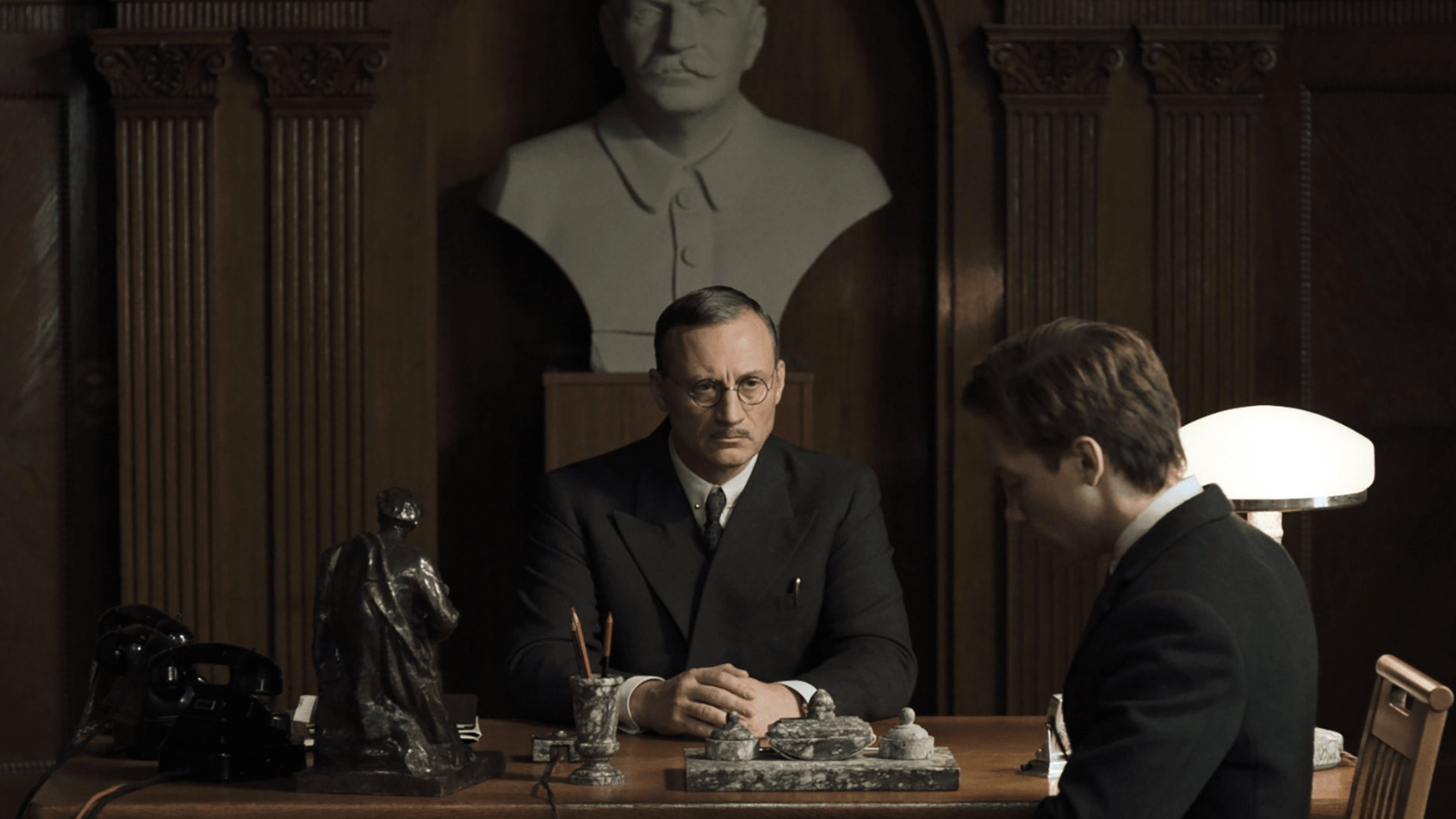
Two Prosecutors is about someone who tries to do the right thing, even follow procedure, and finds himself targeted by the Party supporters around him. Kornyev (Aleksandr Kuznetsov, excellent) is fresh out of law school when he receives, through unofficial channels, a message from a prisoner mistreated by guards, who remain loyal to Stalin’s secret police, then called the NKVD, but later replaced by the KGB. Kornyev investigates and, upon experiencing the prison’s shady guards, complicit warden, and lies about widespread infectious disease among the population, resolves to bring the matter to the head prosecutor in Moscow. There, he navigates a labyrinth of bureaucracy reminiscent of Brazil (1985) before he can be seen.
Kornyev’s journey consists of waiting rooms and meetings with officials who wonder why he’s so interested in prisoner rights. Loznitsa shoots in the boxy Academy ratio to convey the sociopolitical restraints put on Soviet citizens at the time, desaturating the colors to a palette of ashen grays and browns. The film might be called slow by some. I found myself struggling with the pace early on, which may have been less the film’s fault than my watching it at the end of a long day. Two Prosecutors is the kind of arthouse film I would have preferred to watch at 10 am, sipping a cup of coffee (a category that includes works by many slow-cinema filmmakers). That note aside, the final devastating sequence left me feeling as though the wind had been knocked out of me and reframed the entire film.
Shot in Latvia and financed by sources throughout Northern and Eastern Europe—some of the countries most historically impacted by Russia—the film has the spare, unrelenting quality of an Andrei Tarkovsky film. Loznitsa’s long shots and use of time capture not only a system designed to wear down a person’s resilience, but also highlight Kornyev’s resolve and bravery (and naïveté) in his pursuit of justice. Two Prosecutors dramatizes how, when a whole system is venal, there’s no hope of finding fairness or equity. And simply by speaking up, you put a target on your back. But where would we be if people didn’t speak out against wrongs when they see them? Rating: 3.5 out of 4 Stars
The Travel Companion
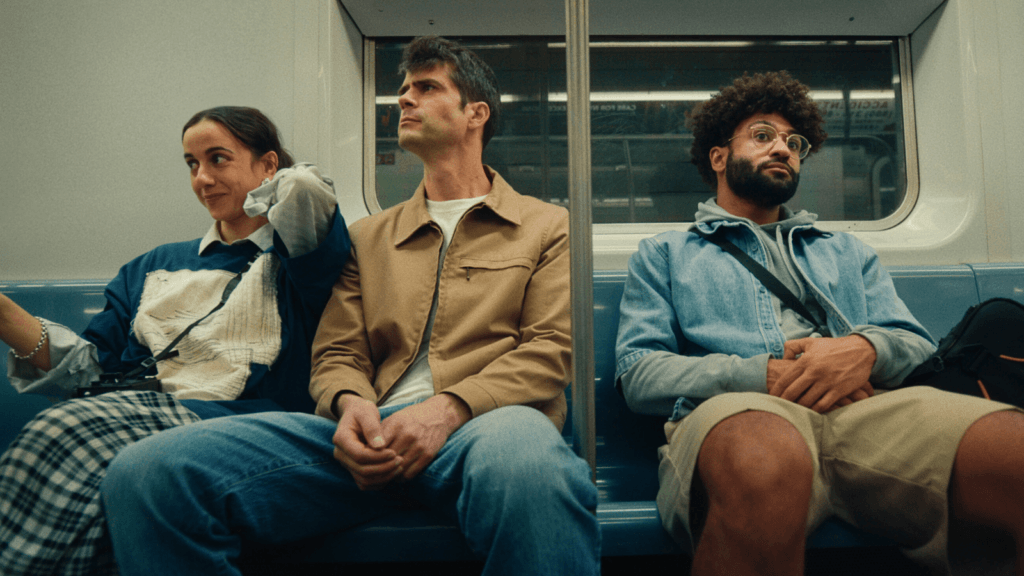
Appropriately enough, the opening scene of Travis Wood and Alex Mallis’ debut feature, The Travel Companion, takes place at a film festival. It’s a familiar scene, unfolding after a block of short films. Various filmmakers participate in the Q&A, while a moderator takes unfocused audience questions. The filmmakers respond with equal doses of inarticulation and pretension. Among them is Simon (Tristan Turner), who never even gets a chance to remark about his film. That’s how life goes for Simon. Despite his bad luck, artistic drive (or lack thereof) and indecision remain his downfalls, not the misaligned universe. For his latest film, Simon says he’s “marinating” on several ideas for an experimental travelogue documentary. When he tries to explain his concept, he unloads verbal diarrhea that makes it apparent he doesn’t know what his proposed film is about.
Fortunately, that’s not the case for Wood and Mallis, who co-wrote the film with their fellow producer, Weston Auburn. Using the independent film scene as a backdrop, the filmmakers focus on how the dynamic between two friends changes when one becomes involved with a new romantic partner. Simon’s best friend and roommate, Bruce (Anthony Oberbeck), works as an airline scheduler, a gig with a considerable perk: The airline allows Bruce to have one “travel companion,” meaning he can book a free standby seat for someone to anywhere in the world. Simon is his current choice. But when Bruce begins dating Beatrice (Naomi Asa), a more successful and notably privileged independent filmmaker, Simon worries that he’ll lose his free travel to her. After all, travel is necessary for his vague next project, which he hasn’t started because he’s crippled by imposter syndrome and has no crystallized ideas.
Indeed, one suspects that Simon only wants to travel because it allows him to procrastinate about starting his new project. Still, the threat of losing his fringe friendship benefit to Beatrice becomes all-consuming, to the extent that he brings it up and barters for it in every interaction. He strains Bruce’s patience (and the audience’s) in several transparent, transactional attempts to win his friend’s favor and maintain his “travel companion” status. Turner somehow manages to preserve his character’s frustrating but likable persona, even as Simon alienates himself with his rudderless state of being. Oberbeck plays Bruce as easygoing, rational, and reasonable, putting up with Simon’s neediness and self-absorption better than some would have.
Countless films have been made about directors making their debut feature or simply struggling to get their ideas onscreen. When in doubt, they make a film about the filmmaking process. It’s what they know. In that, The Travel Companion adopts a 1990s indie sensibility, with long stretches of dialogue on actual city streets—what Simon and Bruce call a “walk-around, fuck-around.” But the film’s look and feel are more professional than its ’90s antecedents, with crisp, natural digital lensing by Jason Chiu. Moreover, Wood and Mallis offer shrewd observations about the industry subculture of short films and festivals, where a $150,000 budget feels like a lot, and filmmakers must compete with viral TikTok and YouTube videos.
Teeming with Simon’s self-obsession and self-doubt, The Travel Companion is about the fear of being left behind—both as a third wheel in his friend’s partnership and as an emerging artist. The ending, set at a festival where Simon screens his completed project, finds him after he overcomes his period of floundering. This conclusion feels tacked on, or perhaps that’s intentional (or even a dream sequence). In either case, Wood and Mallis don’t show us Simon’s project, and we’re left to wonder if it’s any good. Maybe that doesn’t matter. Maybe the film is about the drive to make something happen, and how Simon was forced to develop it after losing his friend. Either way, it’s a well-made, relatable story about a filmmaker who learns he must stop waiting on standby to find artistic inspiration. Rating: 3 out of 4 Stars.
Living the Land
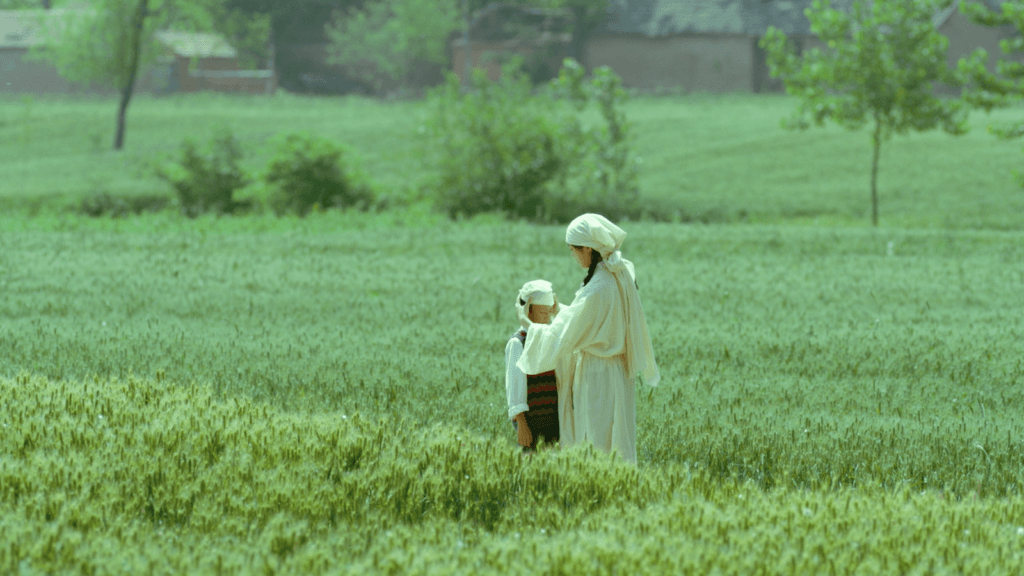
Shot over the course of a year in the Henan Province, Huo Meng’s Living the Land immerses the viewer in an isolated Chinese farming community over several seasons. Opening in the spring of 1991, the film explores a period of profound change in China, when the government began to deprioritize agriculture to modernize, industrialize, and globalize. Unlike Jia Zhangke (Xiao Wu, 1997)—whose cinema usually considers the expansion of small towns into urban centers as a metaphor for China—Huo’s interest lies in the struggle to survive on a farm. Its leisurely pacing and more-than-two-hour runtime may make the film a challenge for some, but it recalls the visually stunning meditative atmosphere of Terrence Malick’s Days of Heaven (1979).
At least in that film, set in the 1910s, the farmers had machines to assist their labor. That’s not the case for the family in Living the Land, who collect wheat not with a harvester but with sickles. The story begins with narration from the dreamy perspective of a 10-year-old boy named Xu Chuang (Wang Shang), a bed-wetter whose family name doesn’t match his family’s. Chuang has been sent to live with his Auntie (Zhang Chuwen) and his foul-mouthed great-grandma (Zhang Yanrong), among other family members. His parents work elsewhere, and he questions his identity and solitude amid his extended family. He also believes his family is the poorest in the world’s poorest village, making their eventual first television a major milestone. The film meanders through the lives of these farmers, from the rain that spoils their wheat crop to a tragedy involving a family member with an intellectual disability. However, it loses focus on Chuang’s perspective to capture a broader view of a community.
Huo, who also wrote the film, told a similar story about a boy moving to the countryside in his 2018 film, Crossing the Border. His patience and eye for stunning imagery stand out in Living the Land, with vast pastel skies and striking green fields. His few master and even medium shots almost seem out of place in a film that prefers to step back and watch the action unfold. Cinematographer Guo Daming captures leisurely scenes with a documentary-like focus on observation and process, depicting the effort these farmers put into their land and the desperate circumstances that will determine whether it will be a good year. Even with everyone toiling away, the harvest could become catastrophic without luck on their side. Other conflicts arise from the one-child policy and the need to comply with government orders blared over loudspeakers to villagers. The juxtaposition of the old world and new remarks on how much China has changed in a few decades and how much a farming community changes in a year. Rating: 3 out of 4 Stars.
Thank You for Supporting Independent Film Criticism
If the work on DFR has added something meaningful to your love of movies, please consider supporting it.
Here are a few ways to show your support: make a one-time donation, join DFR’s Patreon for access to exclusive writing, or show your support in other ways.
Your contribution helps keep this site running independently. However you choose to support the site, please know that it’s appreciated.
Thank you for reading, and for making this work possible.
Brian Eggert | Critic, Founder
Deep Focus Review