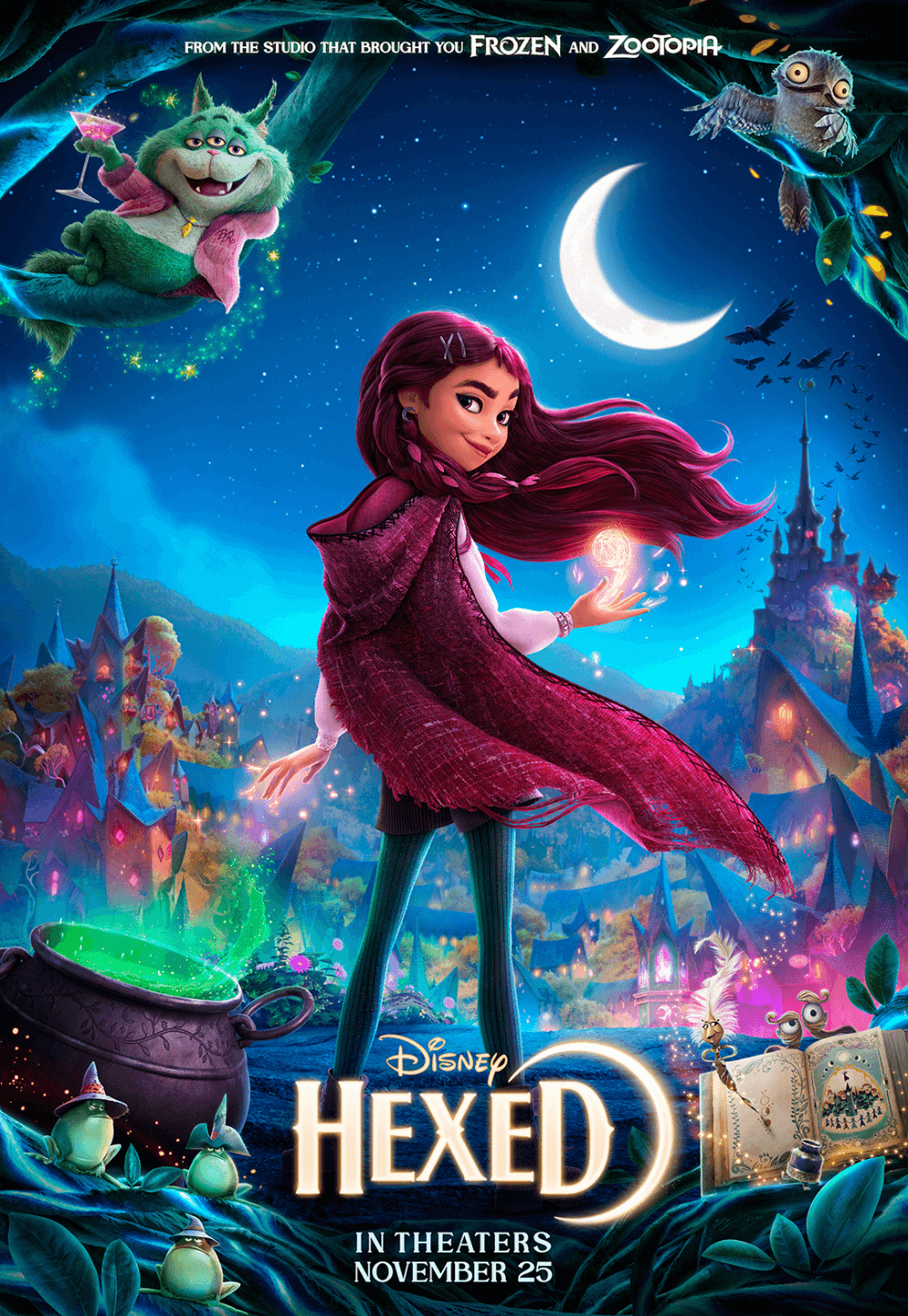
Hexed
By Brian Eggert |
A few years ago, Disney stopped putting animated short films before its features. These were often a highlight of the moviegoing experience, except for the tedious, overlong Olaf’s Frozen Adventure that played before Pixar’s Coco (2017). The House of Mouse revives this tradition before its latest, Hexed, with the delightful Lilo & Scratch, a six-minute short that blends the hand-drawn look of Lilo & Stitch (2002) with computer-generated animation. The simple story finds Lilo bringing home a stray kitten. Stitch soon discovers the feline is an alien intent on eating his goldfish. It’s a welcome primer to a charming, if unremarkable movie about witches and magic. With its gorgeously animated autumnal panorama of spells and secret realms, Hexed is technically another princess tale from Walt Disney Animation Studios. However, it’s free of a romantic subplot and boasts some loaded mother-daughter dynamics that will resonate with those who have uneasy relationships with their parents, whether they’ve worked through their tensions or not.
Hexed shares unmistakable traits with Harry Potter lore and world-building, from a chosen child prophesied to save the day to a hidden domain for the magically inclined. The story centers on Billie Doe (voice of Hailee Steinfeld), whose overbearing mother, Alice (Rashida Jones), has tried to suppress her daughter’s abilities with a restriction-charm bracelet. Because Billie is a teen who doesn’t feel like the other kids, she rebels with a streak of bad behavior that leads her to discover Hexe, a land inhabited by witches, wizards, and enchanted animals called familiars. It’s not uncommon for Disney protagonists to feel different and search for a place where they belong, only to learn that their difference is their strength. That aspect of Hexed is predictable. But screenwriters Jared Bush and Dana Ledoux Miller also imbue the movie with a generational look at how parents pass their issues with their own parents down to their children.
Part of the joy here is discovering the colorful, witchy design of Hexe, filled with all manner of anthropomorphized objects, raven watchdogs, and talking animals. The newcomer Billie has no control over her newfound powers and quickly learns that her ability to fly is unique among her kind—apart from Queen Celeste (Jodie Foster), the high sorceress ruler of Hexe and Billie’s grandmother. Billie earns the nickname “the girl who flew,” similar to Harry Potter’s “the boy who lived.” And like Potter, our hero has a fateful connection with the villain. A prophecy says a flying witch will cast a lunar spell, expanding the magical world so everyone can explore their abilities to the fullest. Queen Celeste wants that honor in order to maintain her rule, and she sees Billie as a threat to her power, family ties notwithstanding. Alice soon arrives in Hexe to protect her daughter, but her magic skills are rusty. The two bond as they learn and relearn the basics of magic (intention, ignition, and inwitchification). Afterward, they set out to confront the land’s duplicitous matriarch.
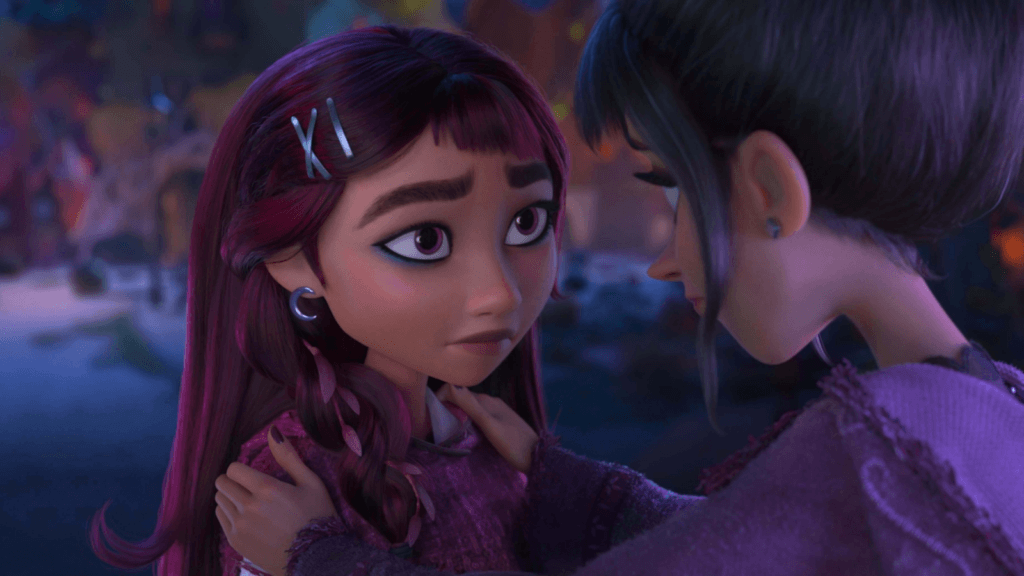
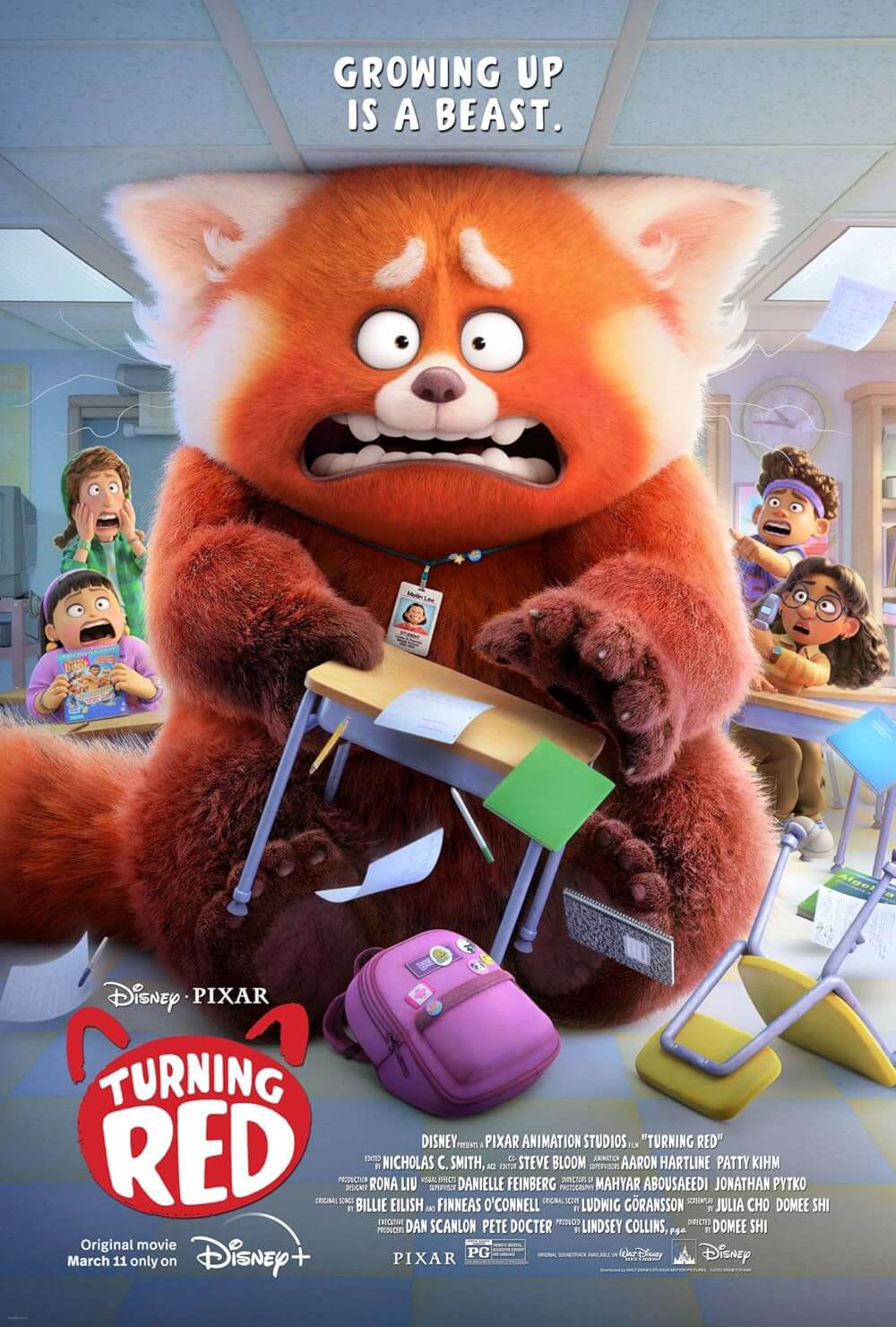
Hexed has a comical weirdness factor, somewhat uncharacteristic for the studio, with creepy monsters and a fair amount of humor around death. An early scene finds Billie releasing her school’s caged owl, only for the bird to fly into a power line. Directors Fawn Veerasunthorn and Jason Hand, along with co-director Josie Trinidad, also lend the movie a mature edge in subtler ways. When Billie first unlocks her powers in her high school restroom, she moves hand soap, toilet paper, and tampons with her mind—the last marking a rare acknowledgment of menstruation in an animated film (see also 2022’s Turning Red, a similarly themed story about magical suppression and mother-daughter relationships). Hexed features some Disney in-jokes as well, with nods to Ursula from The Little Mermaid (1989) and the talking objects from Beauty and the Beast (1991). Mangy stray cats, centipedes made entirely of huge eyes, talking spiders that swathe their prey in webbing, and countless other elements prove pleasantly morbid.
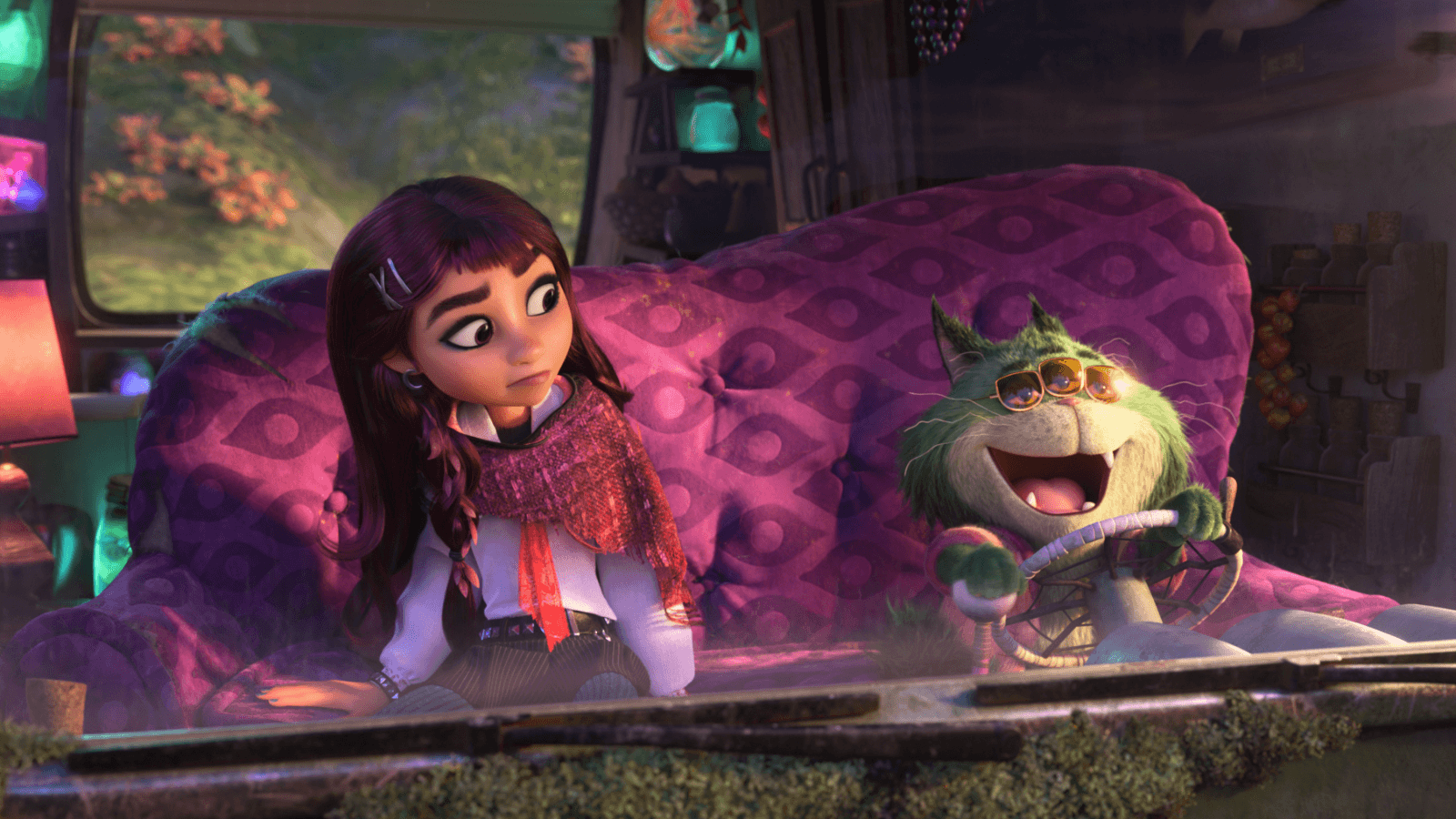
The production is visually inspired. Every frame is packed with detail and intricacy, particularly in scenes with the human Hexe populace or, later, the familiars. Chief among them is Beef Roger Crummchuk (Walton Goggins), a three-eyed cat who bears a slight resemblance to the Cheshire Cat from Alice in Wonderland (1951). Goggins’ voice work is often hilarious and scene-stealing, while his character, who lives in a mobile home overstuffed with potions and magical trinkets, serves as a mentor for Billie. The movie’s color palette is pure Halloween, with burnt-orange leaves, glowing pink or green brews, and Billie’s naturally purple hair. If there’s a misstep in the production, it’s the overreliance on needle drops and on-the-nose songs, in particular during the prolonged climax. At least Queen’s “I Want to Break Free” is easier on the ears than the obnoxious pop choices, including one by Steinfeld. Hexed would have been considerably better had it relied more on Kris Bowers’ solid score.
Elsewhere, the directors use the aspect ratio symbolically, showing the non-magic world in a 2.35:1 ratio, with black bars on top and bottom narrowing the view. The perspective expands in Hexe to a more open, freeing 1.85:1. Later, after Billie and her mother come to understand each other, the human world opens up too, with Billie no longer feeling held back by her mother. It’s a subtle flourish that captures how parents can make their children’s lives smaller by trying to prevent them from being who they are and who they could be. Here, that plays out between Alice and Billie, but also between Alice and Celeste, supplying a refreshing alternative to the “chosen teen hero” plot of so many YA and children’s fantasy stories. If the film doesn’t quite reach greatness, it has enough emotional stakes and amusing, dark-hued strangeness to earn comparisons to Coraline (2009) and ParaNorman (2012). But it’s also characteristic of Disney’s good-but-not-quite-exceptional track record over the last decade or so.
Like DFR? Support us.
This site exists because readers like you care about film. If DFR has enriched your experience with movies, I’d be grateful for your support. You have a few options:
• Join DFR’s Patreon community
• Make a one-time donation on PayPal
• Buy me a coffee
Whatever option you choose, it helps keep my work independent. And it means a lot to me.
Thank you for reading, and for making this work possible.
Brian Eggert | Critic, Founder
Deep Focus Review