The Social Reckoning
By Brian Eggert |
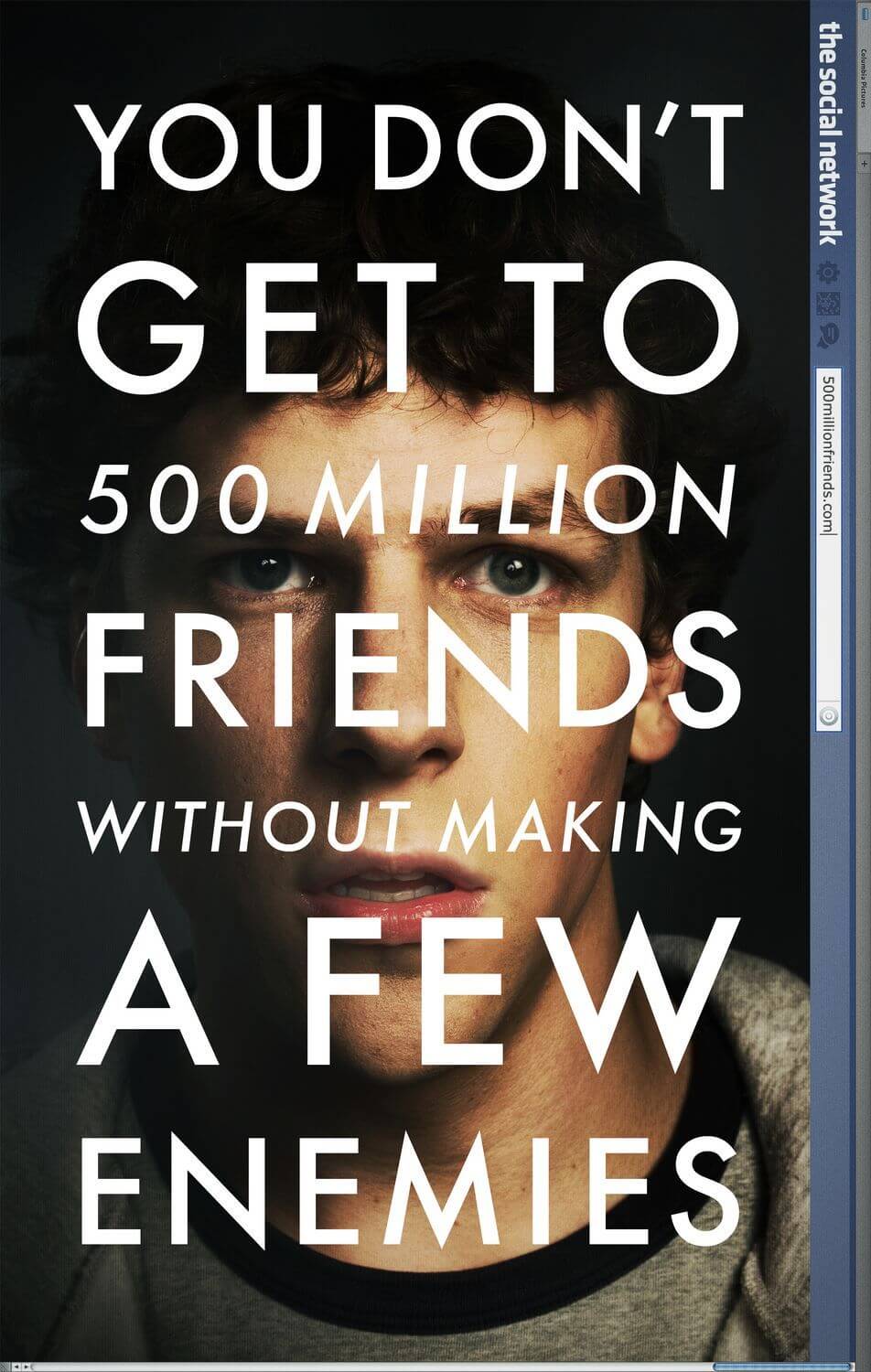
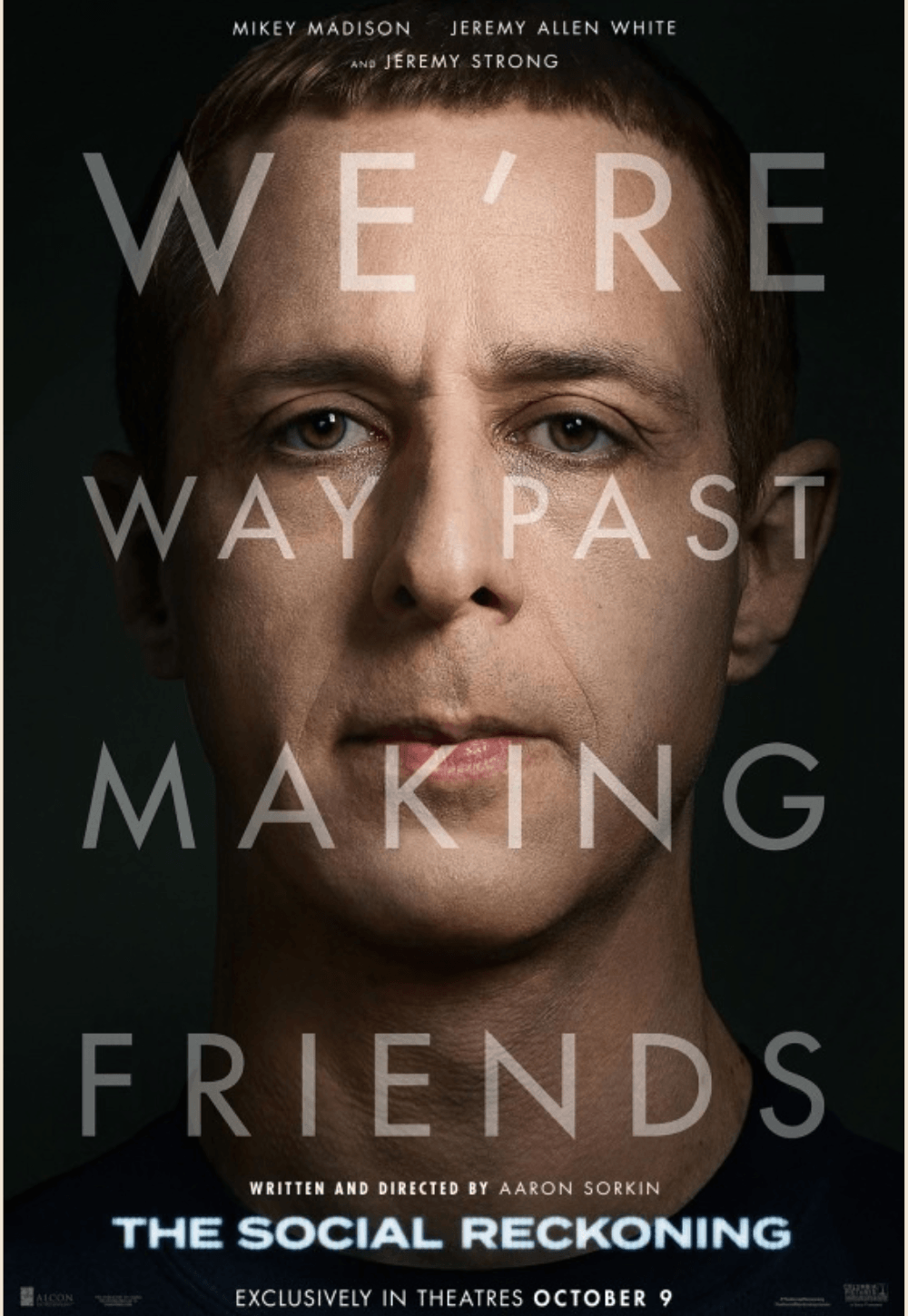
Thanks to Aaron Sorkin, when people ask why I deleted my Facebook and Instagram accounts a few years ago, I can skip the usual tirade about social media’s toxicity and simply say, “Go watch The Social Reckoning.” This sequel of sorts to one of the best films of this century, the Sorkin-scripted The Social Network (2010), details how whistleblower Frances Haugen reached out to an investigative reporter at The Wall Street Journal to expose how Facebook (now Meta) knew its algorithm promoted harmful posts and profited from it. They allowed political ads with false information, they drove users to hate groups, they ignored the unhealthy consequences to children, and they accepted that their platform was radicalizing users. It’s an important story for understanding the rise of far-right extremism around the world, but the movie has little of the style and energy of its antecedent, largely because of Sorkin’s flat direction. Still, it’s a sturdy production, just not the kind of era-defining cinema that David Fincher delivered with the original.
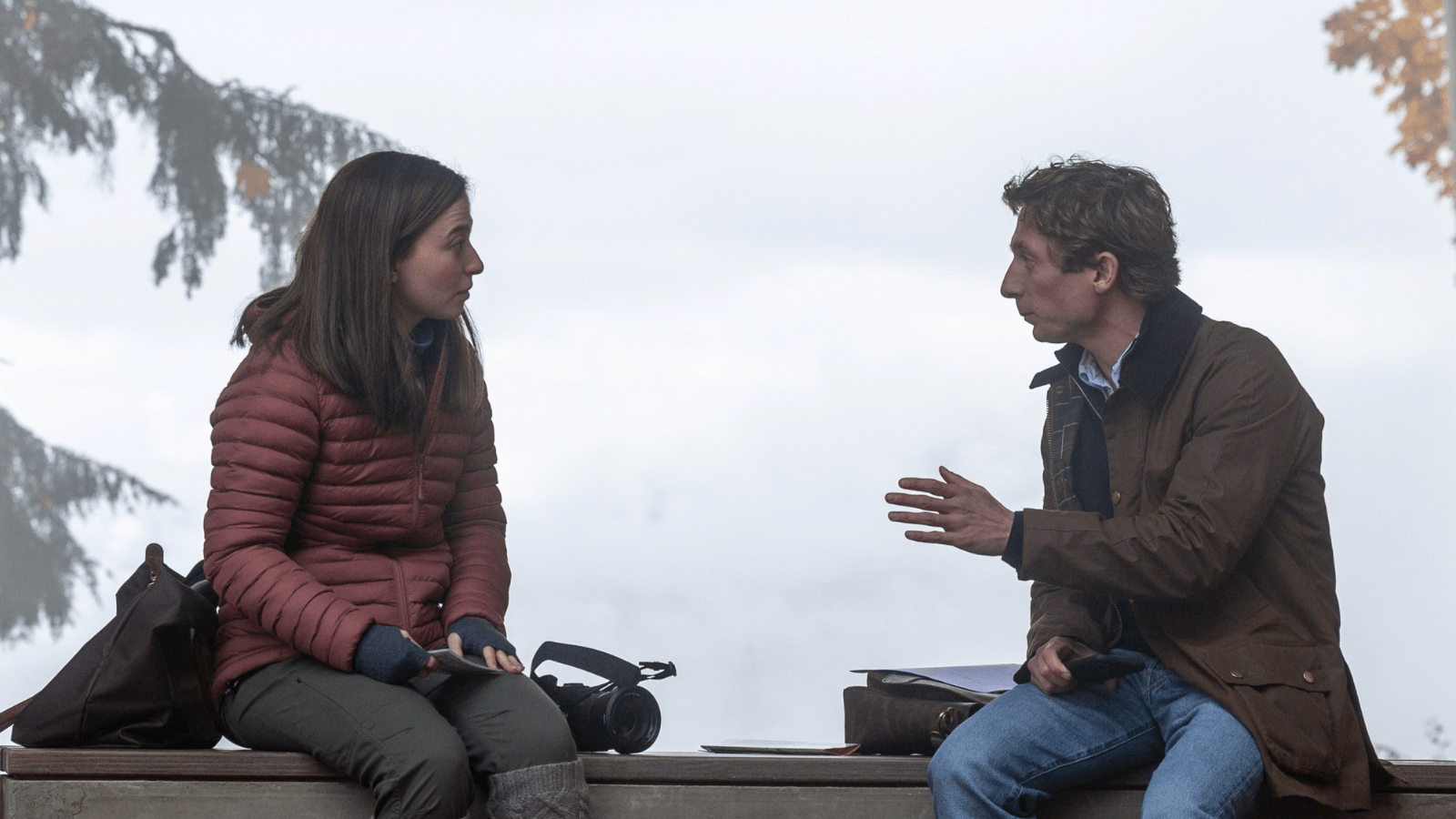
In her first role since winning an Oscar for Anora (2024), Mikey Madison plays Frances, a data engineer in Facebook’s Civil Integrity department. She’s among some of the smartest people on the planet (yet they don’t know the difference between “conscious” and “conscientious”). After seeing how the site has radicalized one of her progressive friends into a right-wing zealot, Frances uncovers some disturbing evidence that shows 64% of people who join extremist groups were sent there by Facebook’s algorithm. She attempts to raise the issue in the office, only to be dismissed and ignored (and told she needs to date more). That’s when she reaches out to Jeff Horwitz (Jeremy Allen White), a tech-illiterate reporter recently hired at the WSJ to investigate what Mark Zuckerberg calls his “corkboard” or “town square” that supports free-speech absolutism—regardless of whether those messages involve hate speech or facilitate drug cartels and human trafficking. However, Frances is hesitant to go on record or provide internal documents in breach of her NDA.
At this point in the story, Facebook has nearly three billion users and a value of a trillion dollars, so the chillingly out-of-touch Zuckerberg (Jeremy Strong) can’t be bothered to do the right thing—not even with advisors on his legal team (Wunmi Mosaku, Bill Burr) encouraging him to. Used to getting what he wants and no one daring to tell him “No,” he wants maximum engagement on Facebook, even if it means a substantial rise in negative content passed among users. Sorkin structures his screenplay nonchronologically, sliding along an on-screen timeline between 2019 and 2021, with the COVID-19 pandemic spreading in the background. He frames Frances’ work with Jeff against Zuckerberg preparing to address a subcommittee about online misinformation—scheduled for just two months after the January 6 attack on the U.S. Capitol by Trump supporters. Sorkin frames the attack as a direct result of Zuckerberg’s policy to favor “meaningful social interactions,” which one character defines as “outrage bait,” instead of the customary likes.
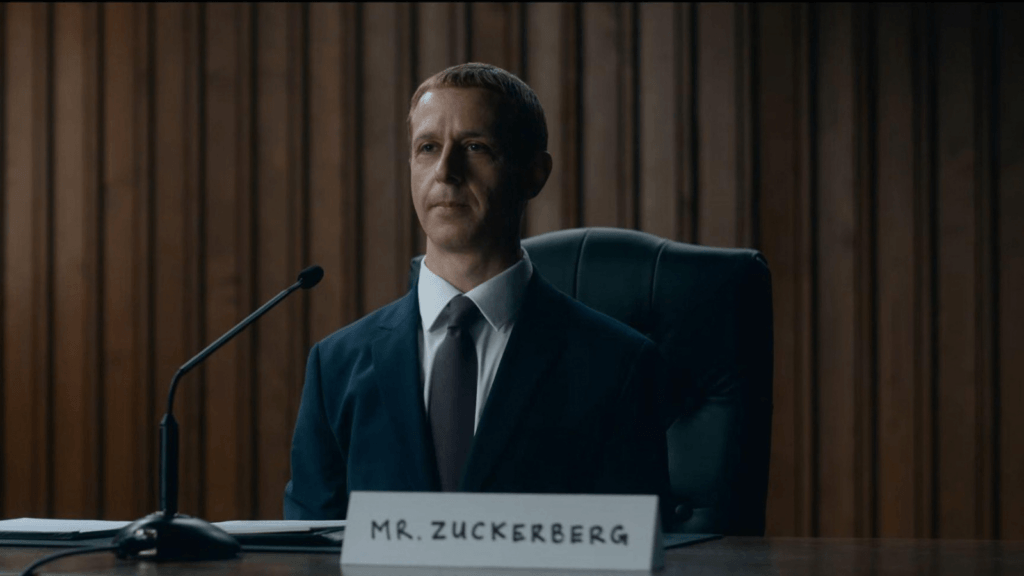
The Social Reckoning isn’t a story with three-dimensional characters or deep emotional breakthroughs like The Social Network. However, it looks similar to its predecessor thanks to cinematographer Jeff Cronenweth, who shot the earlier film for Fincher. Sorkin’s behind-the-camera talent includes editor Alan Baumgarten and composer Alexandre Desplat, neither of whom draws much attention to their competent work. Whereas Fincher’s production earned Oscars for its editors (Angus Wall and Kirk Baxter) and its composers (Trent Reznor and Atticus Ross), the technical aspects here feel less award-worthy, with a decided lack of visual or auditory style. The acting fares better. Madison goes against type as a relatively grounded individual, and White lends his commanding presence to a journalist with no apparent life outside of his work. Strong gives the showiest performance, capturing Zuckerberg’s sense of superiority and android-like body language—an empty vessel where a human used to be. Surprisingly, Burr serves as the voice of reason, playing a former colleague who isn’t afraid to confront the billionaire weirdo. Betty Gilpin and Billy Magnussen have small but memorable parts as a dogged editor and a PR slimeball, respectively.
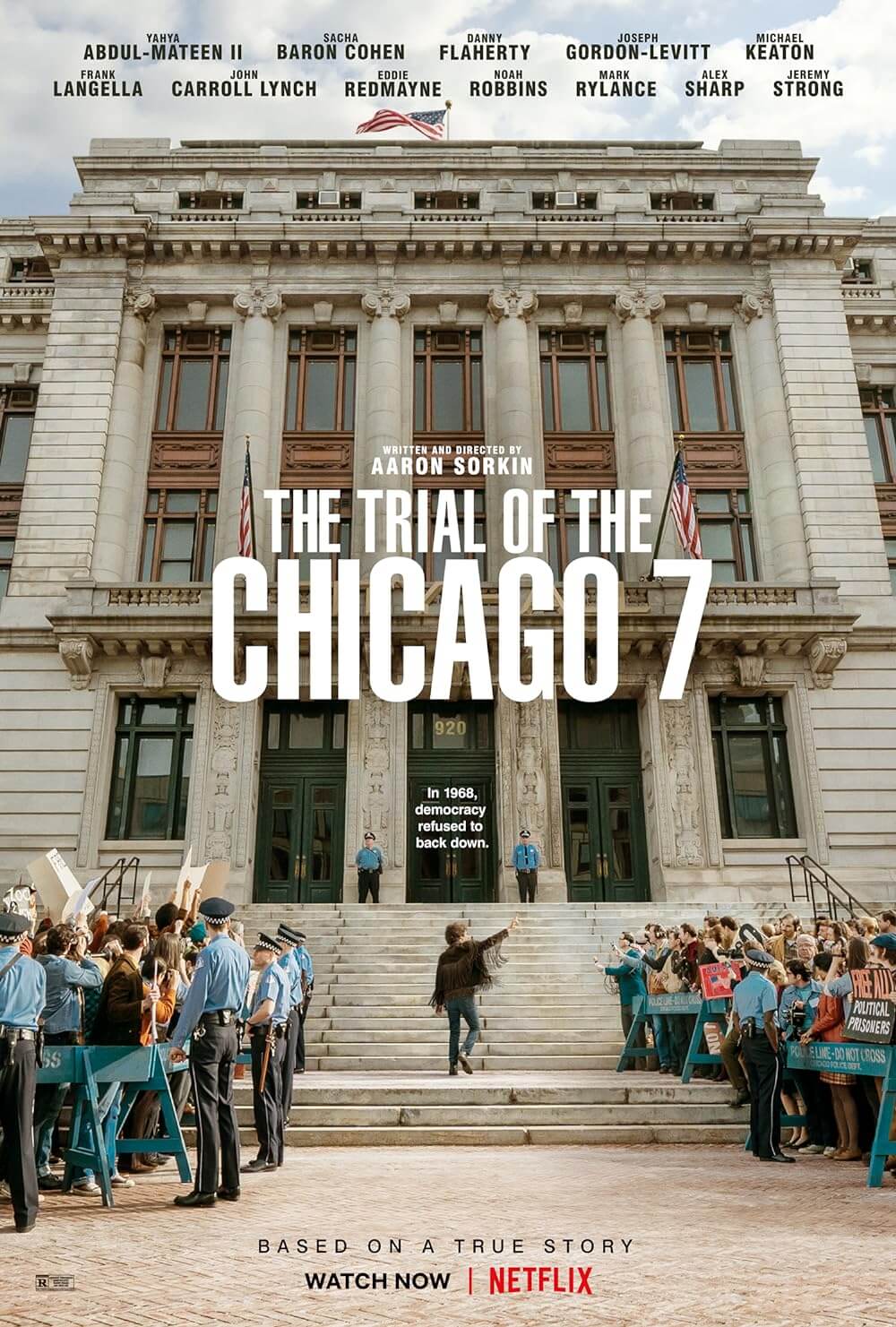
Fittingly, Sorkin takes a few notes from Frank Capra’s filmography, creating parallels between Frances’ eventual testimony before Congress and the filibuster scene from Mr. Smith Goes to Washington (1939)—or any number of other impassioned speeches in Capra pictures. It’s a perfect alignment of sensibilities, since Capra often acknowledged the rampant corruption in American business and politics. Yet, as an Italian immigrant who came to America and started at the bottom, Capra believed in the country despite its imperfections, just as Frances believes in social media’s potential to connect people. Sorkin has long been interested in characters who recognize institutional flaws in an aspirational system. His characters in The Trial of the Chicago 7 (2020) have such faith in America that they’re willing to protest and go to prison for their beliefs. And Jeff Daniels’ reporter on The Newsroom (2012-2014) declares in a superb speech that “America is not the greatest country in the world anymore,” but he believes it used to be and could be again. The prospects for Meta’s apps are decidedly less hopeful.
The Social Reckoning features an underdeveloped theme I wanted Sorkin to explore further. Jeff remains a tech skeptic. He tells Frances he doesn’t despise technology because it’s eroding print journalism; the medium doesn’t matter. Rather, he sees how the desire for clicks and engagement leads to bad reporting. When the press is compromised, either by misinformation or editorial biases by a publication’s owners, everything around it crumbles. A disturbing data point in the film’s postscript claims that 43% of adults get their news from Facebook, all of it unvetted or unverified by the company. When commentators talk about living in a post-truth world (one Facebook rep calls it a “post-government” world, suggesting the oligarchs have control), this is what they mean. The Social Reckoning shows us how we got here, with a capable execution that might have been even more effective if Sorkin’s directing had been as skilled as his screenwriting.
Thank You for Supporting Independent Film Criticism
If the work on DFR has added something meaningful to your love of movies, please consider supporting it.
Here are a few ways to show your support: make a one-time donation, join DFR’s Patreon for access to exclusive writing, or show your support in other ways.
Your contribution helps keep this site running independently. However you choose to support the site, please know that it’s appreciated.
Thank you for reading, and for making this work possible.
Brian Eggert | Critic, Founder
Deep Focus Review