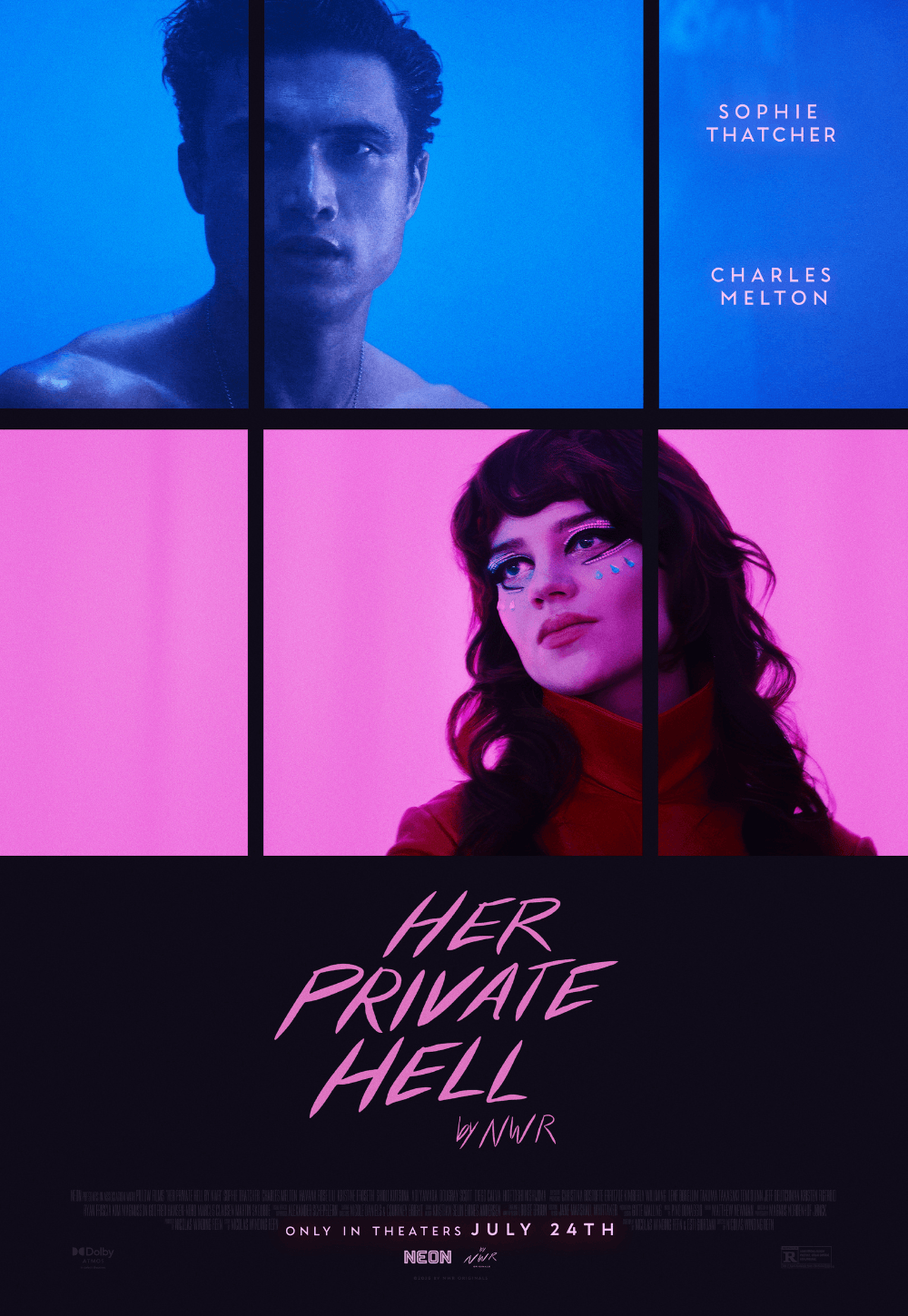
Her Private Hell
By Brian Eggert |
Nicolas Winding Refn’s provocateur shenanigans have much in common with those of his fellow Dane, Lars von Trier. Both say outlandish things to the press to draw attention to their work. Except, unlike von Trier, Refn seldom delivers films worthy of celebration or even debate. Next to von Trier, Refn’s work seems shallow, and his self-conscious style replaces drama and humor with an oppressive, obnoxious preoccupation with looking cool. In one of Refn’s most memorable antics, he once declared his underwhelming Only God Forgives (2012) to be the “greatest film ever made,” a statement he later said was meant to provoke debate. More recently, at the Cannes Film Festival premiere of Her Private Hell, his first feature since The Neon Demon (2016), Refn said he had reached the end of his creative output a few years ago. But then a 2023 medical emergency involving a “leaking heart” supposedly left him dead for 25 minutes. The director used his spurious near-death experience to frame Her Private Hell as a creative comeback made possible by a second chance from God.
With a buildup like that, Refn sets expectations for the cinematic divine. But the result of his Lazarus-like return to the director’s chair is an exceedingly dull amalgamation of his last two efforts. Her Private Hell is saturated in neon pinks and blues, with sets and costumes so ornate that they almost register as parodies of a bad arthouse film aesthetic. The story is a nonsense giallo set in a dystopian sci-fi landscape, where everyone speaks at a lethargic pace as if they’re on horse tranquilizers. Granted, most Italian gialli value style and mood over tight plotting, but they counteract the lack of story logic with thrills and escapism. Refn offers his audience no such pleasures. He has delivered a film destined to play in the background at parties, where a few moments’ glance here and there may compel a passing interest. But sitting through nearly two hours of this languid behavior and uninspired storytelling is pure tedium.
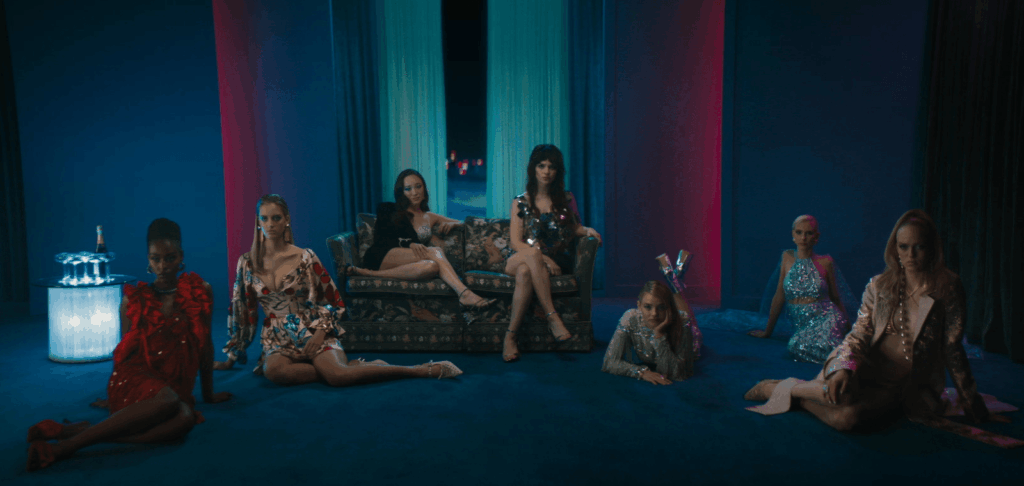
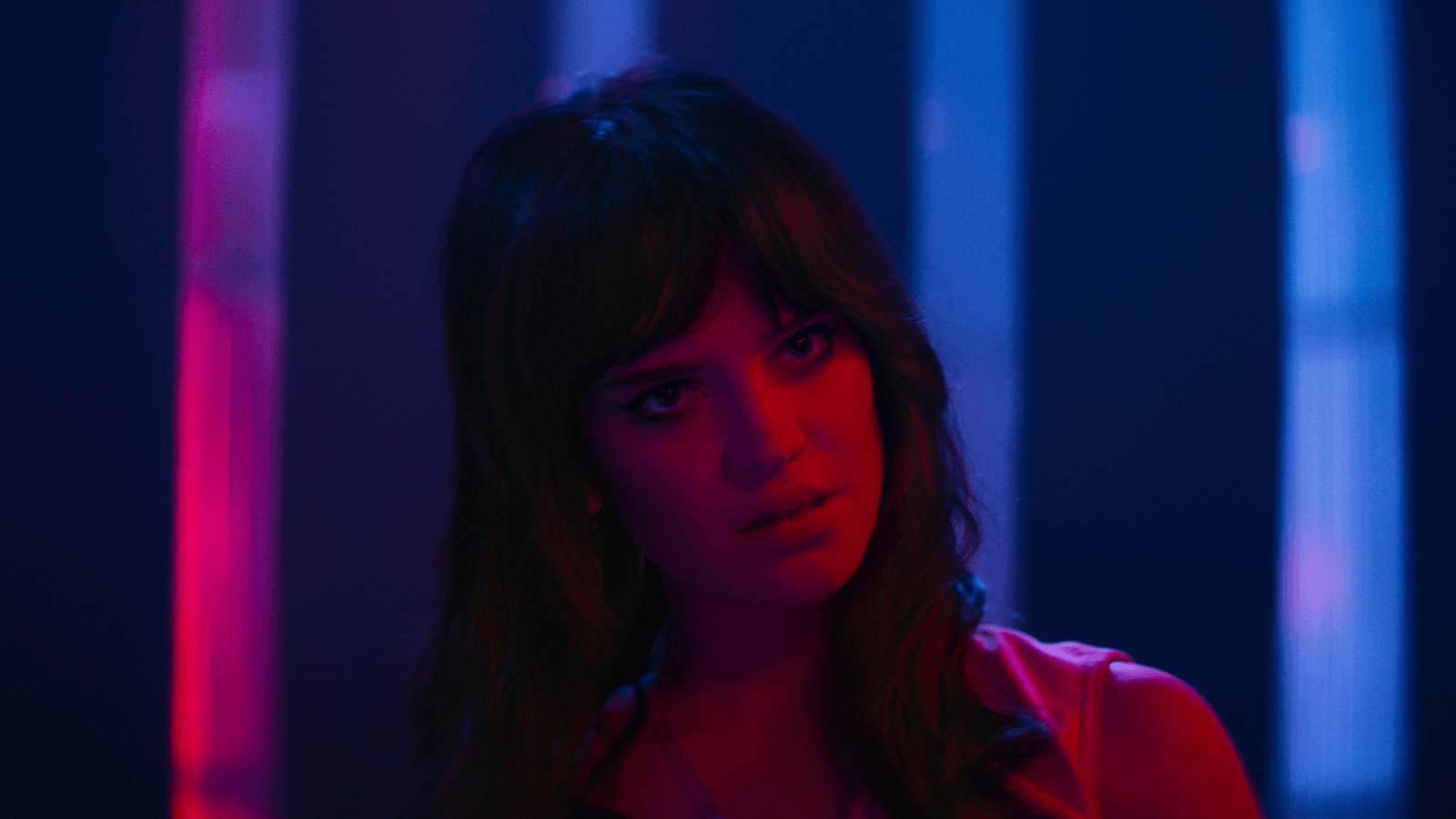
The film opens like a Silent Hill game, with a ghostly mist enshrouding an unnamed, mostly uninhabited metropolis. In this dreamlike world, the bindi-faced actress Elle (Sophie Thatcher) returns to her hotel, where she meets Hunter (Kristine Froseth). They’re collaborating on a film adaptation of a comic book called Candy Floss, a space opera that looks like a less inspired version of the original Star Trek series from the 1960s. Elle and her costars don retro costumes, replete with pointy breast cups and gaudy, shimmering makeup, and they perform their scenes on sets littered with cheap glowing crystal formations. When not acting, Elle grapples with her messed-up family dynamics. Her father, the seedy Johnny Thunders (Dougray Scott), keeps a stable of models in shimmering dresses, all of whom creepily call him “daddy.” Among them is his wife, Dominique (Havana Rose Liu), Elle’s former friend, who’s now her stepmom.
Everyone dreads the mist, which is said to herald a mysterious killer known as The Leather Man, a figure clad in a bedazzled full-body leather getup and gloves with razor-sharp diamond-studded knuckles. “Is he a ghost, a monster, a god? I don’t know,” one character reflects. The killer targets young women, bashing their heads against windows before tearing open their chest cavities in a splattery mess. Elsewhere, military man Private Kay (Charles Melton) dispenses justice against men who abuse women, his ultimate target being The Leather Man. Kay has a daughter he failed to protect, and he believes stopping the killer will somehow reunite them. Refn explores distinctly masculine and feminine worlds: the former, accented by themes of revenge, muscles, and bloody fight sequences; the latter, by dreamy dialogue, sparkly makeup and clothing, and psychosexual anxieties about friendships and family relationships. Both are riddled with embarrassing clichés.
Her Private Hell moves at an interminable pace, with characters spouting nonsensical dialogue at a speed that suggests everyone in the movie has suffered a traumatic brain injury. Not one character behaves believably, and their particular mode of expressionism leaves the viewer at a remove. Since his last good film, Drive (2011), Refn has lost any ability to capture human beings who feel alive. Instead, they register as empty “models” in the Bressonian sense, yet Refn doesn’t give them anything interesting to do. They sit around, sharing not-so-profound ideas about how they’re made of stardust and how (unseen) magical foxes lead The Leather Man to his victims. There’s also a loaded dynamic between Elle and Dominique, who share a private wolf language (don’t ask). It’s unclear whether they resent each other, want to sleep together, or both. Regardless, their relationship becomes unintentionally funny when Elle has an epic breakdown after confronting Dominique with a pair of her soiled underwear.
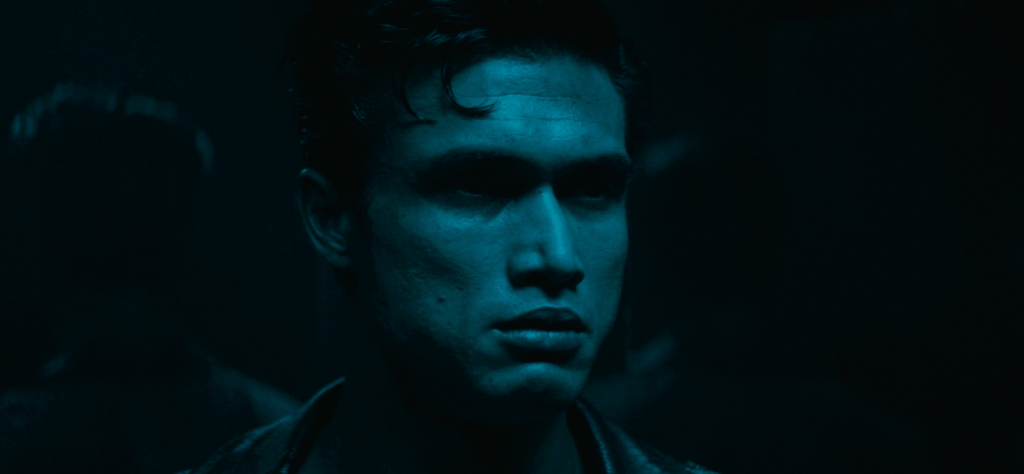
Refn at least has a knack for visual compositions and setting a mood; he just doesn’t have any compelling ideas to reinforce those skills. Cinematographer Magnus Nordenhof Jønck and editor Matthew Newman make Her Private Hell look neat, apart from the iffy CGI used to render billowing mist. Refn’s interest in surfaces extends to characters who moodily smoke cigarettes while belaboring every line reading, until the dialogue sounds stilted and unnatural. The viewer is supposed to be absorbed in the film’s soggy atmosphere and fluorescent colors. But I squirmed with impatience in my seat, annoyed by Refn’s banal characters and faux David Lynch mannerisms. One inspired note is Italian composer Pino Donaggio (a frequent collaborator with Brian De Palma), whose operatic, even melodramatic score here gives the film its personality—without it, the experience might be unwatchable.
Still, Refn has a devoted fanbase who will doubtlessly defend every choice as masterful—that of a true artist who’s either an earnest genius or a self-aware prankster. However, these labels give Refn too much credit. His film, co-written with Esti Giordani, is saddled with intermittent voiceover and no real narrative progression; neither the serial-killer subplot nor the family conflict plays out in a dramatically engaging way. The material is vapid, with incestuous overtones built into every sexual relationship and an almost fetishistic interest in Japanese culture—including the sole effective sequence in the film, when Melton’s hero tangles with a portly gangster in a well-choreographed fight. The rest is rubbish, wasting otherwise talented performers and occasionally slick visuals on a film that’s more likely to prompt a nap than any sort of meaningful emotional response.
Like DFR? Support us.
This site exists because readers like you care about film. If DFR has enriched your experience with movies, I’d be grateful for your support. You have a few options:
• Join DFR’s Patreon community
• Make a one-time donation on PayPal
• Buy me a coffee
Whatever option you choose, it helps keep my work independent. And it means a lot to me.
Thank you for reading, and for making this work possible.
Brian Eggert | Critic, Founder
Deep Focus Review