Whistle
By Brian Eggert |
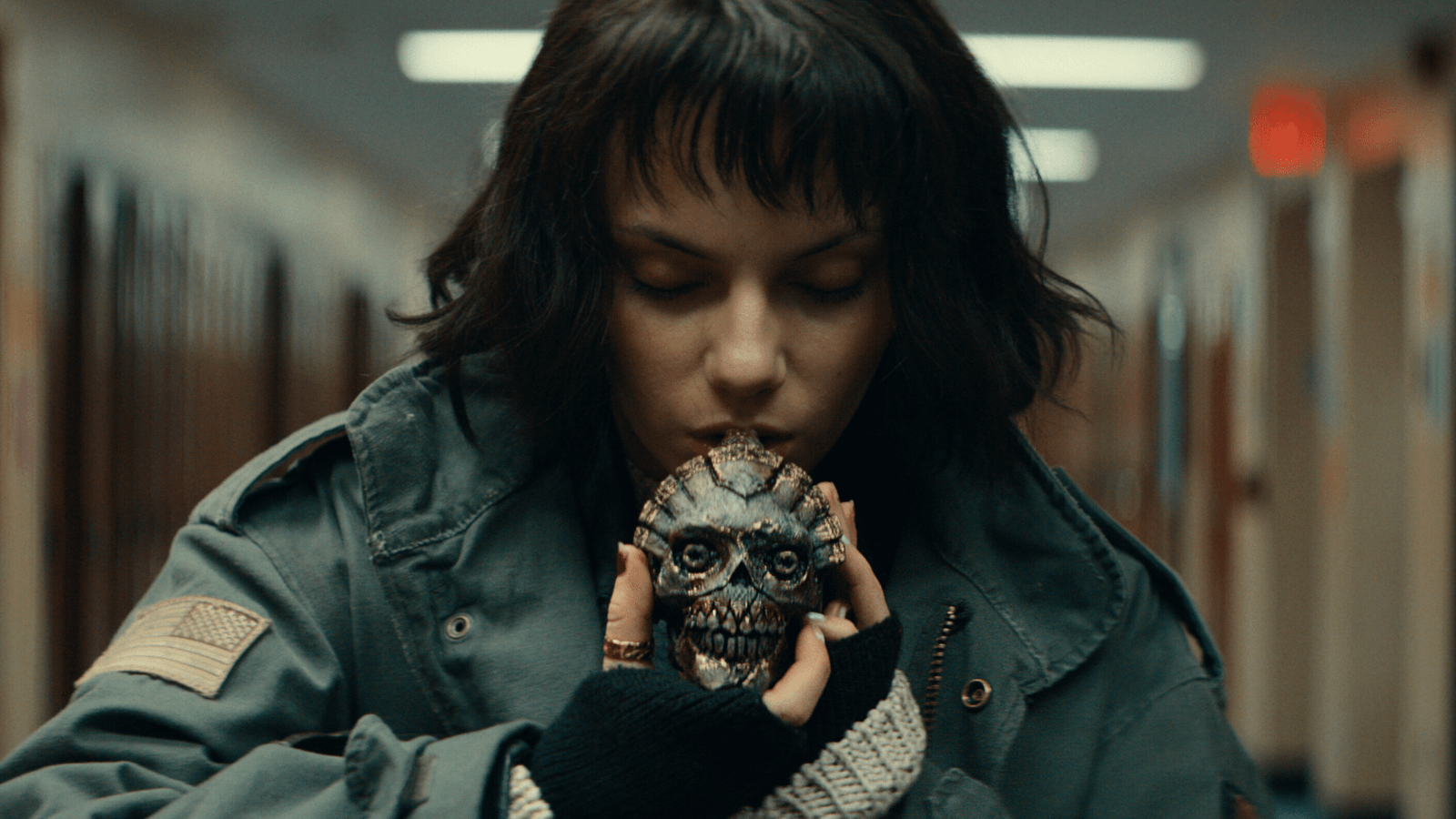
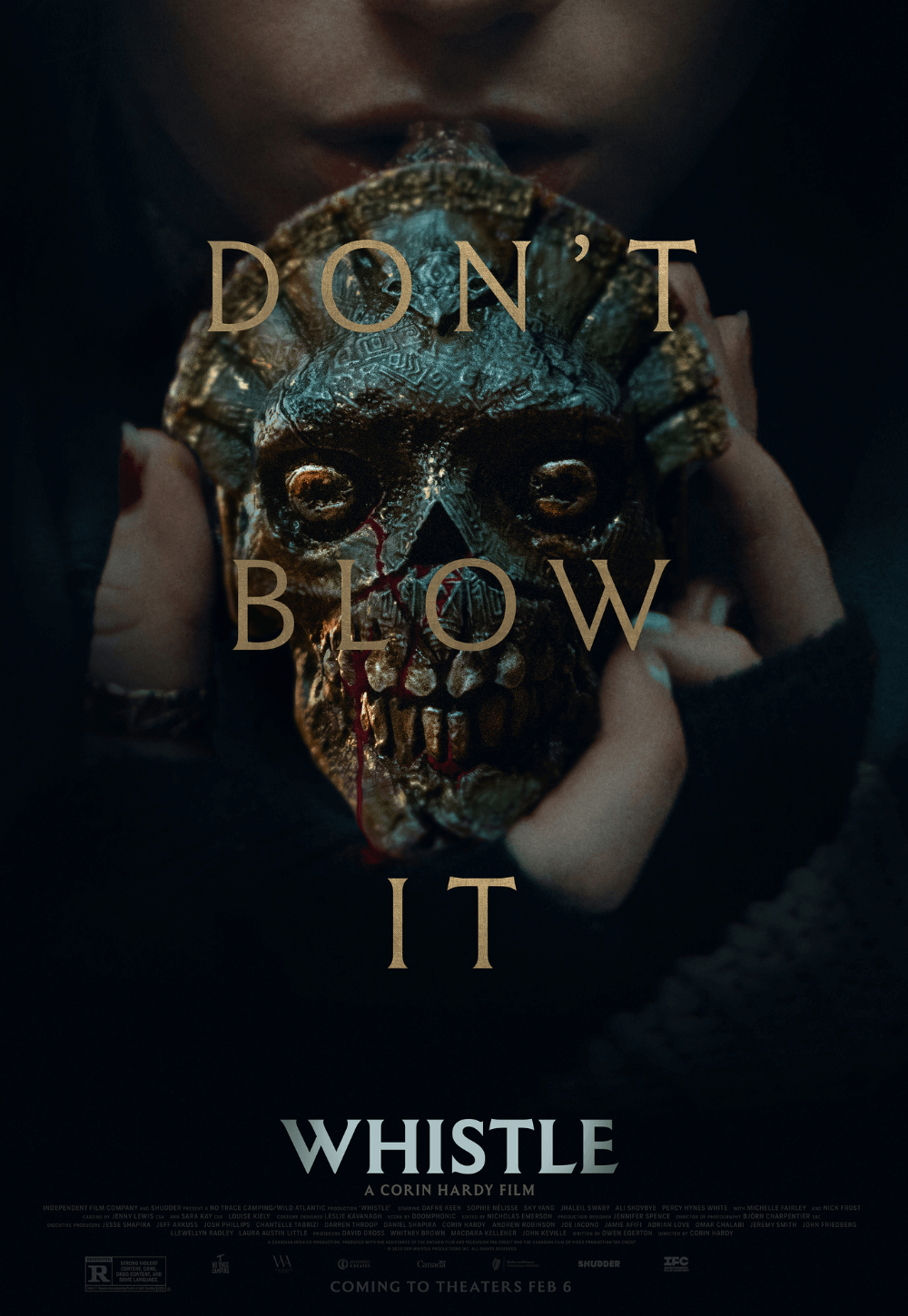
Whistle is about teens tormented by a haunted object. If you keep up with the horror genre, you’ve seen a lot of these. Sometimes, they involve an ancient religious artifact or mystical relic. See The Possession (2012), about a dybbuk box, or Talk to Me (2023), about a medium’s hand encased in plaster. Sometimes, they’re about everyday objects inhabited by some supernatural force, like the mirror in Oculus (2013) or the teens in Polaroid (2019), who discover that anyone who gets their picture taken by a cursed camera meets an early demise. Monkey paws, music boxes, videotapes—they’ve all been the source of untold evil. This film follows high schoolers who find an Aztec death whistle in a locker and, after blowing it, experience a series of premonitions about their inevitable deaths. Eventually, a specter in the form of their future self appears and brings about their scheduled death early. For instance, if a victim was slated to depart in 40 years from a heart attack, their middle-aged self would appear now and stop their heart.
Besides the aforementioned antecedents, this Canadian production has plenty in common with several other horror movies. Screenwriter Owen Egerton initially stitches together ideas from the Final Destination franchise and various cursed-object movies; later, he draws on the pass-the-curse theme of Drag Me to Hell (2009), with a hint of the voluntary-death-and-resuscitation scenario of Flatliners (1990). However derivative, at least Whistle opens with a fascinating hook. Real Aztec death whistles almost feel like Egerton invented them for this movie. Carved out of stone, they look like skulls with a small mouthpiece that, when blown, makes a horrible screaming sound. Some archaeologists believe the Aztecs used them to unnerve enemies during battle; others argue that the sound replicates not screaming, but wind to appease an Aztec deity. Either way, it’s a creepy-looking tool that, similar to the crystal skulls supposedly found in Central America, ignites the imagination.
Dafne Keen stars as Chrys, short for Chrysanthemum, a parentless teen and recovering addict. Chrys just got out of treatment, so she moves in with her cousin, Rel (Sky Yang, overacting). Grappling with feelings of guilt, loss, and the temptation to use again, she attends her first day of school and finds that her locker recently belonged to Mason (Stephen Kalyn), a jock who, in the opening sequence, finds himself stalked by a fiery figure during a basketball game. He’s later found burnt to a crisp in the shower, his death deemed a freak accident. Chrys finds an Aztec death whistle in Mason’s locker. You may wonder why, after Mason’s death, the school didn’t search or at least clean out his locker before giving Chrys access. Well, if they had, there wouldn’t be a movie. In any case, another jock, Dean (Jhaleil Swaby), gives Chrys a hard time about using his late friend’s locker, and during a hallway squabble, she and several others receive detention.
The mismatched group becomes a veritable Breakfast Club, bonding in detention over their shared interest in the whistle. Along with Chrys, Rel, and Dean, there’s the good-hearted Ellie (Sophie Nélisse), on whom Chrys has a mutual crush, and the rich girl Grace (Ali Skovbye), on whom Rel has an unrequited infatuation. Initially, their history teacher, Mr. Craven (Nick Frost), blows the whistle, and it ends badly for him. Then the whistle ends up back with the teens. They attempt to return the whistle to its owner by reaching out to Mason’s grandmother (Michelle Fairley), who is interested in memento mori from various cultures. She bought the whistle some time ago in Guatemala, and she knows all about its curse: “You didn’t find it,” she warns. “It found you.” Soon enough, Grace blows the whistle, and the fivesome learns that doing so summons their death to occur sooner than fate had planned—even though Grace blew the whistle, and the rest were only in earshot.
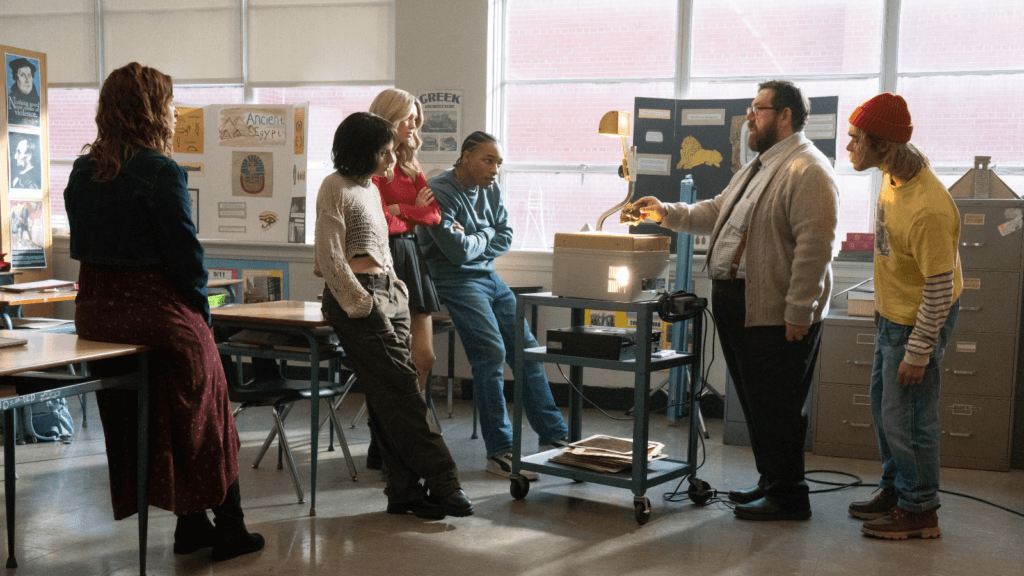
Director Corin Hardy delivers a capably shot and edited production, with creepy sequences set in a dark school hallway, a hedge maze, and an old warehouse. In some cases, the teens face a dark reflection of their own dead body from the future; in others, the threat is invisible. The deaths are particularly gnarly, and Doomphonic’s effective music accompanies each with an electronic thumping, the synth equivalent to Bernard Herrmann’s stabbing strings in the shower scene from Psycho (1960). Take a scene where the curse attacks one teen in his bedroom. Despite not seeing the source of the impact, the soundscape and the teen’s mangled body suggest a death by car accident, with a disturbing number of lacerations and smashed limbs. Another victim, who would have died in an industrial machinery accident, watches as something grinds up their flesh into a bloody mist. Eventually, Mason’s grandmother tells them to pass along the curse by marking someone else with their blood. This recalls how, in Drag Me to Hell—a variation on a theme established in Night of the Demon (1957)—the target must hand off the curse to someone else to survive. And sure enough, the teens plan to give their curse to Noah (Percy Hynes White), a drug-dealing, switchblade-carrying youth pastor.
Admittedly, this breed of supernatural horror seldom works for me, since, with few exceptions, its entries are often clunkily assembled. Whistle benefits from Hardy’s assured direction, a vast improvement over his efforts on The Nun (2018). The cinematography by Björn Charpentier has atmosphere to spare, especially inside an impressive Harvest Festival setting, where Grace comes face-to-face with a twitchy, elderly version of herself, played by a woman in a prosthetic suit who climbs on walls and, confusingly, performs various acrobatics. The specters’ behavior isn’t consistent, which left me confused about the movie’s rules. Still, along with Nick Emerson’s cohesive editing, it’s a generally solid technical presentation, apart from some questionable hair and makeup choices. The young cast is uneven. Keen, who was excellent in Logan (2017) and the BBC’s His Dark Materials series, is serviceable but no longer has the spark she had as a child actor.
It’s not exactly clear to me why the Aztec god torments its victims, nor can I explain why the death whistle targets high school kids. Perhaps it’s revenge for taking a cultural relic out of Central America, or perhaps it’s as Mason’s grandmother claims, and the Aztec god inhabiting the whistle simply wants to collect souls. Whatever the motivation, the movie rests on a flimsy story logic. Along with the ending’s cornball narration, with its tacked-on theme about embracing this moment, there’s not much driving Whistle. But for those who like a good death scene, this movie has several of them, making it worthwhile for those moments but not altogether satisfying as a whole. Whistle isn’t a great horror movie, but there’s enough here to admire for those curious.
Thank You for Supporting Independent Film Criticism
If the work on DFR has added something meaningful to your love of movies, please consider supporting it.
Here are a few ways to show your support: make a one-time donation, join DFR’s Patreon for access to exclusive writing, or show your support in other ways.
Your contribution helps keep this site running independently. However you choose to support the site, please know that it’s appreciated.
Thank you for reading, and for making this work possible.
Brian Eggert | Critic, Founder
Deep Focus Review