undertone
By Brian Eggert |
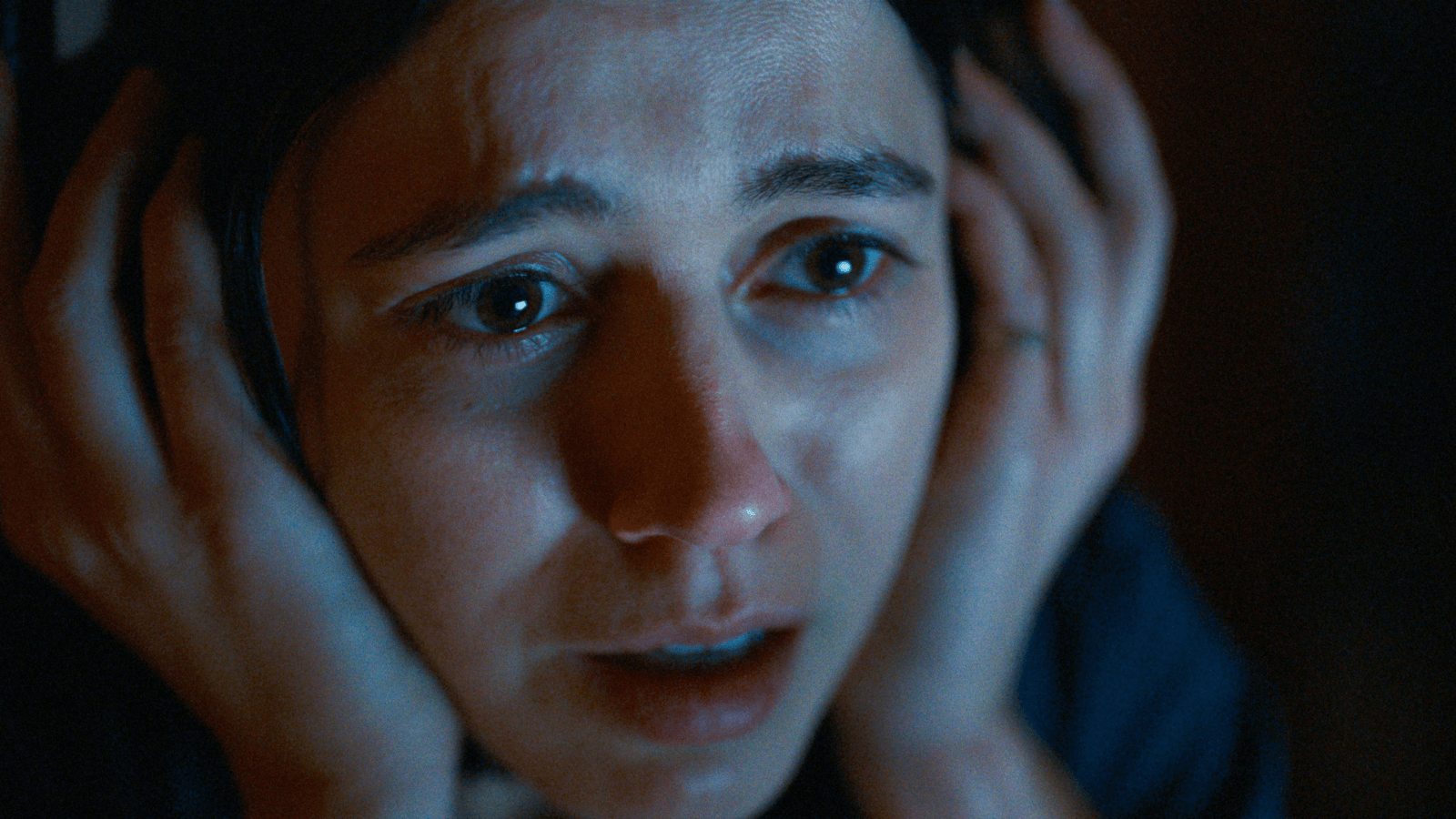
Creepy children singing nursery rhymes. Mysterious audio recordings. Unexplained flickering lights. Investigations of weird sounds at night. A general aversion to well-lit rooms. Demonic forces that prey on women. Bizarre religious iconography. Grief and trauma. Writer-director Ian Tuason makes his feature debut with undertone, which combines every gimmick in the supernatural horror playbook with a desire to become so-called elevated horror. Picked up for distribution by A24 after debuting at last year’s Fantasia International Film Festival, the Canadian production is a delivery system for jump scares and an unnerving soundscape. It has much in common with movies such as The Blair Witch Project (1999) and Paranormal Activity (2009), given that it’s a low-budget production about amateur paranormal investigators seeking answers. And like those examples, undertone builds unbearable tension that leads to a deflating, unsatisfying conclusion.
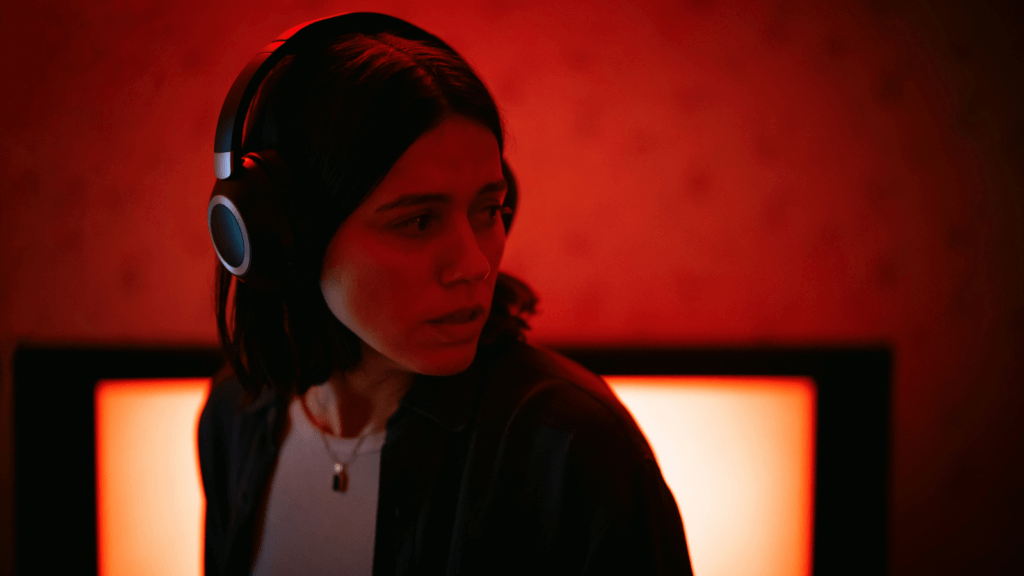
Tuason, recently hired by Blumhouse to reboot the Paranormal Activity franchise, draws from familiar sources, as though engineering a movie for maximum scares. His scenario follows Evy (Nina Kiri), a podcaster who co-hosts a show called The Undertone with her London-based friend Justin (Adam DiMarco). Given the time difference, they meet at 3 a.m. for her, listen to hair-raising audio recordings akin to YouTube creepypasta videos, and then debate whether they’re genuine or a hoax. She’s the skeptic, a voice of logic and reason. He’s the true believer. Their latest episode is recorded while Evy looks after her dying mother (Michèle Duquet), who remains unresponsive in an upstairs bedroom and could pass at any time. Evy tries to stay focused on the show to distract from her anticipatory grief, but their new case has several alarming parallels to her life.
Justin has received ten audio files from an unknown sender. Played in sequence over several nights during the movie’s 85-minute runtime, they involve a guy named Mike (Jeff Yung) who records overnight audio of his girlfriend Jessa (Keana Lyn Bastidas) to prove that she talks in her sleep. What Evy and Justin hear leads to an investigation into the disturbing origins of the songs “London Bridge” and “Baa Baa Black Sheep,” including how they sound when played in reverse. After some research (on Wikipedia and driven by confirmation bias), Justin believes the audio may be related to stories of children disappearing and expecting mothers tormented by a demon named Abyzou. The demon, also the subject of The Possession (2012) and The Offering (2022), is drawn from actual folklore across various cultures, dating back to the ancient Greeks and Egyptians. Of course, the demon and audio files somehow connect to Evy’s curious relationship with her mother, whom she calls “Mama” like a toddler, and Evy’s realization that she may be pregnant.
For much of the first two-thirds of undertone, Tuason raises the terror quotient by gradually laying out pieces of the puzzle, which we assume will eventually compose a full picture—a revelation or profound understanding that explains why these events have transpired. And in a way, it does. But it also leads to one of those abrupt endings that left me scratching my head and unsure of what just happened. The screen goes black. We hear a jumble of scary sounds. And that’s it. Tuason resists the need to explain every detail, relying instead on abstract dream logic. The choice gives him the freedom to explore uncanny soundscapes and nightmare imagery, which echo Evy’s anxiety about her pregnancy and her mother’s impending death, along with stress from her unreliable boyfriend and sudden relapse into alcoholism. There’s also her automatic drawing with crayons to consider. She unconsciously scribbles in black and red to create a collage that, when assembled, reveals a freaky image.
Formally, Tuason’s presentation is, for the most part, controlled. He and cinematographer Graham Beasley set up deliberate compositions that invite us to explore the space around Evy, who, besides her mother and a brief appearance by a nurse, is the sole person onscreen. The dark hallway behind her, the empty room she sits in—something always seems to be lingering there, even when there isn’t. Beasley’s camera also employs several tilts to create an off-kilter sensation, but its calculated movements have a distracting rather than immersive self-conscious style. Shanika Lewis-Waddell’s music is less a traditional score than a series of tones, pulses, and ambient sounds. More effective is Tuason’s sound design, which he augments to emphasize every shuffle or creak, from footsteps to room noise, until Evy puts on her noise-canceling headphones and all the audio goes silent. Sound also fills Evy’s home with loud booms and scratchy voices that say unintelligible things. The viewer cannot help but react, mostly because these sounds pierce our eardrums and prompt an involuntary jolt response to a scare delivered with an audio zing.
Whatever the aural antithesis of ASMR is called, undertone is that. And while the movie is undeniably frightening in its audiovisual techniques, I wanted more from this underwhelming story. Tuason seems to have something to say about faith, motherhood, caregiving, guilt, religious devotion or lack thereof, and pregnancy. His movie might even belong in a category of recent horror films about women’s fear of losing bodily autonomy, alongside False Positive (2021), Immaculate (2024), The First Omen (2024), and Fetus (2025). However, none of his ideas congealed into a sturdy narrative foundation that moved me, apart from not wanting to see (or hear) Evy succumb to the evil forces at work. But for those who value a spooky experience over a fully developed story, undertone will give you the willies.
Thank You for Supporting Independent Film Criticism
If the work on DFR has added something meaningful to your love of movies, please consider supporting it.
Here are a few ways to show your support: make a one-time donation, join DFR’s Patreon for access to exclusive writing, or show your support in other ways.
Your contribution helps keep this site running independently. However you choose to support the site, please know that it’s appreciated.
Thank you for reading, and for making this work possible.
Brian Eggert | Critic, Founder
Deep Focus Review