The Testament of Ann Lee
By Brian Eggert |
Note: This review was originally published on November 25, 2025. It has been re-posted in advance of its expanded release on January 23, 2026.
The Testament of Ann Lee is an intrepid work of speculative fiction about the religious leader of the Shakers, a Christian sect founded in mid-eighteenth-century England, which fizzled out shortly after relocating to pre-revolutionary America. The movement started as an offshoot of Quakerism, but it was distinguished by followers who trembled in religious ecstasy. The so-called Shaking Quakers became Shakers (and later a mouthful, the United Society of Believers in Christ’s Second Appearing), a belief system all but forgotten and unpracticed today—except by its two current members, according to the film. As Christian sects go, the utopian Shaker belief system has some intriguing values. They champion gender equality, pacifism, and harmonious living with the environment; however, they also demand celibacy from their members. Amanda Seyfried stars as Ann, whom the authorities in New England at the time accused of witchcraft and treason—in part because the Shakers believed her to be the second coming of Christ (and it was heretical to think a woman could fill such a role), and in part because she refused to support the violence of the Revolutionary War.
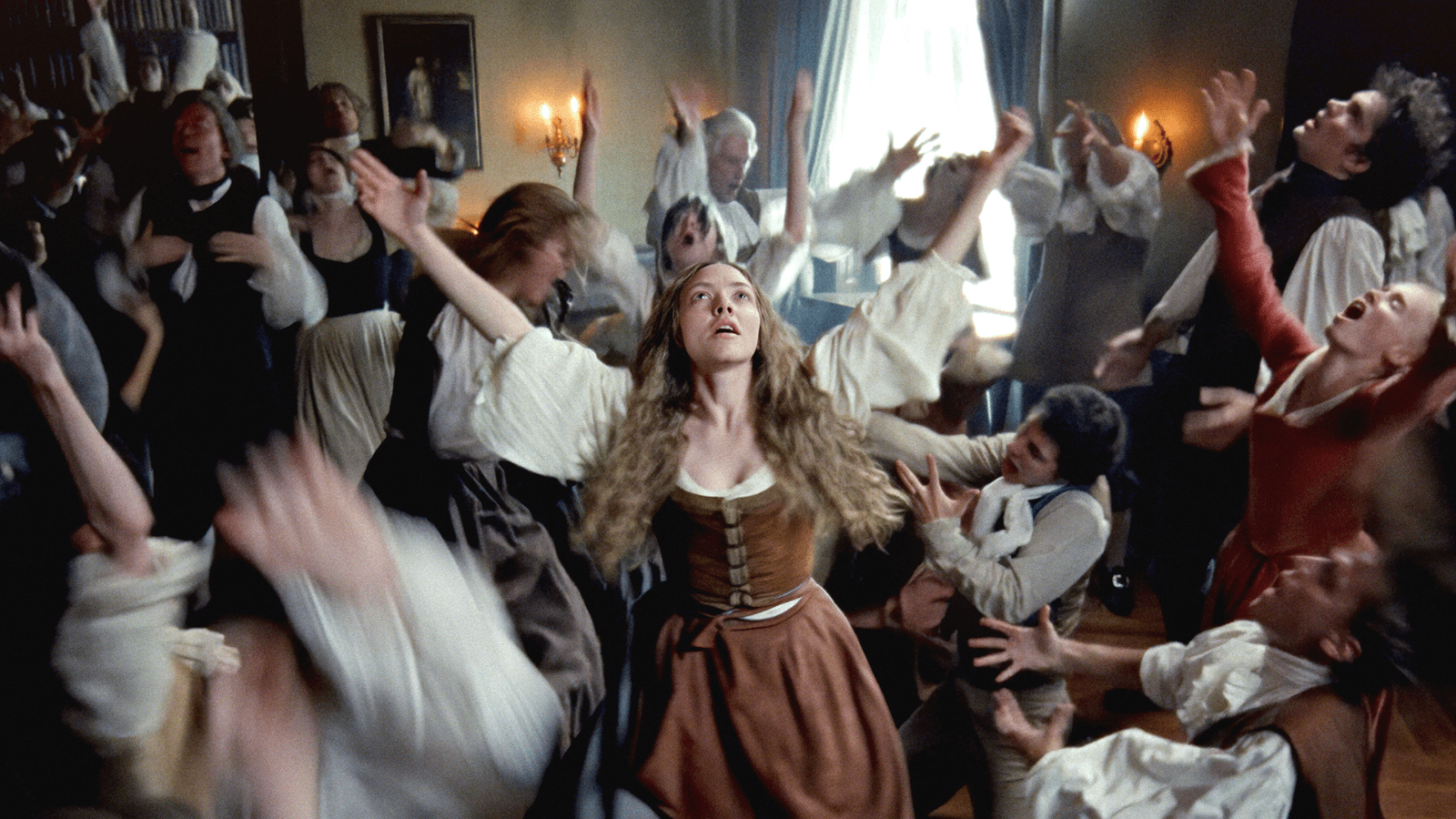
Directed by Mona Fastvold, who co-wrote the picture with her partner Brady Corbet—helmer of last year’s The Brutalist, an astounding human epic—The Testament of Ann Lee adopts a bold vision and uncompromising artistic ambitions. Tackling the subject head-on would be challenging enough; Fastvold and Corbet go even further, turning the material into a musical. However, it’s not the sort of Hollywood musical moviegoers are accustomed to seeing, where music, lyrics, and dancing mark a fanciful break from reality with a catchy tune. The film’s musical scenes feature Ann Lee and her fellow Shakers, inspired by religious passion, singing melodic, hymn-like refrains of gratitude and worship. Written by composer Daniel Blumberg, they often consist of repeated lyrics or tonal nonwords. The Shakers dance not in synchronous choreography reminiscent of a classical Broadway musical but engage in rapturous flailing or arm gestures, recalling the movements in Netflix’s The OA. Indeed, to claim The Testament of Ann Lee breaks from traditional musical format is an understatement, and the genre description might even be deceptive for the images it conjures.
Seyfried gives a passionate performance as Ann, about whom there’s so little known that the character, as written by Fastvold and Corbet, feels compelled by little more than her zealous devotion. Early in the proceedings, set in Manchester, we learn the source of Ann’s trauma that later fueled her commitment to abstinence. First, the young Ann sees her parents having sex, and she recoils at the sight of this. Years later, as an adult open to a Protestant alternative, she quickly adopts the Shaker views and behaviors when she learns about their sect, particularly their belief that God must be male and female. Therefore, the second coming could also manifest as a woman. She’s joined in the Shaker faith by her inseparable brother, William (Lewis Pullman), and close friend, Mary (Thomasin McKenzie), the story’s narrator. Around this time, Ann marries Abraham (Christopher Abbott), who, inspired by a different kind of text, introduces Ann to light S&M and various other forms of “fornication.” Their bedroom adventures result in four pregnancies and as many dead infants. It’s punishment, she believes, for her “sexual sin.”
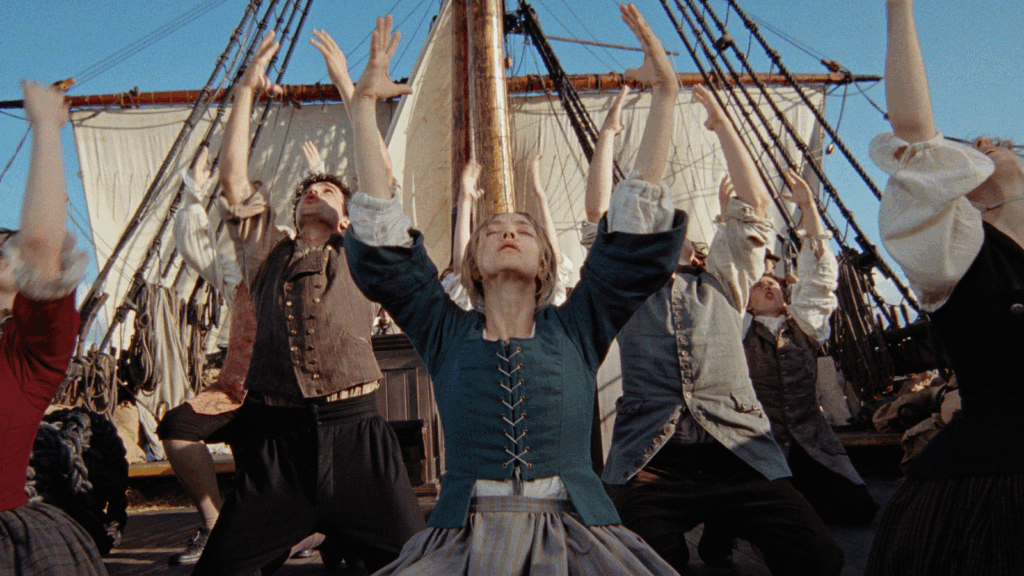
Ann soon begins preaching in Manchester, and she causes enough fervor that authorities persecute and arrest her. But then something miraculous happens while she’s imprisoned: she levitates, grows some downy fur on her arms for some unexplained reason, and sees visions. After declaring her the second coming, the Shakers call her “Mother” and remain unwavering in their devotion. Ann vows celibacy and encourages Will to do the same, requiring him to abandon his secret gay lover. Soon, the religious persecution in Manchester prompts their group to start over in the New World, in the isolated Watervliet, New York, in what is Albany County today. In one of the film’s few humorous musical sequences, the Shaker’s financial backer, John Hocknell (David Cale), races through the forest toward the future spot of their settlement, his arm outstretched, as though a spirit pulled him by the finger toward their destination. To be sure, every lucky break in their travels becomes a sign; every choice Ann makes has been ordained.
Running over two hours, the film settles into a tonal sameness about halfway through, as though Fastvold found the harmonic register of the Shaker belief system and never wavers from that heightened perspective. The effect may be immersive for some; I found it rather monotonous, though fascinating from a historical perspective. Little about the characters connects on the emotional front, apart from the injustice of what happens to the Shakers. Their fanaticism kept me both intrigued and at a remove, which is how I often feel watching people caught up in a spiritual frenzy. Regardless, this is a handsome and admirable production that’s sure to garner Oscar consideration in multiple technical and craft categories. Cinematographer William Rexer shoots on 35 mm celluloid, with earthy colors and atmosphere, reminding viewers that there’s really no comparison to the luminous, textured beauty of the photochemical process. Production designer Sam Bader and costume designer Malgorzata Karpiuk’s period garb will surely earn Oscar consideration, as will the winding and hypnotic score by Blumberg.
In the end, The Testament of Ann Lee doubles as a portrait of Shakerism and a commentary on American intolerance. Motivated by Protestant doctrine and tradition, the authorities imprison Ann and torment her followers for their differing views. Maybe Ann was the second coming, but we’ll never know because those in power stomped her out. Doubtless, if Jesus came back today, and he defended the “blessed” poor, censured the rich, and advocated for greeting strangers and immigrants with a welcoming generosity, he’d probably be deemed a hoax by those clinging to their power and then arrested by ICE based on his skin color. Much like Corbet’s The Brutalist, Fastvold depicts America as a land that doesn’t practice the religious freedom it preaches and behaves cruelly toward outsiders. Commentary aside, this is an extraordinarily well-made picture, anchored by Seyfried’s committed performance, and it should be witnessed on a large-format screen. However, my enthusiasm for the material was muted and hardly reached the levels of Shaker zealotry.
Thank You for Supporting Independent Film Criticism
If the work on DFR has added something meaningful to your love of movies, please consider supporting it.
Here are a few ways to show your support: make a one-time donation, join DFR’s Patreon for access to exclusive writing, or show your support in other ways.
Your contribution helps keep this site running independently. However you choose to support the site, please know that it’s appreciated.
Thank you for reading, and for making this work possible.
Brian Eggert | Critic, Founder
Deep Focus Review