Reader's Choice
Lady of Burlesque
By Brian Eggert |
Lady of Burlesque’s opening titles describe the story as taking place “Along the Great White Way, before the lights went out.” This refers to Broadway’s Theater District during World War II, when the US Army ordered “dim-outs” in New York City in the event of air raids. Throughout the war years, theater owners shut down their marquees, and advertisers turned off their billboards in Times Square, both as a power-conservation measure and as a preemptive defense against enemy attacks. The titles signal the 1943 feature’s conversation with the recent past, dramatizing a period that moviegoers living through the war may have regarded as “simpler times.” By design, Lady of Burlesque is an entertaining programmer, even somewhat frivolous. Although it’s a backstage murder mystery involving comedians, singers, stagehands, and a string of dead performers, it’s also a comedy and a romance, offering its audience a funny and often borderline bawdy escape from wartime dread.
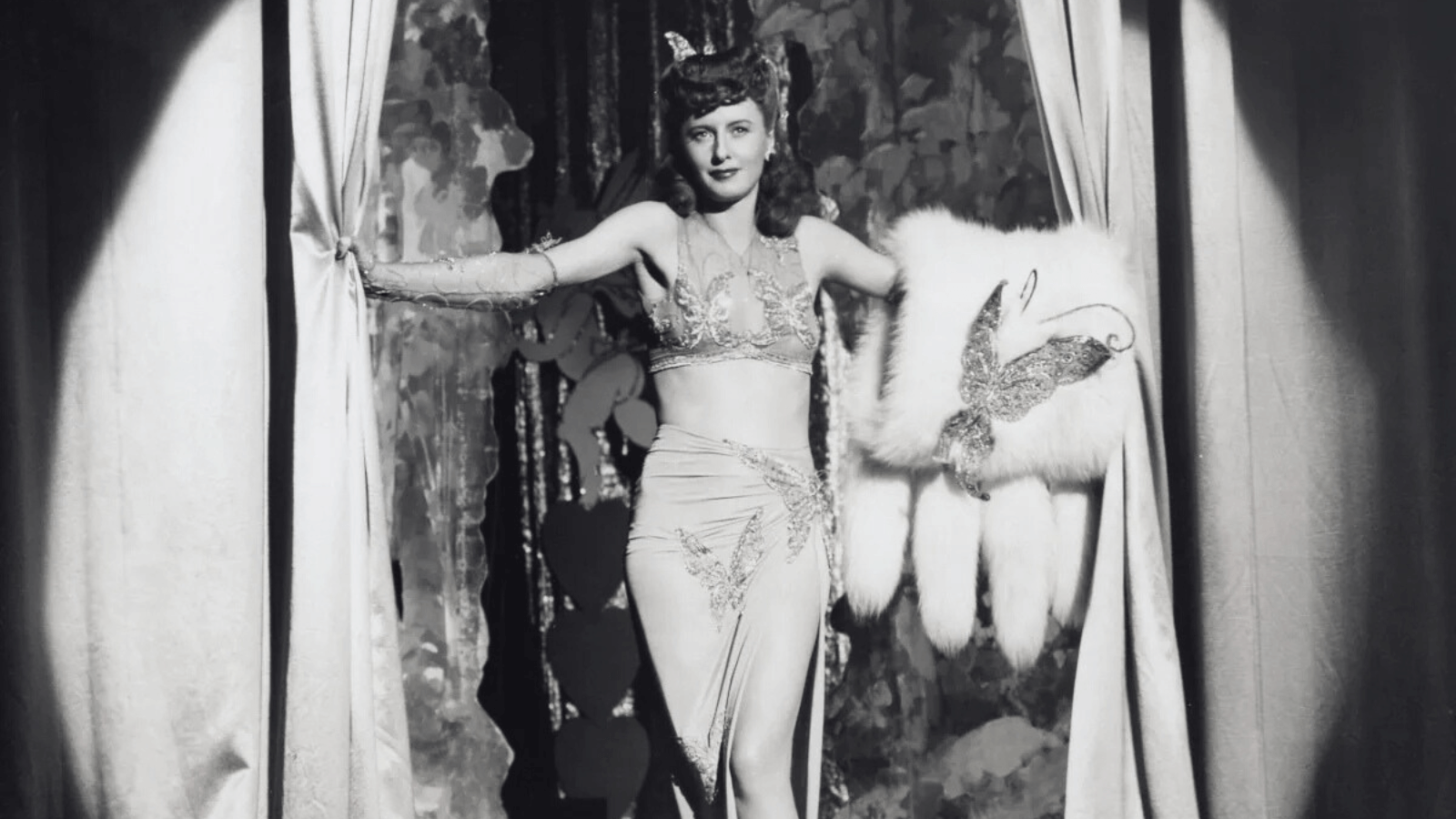
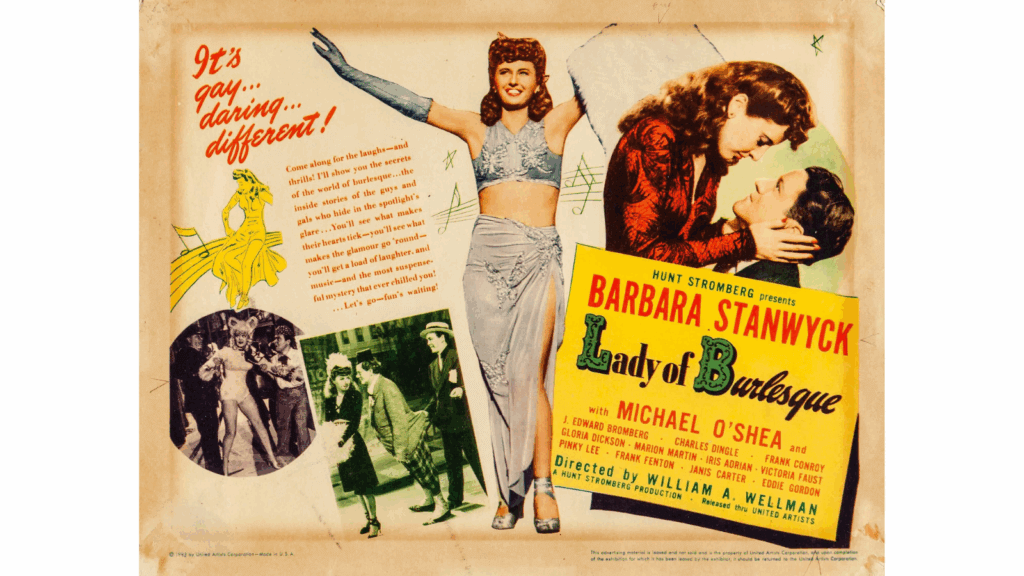
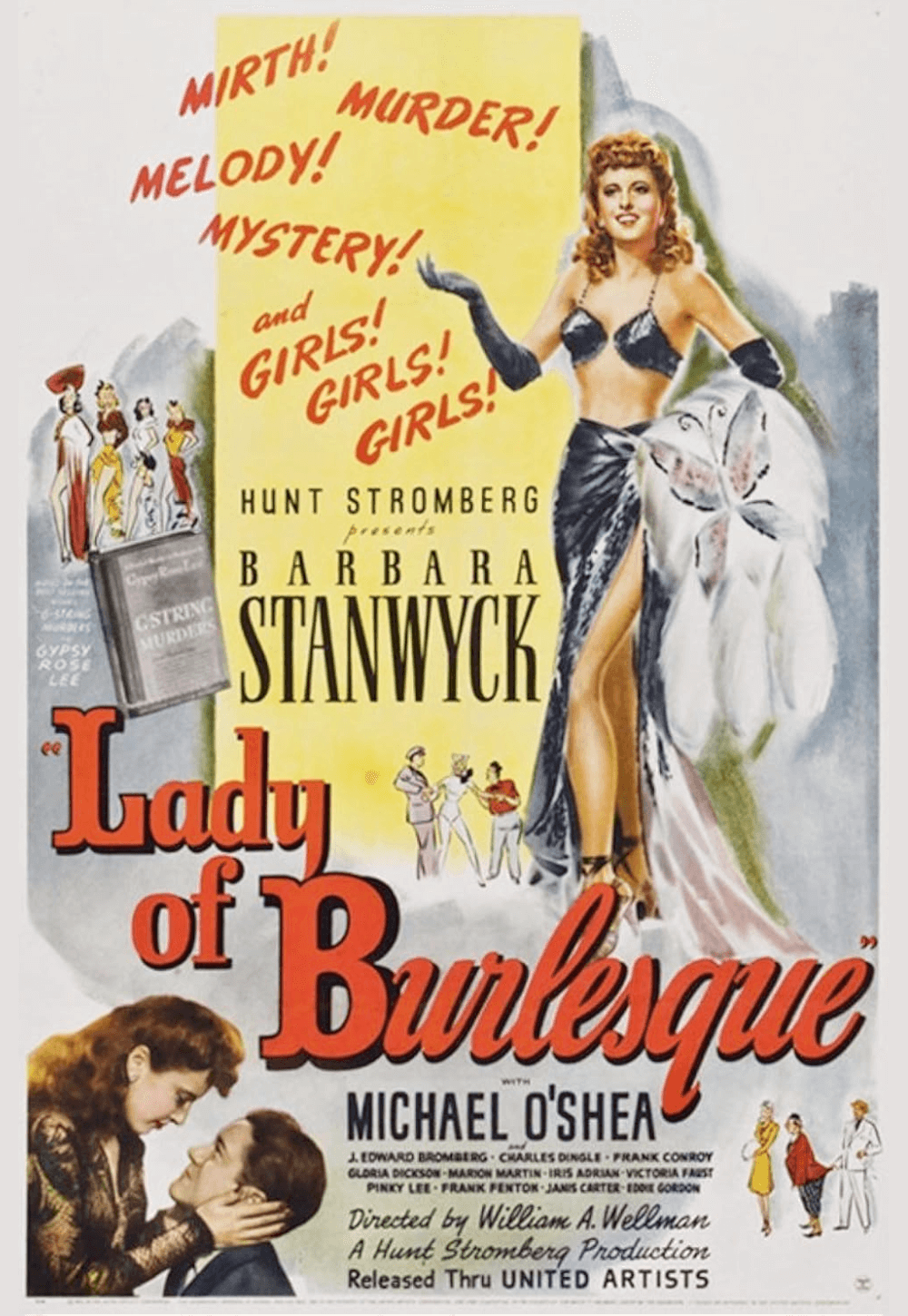
Barbara Stanwyck headlines the picture as Dixie Daisy, the new star at S. B. Foss’ Old Opera House, a famous nightspot for burlesque dancers and variety shows. She appears in several routines, including comic acts with her flirtatious clown counterpart, Biff Brannigan (Michael O’Shea). But her centerpiece is “Take It Off the E String, Play It on the G String,” a dishy ditty by Sammy Cahn and Harry Akst that alludes to the film’s central murder weapon. Indeed, the basis of James Gunn’s screenplay is Gypsy Rose Lee’s novel The G-String Murders. Gunn (no relation to the superhero movie director) remains an uncelebrated writer of B-movies who would collaborate again with Stanwyck on Douglas Sirk’s All I Desire (1953). William A. Wellman directed Gunn’s screenplay for United Artists and independent producer Hunt Stromberg—who was no stranger to the comic murder mystery genre, having produced The Thin Man series at Metro-Goldwyn-Mayer.
Lady of Burlesque was the brainchild of Gypsy Rose Lee, a popular mid-twentieth-century figure known for her distinct blend of sex appeal and smarts. Born in 1911, she was pushed to the stage at age four by her mother-manager, “Madam” Rose Thompson Hovick, and performed opposite her sister, who later became actress June Havoc. Gypsy Rose featured in burlesque shows and stripteases in Kansas City in 1929, before making her Broadway debut in Madam Rose’s Dancing Daughters alongside June. After a successful run of stage appearances, including Ziegfield Follies, she began touring the United States and Canada in variety acts in the 1930s, all the while contributing sophisticated, witty print pieces to Cosmopolitan, Harper’s Magazine, and The New Yorker. An entertaining writer and scenarist, Gypsy Rose sold her first novel, The G-String Murders, in 1941, and it became a bestseller. She later wrote the autobiographical Gypsy: A Memoir (1957), which supplied the basis for the 1959 stage musical and 1962 film, the latter starring Natalie Wood and Rosalind Russell.
Lady of Burlesque’s star had a career trajectory similar to that of Gypsy Rose Lee. Born Ruby Stevens in 1907, Barbara Stanwyck’s mother died when she was young. Her father abandoned the family shortly thereafter, leaving her to be raised by her sister and the foster system before she took to the stage at 13. Like Lee, Stanwyck also performed in Ziegfeld Follies and acted on Broadway. But it was her performance in the 1927 stage production Burlesque that earned her the attention of Hollywood. With a few minor roles in negligible pictures to her credit, she finally broke out in Frank Capra’s Ladies of Leisure (1930), followed by pre-Code dramas such as Baby Face (1933) and Forbidden (1932). Her stardom rose even further in the 1940s with her roles in Preston Sturges’ The Lady Eve and Capra’s Meet John Doe, both released in 1941, and then Billy Wilder’s Double Indemnity (1944), in which she played perhaps the most iconic femme fatale in movie history. During this time, she collaborated with director William A. Wellman on several projects, starting with Night Nurse (1931), then The Purchase Price and So Big! in 1932, and The Great Man’s Lady (1941). Their final collaboration on a feature film would be Lady of Burlesque.
Stanwyck looks comfortable in such familiar territory, dancing to a live orchestra in slinky getups. Dixie and the other women of the Old Opera House perform synchronized dance numbers with winks, giggles, and crinkled noses at the suited, whistling men in the audience. But they’re downright tame next to Dixie. “Come on and give me heat,” she sings, “’Cause I don’t like my music sweet. I want to feel my impulse beat.” Whatever the temperature, she turns it up. As she performs, Biff flirts with her offstage in saucy dialogue. Dixie doesn’t have time for his advances; she’s too intelligent, independent, and in control of her sex appeal to fall for him—initially, anyway. Plus, he’s a comedian, which she views as the lowest rung on the burlesque social ladder. Dixie can sing, dance, and perform cartwheels on stage, and so can Stanwyck. Her performance recalls a period when actors learned everything from high drama to song-and-dance skills on the vaudeville stage. Those skills meant they could perform in any material. Few of today’s performers can say the same.
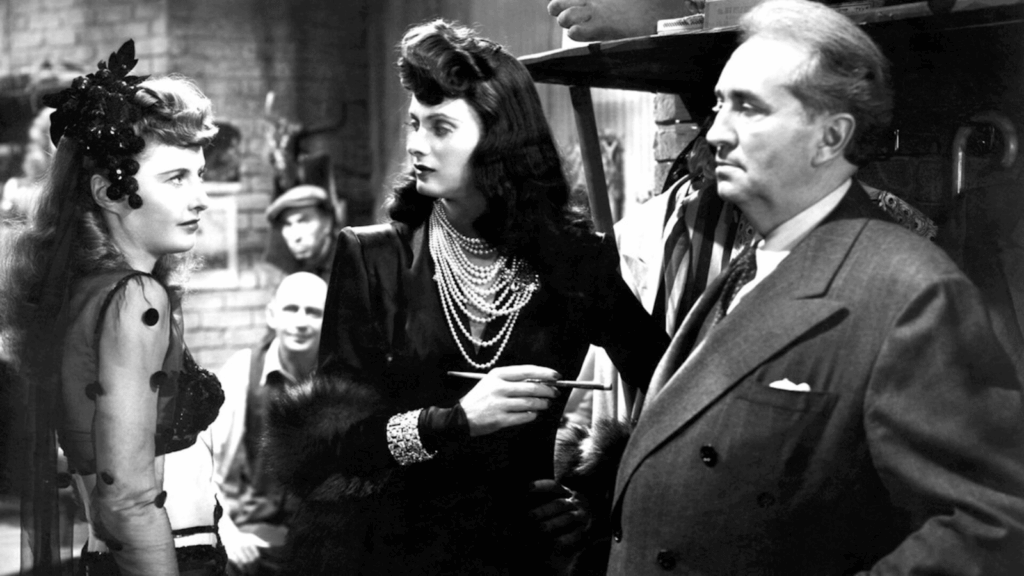
When the lights suddenly go out in the Old Opera House, Dixie feels hands grasp her neck, but she avoids strangulation. Someone was trying to kill someone, she observes. Sure enough, the troupe finds a dancer’s body strangled with a g-string. Inspector Harrigan (Charles Dingle) conducts an investigation, bringing everyone together in the women’s dressing room for a mass questioning. Everyone’s a suspect. There’s Louie (Gerald Mohr), a hardened criminal dating a showgirl; the jealous Princess Nirvena (Stephanie Bachelor), a Garbo-esque figure who resents that Dixie has stolen her spotlight; Russell (Frank Fenton), a jealous boyfriend; even theater owner Foss (J. Edward Bromberg) has a motive, since his wife wants him out of the burlesque business. But the answer to the whodunit question proves less compelling than the accusations and salacious lines of dialogue along the way, with Dixie and Biff looking for clues for much of the runtime.
Watching Lady of Burlesque today, it plays like something produced before the Hays Code went into effect in 1934 (and ended in 1968). The Code served as Hollywood’s self-governing set of moral principles of representation, designed to keep the US government out of the film business. Overseen by administrator Joseph Breen until the mid-1950s, the Code looked for various “Don’ts” and “Be Carefuls” that might cause a scandal—everything from references to sexual hygiene to amoral themes outside of a “crime doesn’t pay” message. Lady of Burlesque faced scrutiny over its use of an intimate garment as a murder weapon, not to mention its portrayal of burlesque dance routines with sexualized jiggling and gyrating. But after some back-and-forth with Breen, who demanded they minimize scenes of stripping and juicy language, the production was approved.
The film carefully walks the Code’s lines, sometimes skirting them in obvious ways. For instance, Gunn’s screenplay deploys several sexual allusions. When Biff flirts with Dixie in an early sequence, he suggests they have a Sunday breakfast together. And while not explained fully, the implication is that their breakfast would come after spending the night together. Or take the final exchange between Alice Angel (Marion Martin), a showgirl with a squeaky voice and large, outlandish costumes, who towers over the diminutive comic Mandy (Pinky Lee)—a pairing that brings to mind Roger and Jessica Rabbit. Even Mandy’s comic routines recall Roger Rabbit’s humor. In the final scene, Alice admits she’s attracted to Mandy and plants a kiss on his face. Brimming, he exclaims, “You make me so… glad!”—a thinly veiled alternative to “horny.”
If there’s more to Lady of Burlesque than a familiar backstage murder setup, enriched by the novelty of the showgirl scene, viewers might find it in another Wellman picture, this one a Western, released the same month by 20th Century Fox: The Ox-Bow Incident. Both depict people too quick to assume guilt and assign blame when a murder has been committed. Wellman’s film—starring Henry Fonda, Dana Andrews, and Anthony Quinn—dramatizes the injustice of mob mentalities, feeding a larger commentary on lynch mobs and racial profiling. The resonant story earned The Ox-Bow Incident a Best Picture nomination at the 1944 Academy Awards, but no one took Lady of Burlesque so seriously. Even so, both of Wellman’s films portray authorities who quickly pin the crime on marginalized groups and outsiders. Here, the investigators believe Dixie or some other performer is guilty because they work in a so-called low business. Much like the outcome of The Ox-Bow Incident, this prejudice is proven incorrect.
Lady of Burlesque conforms to a whodunit structure found in the mystery-comedies of Nick and Nora Charles, Miss Marple, Hercule Poirot, and the lesser-known Dr. Lawrence Bradford. It doesn’t quite put the case into Dixie’s hands, and Dingle’s detective doesn’t amount to much of a character. But Dixie contributes plenty to the investigation so that she’s never just a showgirl; the character’s presence and Stanwyck’s intelligence, naturalism, and appeal in the role legitimize burlesque as honest work—a bold concept under the Code. What might’ve been another in a long line of detective programmers or backstage dramas has a touch of novelty and sex thanks to Gypsy Rose Lee’s story and Stanwyck’s evident comfort in the milieu. Lady of Burlesque may not break any molds but operates inside them with a blithe energy.
(Note: This review was commissioned by Elizabeth and posted on Patreon on May 25, 2025. Thanks for your suggestion and long-time support!)
Bibliography:
Callahan, Dan. Barbara Stanwyck: The Miracle Woman. University Press of Mississippi, 2012.
DiOrio, Al. Barbara Stanwyck: A Biography. Coward, McCann, 1984.
Frankel, Noralee. Stripping Gypsy: The Life of Gypsy Rose Lee. Oxford University Press, 2009.
Thompson, Frank T. William A. Wellman. The Scarecrow Press, 1983.
Wellman, William, Jr. Wild Bill Wellman: Hollywood Rebel. Pantheon Books, 2015.
Wilson, Victoria. A Life of Barbara Stanwyck: Steel-True 1907–1940. Simon & Schuster, 2013.
Like DFR? Support us.
This site exists because readers like you care about film. If DFR has enriched your experience with movies, I’d be grateful for your support. You have a few options:
• Join DFR’s Patreon community
• Make a one-time donation on PayPal
• Buy me a coffee
Whatever option you choose, it helps keep my work independent. And it means a lot to me.
Thank you for reading, and for making this work possible.
Brian Eggert | Critic, Founder
Deep Focus Review