It Ends
By Brian Eggert |
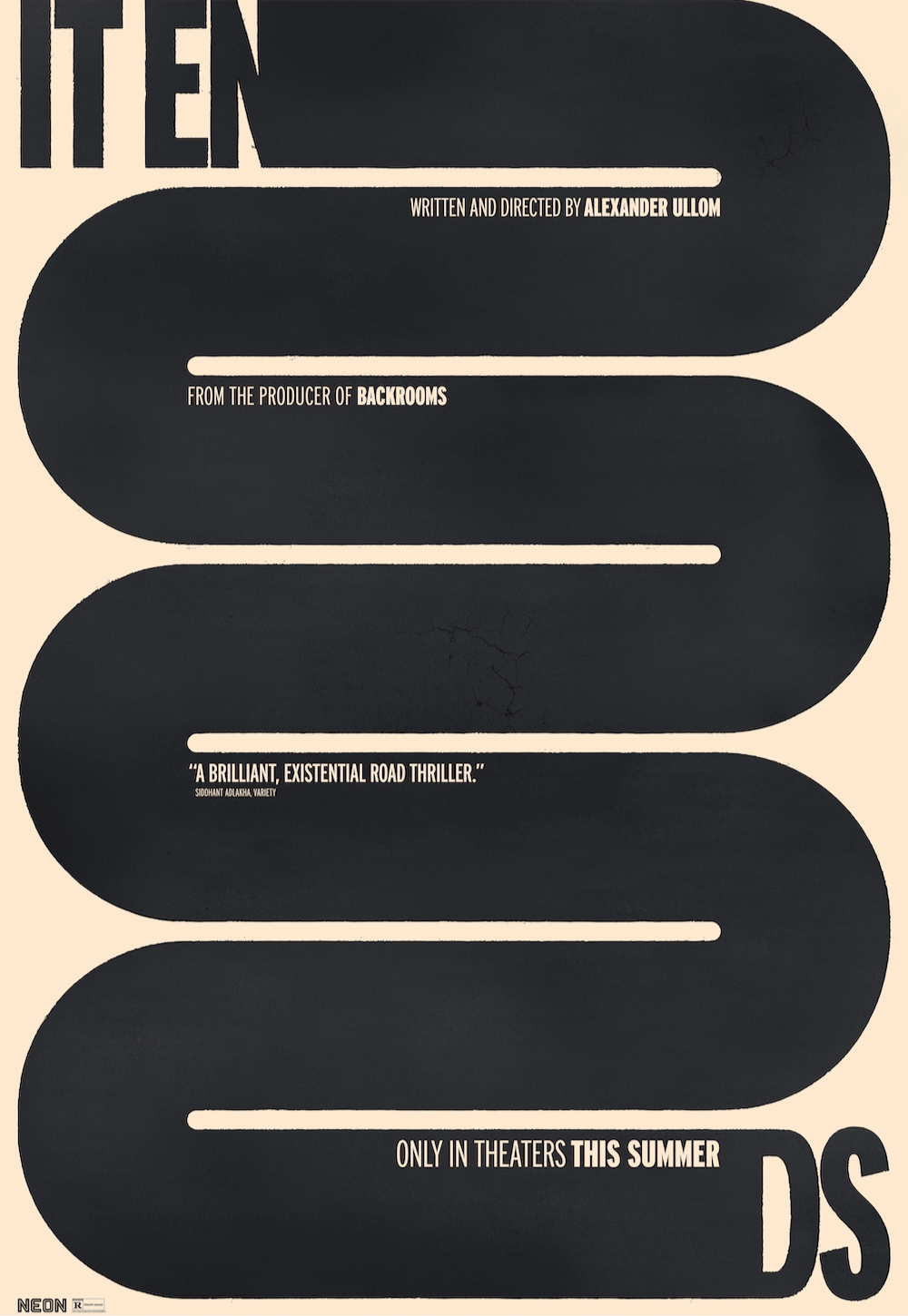
You’re traveling on an endless road into another realm or dimension, a road of sight and sound but also of the mind—a journey through an endless forest whose boundaries remain unknown. Is it purgatory or some private hell? Then, a signpost reveals your next destination: no, it’s not the Twilight Zone. It’s writer-director Alexander Ullom’s debut feature, It Ends, a South by Southwest premiere picked up for theatrical release by Neon. Fitting squarely into the liminal horror genre, the movie belongs in a triple-feature with this year’s Backrooms and Exit 8. They’re all surreal experiences about getting trapped in never-ending spaces. While the others take place inside labyrinthine structures, It Ends is frightening because its prison takes the form of a road with no turns inside a vast forest. The only thing more claustrophobic than a cramped space is a limitless one from which there’s no escape.
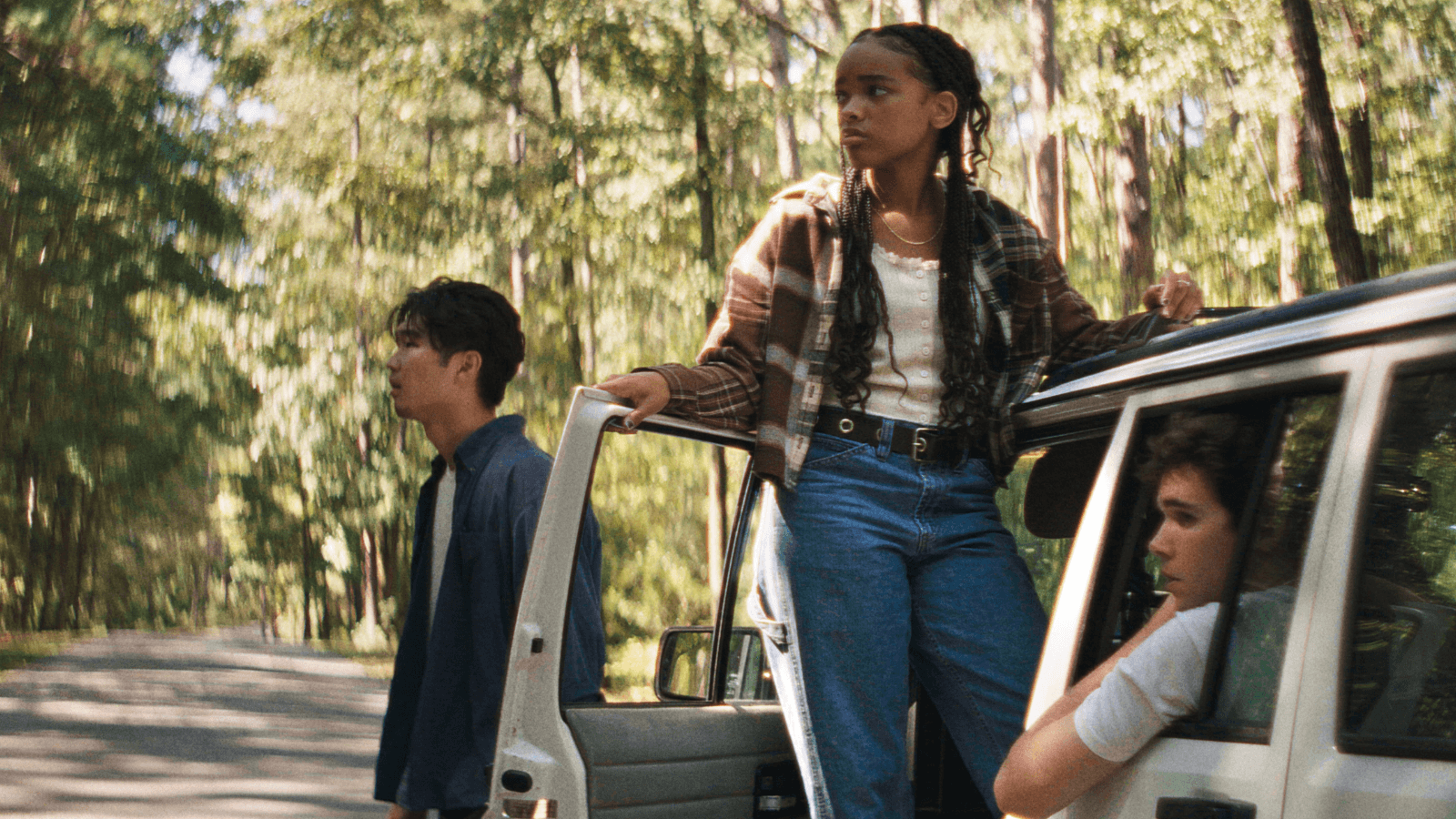
The movie centers on four former classmates, the kind of bickering movie friends who make you wonder why they’re friends at all. There’s Day (Akira Jackson), who’s getting over some suicidal ideation; the generally nervous Fisher (Noah Toth); the sourpuss James (Phinehas Yoon); and Tyler (Mitchell Cole), a former military man the others haven’t seen in a while. Driving them to a night spot, Tyler turns his Jeep Cherokee from the highway onto a forest road that, after a while, doesn’t seem to go anywhere. He turns around, assuming he missed a turn somewhere, only to hit a dead end where the turn to the highway should be. Tyler gets out to investigate, only for a horde of people to rush the car, violently scratching Fisher and screaming “Let me in!” The foursome quickly speeds away and soon realizes they’re on a road to nowhere, and if they stop, another throng of people from the forest will give chase.
Driving for miles, James finally says it: “This is not real life anymore.” When not playing banal road games to pass the time, they explore the possibilities: Maybe they’ve entered a wormhole, shared hallucination, or purgatory. Perhaps it’s some form of karmic punishment or a curse, but for what sins? None of them have done anything worthy of such a supernatural penalty. Have they been abducted by aliens and put into some manner of experiment? Are they in a simulation designed to test their reactions? Besides the never-ending road, other strange realities emerge. None of them feel the need to answer nature’s various calls for sleep, sustenance, fluids, or waste. Their hair doesn’t grow, but a wound on Fisher’s arm heals. Strangely, the Jeep’s fuel gauge stays at a quarter tank, despite them driving hundreds, even thousands of miles. And whenever they stop to, say, investigate an abandoned car on the road, they have a mere 90 seconds before swarms of people come running out of the woods. It just goes on like this ad infinitum.

As you might suspect, It Ends doesn’t offer much visual variety, but it’s also never monotonous-looking. Most of the 89-minute feature takes place inside the Jeep’s interior, with a few brief sojourns into the woods. The scenery is quite pleasant aside from the whole trapped-for-eternity aspect, with sunny woodlands by day and silvery moonlight nights. Ullom, who also serves as editor, works with two cinematographers (Evan Draper, Jazleana Jones) to keep the setting lively. But much like the characters, how you see the movie will depend on your worldview. James remains convinced that they’re making “progress,” that new developments represent some sort of cumulative advancement, even going so far as to believe there’s some manner of deity or gamesmaster behind it. The others face their new reality with almost radical acceptance.
Ullom’s scenario shares a sense of existential dread with Luis Buñuel’s The Exterminating Angel (1962) and The Discreet Charm of the Bourgeoisie (1972), both about situations that either never end or come to fruition. Ullom, like Buñuel, uses his setup to examine human behavior and how some people crack from prolonged uncertainty, while others can endure just about anything. The characters don’t have rich internal lives or interpersonal dramas to resolve. If they had something to work through to achieve emotional catharsis, their veritable imprisonment might have made more sense and been more dramatically satisfying. Ullom’s refusal to offer a narrative end zone leaves the movie ambiguous and open to interpretation. It will also leave a certain kind of viewer increasingly frustrated by the lack of answers to its mysteries, like we’re trapped in a road movie version of TV’s Lost. That’s the point, I suppose.
Liminal horror is popular right now because it reflects our present through a potent metaphor. Lately, it feels like we’re all trapped in a world without escape, with no signs of improvement. It’s a particularly resonant genre among younger generations, who struggle to make a living wage and will probably never be able to afford a home. The looming dangers of climate change and disease worsen every day, and the regressive anti-science movement prevents any progress in environmental or medical solutions. It Ends offers commentary on this inescapable doom, as well as a critique of how people too often become overly comfortable and apathetic in their prisons. The movie is narratively indeterminate by design. That may frustrate some and intrigue others. Either way, Ullom’s filmmaking is confident, and his premise is admirably obscure, making this, and whatever he does next, worth seeking out.
Thank You for Supporting Independent Film Criticism
If the work on DFR has added something meaningful to your love of movies, please consider supporting it.
Here are a few ways to show your support: make a one-time donation, join DFR’s Patreon for access to exclusive writing, or show your support in other ways.
Your contribution helps keep this site running independently. However you choose to support the site, please know that it’s appreciated.
Thank you for reading, and for making this work possible.
Brian Eggert | Critic, Founder
Deep Focus Review