Short Takes
Ghost in the Cell
By Brian Eggert |
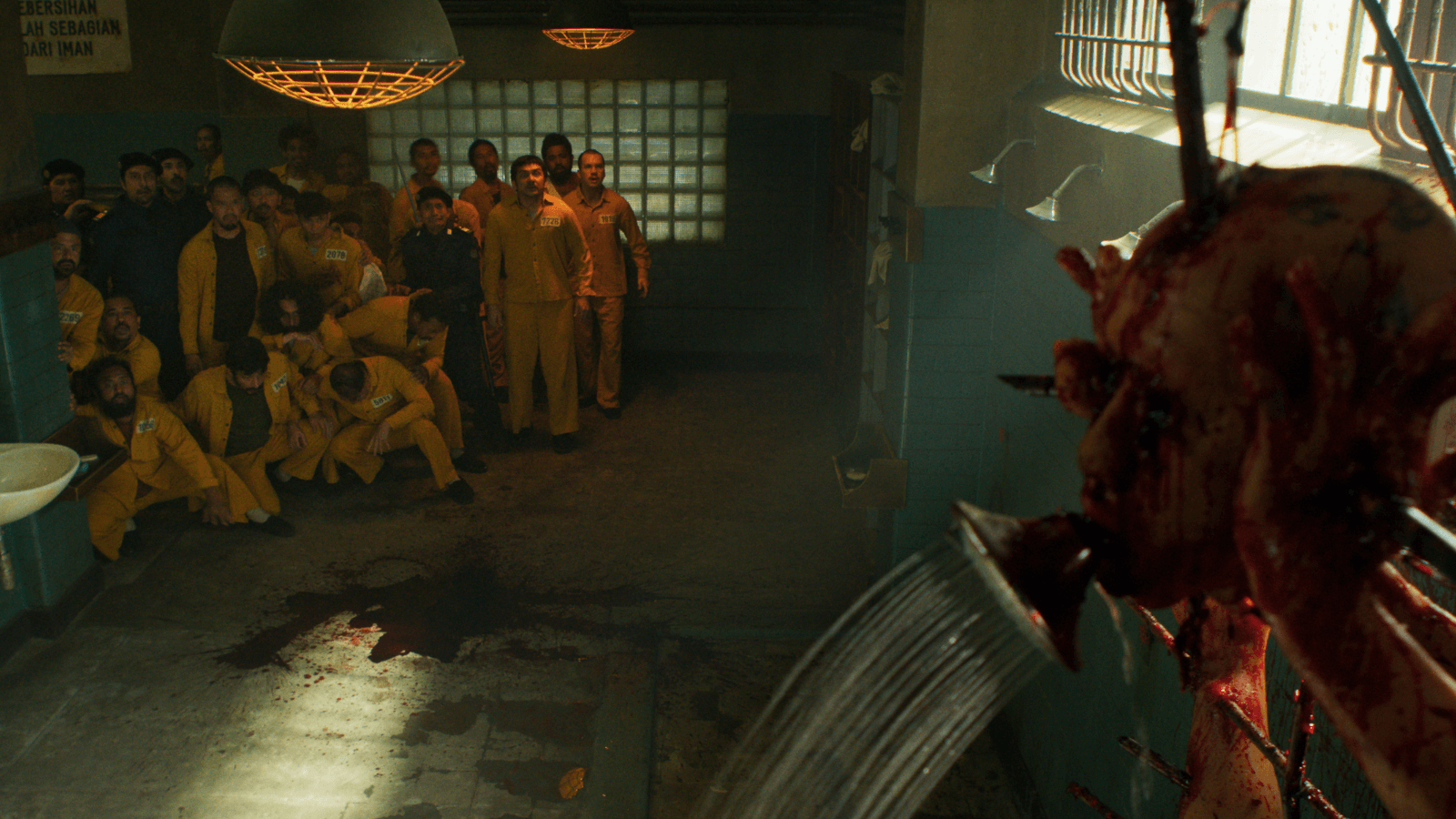
On paper, Ghost in the Cell, the latest from Indonesian director Joko Anwar, should suit my sensibilities perfectly. It’s a maximalist story that freely blends genres and tones with elements of martial arts action, slapstick comedy, and even playfully choreographed synchronized dancing, all set inside a prison haunted by a cruel spirit that makes Cenobite-level art out of its victims (really, it’s some of the goriest horror I’ve seen in recent years). Anwar spreads these wild indulgences across a 106-minute running time, hardly giving his audience a chance to catch up. He also sidelines character development amid his group of inmates, leaving the movie’s joys relegated to individual moments of action, humor, or shock. Ghost in the Cell boasts several unforgettably nasty sights you can’t unsee, but it offers little narrative thrust to guide us through this genre gauntlet.
The story opens with a reporter, Dimas (Endy Arfian), who finishes an impassioned exposé on illegal mining in Borneo and presents the piece to his editor. Dimas leaves the room, and when he returns, his editor has been gruesomely slaughtered and hung by his guts from a ceiling fan. Some time passes. Then Dimas, apparently found guilty of killing his editor, arrives in Block C of the local prison, where thin characters are introduced so quickly and often through a single trait that I struggled to keep track of who’s who. However, it’s difficult to miss the inmates’ cruel guard, Jeffri (Bront Palare), and one of the more charismatic inmates, Angorro (Abimana Aryasatya). There’s also Dimas’ worst nightmare, Tokek (Aming Sugandhi), a vile sort who gleefully promises to rape and do all manner of nasty things to the wrongly convicted journalist. Many of the others prove too generic to remember.
Nevertheless, they band together after several inmates are found in the same manner as Dimas’ editor—strung up and splayed out, much like Hannibal Lecter did to Sergeant Boyle in the Memphis sequence in The Silence of the Lambs (1991), only worse. Both the inmates and the audience have the same questions. What’s doing this, and why has it seemingly followed Dimas into the prison? And more importantly, how do the powerless inmates stop this thing from killing the rest of them? None of the answers to these questions are particularly satisfying, but Anwar makes the proceedings so energized that it won’t matter to some.
Ghost in the Cell combines several aspects familiar to Anwar, from his origins in well-shot action movies to his early days as a journalist covering the crime beat for The Jakarta Post. Some of his throwaway dialogue during mealtime establishes the characters’ worldviews; though he doesn’t develop strong characters, he at least tries to break stereotypes about prisons being full of hardened criminals. But the filmmaker is clearly more interested in action set pieces with the playful energy of Sammo Hung or Jackie Chan—a curious tone to pair with the horrific sights. Among these terrors is a porous face that will have trypophobes gagging or screaming or both. Yet, in a delightfully silly flourish, we find the spirit can be subdued by fervent prayer or dancing, leading to some amusingly offbeat moments.
Anwar’s manic production boasts an admirable formal cohesion and technical bravado, rendering his crazy indulgences into a gleefully weird experience from moment to moment. Still, his attempts to forge meaningful bonds between underdeveloped inmates and solidify a powerful political commentary about systemic failures fall flat. The movie might’ve been better with a less-is-more approach rather than a more-is-more approach. Neither the prison movie nor the supernatural scares have much impact. But there’s a kind of viewer who will embrace how Anwar can leap from one extreme to the next without needing a strong narrative throughline, who will appreciate how he’s willing to stuff Ghost in the Cell with so much. This time, anyway, that wasn’t me.
Thank You for Supporting Independent Film Criticism
If the work on DFR has added something meaningful to your love of movies, please consider supporting it.
Here are a few ways to show your support: make a one-time donation, join DFR’s Patreon for access to exclusive writing, or show your support in other ways.
Your contribution helps keep this site running independently. However you choose to support the site, please know that it’s appreciated.
Thank you for reading, and for making this work possible.
Brian Eggert | Critic, Founder
Deep Focus Review