Ghost Elephants
By Brian Eggert |
(Note: Werner Herzog’s Ghost Elephants will open in select North American theaters on February 27, air on National Geographic on March 7, and stream on Disney+ and Hulu on March 8.)
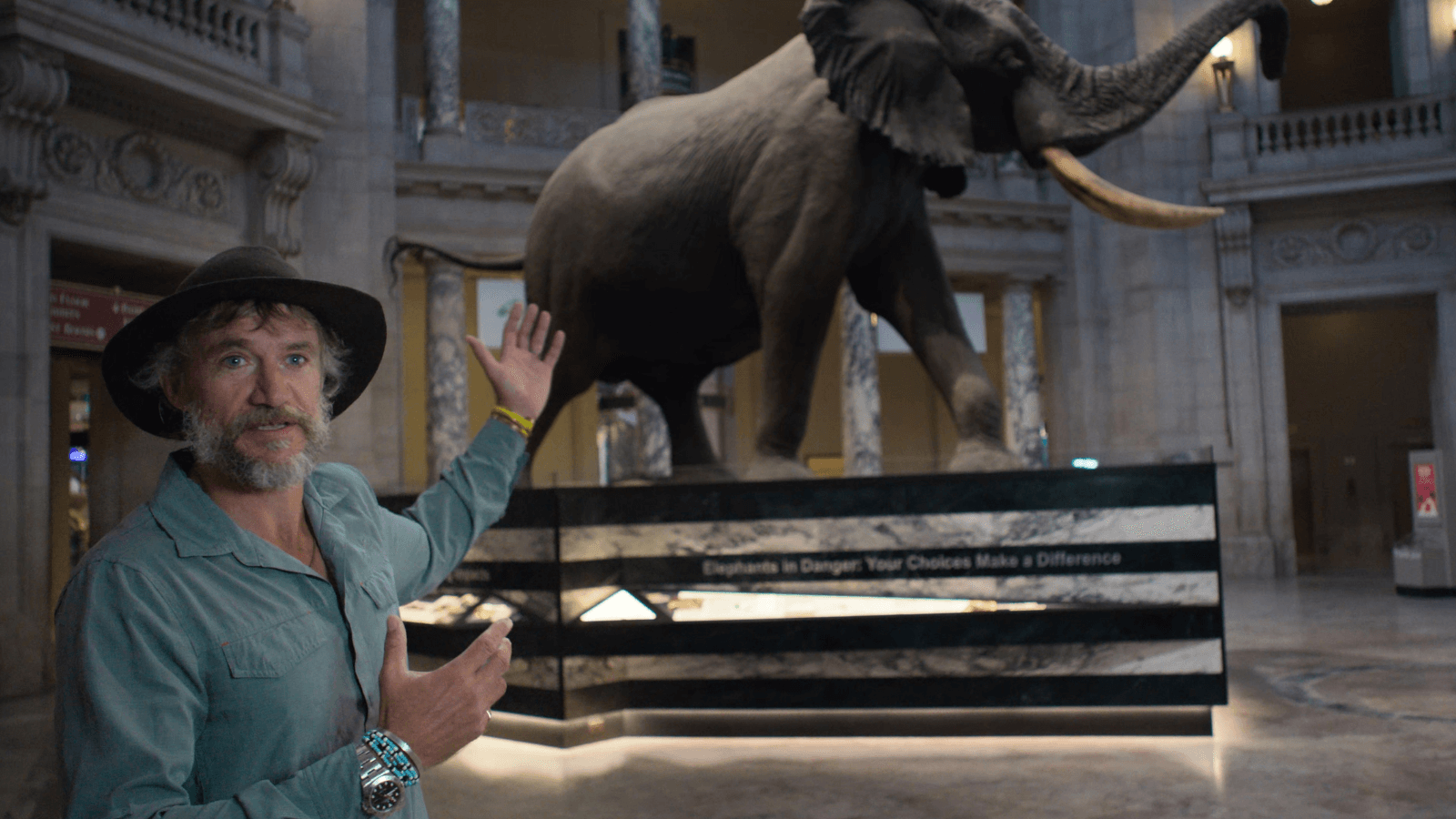
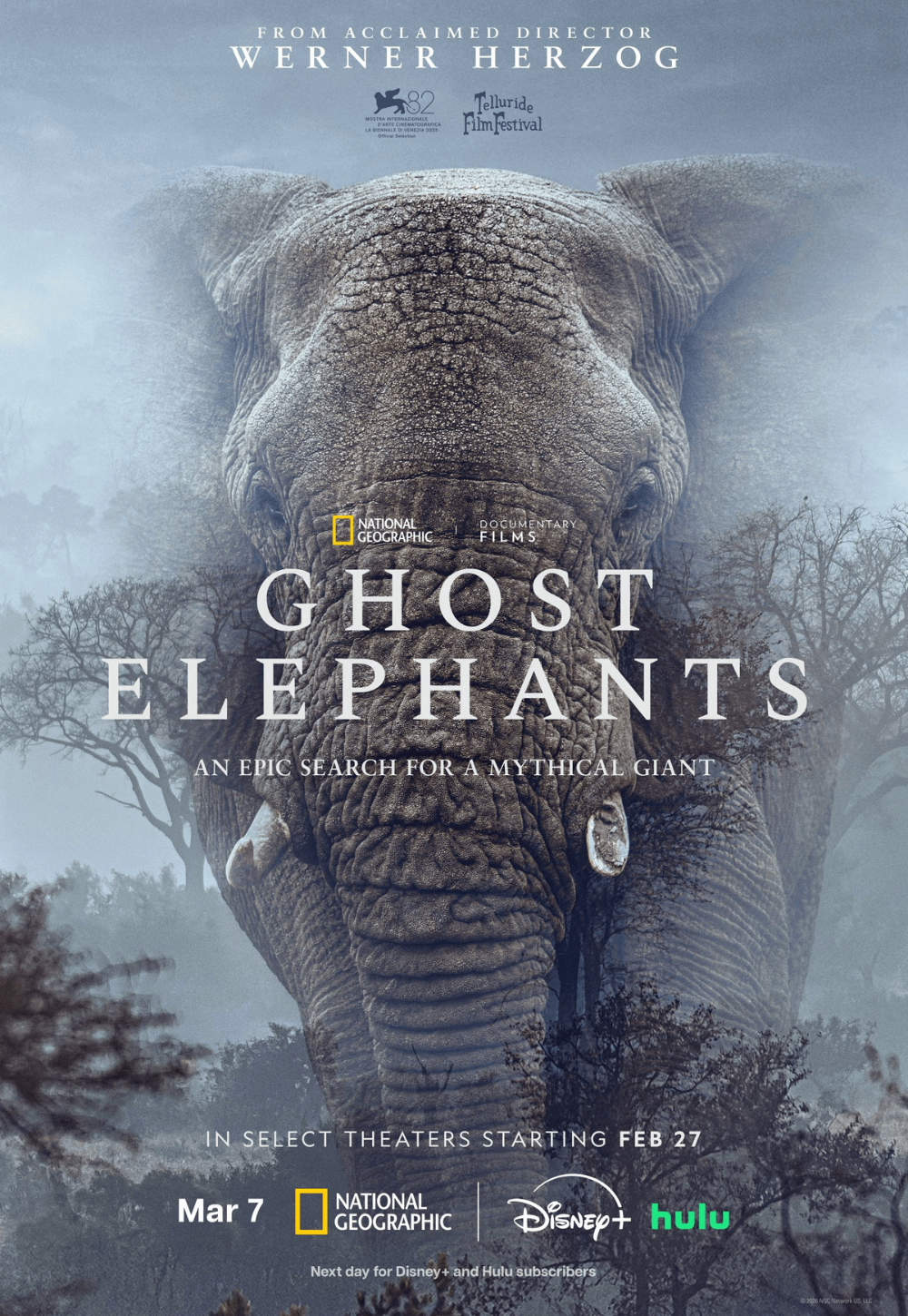
Ghost Elephants is a documentary following Dr. Steve Boyes, a world-renowned conservationist who searches for the titular animals, an elusive line of our planet’s largest living land mammals. Dr. Boyes believes there’s an unconfirmed family of elephants living in the wetlands on the Bié Plateau in Angola, which the Ramsar Convention recently named as a Wetland of International Importance. The unique spot is rich in biodiversity, earning its name from the local Bantu: Lisima Lya Mwono, meaning “Source of Life.” Dr. Boyes theorizes that the mysterious elephants may be descendants of the largest one ever recorded, nicknamed Henry, an 11-ton specimen on display in the Smithsonian. Henry was shot by big-game hunter Josef J. Fénykövi in 1955, a time when some believed appreciating Nature meant killing it, stuffing it, and putting it on display. Dr. Boyes just wants to know if ghost elephants really exist.
As straightforward a subject as that may sound for a National Geographic documentary, Ghost Elephants was written, directed, and narrated by the great Werner Herzog. Though his distinctive voice and darkly poetic persona have been parodied to no end, Herzog remains among the finest filmmakers to regularly shift between dramatic features and docs with an incomparable perspective. The topic is fitting for Herzog, who, in both his narrative films and non-fictional works, tends to gravitate toward holy fools who believe in the impossible and follow that pursuit relentlessly. By extension, Herzog becomes just as obsessed with his dogged pursuit of the story. This interplay has shaped many of his best films: Aguirre, the Wrath of God (1972), Fitzcarraldo (1982), and Grizzly Man (2005).
Dr. Boyes isn’t quite the madman Aguirre was, or the tragically misguided wilderness enthusiast Timothy Treadwell was. Rather, he’s a man of science and culture, passionate about a theory. But there’s also a spiritual element to his search for these rumored elephants. It’s a fixation that Herzog equates to Ahab and the white whale. Dr. Boyes seems more inspired by the tribes of Angola, who believe in the transmigration of elephant spirits. They even perform ritual dances, inviting these spirits into their bodies. Perhaps ghost elephants are nothing more than “a dream I never had,” he remarks. Dr. Boyes admits it might be “almost better” if they were just a dream and didn’t really exist, for both the animals’ safety and the crew determined to find them. In a signature Herzog technique, he holds the shot after Dr. Boyes finishes his thought, his expression filled with a kind of passion and desperation often seen in the director’s subjects.
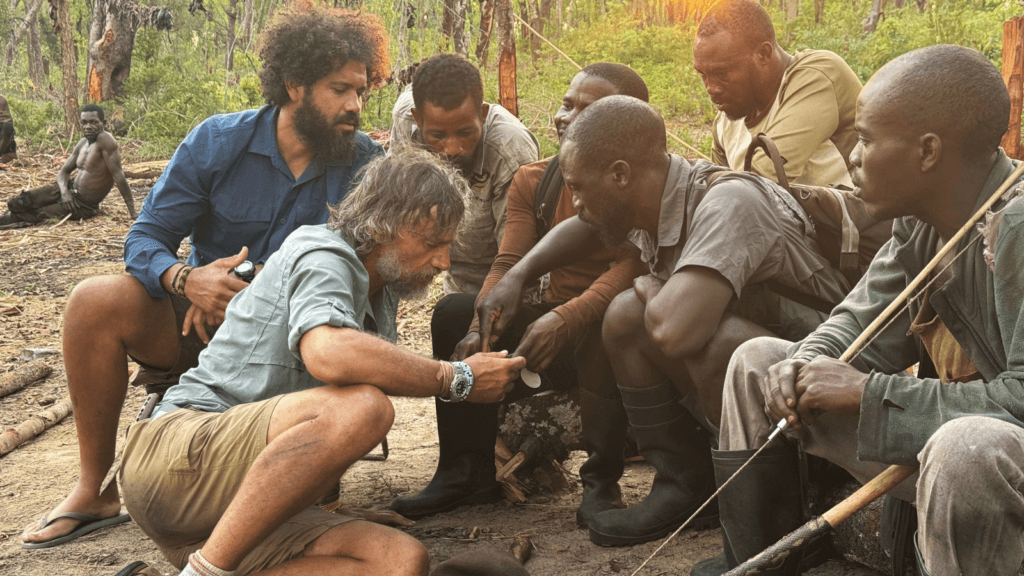
Herzog outlines the mission and its dangers, building a case that Dr. Boyes, ethnobiologist and anthropologist Kerllen Costa, and three KhoiSan master trackers (Xui, Xui Dawid, and Kobus) face significant perils in their search for the ghost elephants. Take the tiny grub worm whose poison the trackers use in their darts. A small amount would kill a man. Herzog then trains his camera on a venomous spider with hundreds of equally deadly young teeming on its body. The filmmaker adds to the story’s texture with such characteristic tangents, such as his sudden interest in a tracker’s use of dung, which leads Herzog to regard a dung beetle, then the fly after the beetle’s dung ball. Another aside considers Angolan refugees scattered by their civil war. Both human and animal refugees remain in danger from leftover landmines. There are also less dire political challenges to overcome, such as getting the King of the Nkangala to ask his tribe’s ancestors to grant Steve permission to see the elephants, without which he won’t see them.
In his first collaboration with Herzog, cinematographer Eric Averdung adopts the director’s unmistakable style of roving camera that floats within each scene, like an alien observer who examines every human and animal onscreen with equal fascination. They capture enchanting underwater footage of elephants swimming and panoramic drone-shots of the stunning Bié Plateau. Underneath such imagery, the traditional score by Ernst Reijseger is joined by harmonizing tribal songs. The film also boasts some slick graphics, including a computer-generated look at what makes this African terrain so rich with life not found anywhere else on Earth. Still, Herzog is unflinching in his despair over how humans treat Nature, condemning big-game hunters with heartbreaking archival footage of elephant hunts and photos of a wealthy man proudly standing over his quarry, which has been wrangled so he needed only to pull the trigger. The director then pans over an endless terrain covered in animal bones—an image compared to grasslands covered with buffalo, senselessly killed both for their hides and to help the US government combat Native American tribes by wiping out their resources.
Herzog’s film premiered at last year’s Vienna International Film Festival (produced by Sobey Road Entertainment, The Roots production service, and Skellig Rock Inc.), and National Geographic acquired the US rights. But don’t let the distributor fool you. This is still a Herzog production. As ever, the director’s interest lies less in the search than in what the quest means to Dr. Boyes. After the crew eventually sees what they believe to be one of Henry’s towering relatives, compiling genetic comparisons to Henry’s historical examples will take about a year. Even though Dr. Boyes will have to wait to understand the implications of his find, he saw the elephants he wanted to see. Herzog remarks, “Steve would have to live with his success.” Beneath the surface of Ghost Elephants is the realization that the search is more fulfilling than the destination, and a discovery is also the death of a dream.
(Editor’s Note: Corrected the reference to the cinematographer and added production companies. Stills captured by Ariel León Isacovitch.)
Thank You for Supporting Independent Film Criticism
If the work on DFR has added something meaningful to your love of movies, please consider supporting it.
Here are a few ways to show your support: make a one-time donation, join DFR’s Patreon for access to exclusive writing, or show your support in other ways.
Your contribution helps keep this site running independently. However you choose to support the site, please know that it’s appreciated.
Thank you for reading, and for making this work possible.
Brian Eggert | Critic, Founder
Deep Focus Review