Exit 8
By Brian Eggert |
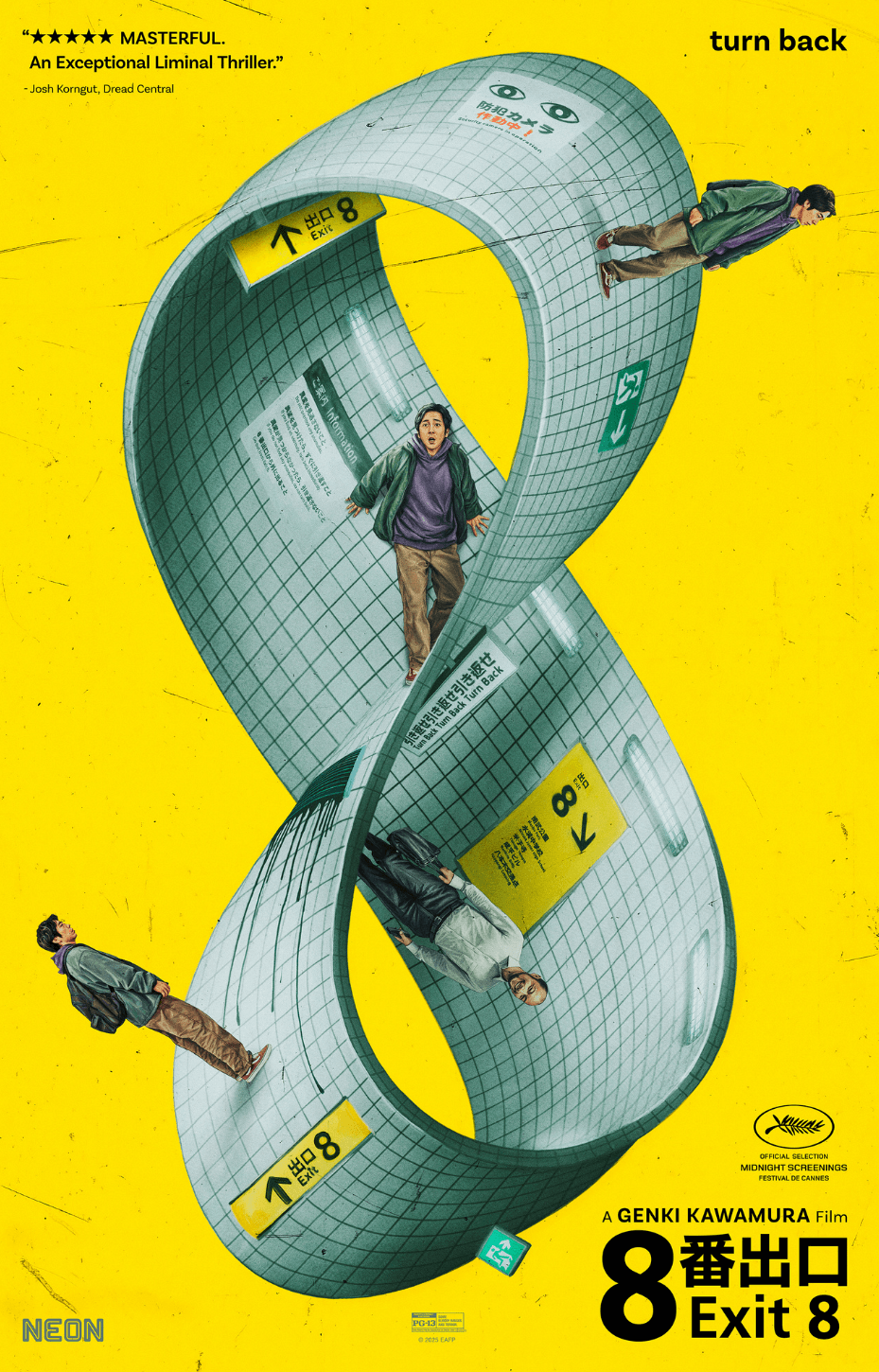
To beat Kotake Create’s 2023 video game The Exit 8, you have to find your way out of an infinite loop. By definition, that should be impossible. With its figure-eight shape, it has no entrance or exit; it just goes round and round. In this first-person walking simulator, downloaded by approximately two million players around the world, the player navigates the notoriously labyrinthine Tokyo metro passages. There is no music. You just hear footsteps. The only visual variations in the oppressively white walls and tiled floors are the occasional subway posters and the yellow Tenji blocks on the ground (a kind of signpost system for the visually impaired). Along the way, the player must pass through a series of eight loops, following station exit signs ranging from zero to eight. The game warns that, as you proceed, you must look out for “anomalies,” at which point you must turn back to make progress toward Exit 8. Miss an anomaly, and you start back at Exit 0. However simple a premise, it’s a game that rewards observant players when they notice changes to minor details. The game might take 20 minutes or hours to complete. And if you’re thinking that this hardly seems like good material for a feature film adaptation, well, you might be right.
Director Genki Kawamura co-wrote the film version with Kentaro Hirase. Titled just Exit 8, the movie could easily be called one of the most faithful game adaptations ever, if only because the game offers a slight story beyond its puzzle-box structure. The movie adds little to its setup and will appeal most to the game’s die-hard enthusiasts. The movie adds little to the game’s setup and will appeal most to the game’s die-hard enthusiasts. When the movie was released in Japan by Toho, where the game is hugely popular, it grossed an impressive $39 million. But it’s unlikely to make such a splash in other markets, as its niche appeal and execution do not cater to those unfamiliar with it. Even with the paper-thin plot tacked on to the first and last sequences, there’s not enough here to conjure much feeling beyond the predictable sense of mounting claustrophobia and (inevitable) sense of freedom. As my wife, who fell asleep after about twenty or so minutes, remarked, “There’s only so much watching people walk down a hallway that I can take.”
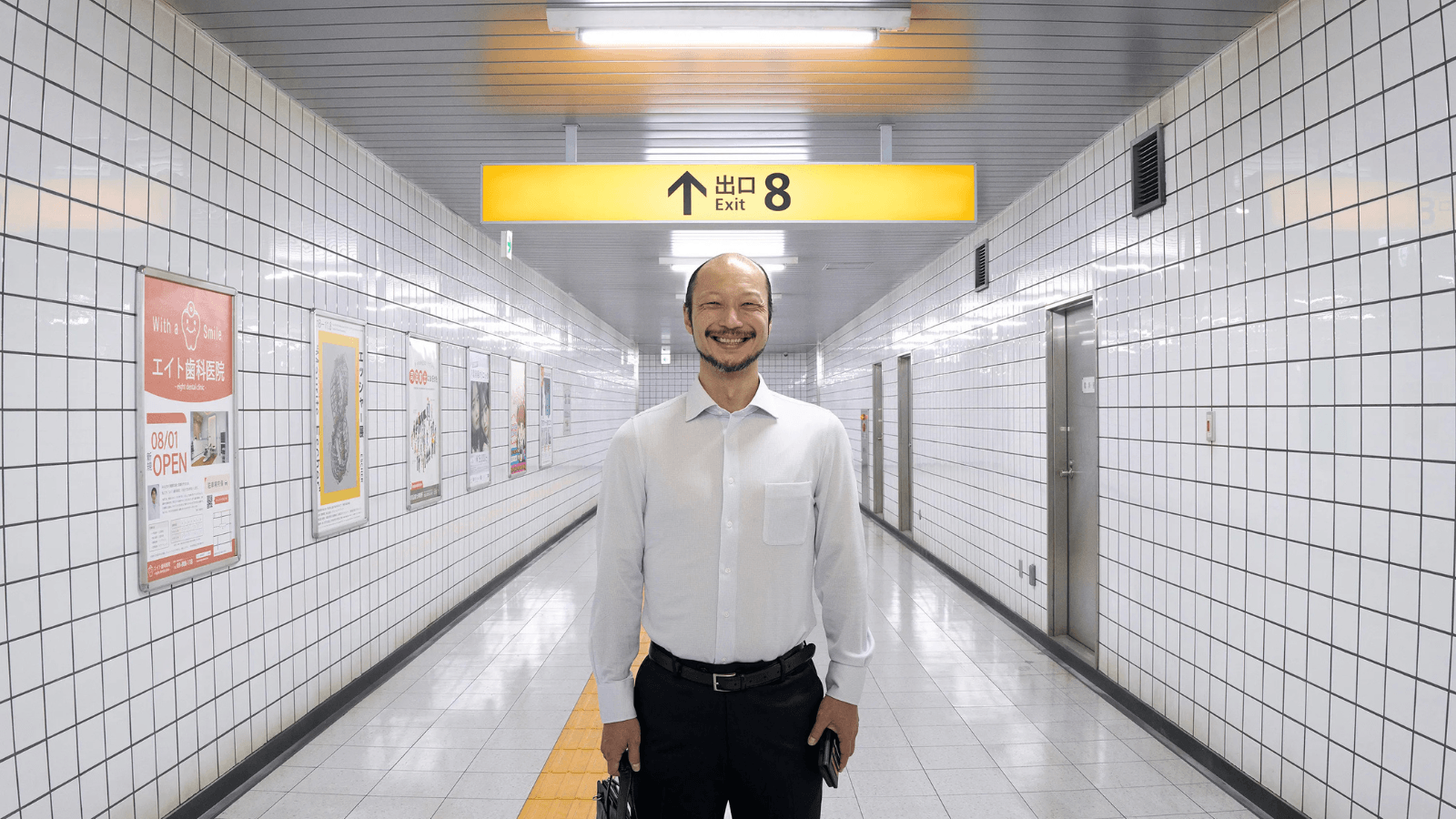
The game’s players will recognize its memorable imagery, recreated by Kawamura in meticulous detail. The movie has convincingly transplanted doors, posters, vents, signage, and other elements from the game into live action, with a few additions. For instance, the movie adds a line of lockers and a smattering of litter around one corner, among the usual sights, such as a solitary man carrying a briefcase and a mobile phone who walks the length of a corridor. The visual variation is so minimal that our eyes begin a frantic search for anomalies, as though noticing them would make the main character see them too. The story begins with The Lost Man (J-pop star Kazunari Ninomiya), who appears on a crowded subway, the camera occupying his POV at first. There, another passenger shouts at a woman who cannot quiet her baby’s piercing cries. No one on the train defends the woman, including our protagonist. Coincidentally for him, when he departs the passenger car, he receives a call from his ex-girlfriend, who has just discovered she is pregnant and wants to know what to do. He promises to visit, though it’s clear he’s only going out of some vague obligation.
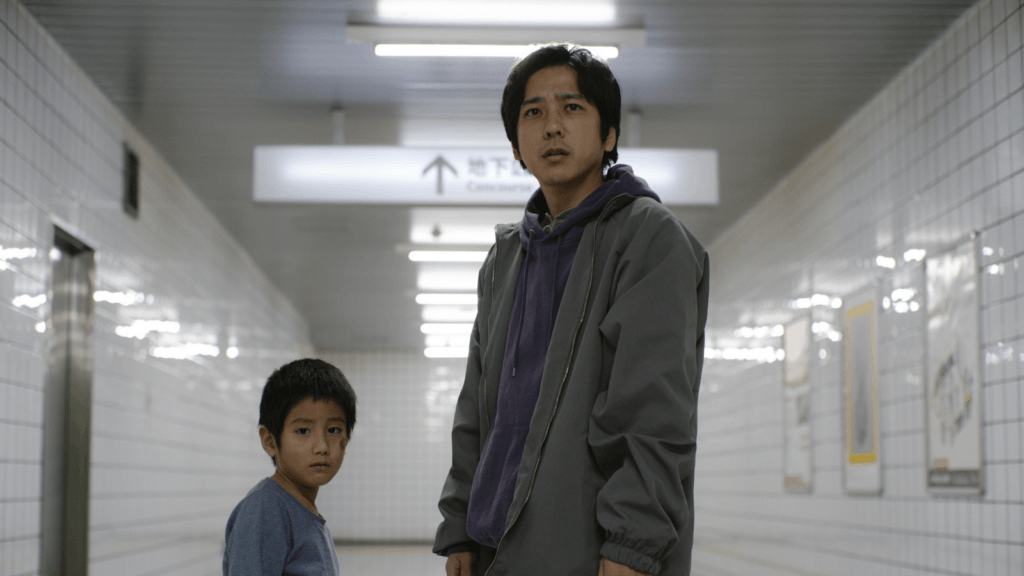
Kawamura and Hirase introduce several cliché story elements beyond the main character’s anxiety about fatherhood. There’s also his asthma, which means he breathes heavily throughout the movie as his fear intensifies. Another familiar image occurs when a massive wave of mucky water emerges from around a corner like the iconic scene of blood pouring out of the elevator in The Shining (1980). Other segments of the movie center on The Walking Man (Yamato Kochi), the businessman with an overenthusiastic smile, and an observant young boy (Naru Asanuma) who sometimes stops to regard an anomaly like a dog signaling the location of prey for their master. Each of them receives a rather superficial backstory. In place of character depth is a 95-minute mindbender with limited locations, minimal dialogue, and the occasional creepy image, such as rats crawling through the vents, human noses, ears, and mouths growing on their hairless flesh. This might sound nightmarish, but Exit 8 isn’t strictly a horror movie armed with jump-scares and stringy ghosts like a lot of J-horror. Rather, it reminded me more of Vivarium (2020) and Cube (1998).
Watching Exit 8 brings a certain detached intrigue for how Kawamura executes it. Production designer Ryo Sugimoto creates hauntingly plain spaces intended to slowly drive us to the brink of madness. However, the environment is more compelling to explore as a player than a viewer. As Ninomiya’s character walks by a poster featuring M.C. Escher’s woodblock print Möbius Strip II (Red Ants) for the umpteenth time, it’s sort of interesting to think about how Kawamura accomplished the appearance of a continuous passage. Cinematographer Keisuke Imamura’s careful framing keeps the camera at eye level, fluidly maneuvering through the passages and around the few characters inside. A combination of CGI and Sakura Seya’s editing disguises the cuts so many shots look like immersive extended takes in the never-ending hallway, and the movie is all the more entrancing for it. If there’s a weak point in the form, it’s the repetitive music by Yasutaka Nakata and Shouhei Amimori, who rely on a tedious two-note refrain that becomes obnoxious after half an hour.
Slow-burning and repetitive, the movie leads to an underwhelming conclusion. Still, the adaptation cannot help but raise questions along the way. Is The Lost Man unconscious from an asthma attack, and is this his path to the afterlife? Is everyone inside dead and trapped in purgatory? Or is hell the repetitiveness of our daily routine? The movie never answers any questions about why or how this puzzle exists, offering a superficially existential theme: Here is a psychological arena in which The Lost Man must snap out of his apathy and engage with life. So it’s less about linearity than following the signs, both literal and figurative, that lead to an escape from a monotonous existence. It’s all a lame metaphor for the fear of shaking up your comfortable life by having a kid. At least, based on the conclusion, that’s my understanding of what happens, even if my interpretation doesn’t explain the other characters who have chapters devoted to them. If, in the end, it doesn’t all make literal sense, and it overstays its welcome by about half an hour, it’s engaging enough to recommend as an oddity.
Thank You for Supporting Independent Film Criticism
If the work on DFR has added something meaningful to your love of movies, please consider supporting it.
Here are a few ways to show your support: make a one-time donation, join DFR’s Patreon for access to exclusive writing, or show your support in other ways.
Your contribution helps keep this site running independently. However you choose to support the site, please know that it’s appreciated.
Thank you for reading, and for making this work possible.
Brian Eggert | Critic, Founder
Deep Focus Review